A career in nursing is a rewarding path, but the journey involves several academic and professional requirements and milestones.
Understanding these requirements as early as possible is a huge step toward making this challenge manageable. From prerequisites to licensure, here is what you need to know to get started!
What Are the Requirements to Become a Nurse?
To ensure that you’re prepared for the high-stakes environment ahead, the path to becoming a nurse generally follows a standard progression of academic, clinical, and legal steps.

Basic Steps
Foundations and Prerequisites
The very first step is getting your high school diploma or GED.
Then, before getting into a formal nursing program, you’ll need to complete certain prerequisite classes. These will typically be things like anatomy, microbiology, and statistics. These will give you the necessary scientific background you need in order to handle the more complex medical concepts you’ll encounter later on.
Nursing Program Admission
Getting into nursing school is a competitive process! Many schools require a certain GPA, and most require certain scores on an entrance exam such as the HESI A2 or TEAS.
Once you get accepted, you’ll enroll in a state-approved nursing program and start your academic journey. Be prepared for both classroom lectures and hands-on clinical training. This is where you start to get some real-world practicing skills!
NCLEX and Licensure
Once you graduate, the final hurdle is passing the NCLEX! This exam is designed to ensure your knowledge is up to snuff and that you’re able to make safe judgments as a nurse.
Once you pass the NCLEX, and assuming you meet the specific state licensure requirements of the board of nursing, your credentials will be verified and you’ll be issued a license!
Academic vs. Real-World
While grades and test scores are important, they aren’t the only factors in your future success as a nurse. There are plenty of personal qualities that will serve you well, including strong communication skills, being able to handle a fast-paced workload, and implementing a safety-focused decision-making process in all areas.
Academic Requirements for Nursing School
The most important thing to remember is that every program is a little different. Each state has its own standards and metrics, and each school has its own standards and expectations.
That said, most traditional four-year BSN programs are looking for a specific set of high school courses and college-level prerequisites to ensure you can handle what nursing school has to offer.
High School Prep
If you’re still in high school or are planning your transition, you should focus on the core sciences and communication.
Biology and chemistry: This will ensure you have the groundwork for understanding how the human body functions and how it reacts to medication.
Algebra or statistics: Math skills are vital to have as a nurse, especially when calculating dosages and interpreting patient data.
English and communication: As mentioned earlier, being able to communicate effectively and write clearly is just as important as the math and science skills.
Common Nursing School Prerequisites
When you first get to college, your initial courses will be “pre-nursing” before you can officially apply to the clinical portion of the program. These courses will give you the building blocks for the rest of your nursing degree.

Anatomy and physiology: You’ll probably split this into two semesters. This is where you’ll learn the structure and function of the human body.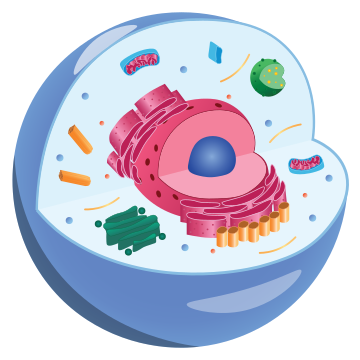
Microbiology: This is where patient safety comes into play, particularly when it comes to bacteria, viruses, and how infections spread.
Chemistry: This is usually focused on organic or biochemistry and helps you understand the general chemical processes within the body.
Nutrition: This course will teach you how dietary choices impact health and recovery.
Psychology: This course will help you understand human behavior and development, which will help you provide better support to your patients.
GPA Requirements and Transcripts
You may have heard the terms “minimum GPA” and “competitive GPA.”
While a program might require a 2.5 or 3.0 to apply (minimum GPA), many will primarily accept students with a 3.5 or higher (competitive GPA) due to the limited number of spots available. In other words, don’t assume that a school will accept your application just because your GPA is above the minimum requirement.
To ensure your credits count, be sure to submit official transcripts for all prior coursework. If one of your grades is lower than the minimum, some schools will let you repeat a course to improve it!
Entrance Exams for Nursing School

Since nursing programs are highly competitive, schools use entrance exams to see if you’re ready to handle the workload of your courses.
While there are a few different exams a school might use, the TEAS and HESI A2 are the most common.
TEAS 7
The ATI TEAS 7 exam is the most common nursing entrance exam, and it covers four main areas:
- Reading (45 questions)
- Math (38 questions)
- Science (50 questions)
- English and Language Usage (37 questions)
Most students take the TEAS during their sophomore year or right before applying to their core nursing program.
Click below to find out more about the TEAS test and to take a free TEAS practice test!
HESI A2
The HESI A2 exam is similar to the TEAS but focuses more on healthcare-specific knowledge. It covers the same core subjects like reading and math, but it also includes sections on more specific subjects like vocabulary and chemistry.
- Math (55 questions)
- Reading Comprehension (50 questions)
- Vocabulary (50 questions)
- Grammar (50 questions)
- Biology (30 questions)
- Chemistry (30 questions)
- Anatomy and Physiology (30 questions)
Each school decides which sections you’ll have to take. For instance, some schools don’t require the chemistry section and others do.
Click below to find out more about the HESI exam and to take a free HESI practice test!
Kaplan Nursing Admissions Test
Some nursing programs require the Kaplan Nursing Admissions Test instead of the TEAS or HESI A2. It covers four core areas.
- Reading Comprehension (22 questions)
- Writing (21 questions)
- Math (28 questions)
- Science (20 questions)
Click below to find out more about the Kaplan Nursing Admissions Test and to take a free Kaplan practice test!
Other Admission Requirements
Certifications and Trainings
Before you start clinicals, you’ll need to have the basic skills to handle various emergencies.
- CPR/BLS: Most programs require a basic life support certification through the American Heart Association (AHA).
- Clinical site requirements: You may need to complete specific HIPAA training, background checks, or drug screenings.
Supplemental Application Materials
Admissions teams generally want to know more about who you are as a person, so there may be supplemental aspects required for your application. These can include personal statements, letters of recommendation, a resume, and an interview.
What Nursing School Is Really Like
Once you’ve made it to nursing school, it’s time to get a feel for the new pace and hit the ground running!
Learning and Practice
Typically, your week is split between traditional classroom lectures, lab and simulation practice, and clinical rotations.
The lectures cover things like theory, pathophysiology, and pharmacology, whereas the hands-on training covers things like starting IVs, performing assessments on mannequins, and spending shifts in hospitals or clinics.
Thinking Style

One of the big adjustments to make is the shift in how you think about and make certain decisions.
Nursing school focuses heavily on clinical judgment, which is the ability to look at a patient, notice a small change, and determine what action to take first. The key here is learning to prioritize, whether it be which patient you attend first or which action should be taken first.
Shifting the way you think will come naturally as you take on more practice hours.
Work and Pace
It should be no surprise that a nurse’s workload is heavy. You have to juggle a ton of reading, constant exams, and “skill checkoffs” where a single error like forgetting to wash your hands will count as an automatic failure.
This is why time management is an incredibly valuable skill to have. You need to know how to set aside time for every task and prioritize how much time to spend on each one.
How to Survive
Most students hit a wall at some point, usually to do with being overwhelmed or struggling with anxiety. That doesn’t have to be you!
There are three main steps you can take to help you push through and succeed:
- Stick to a routine. The best way to get everything done is to create a schedule and stick with it. A consistent routine can help you manage pressure and ensure you aren’t scrambling to finish something last-minute.
- Use active recall. Utilize flashcards and practice tests so you’re continuously pulling information out of your memory instead of just passively reading your notes.
- Build a support system. Whether you use office hours to get extra help or for a study group with friends, having a community helps keep you motivated and stay on track.
Clinical Training Requirements
Let’s talk clinicals. Clinical rotations are basically supervised internships that happen along with your class work.
In a four-year BSN program, you’ll likely rotate through different hospital units to see the various aspects involved depending on patient needs.
What to Expect
A day will usually mirror a real nursing shift, so you could be at the hospital for up to 12 hours at a time. A clinical instructor will lead you and a small group of other students throughout the day.
At first, your tasks will be pretty basic things like taking vital signs or assisting with hygiene. These tasks will become more complex as you go, and by your final year, you could be managing a small patient load, administering medications, and performing procedures like wound care!
Professional Expectations
Just like any job, you’ll be expected to act like a professional from the get-go. This means you cannot miss a shift, you have to follow the dress code, and you can only perform tasks under supervision that have been checked off.
Postconference
At the end of a shift, your group will usually meet for a postconference to discuss what went well, what was hard, and what you learned overall that day. This meeting is a great way for everyone to process the events of the day and reflect on what you can do to improve the next day!
The NCLEX and Licensure Process
Once you’ve completed your nursing program, there’s one last hurdle that stands between you and your nursing career: the NCLEX exam.
What is the NCLEX?
The NCLEX is a national exam that assesses whether you have the critical thinking skills to provide safe and effective care.
The interesting thing about the exam is that it’s computer-adaptive, which means the difficulty of the questions changes depending on how well you’re doing. The more questions you answer correctly, the trickier the questions become.
Click below to find out more about the NCLEX exam and to take a free NCLEX practice test!
Licensure
Once you pass the NCLEX and clear a background check, your scores are sent to the state licensing board, who will then issue you an RN license number!
Something important to keep in mind is that every state works a little differently. Some states allow you to have a multi-state license, which allows you to practice in many different states. Other states only allow you to practice in the state you receive your license for.
After You Become a Nurse
Passing the NCLEX is a HUGE achievement! However, it’s only the first step of the next chapter of your life. Now you have to land your first role and start the journey toward becoming a professional.
Landing Your First Job
Often, graduates kick off their careers in medical-surgical units. This is where specialized care is provided for adult patients with acute illnesses or those recovering from surgery. Med-surg units are great for building a strong clinical foundation and sharpening time-management skills.
Many hospitals now offer 6–12-month residency programs (NRPs) specifically for new graduates. These programs provide one-on-one experience with a preceptor, peer support, and specialized training on hospital-specific equipment.
Keeping Your License Active
Getting your license is one thing—keeping it up-to-date is another! To keep practicing, you’ll need to meet your state’s continuing education requirements. Generally, this means you need to complete a certain number of hours of approved medical training every two years to ensure your skills stay sharp and up to current standards.
Career Growth
Once you’ve got a year or two under your belt, start thinking about which direction you want to go in.
- Specialization: certification in areas like trauma (TCRN), oncology, or wound care
- Leadership: roles like charge nurse or unit manager
- Advanced degree: roles like nurse practitioner (NP), nurse educator, or nurse anesthetist (CRNA)
Final Thoughts
The path to becoming a registered nurse is not an easy one. It’s incredibly demanding and competitive.
But it’s designed that way.
Every impossible science course, early-morning clinical shift, and late-night study session is a key building block that creates the strong foundation you need for your nursing career to take off. Every roadblock along the way is ensuring that you can walk into a patient’s room on your first day and be both competent and confident that you can provide excellent care.
Whether you’re still in high school or about to submit your nursing school applications, remember that staying organized, patient, and diligent will get you through nursing school and prep you to be the best medical professional you can be!
Best of luck on your nursing journey!


This article includes illustrations by Storyset.


