An important step in the process of becoming a nurse, the National Council Licensure Exam for Registered Nurses (NCLEX-RN®) measures whether a candidate has the minimum competency required to provide safe and effective nursing care to patients. It’s required for all candidates hoping to become licensed to practice nursing.
Click the “Start Test” button above to take a free NCLEX-RN practice test!
About the Test
The NCLEX-RN is a computer-adaptive test (CAT), which means that after each scored response, the computer recalculates your ability estimate using all of your previous answers and the difficulty of those items. It then selects an appropriately challenging item while also meeting the NCLEX test-plan requirements.
The exam contains between 85 and 150 items and ends under one of the three pass/fail rules explained below. There are 15 pretest questions embedded in the total number of questions. Pretest questions are used to determine the usefulness of such items in future iterations of the exam, which means they are not scored. However, you will not be able to tell the difference between scored questions and unscored pretest questions, so do the best you can on each consecutive question.
NCLEX-RN Exam Outline
There will be somewhere between 85 and 150 questions on the exam. No matter how many questions you answer, the percentage breakdown of questions by content area will be more or less as follows:
- Management of Care: 15%-21% of questions
- Safety and Infection Prevention and Control: 10%-16% of questions
- Health Promotion and Maintenance: 6%-12% of questions
- Psychosocial Integrity: 6%-12% of questions
- Basic Care and Comfort: 6%-12% of questions
- Pharmacological and Parenteral Therapies: 13%-19% of questions
- Reduction of Risk Potential: 9%-15% of questions
- Physiological Adaptation: 11%-17% of questions
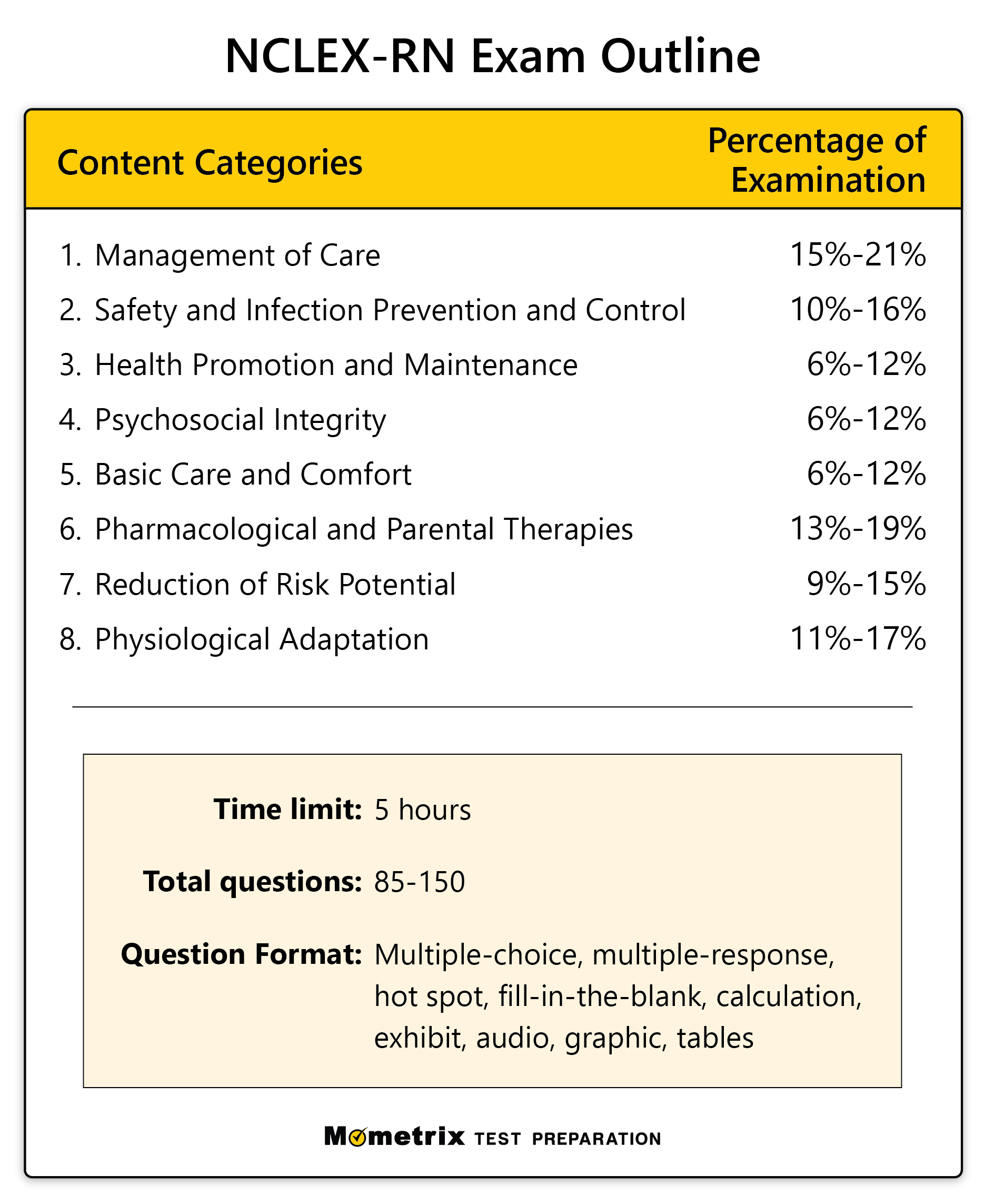
You will have up to five hours to complete the entire exam, which includes two optional short breaks. The actual time will depend on the number of questions you need to answer.
It’s important to note that you are not able to skip questions and return to them. You have to answer a question in order to move on to the next one. This means you need to use some of your study time to work on strategies for finding the best possible answer even when you aren’t really sure about the question.
Prepare with our NCLEX-RN Study Guide and Practice Questions.
Get practice questions, video tutorials, and detailed study lessons
Get Your Study Guide
Top 5 Most Challenging NCLEX Questions
Now that you know more about the exam, try your hand at some targeted practice!
Over the last year, we’ve compiled the data from about 5,000 test-takers who tried their hand at the practice test at the top of this page. According to the data, around 90% of people answered these five questions incorrectly.
Answer each question and read through the answer explanation, whether you got the answer right or wrong. This will help you ensure you’ve got the topic mastered.
Whether you struggled with these questions or aced them on your first try, be sure to take the full practice test to get a better idea of how prepared you really are!
1. A client is to be discharged with a tracheostomy. Which of the following should the nurse most stress when educating the client about home management? Select all that apply.
2. A physician has prescribed nortriptyline hydrochloride, a tricyclic antidepressant, for a client with postherpetic syndrome who prefers not to take opioids because of a history of substance abuse. When discussing use of the drug with the client, which of the following information should the nurse include? Select all that apply.
3. A client has accidentally splashed a toxic (although not caustic) substance in his right eye, and the nurse must flush the eye. Which of the following steps are correct? Select all that apply.
- Begin irrigation immediately. Remove contact lenses if present and easily removable, but do not delay irrigation.
- Position the client supine with the head turned toward the affected right side, and place a drainage basin beneath the right eye and cheek.
- Irrigate with copious room-temperature water or normal saline.
- Hold the eyelids open and direct a gentle stream across the conjunctival sac from the inner toward the outer canthus. Do not touch the eye or direct a forceful stream at the cornea.
- Continue irrigation for at least 15–20 minutes
4. The nurse is providing education about Raynaud’s disease to a 35-year-old female client. Which of the following information should the nurse include? Select all that apply.
5. A client has been diagnosed with Parkinson’s disease and has been prescribed levodopa. Which of the following are contraindications to levodopa? Select all that apply.
Pregnancy is not an absolute contraindication; the potential benefits and fetal risks must be evaluated by the healthcare provider. Macular degeneration is not a contraindication. Clients with controlled open-angle glaucoma may receive levodopa cautiously if intraocular pressure is monitored
Registration
Before you can sit for the NCLEX-RN in the US, you’ll need to complete your program’s academic and licensing prerequisites.
You’ll also need to receive an authorization to test. This is given by the Board of Nursing or other regulatory body where you wish to practice nursing. They will determine whether you meet their eligibility criteria to become a licensed nurse.
If you meet the criteria and are given the authorization to test, you can schedule your test at the nearest Pearson VUE testing center. You will have to pay an exam fee of $200, and you will have to choose a date and time within the test-taking window listed on your authorization to test letter.
How the NCLEX-RN is Scored
The NCLEX-RN is scored using a rather unique system. Rather than receiving a point value that reflects either the number of correct answers or the average difficulty level of questions you answered, the score here will be measured in logits.
Because the NCLEX-RN exam is computer-adaptive, NCSBN uses a logitⓘ A logit is the measurement unit used internally to compare the computer’s estimate of a candidate’s ability with the passing standard. scoring system to determine whether a test-taker passes or fails.
The NCLEX-RN passing standard is 0.00 logits through March 31, 2029.
One of three rules is used to determine whether you pass or fail:
- 95% confidence interval rule: After the minimum number of items, the exam ends when the computer is 95% certain that your ability is clearly above or clearly below the passing standard.
- Maximum-length rule: If you reach 150 items without a 95% confidence decision, the final ability estimate is used. An estimate at or above the passing standard results in a pass; an estimate below it results in a fail.
- Run-out-of-time rule: If time expires before 150 items and you completed the minimum required number of items, you are evaluated using the final ability estimate. If you did not complete the minimum, you automatically fail.
If you have met the passing standard, you will simply be informed that you passed the exam. You will only see a detailed report of how you performed on each section of the test if you failed.
Computer-Adaptive Testing
The NCLEX-RN is computer-adaptive, meaning that the test monitors your responses and adapts the questions to match your abilities. After each response, the computer recalculates your ability estimate using all of your scored answers so far and the difficulty of those items. It then selects an appropriately challenging item while also meeting the NCLEX test-plan requirements.
How to Study for the NCLEX-RN Exam
Start with an NCLEX Practice Test
Before creating your study schedule, take an NCLEX-RN practice test to establish a starting point. You don’t need to wait until you have reviewed every disease, medication, and nursing procedure. At this stage, the goal is to identify where your preparation time will have the greatest effect.
Review your results according to the following “client needs” categories:
- Safe and Effective Care Environment: Can you prioritize care, delegate tasks appropriately, follow legal and ethical standards, prevent infection, and protect clients from injury?
- Health Promotion and Maintenance: Do you understand growth and development, health screening, prevention, pregnancy, and age-appropriate client education?
- Psychosocial Integrity: Can you recognize mental health concerns, communicate therapeutically, support clients through stressful events, and respond appropriately to behavioral emergencies?
- Physiological Integrity: Do you need more work with basic care, medications and intravenous therapies, preventing complications, or caring for clients with acute and chronic conditions?
- Clinical Judgment: Can you recognize important cues, connect those cues to the client’s condition, prioritize possible explanations, select appropriate interventions, and evaluate the client’s response?
Identifying those specific weaknesses will show you where to devote more attention during your study time.
Review Difficult Questions
After each practice session, review every question you answered incorrectly AND every question you guessed on or answered with low confidence. Guessing correctly does not necessarily mean that you have mastered the skill.
For each difficult question, determine which of the following caused the problem:
- You did not know the underlying condition, medication, procedure, or nursing concept.
- You overlooked an important assessment finding, laboratory result, or change in the client’s condition.
- You recognized the problem but selected an intervention that was not the highest priority.
- You confused what the RN should do with a task that could be delegated.
- You selected an action outside the nurse’s role or scope of practice.
- You chose an intervention without assessing the client first.
- You failed to distinguish an expected finding from a complication requiring immediate attention.
- You misread a negative phrase such as “requires further teaching” or “needs intervention.”
- You struggled to interpret a chart, exhibit, case study, or unfamiliar question format.
- You spent too long debating between answers without identifying the central safety issue.
Then, outline a specific plan for improvement based on what you discovered. In other words, don’t just say, “I need to study pharmacology.” Record that you need to review adverse effects of anticoagulants, safe insulin administration, or which laboratory values should be monitored for a particular medication.
Similarly, replace “practice prioritization” with a more useful goal such as comparing stable and unstable clients, identifying acute changes, or distinguishing immediate safety threats from findings that can be addressed later.
Utilize Answer Explanations
Answer explanations are an underutilized studying resource. To take full advantage of them, read the explanation for every question you found difficult, including questions you answered correctly.
For each one, make sure you can confidently explain:
- Why the correct answer is the safest and most appropriate response
- Why each incorrect option is less appropriate
- What nursing concept or clinical judgment skill is being tested
- Which client information is most important
- How the correct decision would change if the client’s condition or circumstances were different
Don’t stop after reading that one intervention is correct. Determine why it takes priority over the other options. Ask whether the decision is based on immediate safety, an acute change, the nursing process, scope of practice, delegation rules, medication safety, or another principle.
For case-study questions, review the client’s record again and identify which findings were relevant. Separate important cues from background information that did not affect the decision.
Study Nursing Decisions, Not Individual Questions
Memorizing the answer to one NCLEX question will not prepare you for a different client with different symptoms, medications, laboratory results, and risk factors. Your goal should be to understand the nursing knowledge and decision-making process behind the answer.
For example, determine which findings made a particular client unstable and why those findings represented a greater threat than the conditions described in the other options.
The exact questions on your test will be different from the ones you encounter during practice. If you can explain a skill without looking at your notes and then apply it correctly to a new question, that is a good indication that you have mastered it.
Prepare with Our NCLEX-RN Flashcards
Get complex subjects broken down into easily understandable concepts
Get Your Flashcards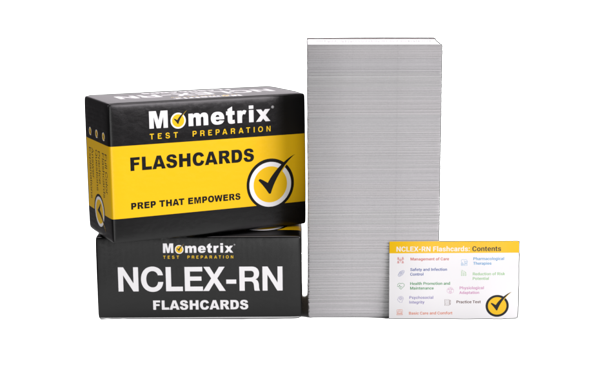

NCLEX-RN Online Prep Course
If you want to be fully prepared, Mometrix offers an online NCLEX-RN prep course designed to give you everything you need to succeed!
Here’s what you’ll find in the NCLEX-RN course:
- 140+ Review Lessons Covering Every Topic
- Over 1,900 NCLEX-RN Practice Questions
- 1,000+ Digital Flashcards
- 120+ Instructional Videos
- Money-back Guarantee
- Mobile Access
Everyone learns differently, so we’ve tailored the NCLEX-RN online prep course to ensure every learner has what they need to prepare for the NCLEX-RN exam.
Click below to check it out!
How to Pass
At this point, you should have a better understanding of the content and structure of the NCLEX-RN. You are undoubtedly ready to begin the process of preparing for the exam. You can help yourself on exam day by getting enough rest, eating properly, and managing your stress. But, the best way to ensure you do well on the NCLEX-RN is to thoroughly prepare.
Mometrix Test Preparation has the test preparation materials you need in the NCLEX Secrets study guide, which gives you real NCLEX-RN content, including expert tips aimed at helping you reduce stress, recall information, and ensure high performance.
In addition to the NCLEX Secrets study guide, Mometrix Test Preparation also offers a comprehensive NCLEX-RN Practice Test, NCLEX Flashcards, and an online NCLEX-RN course!
FAQs
Q
How many questions are on the NCLEX-RN?
A
There are between 85 and 150 questions on the NCLEX-RN.
Q
How long is the NCLEX-RN exam?
A
The NCLEX-RN has a time limit of 5 hours.
Q
What is a passing score on the NCLEX-RN?
A
The NCLEX-RN passing standard is 0.00 logits. Your reported result will be pass or fail; you will not receive a numerical logit score.
Q
When will I receive my test scores?
A
You will receive your NCLEX-RN test scores within six weeks after completing the exam.


NCLEX and NCLEX-RN are registered trademarks of National Council of State Boards of Nursing, Inc., which is not affiliated with Mometrix Test Preparation and does not endorse this page.
Affiliate disclosure: As an Amazon Associate, we may earn commissions from qualifying purchases from Amazon.com.