Welcome to the GED® practice test page!
Click the “Start Test” button above to begin our free GED practice test! These practice questions will give you a better idea of what to study for your exam.
Continue reading to find out more about the GED test, and click below for more test prep resources.
GED Question of the Day
GED Practice Tests by Subject
If you need some extra practice in a specific subject, click one of the subjects below to get started on a subject-specific GED practice test.
Test Outline
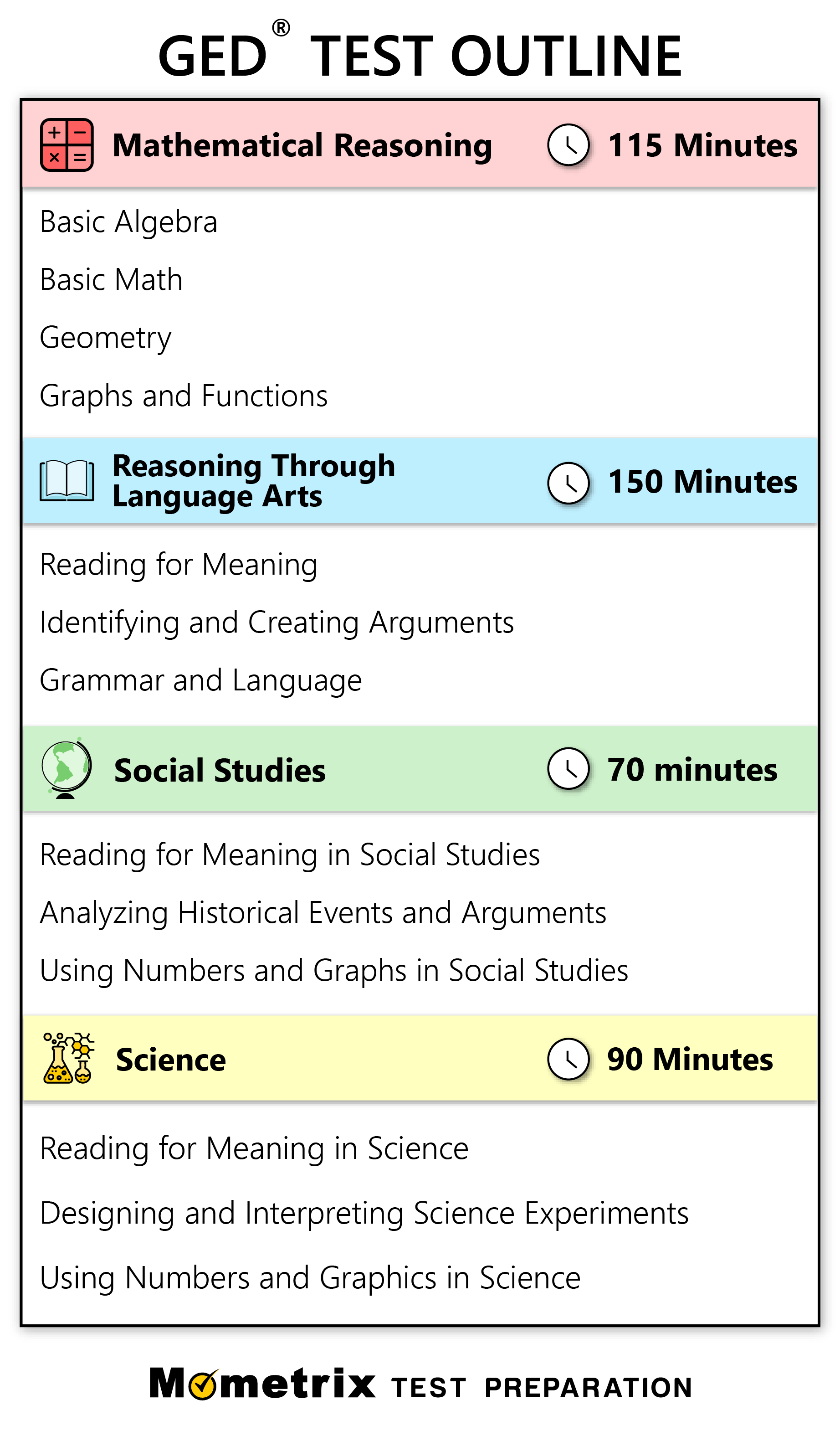
There are four sections on the GED test:
- Reasoning Through Language Arts
- Math
- Science
- Social Studies
Questions are presented in several formats: multiple-choice, hot spot, fill-in-the-blank, drop-down, drag-and-drop, and extended response.
Social Studies
The GED Social Studies test measures your ability to understand and analyze information about civics and government, US history, economics, and geography. Approximately 50% of the test focuses on civics and government, 20% on US history, 15% on economics, and 15% on geography and the world.
Rather than testing your ability to memorize names and dates, the test emphasizes reading for meaning, analyzing historical events and arguments, and interpreting numbers, graphs, maps, and other sources. Some questions are based on a shared passage or graphic, while others are standalone questions.
Math
The GED Mathematical Reasoning test covers basic math, geometry, basic algebra, and graphs and functions. Approximately 45% of the test focuses on quantitative problem-solving, while 55% focuses on algebraic problem-solving.
The test measures both mathematical procedures and your ability to apply math in academic, workplace, and real-world situations. A formula sheet and an on-screen TI-30XS scientific calculator are available for most questions. Calculator use begins in Part 2, and test takers at a testing center may use their own handheld TI-30XS calculator.
Science
The GED Science test measures your ability to understand scientific information, interpret data and graphics, evaluate experiments, and solve problems using scientific evidence. Approximately 40% of the test focuses on life science, 40% on physical science, and 20% on Earth and space science.
About half of the questions are grouped into scenarios in which two or three questions relate to the same passage, graph, diagram, or other stimulus. The remaining questions are standalone. Although you need a basic understanding of scientific concepts, the test emphasizes reasoning and applying information rather than memorizing large amounts of scientific facts.
Language Arts
The Reasoning Through Language Arts test measures reading comprehension, argument analysis, grammar, language use, and writing. Approximately 75% of the texts are informational and 25% are literary. Reading passages generally range from 400 to 900 words and may include workplace materials, science and social studies texts, literature, and documents related to US history and civic life.
The test includes three sections and one 45-minute written essay, known as the extended response. For the extended response, you will read two source texts, analyze their arguments, determine which argument is better supported, and explain your conclusion using evidence from the texts.
The extended response is scored on three areas: your analysis and use of evidence, the development and organization of your ideas, and your command of standard written English. The remaining questions measure skills such as identifying main ideas and supporting details, making inferences, understanding vocabulary in context, evaluating arguments, and correcting grammar and usage errors.
Top 5 Most Challenging GED Questions
Now that you know more about the exam, try your hand at some targeted practice!
Over the last year, we’ve compiled the data from about 6,000 test-takers who tried their hand at the practice test at the top of this page. According to the data, around 80% of people answered these five questions incorrectly.
Answer each question and read through the answer explanation, whether you got the answer right or wrong. This will help you ensure you’ve got the topic mastered.
Whether you struggled with these questions or aced them on your first try, be sure to take the full practice test to get a better idea of how prepared you really are!
1. Read the poem below before answering the question:
 Read Passage
He kindly stopped for me —
The Carriage held but just Ourselves —
And Immortality.
We slowly drove — He knew no haste
And I had put away
My labor and my leisure too,
For His Civility —
We passed the School, where Children strove
At Recess — in the Ring —
We passed the Fields of Gazing Grain —
We passed the Setting Sun —
Or rather — He passed Us —
The Dews drew quivering and chill —
For only Gossamer, my Gown —
My Tippet — only Tulle —
We paused before a House that seemed
A Swelling of the Ground —
The Roof was scarcely visible —
The Cornice — in the Ground —
Since then — ’tis Centuries — and yet
Feels shorter than the Day
I first surmised the Horses’ Heads
Were toward Eternity —
Which of the following best describes the tone of this poem?
2. Read the poem below before answering the question:
Read PassageHe kindly stopped for me —
The Carriage held but just Ourselves —
And Immortality.
We slowly drove — He knew no haste
And I had put away
My labor and my leisure too,
For His Civility —
We passed the School, where Children strove
At Recess — in the Ring —
We passed the Fields of Gazing Grain —
We passed the Setting Sun —
Or rather — He passed Us —
The Dews drew quivering and chill —
For only Gossamer, my Gown —
My Tippet — only Tulle —
We paused before a House that seemed
A Swelling of the Ground —
The Roof was scarcely visible —
The Cornice — in the Ground —
Since then — ’tis Centuries — and yet
Feels shorter than the Day
I first surmised the Horses’ Heads
Were toward Eternity —
This poem is an example of a
3. Which is the best version of the sentence below?
Remember to include, and periodically rotate medications you take every day such as insulin and heart medicine.
4. Read the passage below before answering the question:
Read PassageJermaine then adds 2 cm of water to a clean beaker. He hangs the three pieces of chromatography paper so that the paper touches the water, but the ink does not. The water moves up and soaks into the paper. After 20 minutes, he records the results. The permanent marker ink has not changed or spread. The non-permanent marker on the second paper has separated into the colors blue and brown, which have moved up the paper. The non-permanent marker on the third paper has separated into the colors purple and blue, which have moved up the paper.
Which of the following is the best conclusion that can be drawn based on Jermaine’s results?
5. Read the passage below before answering the question:
Read PassageHow could Joseph improve the design of his study?
Check Out Mometrix's GED Printed Study Guide
Get practice questions, video tutorials, and detailed study lessons
Get Your Study Guide
GED vs. High School Diploma vs. HiSET
The GED, a high school diploma, and the HiSET are all credentials widely accepted by colleges and employers, but there are some notable differences among them.
Take a look at the details of each here:
| Time | ||
|---|---|---|
| GED | High School Diploma | HiSET |
7 hours (estimated) | 4 years (estimated) | 7 hours (estimated) |
| Subjects | ||
|---|---|---|
| GED | High School Diploma | HiSET |
|
|
|
| Requirements | ||
|---|---|---|
| GED | High School Diploma | HiSET |
| Complete the required credits and other graduation requirements established by the school, district, or state. | Requirements vary by state or jurisdiction. |
| Test Dates or Schedule | ||
|---|---|---|
| GED | High School Diploma | HiSET |
Year-round, based on testing-center availability | Based on the school calendar | Year-round where the exam is offered |
| Registration or Enrollment | ||
|---|---|---|
| GED | High School Diploma | HiSET |
Register online | Enroll through a school or district |
|
| Typical Cost | ||
|---|---|---|
| GED | High School Diploma | HiSET |
$80–$150, depending on the state and testing format | Generally free for public-school students | $50–$100, depending on the state |
| Retakes or Credit Recovery | ||
|---|---|---|
| GED | High School Diploma | HiSET |
Retake rules and fees vary by state. | Summer school or credit-recovery programs may be available. | Retake rules and fees vary by state or jurisdiction. |
How to Register for the GED Test Online
GED registrations take place online and are accessed through registration with the official GED website. The qualifications to take the GED test are determined by your state. During the process, you will be asked when you want to take your test and which subject you want to take, then pay the designated amount. You have the option to pay for each section separately if you choose, or the entire test at once. If the test happens to be unavailable in your home state, you can travel to a nearby state if it allows people who are not official residents to test there.
GED Test Scores
Each GED subject test is scored on a scale of 100 to 200. You must earn at least 145 on each of the four subject tests to pass.
- 145–164: Passing — You have demonstrated high school–level knowledge and skills.
- 165–174: GED College Ready — You may qualify to bypass placement testing or developmental courses at participating colleges.
- 175–200: GED College Ready + Credit — You may qualify for up to 10 college credit hours, depending on the policies of the college you attend.
Scores are generally available the same day in the My Scores section of your GED account. After you pass all four subject tests, the process for receiving your diploma and transcript depends on the state or jurisdiction where you tested.
If you do not pass a subject test, you can take that subject again. Retake waiting periods, fees, discounts, and attempt limits vary by location and testing format, so check the official GED policies for your state before scheduling another attempt.

GED Online Prep Course
If you want to be fully prepared, Mometrix offers an online GED prep course designed to give you everything you need to succeed!
Here’s what you’ll find in the GED course:
- 90+ Review Lessons Covering Every Topic
- Over 2,100 GED Practice Questions
- 300+ Digital Flashcards
- 400+ Instructional Videos
- Money-back Guarantee
- Mobile Access
Everyone learns differently, so we’ve tailored the GED online prep course to ensure every learner has what they need to prepare for the GED exam.
Click below to check it out!
Study Tips
Start with a GED Practice Test
Before creating your study schedule, take a GED practice test to establish a starting point. You don’t need to wait until you have reviewed every topic. At this stage, the goal is to identify where your preparation time will have the greatest effect.
Review your results by section and content area:
- Mathematical Reasoning: Are you comfortable with basic math, algebra, geometry, graphs, functions, and applying math skills to word problems?
- Reasoning Through Language Arts: Can you understand written passages, evaluate arguments and evidence, apply grammar rules, and develop a clear written response?
- Science: Can you interpret experiments, identify relationships between variables, and draw conclusions from scientific passages, tables, and graphs?
- Social Studies: Can you analyze historical information and arguments, interpret primary and secondary sources, and use information from charts and graphs?
Identifying those specific weaknesses will show you where to devote more attention during your study time.
Review Difficult Questions
After each practice session, review every question you answered incorrectly AND every question you guessed on or answered with low confidence. Guessing correctly does not necessarily mean that you have mastered the skill.
For each difficult question, determine which of the following caused the problem:
- You didn’t know the topic or concept.
- You misread a passage, graph, table, or set of instructions.
- You knew the information but could not apply it to the question.
- You made a calculation or calculator-entry error.
- You overlooked evidence that supported the correct answer.
- You struggled with the question format.
- You spent too long trying to determine the answer.
- You had difficulty organizing or supporting your written response.
Then, outline a specific plan for improvement based on what you discovered. In other words, don’t just say, “I need to study math more.” Note that you need to practice solving linear equations, interpreting graphs, or translating word problems into calculations.
Similarly, replace “study science” with a more useful goal, like practicing how to identify experimental variables or draw conclusions from data.
Utilize Answer Explanations
Answer explanations are an underutilized studying resource. To take full advantage of them, read the explanation for every question you found difficult, including questions you answered correctly.
For each one, make sure you can confidently explain:
- Why the correct answer is correct
- Why each incorrect option is wrong
- What rule, concept, or skill is being tested
- How the same skill might appear in a different question
For Mathematical Reasoning questions, make sure you understand each step and can complete similar problems using the calculator and formula sheet available on the test.
For Reasoning Through Language Arts questions, identify the exact sentence, detail, graph, or piece of evidence that supports the answer. Don’t choose an answer simply because it sounds reasonable or matches something you already know.
Study Concepts, Not Individual Questions
Memorizing the answer to a GED practice question will not prepare you for a new question testing the same skill with a different passage, equation, graph, or set of numbers. Your goal should be to recognize and apply the underlying skill to any question that asks you to use it.
For example, do not memorize the steps used in one algebra problem. Make sure you can solve the same type of equation when it is presented as a graph, table, or word problem.
For social studies, learning historical background can be helpful, but the test is not primarily about memorizing dates and names. You must be able to understand sources, evaluate arguments, and interpret numerical information.
The exact questions on your test will be different from the ones you encounter during practice. If you can explain a skill without looking at your notes and then apply it correctly to a new question, that is a good indication that you have mastered it.
Check Out Mometrix's GED Flashcards
Get complex subjects broken down into easily understandable concepts
Get Your Flashcards
FAQs
Q
Is a GED the same as a high school diploma?
A
The GED is not the same as a high school diploma. A GED credential is a high school equivalency credential earned by passing four subject tests. A traditional high school diploma is generally earned by completing a school’s coursework and graduation requirements.
Q
How much does the GED test cost?
A
The cost to take the GED differs in every state. Most states charge anywhere between $36 and $41 for each subject test.
Q
Can I take the GED subject tests separately?
A
Yes. The GED consists of four separate subject tests, and you can schedule them one at a time or take multiple subjects on the same day.
Q
Is the GED test all multiple-choice?
A
No. The GED includes multiple-choice questions as well as formats such as drag-and-drop, fill-in-the-blank, drop-down, and select-an-area questions. The Reasoning Through Language Arts test also includes a written extended response.
Q
Can I take the GED test online at home?
A
Yes, online GED testing is available in participating states to eligible test-takers. You must have an appropriate computer, webcam, internet connection, identification, and private testing space.
Q
Can I use a calculator on the GED test?
A
Yes. An on-screen TI-30XS scientific calculator is available for most Mathematical Reasoning questions and certain Science and Social Studies questions. If you test at a testing center, you may also bring an approved handheld TI-30XS calculator.
Q
What score do you need to pass the GED?
A
You must earn a score of at least 145 on each of the four GED subject tests. Scores are reported separately for Mathematical Reasoning, Reasoning Through Language Arts, Science, and Social Studies.
Q
Can you go to college without a GED?
A
Yes. Many colleges and universities accept applicants with GED credentials, but admission requirements vary. Check the requirements of each college you are considering.


GED® is a registered trademark of the American Council on Education (ACE) and administered exclusively by GED Testing Service LLC under license. This material is not endorsed or approved by ACE or GED Testing Service.