
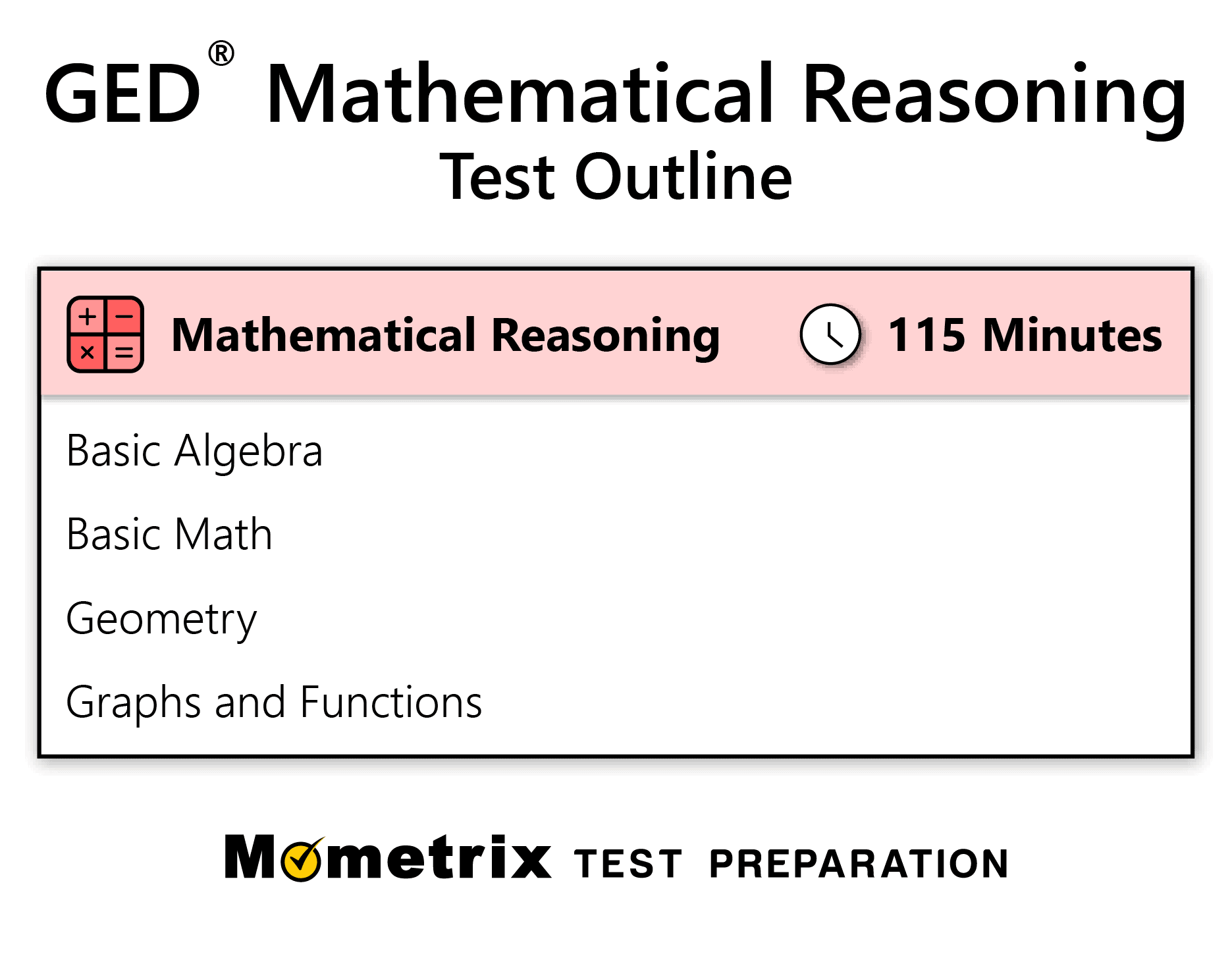
The Mathematical Reasoning section of the GED® tests your ability to solve algebraic and quantitative problems. To help you prepare for this section of the GED, this page contains everything you need to know, including what topics are covered, how many questions there are, and how you can study effectively.
Click “Start Test” above to take a free GED Math practice test!
What’s on the GED Math Test?
GED Question of the Day

GED Test Online Prep Course
If you want to be fully prepared, Mometrix offers an online GED prep course designed to give you everything you need to succeed!
Here’s what you’ll find in the GED course:
- 90+ Review Lessons Covering Every Topic
- Over 2,100 GED Practice Questions
- 300+ Digital Flashcards
- 400+ Instructional Videos
- Money-back Guarantee
- Mobile Access
Everyone learns differently, so we’ve tailored the GED online prep course to ensure every learner has what they need to prepare for the GED exam.
Click below to check it out!
GED Math Practice Questions
One of the best ways to test your knowledge is by taking a practice test. Evaluate your math skills by trying your hand at the three practice questions below!
Answer each question and read through the answer explanation, whether you got the answer right or wrong. This will help you ensure you’ve got the topic mastered.
Whether you struggled with these questions or aced them on your first try, be sure to take the full math practice test to get a better idea of how prepared you really are!
1. A combination lock uses a three-digit code. Each digit can be any one of the ten available integers 0–9. How many different combinations are possible?
\(P=P_1 \times P_2 \times P_3=10 \times 10 \times 10=1{,}000\)
This result makes sense when we consider trying every possible code in sequence, beginning with the combinations 0-0-0, 0-0-1, 0-0-2, etc. In ascending order, the last three-digit combination would be 9-9-9.Although it may seem that there would be 999 possible combinations, there are in fact 1,000 when we include the initial combination, 0-0-0.
2. What is the surface area of a cube, in square inches, if the length of one side of the cube is 3 inches?
\(A=6\times 3^2=6\times 9=54\)
Therefore, the surface area of the cube is 54 in2.3. What is the factored form of the expression below?
\(3x^2+4x-15=(\:\:\:)(\:\:\:)\)
First, determine what goes in the first part of each set of parentheses. Since the leading term is \(3x^2\), the first terms of the binomials should be \(3x\) and \(x\). Put these terms in each of the first parts of the sets of parentheses.\(3x^2+4x-15=(3x\:\:)(x\:\:)\)
Next, determine what numbers multiply to –15 and will make the middle term of the multiplied expression equal to \(4x\).\(3x^2+4x-15=(3x-5)(x+3)\)
Notice that it is important to make sure –5 goes in the left set of parentheses and +3 goes in the right set of parentheses. If they were switched, using the FOIL method on the two binomials would result in \((3x+3)(x-5)=3x^2-12x-15\), which is not the desired expression. Therefore, the correct factorization of the expression is \((3x-5)(x+3)\).GED Math Fact Sheets

Check Out Mometrix's GED Math Study Guide
Get practice questions, video tutorials, and detailed study lessons
Get Your Study Guide
GED Math Formulas
Though you are able to use a calculator during the test, you won’t be given a formula sheet to reference.
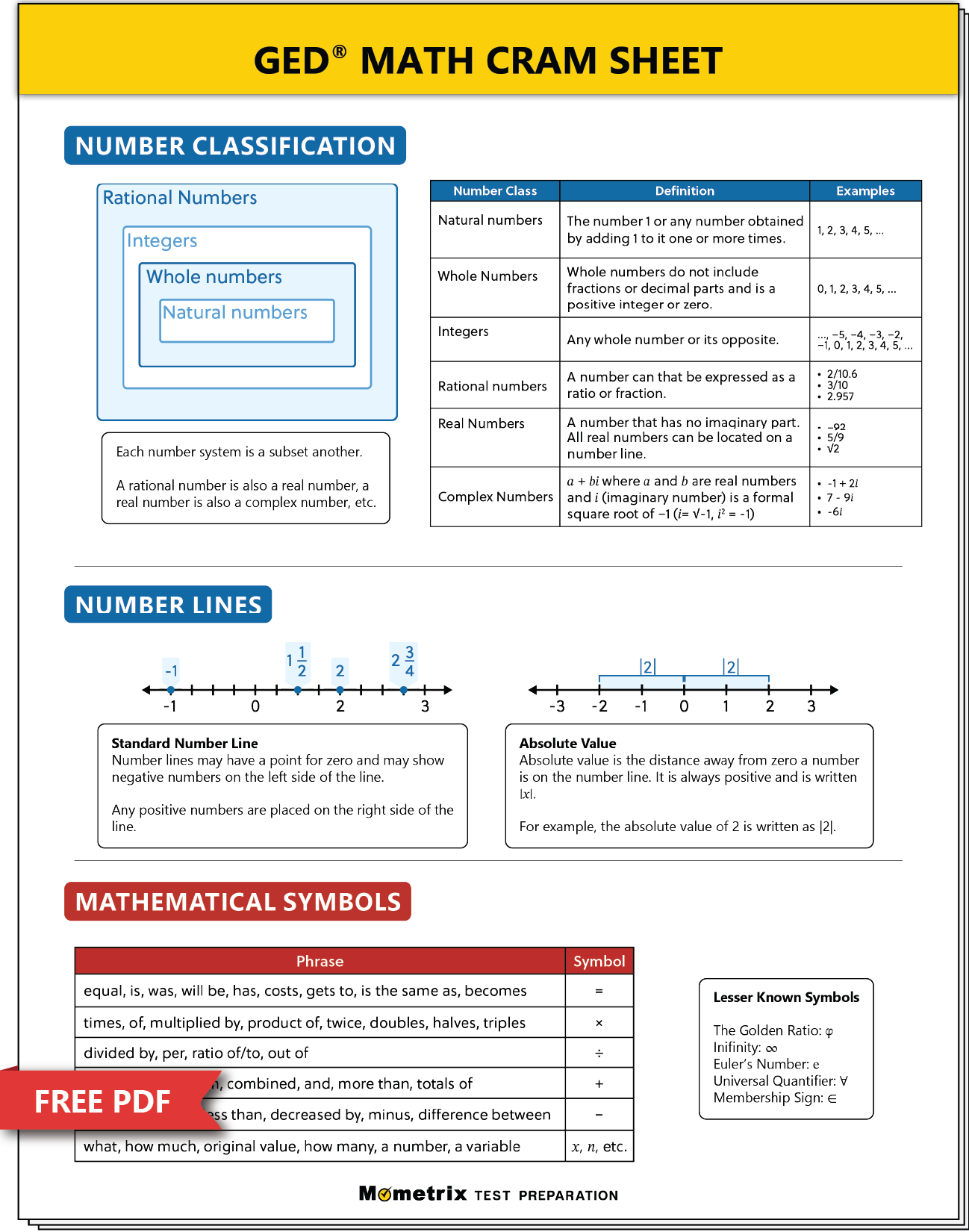
To help you out, we’ve compiled all of the formulas you need to know into one free PDF, including area and volume formulas, algebraic expressions, metric conversions, and more!
FAQs
Q
Who is eligible to take the GED Math Test?
A
You are eligible to take the GED Math test if you meet the following requirements:
- You are at least 16 years old
- You are not enrolled in high school
- You have not graduated from high school
- You meet all of your state’s additional requirements
Q
How many questions are on the GED Math Test?
A
The GED Math Test contains 46 questions. Some question types include multiple-choice, drag-and-drop, hot spot, and fill-in-the-blank.
Q
How long is the GED Math Test?
A
The GED Math Test is 115 minutes (1 hour and 55 minutes).
Q
What type of math is on the GED Test?
A
The mathematical reasoning section of the GED test consists of two types of problems, quantitative problem-solving and algebraic problem-solving.
Q
How much is the GED Math Test?
A
In most states, the GED Math test is $30 or less. Students are encouraged to check out the GED website for their state’s prices.
Q
Can you use a calculator on the GED Math Test?
A
On the first section of the GED Math Test, you are not allowed to use a calculator. For the second section, you may use a calculator. Please note that you must bring your own TI-30XS calculator.
Q
How many questions can you miss on the GED Math Test?
A
The GED scoring system is complex, so one question doesn’t always equal one point. Some questions are fill in the blank or multiple select, where you must select multiple answers, which means multiple points. There is no exact number of questions you can miss and still pass, but, according to the GED Testing Service, you need approximately 60%-65% of your points to pass.
Q
How many times can you retake the GED Math Test?
A
There are no restrictions on how many times you can retake the GED Math Test. Generally, you can take the GED 3 times, and after the 3rd attempt, you have to wait 60 days.
Q
What do you have to score to pass the GED Math Test?
A
To pass the GED Math Test, you must earn a score of at least 145. The highest score is 200, and anything below 145 is considered failing.


GED® is a registered trademark of the American Council on Education (ACE) and administered exclusively by GED Testing Service LLC under license. This material is not endorsed or approved by ACE or GED Testing Service.