
0d0hrs0mins0secs
0d0hrs0mins0secs

GED® Reasoning Through Language Arts Practice Test

Prepare for your test with realistic questions.

GED Reasoning Through Language Arts Practice Test

The Reasoning Through Language Arts section of the GED® tests your ability to identify and create arguments, comprehend various meanings from texts, and correctly utilize English grammar. To help you prepare for this section of the GED, this page contains everything you need to know, including what topics are covered, how many questions there are, and how you can study effectively.

Click “Start Test” above to take a free GED Reasoning Through Language Arts practice test!

What’s on the Reasoning Through Language Arts Test?
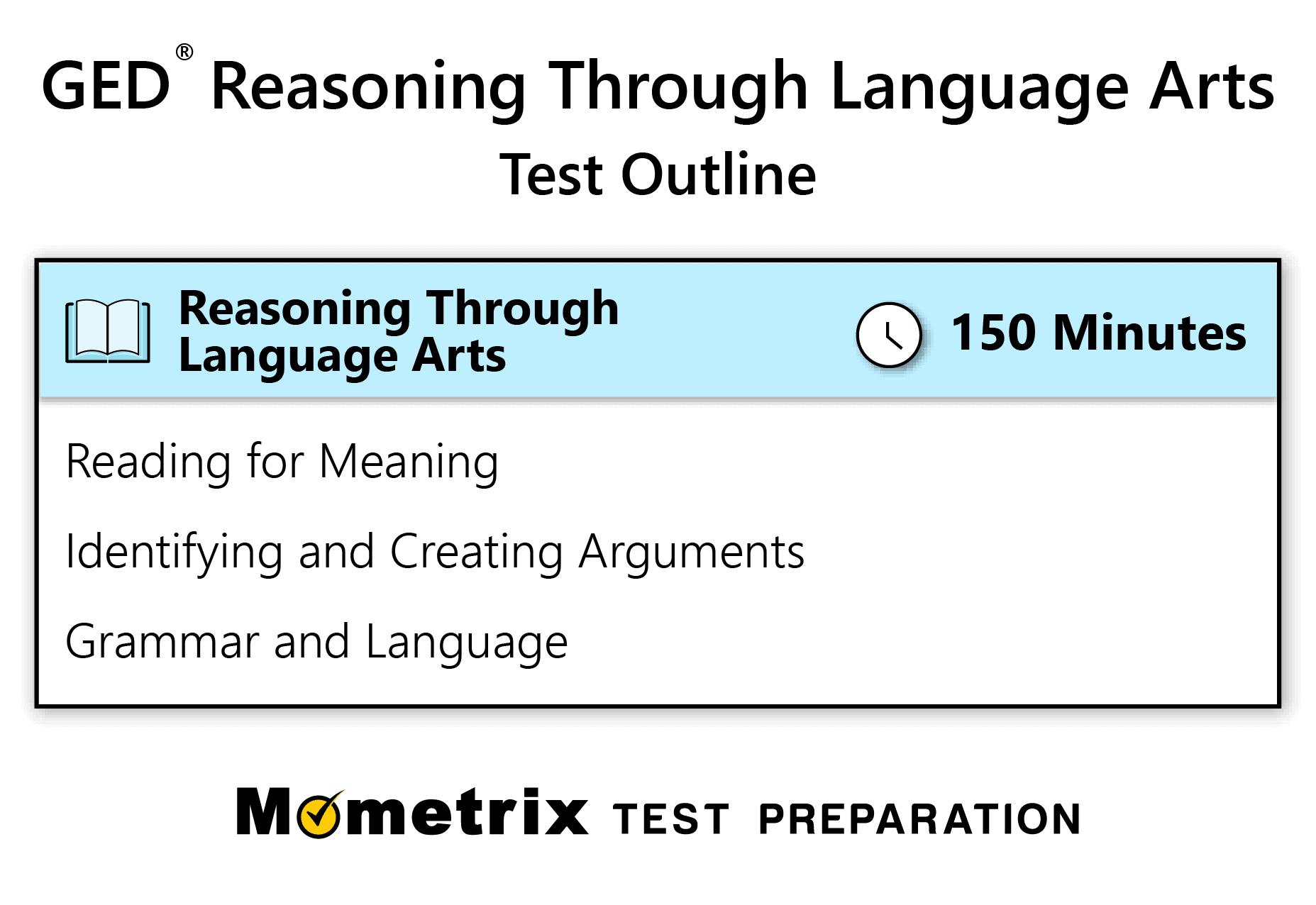
test outline for the GED Reasoning through Language Arts test, which has a time limit of 150 minutes

GED Question of the Day

Click here for 30% off the Mometrix GED online course. Use code: SECRET30

GED Test Online Prep Course

If you want to be fully prepared, Mometrix offers an online GED prep course designed to give you everything you need to succeed!

Here’s what you’ll find in the GED course:

  • 90+ Review Lessons Covering Every Topic
  • Over 2,100 GED Practice Questions
  • 300+ Digital Flashcards
  • 400+ Instructional Videos
  • Money-back Guarantee
  • Mobile Access

Everyone learns differently, so we’ve tailored the GED online prep course to ensure every learner has what they need to prepare for the GED exam.

Click below to check it out!

GED English Practice Questions

One of the best ways to test your knowledge is by taking a practice test. Evaluate your English language skills by trying your hand at the three practice questions below!

Answer each question and read through the answer explanation, whether you got the answer right or wrong. This will help you ensure you’ve got the topic mastered.

Whether you struggled with these questions or aced them on your first try, be sure to take the full practice test to get a better idea of how prepared you really are!

1. Read the passage below before answering the question:

Closed Book Icon Read Passage
Salvage logging moves material like small, broken branches to the forest floor. These pieces can become fuel for more fires. The removal of larger, less flammable trees leaves behind small limbs and increases the risk of forest fires. In unmanaged areas, these pieces are found more commonly on the tops of trees where they are unavailable to fires. Logging destroys old forests that are more resistant to wildfires. So, this creates younger forests that are more open to fires. In old forests, branches of bigger trees are higher above the floor where fires may not reach.

Replanting after wildfires creates monoculture plantations where only a single crop is planted. This monoculture allows less biological diversity. Also, it allows plants to be less resistant to disease. So, this increases the chance of fire. Salvage logging also upsets natural forest regrowth by killing most of the seedlings that grow after a wildfire. It breaks up the soil and increases erosion. Also, it removes most of the shade that is needed for young seedlings to grow.

According to the passage, why are the broken branches in unmanaged forests preferable to those in logged areas for wildfire resistance?


The passage argues that small, woody material is left on the tops of trees and is less likely to be reached by fire.
Found a bug? Let us know!

2. What correction should be made to the following sentence?

Anyone who live in a climate which brings snow during the winter knows how important it is to have a working vehicle.

The problem in this sentence is subject-verb agreement. Remember that the indefinite pronouns are always singular. Choice B is incorrect because the clause is essential to the sentence (so commas are not needed). Choice C is wrong because the prepositional phrase does not need punctuation. Choice D is incorrect because there is no need to change "which" to "that."
Found a bug? Let us know!

3. Read the passage below before answering the question:

Closed Book Icon Read Passage
I recall many incidents of the summer of 1887 that followed my soul's sudden awakening. I did nothing but explore with my hands and learn the name of every object that I touched; and the more I handled things and learned their names and uses, the more joyous and confident grew my sense of kinship with the rest of the world.

I had my first lessons in the beneficence of nature. I learned how the sun and the rain make to grow out of the ground every tree that is pleasant to the sight and good for food, how birds build their nests and live and thrive from land to land, how the squirrel, the deer, the lion and every other creature finds food and shelter. As my knowledge of things grew I felt more and more the delight of the world I was in.

What is the meaning of the word "beneficence"?


The word "beneficence" is used to show how nature helps the plants and animals on Earth. For example, nature provides sunlight and rain to help trees grow. Choice A is incorrect because duties and beneficence are not synonymous. Choice C is incorrect because nature gives the sunlight and the rain. This makes it the opposite of stingy. Choice D is incorrect because the second paragraph is about the generosity of nature.
Found a bug? Let us know!

GED Language Arts Fact Sheets

FAQs

Q

Who is eligible to take the GED Reasoning Through Language Arts Test?

A

You are eligible to take the GED Reasoning Through Language Arts test if you meet the following requirements:

  • You are at least 16 years old
  • You are not enrolled in high school
  • You have not graduated from high school
  • You meet all of your state’s additional requirements

Q

How much is the GED Reasoning Through Language Arts Test?

A

The GED Reasoning Through Language Arts test fees vary with each state. The test is usually $30 or less. Some states are as low as $3.75.

Q

How many questions are on the GED Reasoning Through Language Arts Test?

A

The number of questions on the GED Reasoning Through Language Arts test varies with each state, but the test is 150 minutes.

Q

What do you have to score to pass the GED Reasoning Through Language Arts Test?

A

In order to pass the GED Reasoning Through Language Arts test, you must earn a score of at least 145. In some states, like New Jersey, you must earn a score of at least 150 to pass the test.

Q

How many times can you retake the GED Reasoning Through Language Arts Test?

A

There are no restrictions on how many times you can retake the GED Reasoning Through Language Arts test. Each state has its own policies and waiting periods. Generally, you can take the test 3 times, and after the 3rd attempt, you have to wait 60 days.


Aaron Lanni profile pic

Edited by Aaron Lanni

Aaron is the content manager and lead editor for Mometrix Academy. He regularly produces, updates, proofreads, and edits content to ensure it meets Mometrix’s quality and accessibility standards.

GED® is a registered trademark of the American Council on Education (ACE) and administered exclusively by GED Testing Service LLC under license. This material is not endorsed or approved by ACE or GED Testing Service.


by Mometrix Test Preparation | Last Updated: July 21, 2026

0
d
0
hrs
0
min
0
secs