Welcome to the ACT® practice test page!
Click the “Start Test” button above to begin our free ACT practice test! These ACT practice questions will give you a better idea of what to study for your exam.
ACT Practice Tests by Subject
If you need some extra practice in a specific subject, click one of the subjects below to get started on a subject-specific ACT practice test.
Good luck with your studying!
Test Outline
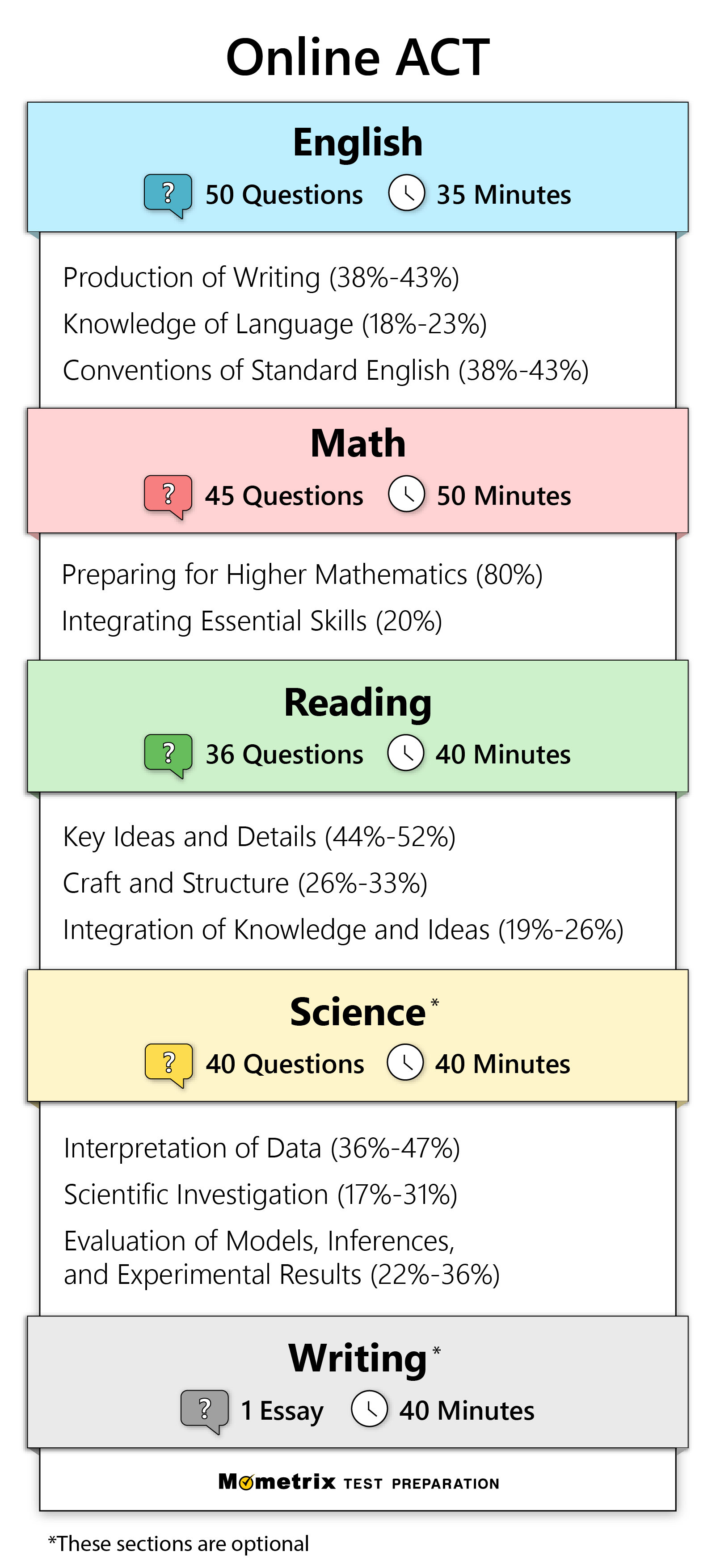
There are two versions of the ACT test: online and paper-and-pencil. For both versions, the test is split into five sections and the Writing and Science sections are optional.
The ACT contains 171 multiple-choice questions and has a time limit of about 3 hours.
Top 5 Most Challenging ACT Questions
Now that you know more about the test, try your hand at some targeted practice!
Over the last year, we’ve compiled the data from about 5,000 test-takers who tried their hand at the practice test at the top of this page. According to the data, around 70% of people answered these five questions incorrectly.
Answer each question and read through the answer explanation, whether you got the answer right or wrong. This will help you ensure you’ve got the topic mastered.
Whether you struggled with these questions or aced them on your first try, be sure to take the full practice test to get a better idea of how prepared you really are!
1. Read the passage below before answering the question:
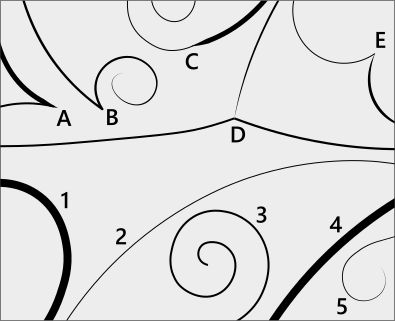
What is trail 5 most likely to represent?
2. If \(x\) and \(y\) are positive integers, which of the following expressions is equivalent to \((xy)^{7y}-(xy)^y\)?
\((xy)^{7y}-(xy)^y=(xy)^y ⌊(xy)^{7y-y}-1⌋\)\(\:=(xy)^y ⌊(xy)^{6y}-1\)

3. The sides of a triangle are equal to integer values of units. Two sides are 4 and 6 units long, respectively. What is the minimum value for the triangle’s perimeter?
Since we are told the sides are all integers, the last side must be 3 units in length. Thus, the minimum length for the perimeter is \(4+6+3=13\) units.
4. Read the passage below before answering the question:
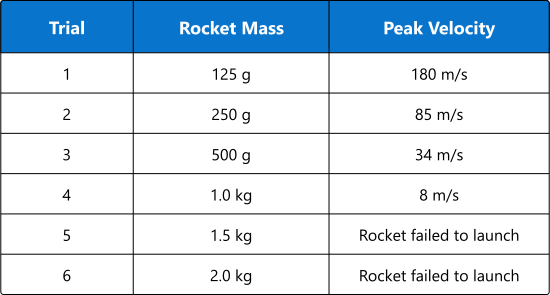
How would the previous calculations have been off if he used the rockets’ initial mass and did not take into account the change?
5. Read the passage below before answering the question:
Some recent observations seem to show that at least two galaxies, NGC-1052-DF2 and NGC-1052-DF4, do have enough visible mass to account for their motion and therefore contain little or no dark matter. If these measurements turn out to be valid, on which scientist’s statement would they cast the most doubt?
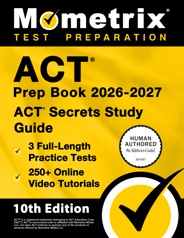
Check Out Mometrix's ACT Printed Study Guide
Get practice questions, video tutorials, and detailed study lessons.

ACT Online Prep Course
If you want to be fully prepared, Mometrix offers an online ACT prep course designed to give you everything you need to succeed!
Here’s what you’ll find in the ACT course:
- 80+ Review Lessons Covering Every Topic
- Over 1,150 ACT Practice Questions
- 350+ Digital Flashcards
- 310+ Instructional Videos
- Money-back Guarantee
- Mobile Access
Everyone learns differently, so we’ve tailored the ACT online prep course to ensure every learner has what they need to prepare for the ACT exam.
Click below to check it out!
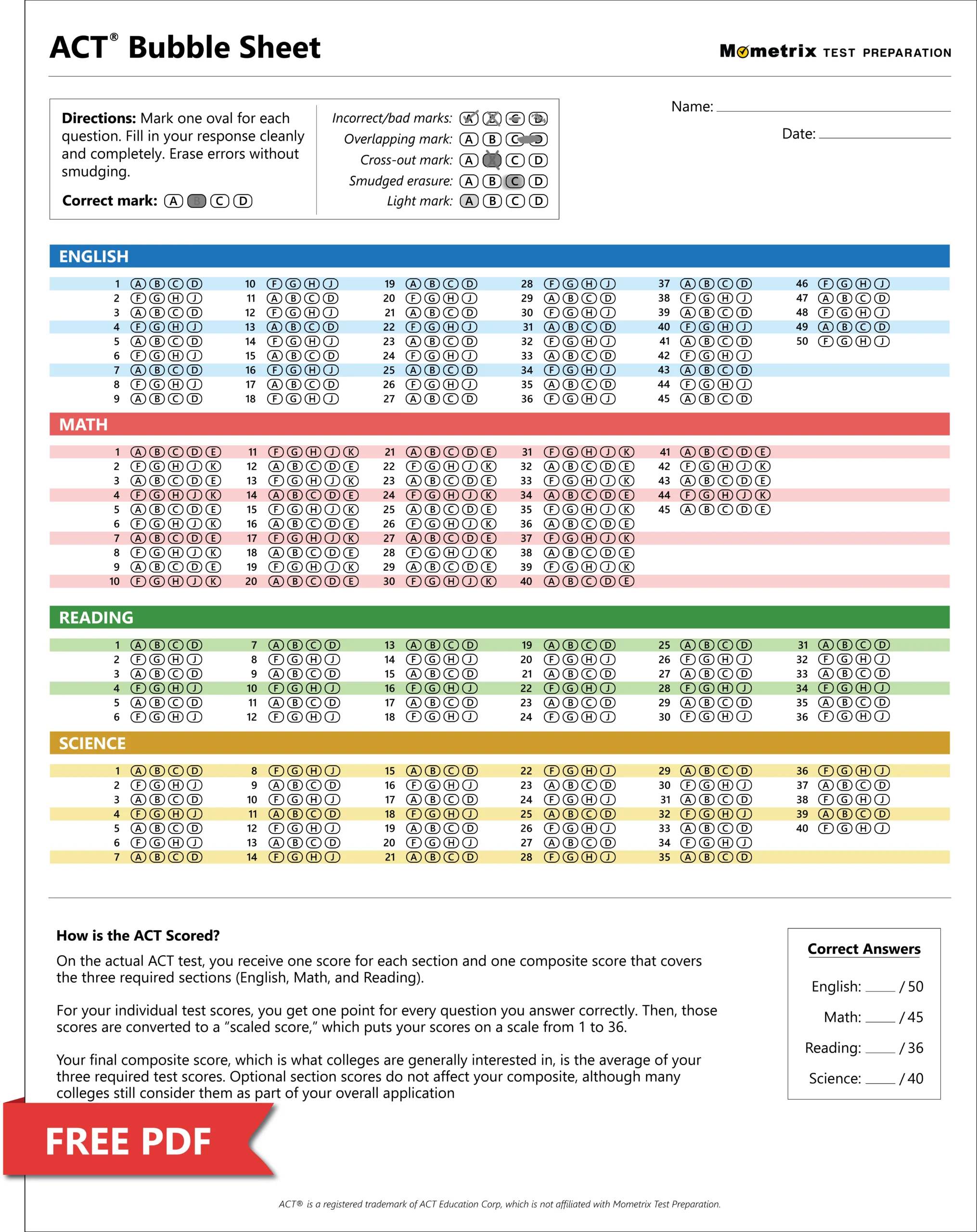
ACT Bubble Sheet (PDF)
When you take the ACT, you’ll fill in your answers using a bubble sheet.
To get the hang of using an ACT test answer sheet, you can download the one below for free!
This printable bubble sheet is designed to help you practice filling out answers just like on test day, so you can boost your confidence and accuracy. Download it now and get one step closer to acing the ACT.


High School Student Toolkit: A Guide to College Success
Get expert tips on acing college applications, preparing for tests, managing finances, and navigating college life. Your guide to success starts here!
How to ACT Prep
Start with an ACT Practice Test
Before creating your study schedule, take an ACT practice test to establish a starting point. You don’t need to wait until you have reviewed every topic. At this stage, the goal is to identify where your preparation time will have the greatest effect.
Review your results by section and content area:
- English: Do you struggle with passage organization, effective transitions, precise wording, sentence structure, grammar, usage, or punctuation?
- Math: Do you need more work with algebra, functions, geometry, statistics, probability, number concepts, or applying several mathematical skills within one problem?
- Reading: Can you identify key ideas and supporting details, interpret words and phrases in context, analyze an author’s choices, and connect information from different parts of a passage?
- Science (optional): Can you interpret graphs and tables, understand experimental procedures, compare scientific explanations, and determine whether evidence supports a conclusion?
- Writing (optional): Can you develop a clear position, engage with multiple perspectives, organize your ideas, support your reasoning, and maintain control of written English?
Identifying those specific weaknesses will show you where to devote more attention during your study time.
Review Difficult Questions
After each practice session, review every question you answered incorrectly AND every question you guessed on or answered with low confidence. Guessing correctly does not necessarily mean that you have mastered the skill.
For each difficult question, determine which of the following caused the problem:
- You did not understand the concept or rule being tested.
- You misread the passage, graph, table, or question.
- You selected an answer that sounded reasonable but was not fully supported.
- You made a calculation or algebra error.
- You used the calculator inefficiently or entered something incorrectly.
- You spent too much time trying to determine the answer.
Then, outline a specific plan for improvement based on what you discovered. In other words, don’t just say, “I need to study English.” Specify that you need to practice sentence boundaries, transitions, modifier placement, or choosing details that support a passage’s purpose.
For science questions, determine whether the difficulty came from reading the data, understanding the experiment, identifying variables, or comparing competing explanations. Do not automatically assume that every missed science question represents a gap in scientific knowledge.
Utilize Answer Explanations
Answer explanations are an underutilized studying resource. To take full advantage of them, read the explanation for every question you found difficult, including questions you answered correctly.
For each one, make sure you can confidently explain:
- Why the correct answer is correct
- Why each incorrect option is wrong
- What skill, rule, or concept the question tests
- Which information in the question supports the answer
- How the same skill could appear in a different ACT question
For English questions, identify the exact grammar rule or rhetorical purpose involved. An answer should not be considered correct merely because it sounds more natural.
For math questions, solve the problem again from the beginning without copying the explanation. Then, determine whether another method would be faster. The ACT lets you use an approved calculator, but not every question is best solved with one.
Study Concepts, Not Individual Questions
Memorizing the answer to an ACT practice question will not prepare you for a new question testing the same skill with a different passage, sentence, equation, graph, or experiment. Your goal should be to recognize and apply the underlying skill.
For example, don’t memorize which punctuation mark worked in one sentence. Learn how to identify independent and dependent clauses and determine whether the sentence requires a period, semicolon, comma, colon, or no punctuation.
The exact questions on your test will be different from the ones you encounter during practice. If you can explain a skill without looking at your notes and then apply it correctly to a new question, that is a good indication that you have mastered it.
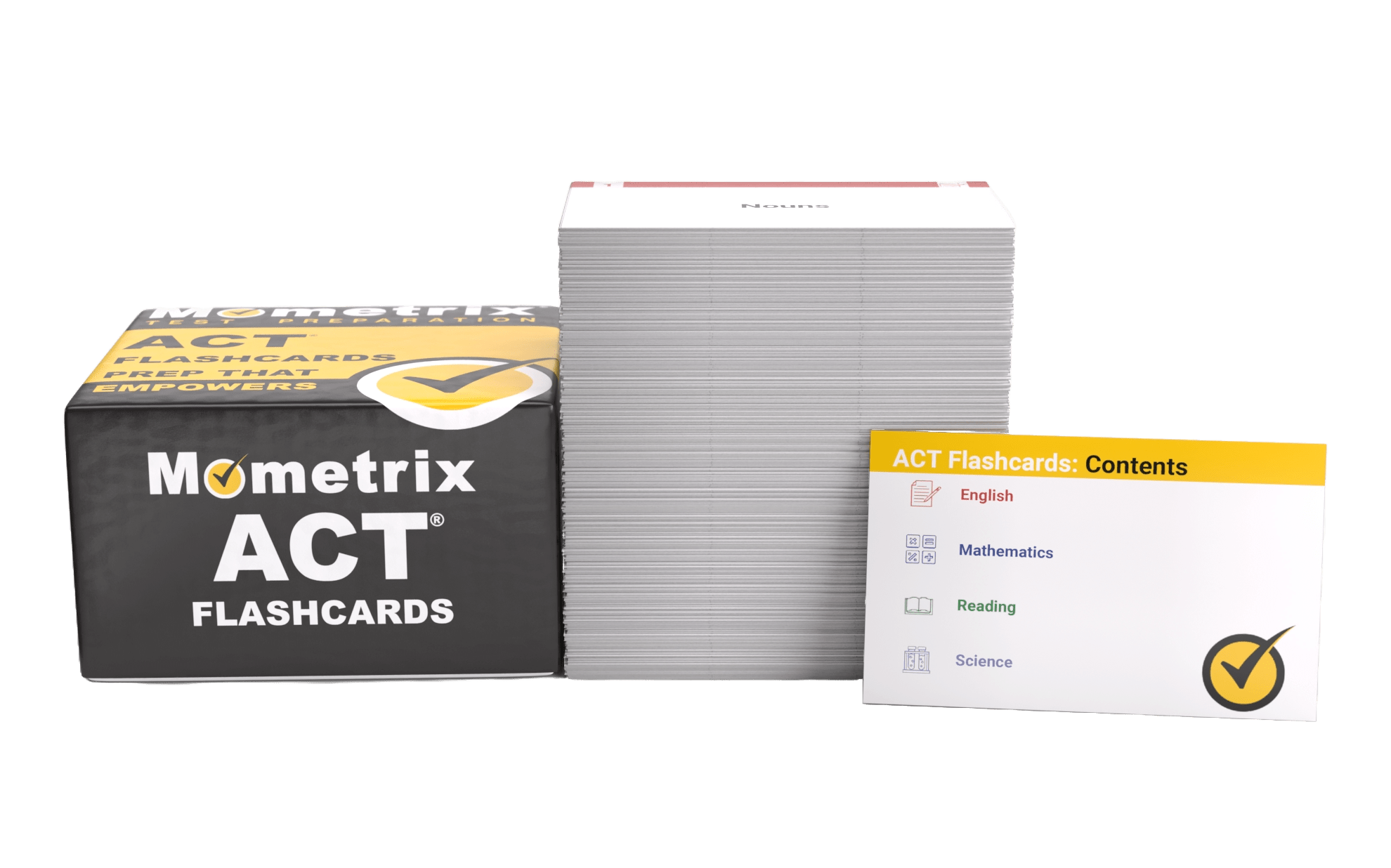
Check Out Mometrix's ACT Flashcards
Get complex subjects broken down into easily understandable concepts.


ACT® is a registered trademark belonging to ACT Education Corp. (“ACT”). ACT is not involved with or affiliated with Mometrix Media LLC, nor does ACT endorse or sponsor any of the products or services offered by Mometrix Media LLC.