
The Science section of the ACT® evaluates your knowledge of various science concepts, including data analysis, graphs, experiments, and formulating predictions.
To help you prepare for this section of the ACT, this page contains everything you need to know, including what topics are covered, how many questions there are, and how you can study effectively.
Click “Start Test” above to take a free ACT Science practice test!
What’s on the ACT Science Section?
ACT Science Practice Questions
One of the best ways to test your knowledge is by taking a practice test. Evaluate your science knowledge by trying your hand at the three practice questions below!
Answer each question and read through the answer explanation, whether you got the answer right or wrong. This will help you ensure you’ve got the topic mastered.
Whether you struggled with these questions or aced them on your first try, be sure to take the full practice test to get a better idea of how prepared you really are!
1. Read the passage below before answering the question:
 Read Passage
In dishes 1 through 3, the scientist then places a drop of solution of the antibiotic to be tested at a concentration of 2 parts per thousand. (The rest of the solution is water.) She does the same to dishes 4 through 6 but with a solution at a concentration of one part per thousand. In dishes 7 through 9, the scientist places a drop of a control liquid. The scientist covers the Petri dishes, leaves them in a cool location for five days, and then examines the results. The diagrams below show the growth of bacteria in each dish after five days; the gray areas show where on the Petri dish bacterial cultures have grown, whereas the white areas show parts of the agar that are clear of bacteria.

What is the best conclusion that can be drawn from the given data?
2. Read the passage below before answering the question:
Read PassageBelow is shown the phase diagram for molecular nitrogen:
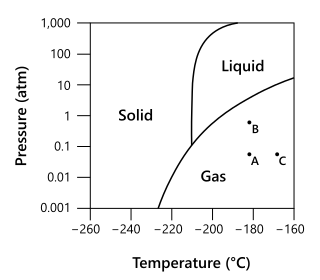
Consider the points labeled A, B, and C on the diagram. How would the volume of a quantity of gas at the temperature and pressure indicated at points B and C compare to the volume of the same quantity of gas at the temperature and pressure indicated at point A?
3. Read the passage below before answering the question:
Read Passage| Water Temperature (°C) | Required Time for Tablet to Dissolve (Seconds) |
|---|---|
| 10 | 184 |
| 20 | 132 |
| 30 | 91 |
| 40 | 63 |
Based on the results, if the researchers repeated the experiment using water at 35°C, the tablet would most likely dissolve in:

ACT Online Prep Course
If you want to be fully prepared, Mometrix offers an online ACT prep course designed to give you everything you need to succeed!
Here’s what you’ll find in the ACT course:
- 80+ Review Lessons Covering Every Topic
- Over 1,150 ACT Practice Questions
- 350+ Digital Flashcards
- 310+ Instructional Videos
- Money-back Guarantee
- Mobile Access
Everyone learns differently, so we’ve tailored the ACT online prep course to ensure every learner has what they need to prepare for the ACT exam.
Click below to check it out!
FAQs
Q
How many science questions are on the ACT?
A
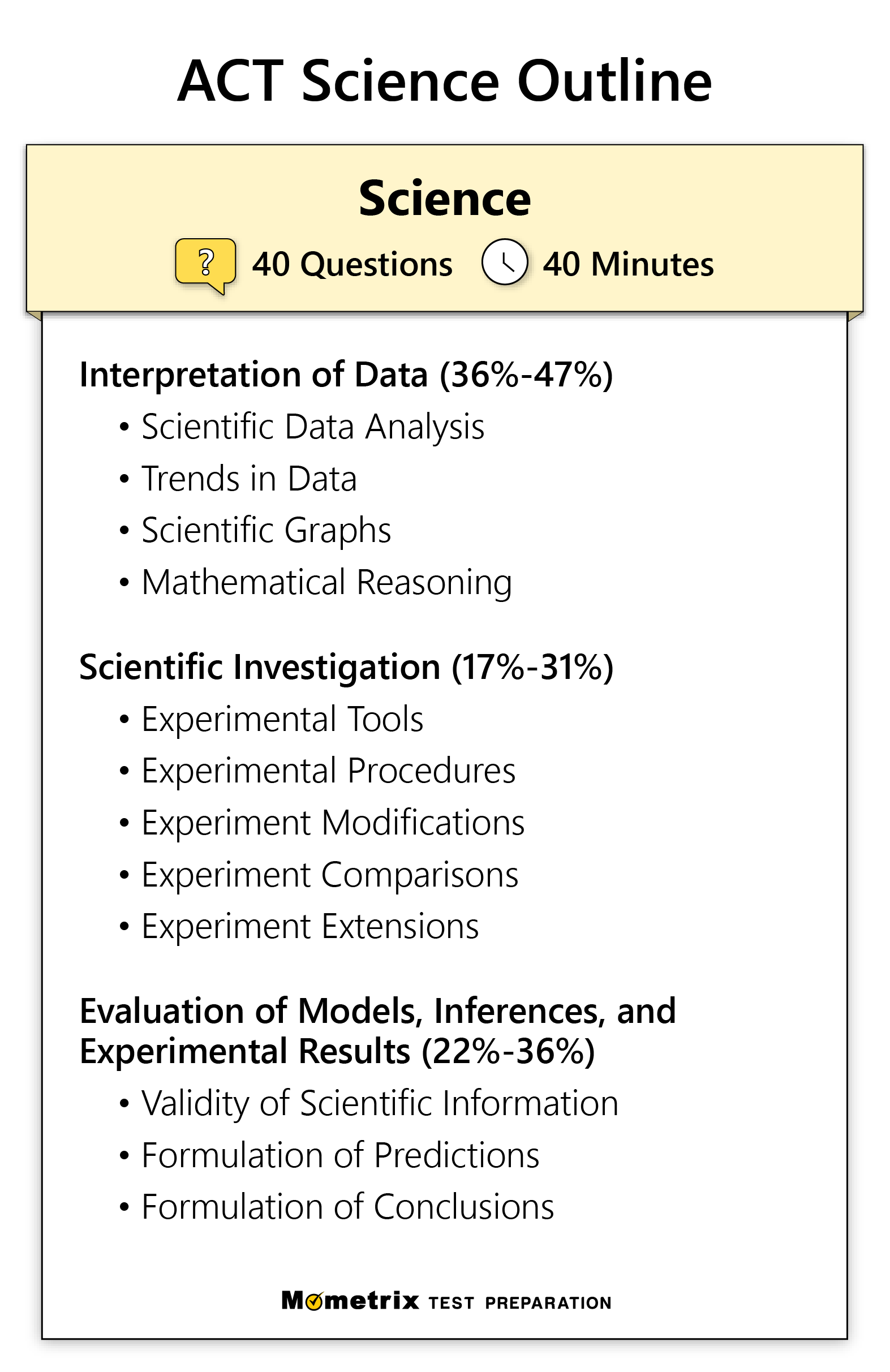
There are 40 questions on the Science section of the ACT.
Q
How long is the Science section of the ACT?
A
The Science section is timed at 40 minutes.
Q
What is a passing score on the ACT Science section?
A
There is no set passing score for the Science section of the ACT. However, a score of at least 21 is generally recommended.


ACT® is a registered trademark belonging to ACT Education Corp. (“ACT”). ACT is not involved with or affiliated with Mometrix Media LLC, nor does ACT endorse or sponsor any of the products or services offered by Mometrix Media LLC.