The PSAT/NMSQT® (Preliminary SAT/National Merit Scholarship Qualifying Test) helps students prepare for the SAT® and serves as the qualifying test for entry into the National Merit Scholarship Program. It is cosponsored by College Board and National Merit Scholarship Corporation.
This page explains what the PSAT/NMSQT covers, how the digital test works, how to register, and how to understand your scores.
What is the PSAT?
The PSAT/NMSQT measures reading, writing, and math skills and is commonly taken by 10th- and 11th-grade students. It helps you identify academic strengths and areas to improve as you prepare for the SAT.
The test is taken digitally using College Board’s Bluebook testing app. Each section has two modules, and your performance on the first module determines the difficulty of the second module.
PSAT Outline
The PSAT/NMSQT contains a total of 98 questions and has a time limit of 134 minutes (2 hours and 14 minutes).
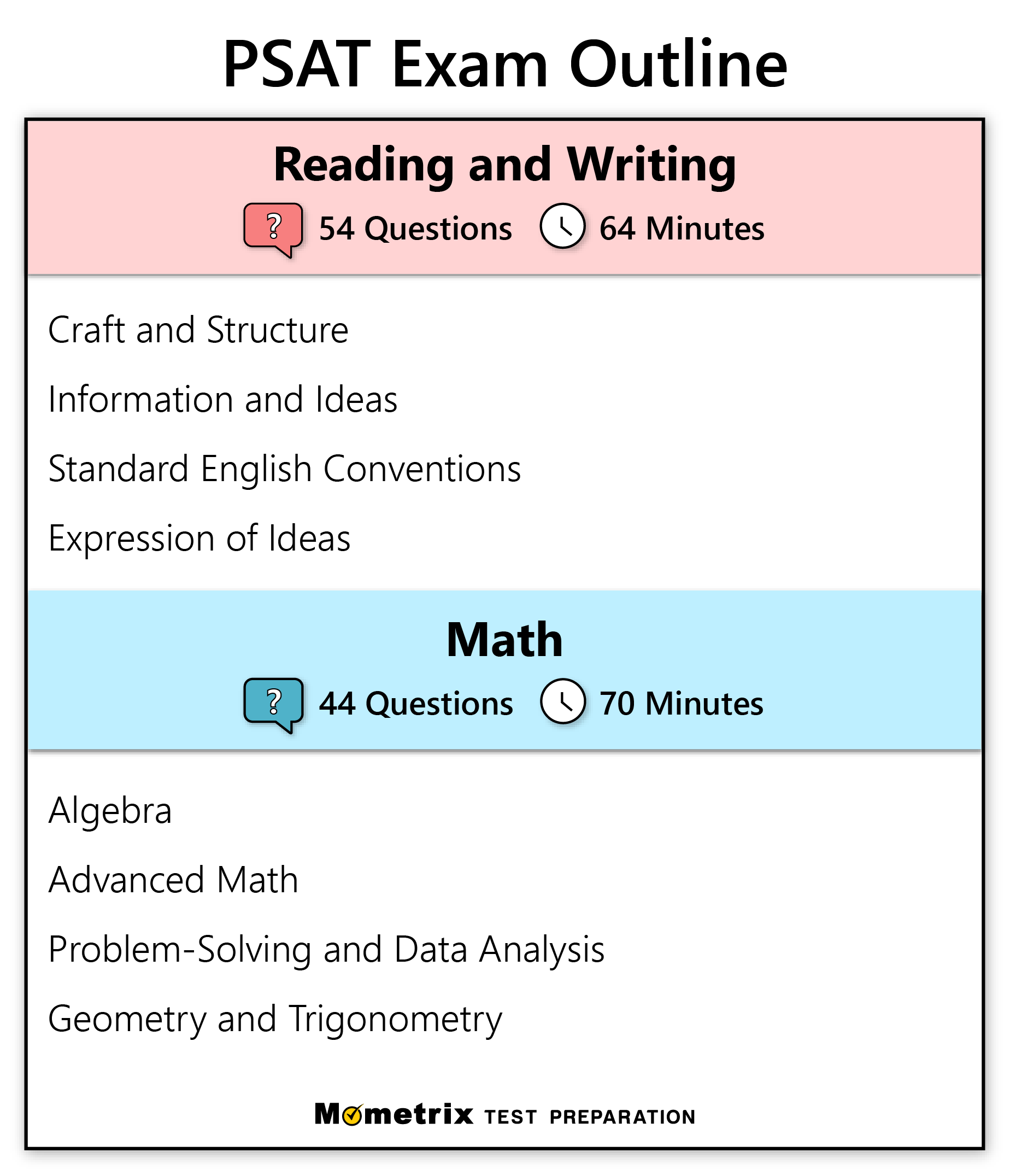
The test is split into two sections:
Reading and Writing
The Reading and Writing section contains 54 multiple-choice questions divided into two modules of 27 questions each. You will have 32 minutes per module, for a total of 64 minutes.
Questions use short passages or passage pairs drawn from literature, history/social studies, the humanities, and science. Each passage or passage pair is followed by a single question. Some questions also include an informational graphic, such as a table or graph.
This section will evaluate your skills in the following four categories:
- Craft and Structure: This category focuses on your ability to analyze, comprehend, and synthesize text, as well as your reasoning skills and vocabulary knowledge.
- Information and Ideas: This category focuses on your ability to evaluate central details and ideas, make inferences, and wield evidence found in tables, graphs, and texts.
- Standard English Conventions: This category focuses on your text editing skills. Specifically, you will be tested on your knowledge of English sentence structure, usage, and punctuation.
- Expression of Ideas: This category focuses on your ability to revise and improve the effectiveness of a text.
Math
The Math section contains 44 questions, which are divided into two modules, and you will be given a time limit of 70 minutes. You will be able to use a calculator throughout the entire Math section, whether it’s the provided digital calculator or an approved physical calculator.
The questions are grouped into four domains.
- Algebra: This domain focuses on the mastery of linear equations, systems of linear equations, and functions. These questions will evaluate your ability to represent situations through equations and solve them, as well as make connections between different representations of linear relationships.
- Advanced Math: This domain focuses on your skills and abilities regarding absolute value, equivalent expressions, and nonlinear functions.
- Problem Solving and Data Analysis: This domain focuses on analyzing problems and drawing information from data. These questions include using ratios, percentages, and statistical analysis to assess a practical command of math applied to real-world situations.
- Geometry and Trigonometry: This domain focuses on your ability to solve geometric problems. You will be tested on your knowledge of area, volume, circles, right triangles, and lines.
Check Out Mometrix's PSAT Study Guide!
Get practice questions, video tutorials, and detailed study lessons.
PSAT vs. SAT vs. ACT
The PSAT, SAT, and ACT are each used to help you get into college, but there are some notable differences among them.
Wondering which test is right for you? Take a look at the details of each exam here:
| Testing Time | ||
|---|---|---|
| PSAT | SAT | ACT |
2 hours and 14 minutes | 2 hours and 14 minutes | 2 hours and 5 minutes |
| Question Count | ||
|---|---|---|
| PSAT | SAT | ACT |
98 | 98 | 171, including the Science section |
| Test Structure | ||
|---|---|---|
| PSAT | SAT | ACT |
Sections: 2
| Sections: 2
| Sections: 3 required, plus 2 optional
|
| Testing and Registration | ||
|---|---|---|
| PSAT | SAT | ACT |
Test dates: Annually in October Registration: Handled by the school | Test dates: Set by the College Board Registration: Online | Typical test months:
Registration: Online and by mail |
| Cost | ||
|---|---|---|
| PSAT | SAT | ACT |
Fee: $18 Fee waiver: Yes, for eligible low-income students | Fee: $68 Fee waiver: Subject to region | Fee: $70 (+$25 for writing, +$5 for science) Fee waiver: Yes |
How to Register
The PSAT/NMSQT is offered during an October testing window. Your school or district handles registration and chooses its testing date within that window. Ask your school counselor about sign-up instructions, deadlines, and any fee you will need to pay.
If you are homeschooled or need to test at another school in the United States, contact a participating school or district office at least four weeks before the testing window begins. Some schools require earlier arrangements. Confirm whether the school will provide a testing device or allow you to bring your own approved device.
Students requesting disability-related testing accommodations must receive approval from College Board’s Services for Students with Disabilities (SSD). Your school counselor or SSD coordinator can help submit the request by the applicable deadline.
If you plan to take the PSAT/NMSQT outside the United States, contact a local school offering the test at least six weeks before the testing window begins.
Test Day
What to Bring
Confirm your school’s device arrangements before test day. For digital testing, you will need:
- A fully charged, approved testing device with Bluebook installed.
- A power cord or portable charger. Access to an electrical outlet is not guaranteed.
- A pencil or pen for scratch work. Testing staff will provide scratch paper; do not bring your own.
- An approved calculator, if you prefer to use your own. A calculator is built into Bluebook, so a separate calculator is optional.
- An acceptable photo ID if you are homeschooled or testing at a school you do not normally attend.
If you have approved accommodations, prepare any required assistive technology in advance. Students approved for a screen reader or text-to-speech must bring wired, non-Bluetooth headphones or earbuds.
If you are a US student temporarily living abroad, also bring your US school’s code, name, and address, along with the name and address of the school where you are testing.
What NOT to Bring
Your approved testing device is permitted. Unless specifically allowed through approved accommodations, prohibited items include:
- Unauthorized electronics
- Electronic writing tools, such as styluses, Apple Pencils, and smart pens
- Books, notes, reference materials, dictionaries, and personal scratch paper
- Compasses, protractors, highlighters, and colored pencils
- Separate timers and watches that beep or have alarms
- Headphones, earbuds, and earplugs
- Prohibited calculators and detachable privacy screens
- Weapons or firearms
If you bring a phone, follow your school’s instructions for turning it in or storing it away. You may not access it during testing or breaks.
Scoring
Your overall score is composed of two section scores: your Reading and Writing score (composed of the Reading and Writing Test) and your Math score. The two section scores range from 160 to 760 and both of these sections contribute equally to your total overall score.
Scores are calculated first by whether they are correct or incorrect. When calculating your raw score, the difficulty level and other qualities of the questions, like how easy it is to guess a certain question or how well it can differentiate a person’s skill level, are also taken into account. All students have the same opportunity to demonstrate their strengths, as every test conforms to a standardized specification of question types and qualities.
PSAT Score Range
Your total PSAT/NMSQT score ranges from 320 to 1520. It is the sum of your Reading and Writing section score and your Math section score, each of which ranges from 160 to 760.
Your score report also includes percentiles, an NMSC Selection Index score, and a Knowledge and Skills section showing your performance across the test’s eight content areas. Use this information to identify strengths and choose areas for further study.
Check Out Mometrix's PSAT Flashcards!
Get complex subjects broken down into easily understandable concepts.

PSAT Online Prep Course
If you want to be fully prepared, Mometrix offers an online PSAT prep course designed to give you everything you need to succeed!
Here's what you'll find in the PSAT course:
- 60+ Review Lessons Covering Every Topic
- Over 950 PSAT Practice Questions
- 300+ Digital Flashcards
- 250+ Instructional Videos
- Money-back Guarantee
- Mobile Access
Everyone learns differently, so we've tailored the PSAT online prep course to ensure every learner has what they need to prepare for the PSAT exam.
Click below to check it out!
FAQs
Q
When do PSAT scores come out?
A
PSAT/NMSQT scores are typically available online 2–4 weeks after testing. Check College Board’s score release schedule for the release date associated with your testing date.
Q
What is a good PSAT score for a sophomore?
A
A good PSAT score is above the 75th percentile, or 1060, on average for students. However, any score higher than 1060 is considered to be an excellent PSAT score for a sophomore. Scores above 920 are okay, and those beyond 1180 indicate an outstanding score.
Q
What is the PSAT out of?
A
A perfect PSAT score is 1520, and the minimum score you can get is 320.
Q
What is a good PSAT score?
A
A good score to aim for is anything above 1000. The top 10% of test-takers score between 1250 and 1520.
Q
What is the PSAT?
A
The PSAT/NMSQT is a standardized test used to measure the reading, math, and writing skills of 11th-grade students as they prepare to go into college.
Q
How long is the PSAT?
A
The time limit for the test is 134 minutes, which is 2 hours and 14 minutes.
Q
What does PSAT stand for?
A
PSAT stands for Preliminary SAT (the term “SAT” is not short for anything).
Q
What is the average PSAT score?
A
The average score on the PSAT/NMSQT is 920.
Q
How many questions are on the PSAT?
A
There are 98 questions on the test.
Q
Is the PSAT easier than the SAT?
A
Yes, the PSAT/NMSQT is not quite as difficult as the SAT.
Q
How is the PSAT scored?
A
Your final PSAT/NMSQT score is based on two section scores: the Reading and Writing score and the Math score. Each section score will be between 160 and 760, which means the highest you can score on the PSAT is 1520.


PSAT/NMSQT® is a trademark registered by the College Board and the National Merit Scholarship Corporation, which are not affiliated with, and do not endorse, this page.