Click the “Start Test” above to start a free PSAT/NMSQT practice test with Reading, Writing, and Math questions! These questions will prepare you for the SAT® and help you compete for National Merit opportunities.

PSAT/NMSQT Practice Tests by Subject
If you need some extra practice in a specific subject, click one of the subjects below to get started on a subject-specific PSAT/NMSQT practice test.
Exam Outline
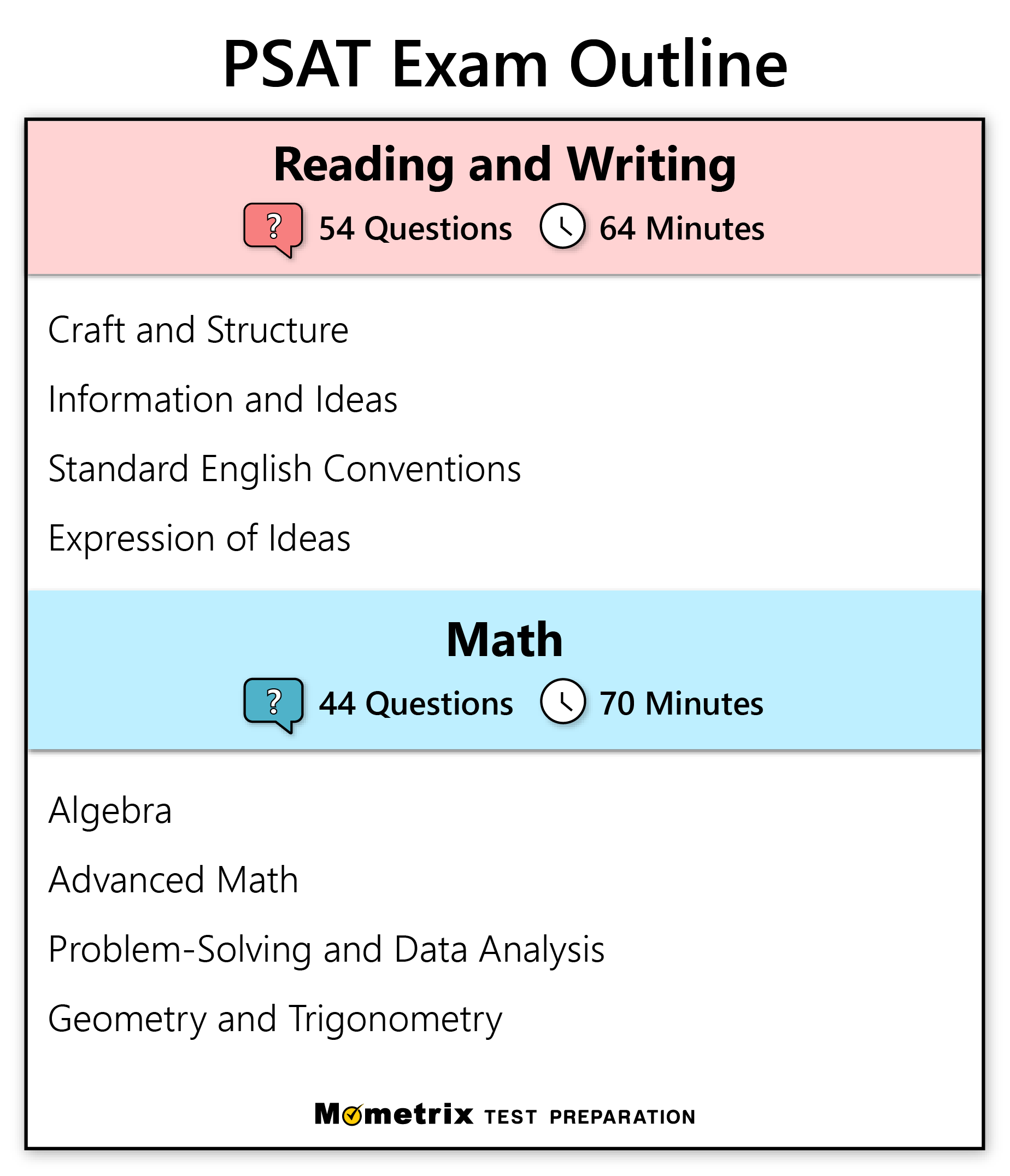
The PSAT/NMSQT contains a total of 98 questions/tasks and has a time limit of 134 minutes (2 hours and 14 minutes).
Here’s a quick look at what’s on the test:
Check Out Mometrix's PSAT Study Guide
Get practice questions, video tutorials, and detailed study lessons.
How to Study for the PSAT
Start with a PSAT Practice Test
Before creating your study schedule, take a PSAT practice test to establish a starting point. You don’t need to wait until you have reviewed every topic. At this stage, the goal is to identify where your preparation time will have the greatest effect.
Review your results by section and content area:
- Craft and Structure: Can you determine the meaning of words in context, analyze an author’s purpose or organization, and connect ideas from related texts?
- Information and Ideas: Can you identify central ideas, locate supporting evidence, interpret graphs and tables, and make reasonable inferences?
- Standard English Conventions: Do you need more practice with sentence boundaries, punctuation, agreement, verb forms, or other grammar rules?
- Expression of Ideas: Can you select effective transitions and improve how information is organized or presented?
- Algebra: Can you solve and interpret linear equations, inequalities, functions, and systems of equations?
- Advanced Math: Are you comfortable with nonlinear equations, equivalent expressions, quadratics, exponentials, polynomials, radicals, and rational expressions?
- Problem-Solving and Data Analysis: Can you work with ratios, rates, percentages, units, probability, statistics, tables, and data?
- Geometry and Trigonometry: Do you understand area, volume, angles, triangles, circles, and basic trigonometric relationships?
Identifying those specific weaknesses will show you where to devote more attention during your study time.
Review Difficult Questions
After each practice session, review every question you answered incorrectly AND every question you guessed on or answered with low confidence. Guessing correctly does not necessarily mean that you have mastered the skill.
For each difficult question, determine which of the following caused the problem:
- You did not understand the concept or rule being tested.
- You misread the passage, graph, table, or question.
- You selected an answer that sounded reasonable but was not fully supported.
- You relied on how a sentence sounded instead of applying a grammar rule.
- You made a calculation or algebra error.
- You used the calculator inefficiently or entered something incorrectly.
- You spent too much time trying to determine the answer.
Then, outline a specific plan for improvement based on what you discovered. In other words, don’t just say, “I need to study reading more.” Specify that you need to practice identifying the function of an underlined sentence, distinguishing claims from supporting evidence, or choosing transitions that correctly express contrast.
Similarly, replace “practice math” with a precise goal such as solving systems of equations, interpreting exponential functions, or converting units in word problems.
Utilize Answer Explanations
Answer explanations are an underutilized studying resource. To take full advantage of them, read the explanation for every question you found difficult, including questions you answered correctly.
For each one, make sure you can confidently explain:
- Why the correct answer is correct
- Why each incorrect option is wrong
- What rule, concept, or skill is being tested
- How the same skill might appear in a different question
For Reading and Writing questions, identify the exact word, sentence, or piece of data that supports the answer. Do not accept an answer merely because it seems logical or sounds more polished.
For Math questions, solve the problem again without copying the explanation. Check whether you can complete it manually and with the available calculator, then decide which method would be more efficient under timed conditions.
Study Concepts, Not Individual Questions
Memorizing the answer to a PSAT practice question will not prepare you for a new question testing the same skill with a different passage, equation, graph, or set of numbers. Your goal should be to recognize and apply the underlying skill to any question that asks you to use it.
For example, don’t memorize which transition completed one particular passage. Learn how transitions express relationships such as contrast, continuation, cause and effect, sequence, and examples.
Similarly, don’t memorize the steps used to solve one quadratic equation. Make sure you can recognize and solve quadratic equations presented in different forms, including equations, graphs, tables, and word problems.
The exact questions on your test will be different from the ones you encounter during practice. If you can explain a skill without looking at your notes and then apply it correctly to a new question, that is a good indication that you have mastered it.
Top 5 Most Challenging PSAT Questions
Now that you know how to approach practice tests, try your hand at some targeted practice on your own!
Over the last year, we’ve compiled the data from about 16,000 test-takers who tried their hand at the practice test at the top of this page. According to the data, around 85% of people answered these five questions incorrectly.
Answer each question and read through the answer explanation, whether you got the answer right or wrong. This will help you ensure you’ve got the topic mastered.
Whether you struggled with these questions or aced them on your first try, be sure to take the full practice test to get a better idea of how prepared you really are!

1. The half-life of caffeine in the human body is 5 hours. If Rafe drinks a cup of coffee at 7:00 a.m., what percentage of the caffeine is still in his system at 2:00 p.m.? Round your answer to the nearest whole percent.
\(\ln(0.5)=\ln(e^{\large{5k}}\normalsize{)}\)
\(\ln(0.5)=5k\)
\(k=\large{\frac{\ln(0.5)}{5}}\)
At 2:00 p.m., it has been 7 hours since Rafe drank the cup of coffee, so we can put that into the equation:\(y(7)=1e^{\large{k7}} \approx 0.379\)
This translates to 37.9%, or approximately 38%.2. In triangle ABC below, side \(AB=4x\) and side \(BC=6x-2\sqrt{2}\). What is the length of \(AC\)?
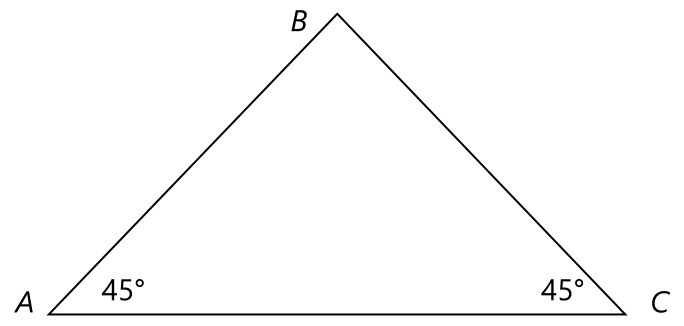
\(180-45-45=90\)
So, this is a 45-45-90 special triangle. The short legs are equal to each other, and the length of the hypotenuse is the length of a short leg times \(\sqrt{2}\).To find the short legs, set \(AB\) and \(BC\) equal to each other:
\(4x=6x-2\sqrt{2}\)
Subtract \(6x\) from both sides:\(-2x=-2\sqrt{2}\)
Finally, divide each side by −2:\(x=\sqrt{2}\)
We can plug this value into the equation for either leg to find that \(AB=4\sqrt{2}\). To find \(AC\), we multiply this by \(\sqrt{2}\):\(4\sqrt{2} \times \sqrt{2} = 4(2) = 8\)
Therefore, the length of \(AC\) is 8.3. Which choice completes the text below with the most logical transition?
Choice A would not be the best fit, as “Consequently, thanks to” implies a cause-and-effect relationship, which is not present in the sentence. Additionally, “thanks to” doesn’t create a smooth transition in this context. Choice B is inappropriate because “In contrast” introduces a comparison between contrasting ideas, which is not the purpose here. The focus of the passage is on the positive contributions of the Medici family and other important figures in Florence during the Italian Renaissance, and “In contrast” would go against this. Choice C is not ideal, as “For instance” is used when providing specific examples to support an idea, which is not relevant here.
4. Read the selections below before answering the question:
Based on the texts, what would the author of the first text most likely say in response to the claims made by the author of the second text?
Choice A is incorrect because the author of the first text has made it clear that he or she believes the ability to appropriately select a book must be developed by the child. Choice B is incorrect, as the author of the first text feels that book selection through critical thinking is a skill that is developed over time--not reached at a particular age. Choice C is also incorrect, as this would also remove individual student autonomy and the opportunity for children to use the aforementioned skills.
5. Which of the following is the solution to the inequality below?
\(2|x+3|-9\geq -1\)
\(2|x+3|\geq 8\)
Then, divide both sides by 2.\(|x+3|\geq 4\)
From here, separate the inequality into two inequalities to remove the absolute value, and solve each inequality.\(x+3 \geq 4\)
\(x \geq 1\)
\(-(x+3) \geq 4\)
\(x+3 \leq -4\)
\(x \leq -7\)
Because the absolute value inequality produces two separate solution regions, the solutions are \(x\leq -7\) or \(x \geq 1\).Check Out Mometrix's PSAT Flashcards
Get complex subjects broken down into easily understandable concepts.
PSAT Online Prep Course
If you want to be fully prepared, Mometrix offers an online PSAT prep course designed to give you everything you need to succeed!
Here’s what you’ll find in the PSAT course:
- 60+ Review Lessons Covering Every Topic
- Over 950 PSAT Practice Questions
- 300+ Digital Flashcards
- 250+ Instructional Videos
- Money-back Guarantee
- Mobile Access
Everyone learns differently, so we’ve tailored the PSAT online prep course to ensure every learner has what they need to prepare for the PSAT exam.
Click below to check it out!


PSAT/NMSQT® is a trademark registered by the College Board and the National Merit Scholarship Corporation, which are not affiliated with, and do not endorse, this page.
Affiliate disclosure: As an Amazon Associate, we may earn commissions from qualifying purchases from Amazon.com.