
Welcome to the ASVAB practice test page!
Click the “Start Test” button above to begin our free ASVAB practice test! These ASVAB practice questions will give you a better idea of what to study for your exam.
ASVAB Practice Tests by Subject
If you need some extra practice in a specific subject, click one of the subjects below to get started on a subject-specific ASVAB practice test.
Good luck with your studying!
ASVAB Scores Explained
Here’s a quick look at how ASVAB scores work:
- AFQT score: Used to help determine enlistment eligibility.
- AFQT subtests: Arithmetic Reasoning, Mathematics Knowledge, Paragraph Comprehension, and Word Knowledge.
- Percentile score: AFQT scores are reported from 1–99 and compare your performance with a reference group.
- Line/composite scores: Military branches use different score combinations to help determine job qualification.
This guide breaks down how ASVAB scores work, including AFQT scores, line/composite scores, and the way each military branch uses them to determine enlistment eligibility and job qualification!

Study Tips
Start with an ASVAB Practice Test
Before creating your study schedule, take an ASVAB practice test to establish a starting point. You don't need to wait until you have reviewed every topic. At this stage, the goal is to identify where your preparation time will have the greatest effect.
Review your results by subtest:
- Arithmetic Reasoning: Can you translate word problems into the correct calculations and work accurately with fractions, percentages, ratios, rates, and proportions?
- Mathematics Knowledge: Do you need more practice with algebra, equations, exponents, or geometry?
- Word Knowledge/Paragraph Comprehension: Can you determine word meanings from context, identify synonyms, locate important details, and understand the main point of a passage?
- General Science: Do you need to review temperature conversions, chemical elements, or molecular structure?
- Electronics, Auto, Shop, and Mechanical Information: Are you familiar with electrical principles, tools, automotive systems, and basic mechanical concepts?
- Assembling Objects: Can you determine how separate pieces will fit together or how an object will look once assembled?
Identifying those specific weaknesses will show you where to devote more attention during your study time.
Review Difficult Questions
After each practice session, review every question you answered incorrectly AND every question you guessed on or answered with low confidence. Guessing correctly does not necessarily mean that you have mastered the skill.
For each difficult question, determine which of the following caused the problem:
- You did not know the topic or concept.
- You knew the required math but could not translate the word problem.
- You overlooked a detail or context clue.
- You confused two technical terms or scientific principles.
- You had trouble visualizing how the pieces of an object fit together.
- You made a calculation error while working without a calculator.
- You spent too long trying to determine the answer.
- You selected an answer because it looked familiar without verifying that it was correct.
Then, outline a specific plan for improvement based on what you discovered. In other words, don't just say, “I need to study math more.” Note that you need to practice solving rate problems without a calculator or reviewing how to calculate the area and volume of common shapes.
Similarly, replace “study mechanical concepts” with a specific task such as reviewing gear direction, mechanical advantage, or the effects of friction.
Utilize Answer Explanations
Answer explanations are an underutilized studying resource. To take full advantage of them, read the explanation for every question you found difficult, including questions you answered correctly.
For each one, make sure you can confidently explain:
- Why the correct answer is correct
- Why each incorrect option is wrong
- What rule, concept, or skill is being tested
- How the same skill might appear in a different question
For math questions, be sure to complete every calculation by hand, since calculators are not allowed on the ASVAB. For science and technical questions, explain the relevant process or principle in your own words.
Study Concepts, Not Individual Questions
Memorizing the answer to an ASVAB practice question will not prepare you for a new question testing the same skill with a different passage, equation, graph, or set of numbers. Your goal should be to recognize and apply the underlying skill to any question that asks you to use it.
For example, don't memorize only that one gear turned clockwise. Learn how connected gears interact so that you can determine the direction of any gear in a different arrangement.
Similarly, learning the definition of one vocabulary word is useful, but recognizing roots, prefixes, suffixes, and context clues will help you answer unfamiliar Word Knowledge questions.
The exact questions on your test will be different from the ones you encounter during practice. If you can explain a skill without looking at your notes and then apply it correctly to a new question, that is a good indication that you have mastered it.
Check Out Mometrix's ASVAB Printed Study Guide!
Get practice questions, video tutorials, and detailed study lessons.
ASVAB Checklists
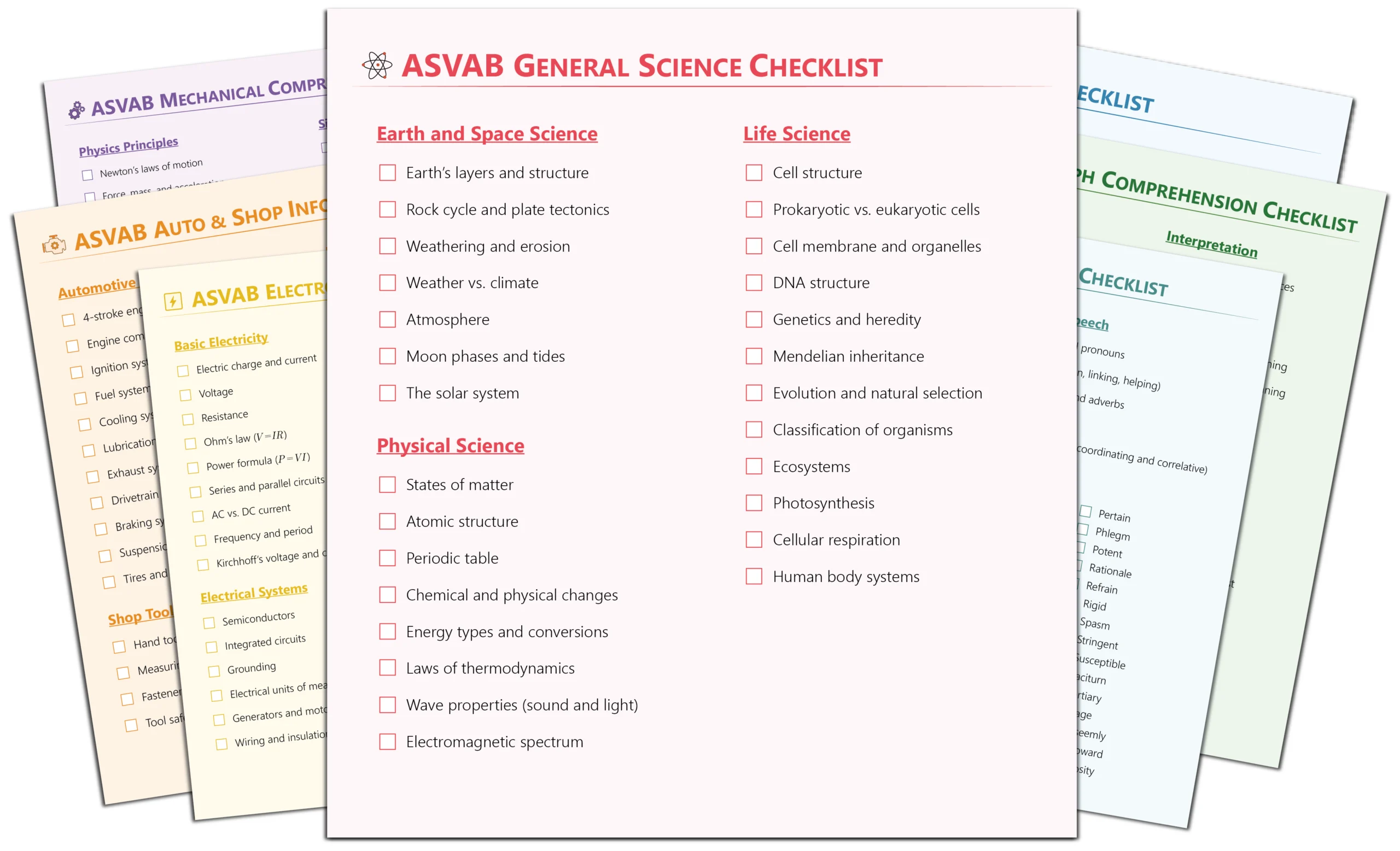
Knowing exactly what to spend your time studying isn't always easy. To help you study effectively and efficiently, we've compiled a free checklist that breaks down the essential topics you need to cover for each section of the exam, making it easy to track your progress!
Click below to start keeping track of your progress and focusing your studying on the topics that really matter.
Top 5 Most Challenging ASVAB Questions
Now that you know how to approach practice tests, try your hand at some targeted practice on your own!
Over the last year, we've compiled the data from about 30,000 test-takers who tried their hand at the practice test at the top of this page. According to the data, around 75% of people answered these five questions incorrectly.
Answer each question and read through the answer explanation, whether you got the answer right or wrong. This will help you ensure you've got the topic mastered.
Whether you struggled with these questions or aced them on your first try, be sure to take the full practice test to get a better idea of how prepared you really are!

1. Which of the following is the most likely pH of a solution containing many hydroxide ions OH- and few hydrogen ions H+?
2. What is the total power of a circuit with a current of 4 A and a resistance of 3 Ω?
\(P=(4^2)(3)\)
Thus, \(P=48text{ W}\).3. If work is force multiplied by displacement (commonly known as distance), which of the following is NOT an acceptable unit of measure for work?
Force can be further broken down into its formula, \(F=mtimes a\). The units of mass (\(m\)) are kilograms (kg) and acceleration (\(a\)) is measured in \(text{m} / text{s}^2\). Acceptable representations for units of work include \(Ncdot m\) and \(text{kg}cdot text{m}^2 / text{s}^2\). Joules (J) are the most common unit used to measure work.
4. A spark plug is most closely related to a(n) ___________.
5. Which of the following is the least likely sign of catalytic converter trouble?

ASVAB Online Prep Course
If you want to be fully prepared, Mometrix offers an online ASVAB prep course designed to give you everything you need to succeed!
Here's what you'll find in the ASVAB course:
- 100+ Review Lessons Covering Every Topic
- Over 1,550 ASVAB Practice Questions
- 300+ Digital Flashcards
- 290+ Instructional Videos
- Money-back Guarantee
- Mobile Access
Everyone learns differently, so we've tailored the ASVAB online prep course to ensure every learner has what they need to prepare for the ASVAB exam.
Click below to check it out!
Check Out Mometrix's ASVAB Flashcards!
Get complex subjects broken down into easily understandable concepts.

FAQs
Q
What is the ASVAB test?
A
The ASVAB is a multiple-choice test taken by over 1 million high-school students and post-high-school students in order to evaluate their suitability for enlistment in the US military.
Q
What's on the ASVAB?
A
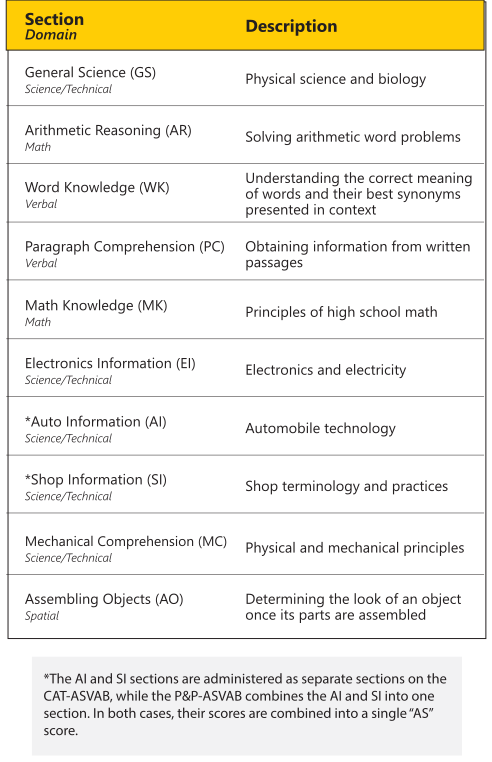
The ASVAB contains 10 sections, listed here in order of administration:
- General Science (GS)
- Arithmetic Reasoning (AR)
- Word Knowledge (WK)
- Paragraph Comprehension (PC)
- Math Knowledge (MK)
- Electronics Information (EI)
- Auto Information (AI)
- Shop Information (SI)
- Mechanical Comprehension (MC)
- Assembling Objects (AO)
Q
How many questions are on the ASVAB?
A
The computerized enlistment ASVAB (CAT-ASVAB) includes 135 scored questions, plus unscored tryout questions in selected subtests. The paper-and-pencil enlistment version contains 225 questions.
Q
What does ASVAB stand for?
A
ASVAB stands for Armed Services Vocational Aptitude Battery.
Q
What is a good ASVAB score?
A
A good target score depends on your military branch, education level, and desired job. Your AFQT percentile helps determine enlistment eligibility, while branch-specific line or composite scores help determine job qualification. Confirm the current requirements for your situation with a recruiter, and aim for the scores needed for the job you want.
Q
How long is the ASVAB?
A
The CAT-ASVAB has separate time limits for each subtest, with additional time provided when tryout questions are included. Most examinees finish in about two hours. The paper-and-pencil enlistment version provides 149 minutes of testing time; the full session, including instructions and administrative tasks, generally takes three to four hours.
Q
Is the ASVAB hard?
A
Overall, the ASVAB is not considered to be a difficult exam to pass, especially if you take the initiative to study well beforehand.
Q
What jobs do I qualify for with my ASVAB score?
A
Depending on which branch of service you wish to be a part of, there are over 480 jobs you may qualify for.
We’ve compiled every available job that the US Army has to offer and listed which ASVAB/AFQT scores you need in order to qualify for each one in a free PDF, which you can download by clicking the button below!
Q
Can you use a calculator on the ASVAB?
A
No, test-takers are not permitted to use a calculator during the exam. This means you’ll need to become familiar with many formulas and expressions. Check out this free ASVAB math cram sheet to get started!
Q
How many times can you take the ASVAB?
A
If you wish to retake the ASVAB, you must wait one calendar month after your initial testing. You must wait another calendar month for a third testing, and you must then wait six calendar months to take the test a fourth time.
Q
How is the ASVAB scored?
A
You receive Standard Scores for the individual ASVAB subtests. Scores from Arithmetic Reasoning, Mathematics Knowledge, Word Knowledge, and Paragraph Comprehension are used to calculate your AFQT percentile, which ranges from 1 to 99 and helps determine enlistment eligibility. Military branches also use line or composite scores to determine job qualification.


Mometrix Test Preparation is not affiliated with or endorsed by any official testing organization. All organizational and test names are trademarks of their respective owners.
Affiliate disclosure: As an Amazon Associate, we may earn commissions from qualifying purchases from Amazon.com.