Welcome to the TSI practice test page!
Click the “Start Test” button above to begin your free TSI practice test! These TSIA2 practice questions will give you a better idea of what to study for your exam.
TSI Question of the Day
TSI Practice Tests by Subject
If you need some extra practice in a specific subject, click one of the subjects below to get started on a subject-specific TSI practice test.
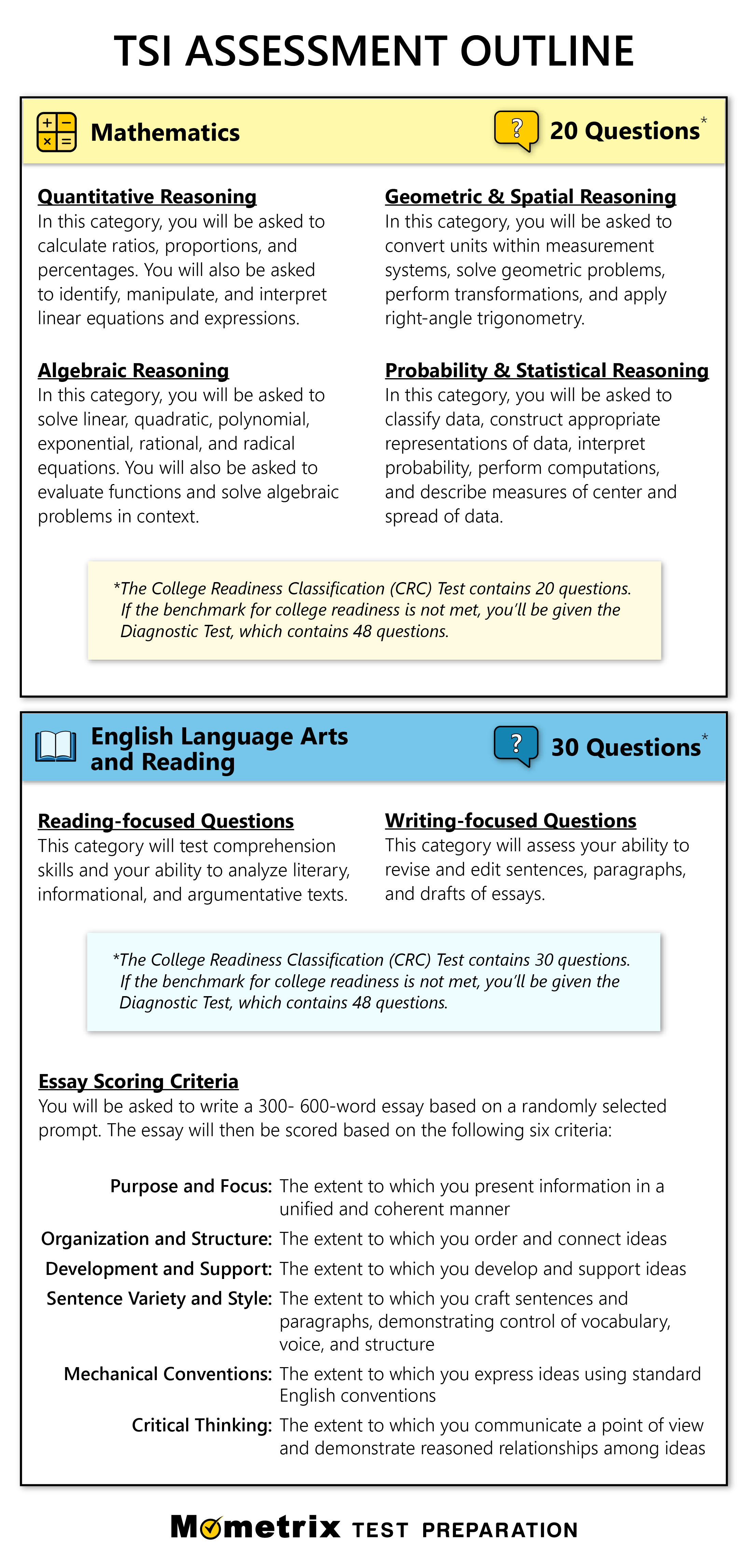
TSIA2 Outline
The TSIA2 includes two computer-adaptive multiple-choice assessments: Mathematics and English Language Arts and Reading (ELAR). The ELAR assessment also includes an essay.
You will first take a College Readiness Classification test in each applicable subject. If you don’t meet the college-readiness benchmark, you’ll then take a Diagnostic Test in that subject. The Diagnostic Test provides another opportunity to demonstrate college readiness while identifying specific academic strengths and areas that may need improvement.
Check Out Mometrix's TSI Study Guide
Get practice questions, video tutorials, and detailed study lessons
Get Your Study Guide
Practice the Best Way
Start with a TSI Practice Test
Before creating your study schedule, take a TSIA2 practice test to establish a starting point. You don’t need to wait until you have reviewed every topic. At this stage, the goal is to identify where your preparation time will have the greatest effect.
Review your results by section and content area:
- Quantitative Reasoning: Can you work with ratios, proportions, percentages, rational and irrational numbers, and linear expressions and equations?
- Algebraic Reasoning: Can you solve equations, inequalities, and systems and work with linear, quadratic, polynomial, exponential, rational, and radical expressions and functions?
- Geometric and Spatial Reasoning: Can you convert measurements, calculate perimeter, area, surface area, and volume, apply transformations, and use right-triangle relationships?
- Probabilistic and Statistical Reasoning: Can you interpret data, select appropriate representations, calculate measures of center and spread, and solve probability problems?
- Reading: Can you identify central ideas, locate supporting evidence, make reasonable inferences, compare paired passages, and interpret words in context?
- Writing and Editing: Can you revise sentences, paragraphs, and early essay drafts for organization, development, clarity, grammar, usage, and punctuation?
Identifying those specific weaknesses will show you where to devote more attention during your study time.
Review Difficult Questions
After each practice session, review every question you answered incorrectly AND every question you guessed on or answered with low confidence. Guessing correctly does not necessarily mean that you have mastered the skill.
For each difficult question, determine which of the following caused the problem:
- You didn’t understand the underlying concept.
- You misread a passage, sentence, graph, table, or question.
- You selected an answer that sounded reasonable but wasn’t supported by the text.
- You confused the central idea with a supporting detail.
- You made an inference that went beyond the available evidence.
- You corrected one writing problem while creating another.
- You selected the wrong operation, equation, or mathematical strategy.
- You answered too quickly.
- You spent excessive time second-guessing a reasonable answer.
Then, outline a specific plan for improvement based on what you discovered. In other words, don’t just say, “I need to study reading.” Note that you need to practice identifying evidence for an inference, comparing the claims made in paired passages, or determining how one paragraph supports an argument.
Similarly, replace “review algebra” with an action such as solving systems of linear equations, evaluating functions, factoring quadratic expressions, or interpreting exponential growth in context.
Utilize Answer Explanations
Answer explanations are an underutilized studying resource. To take full advantage of them, read the explanation for every question you found difficult, including questions you answered correctly.
For each one, make sure you can confidently explain:
- Why the correct answer is correct
- Why each incorrect option is wrong
- What rule, concept, or skill is being tested
- How the same skill might appear in a different question
For Reading questions, return to the passage and identify the exact wording that supports the answer. Separate what the text states or reasonably implies from assumptions based on your own experiences or knowledge.
For essay practice, do not evaluate your response only for grammar and spelling. The essay must present a coherent response to the assigned issue, develop its ideas, and show reasoned relationships among those ideas.
Study College-Readiness Skills, Not Individual Questions
Memorizing the answer to one TSI practice question will not prepare you for another question that uses a different passage, sentence, graph, equation, or set of values. Your goal should be to understand and apply the underlying skill.
For example, don’t study grammar as a disconnected list of rules. Connect sentence-level decisions to the larger purpose of the passage. A sentence may be grammatically correct but still be repetitive, misplaced, vague, irrelevant, or poorly connected to the surrounding ideas.
Similarly, don’t memorize formulas without understanding what each variable represents, which units are required, how the quantities are related, and how changing one value affects the others.
The exact questions on your test will be different from the ones you encounter during practice. If you can explain a skill without looking at your notes and then apply it correctly to a new question, that is a good indication that you have mastered it.
Top 4 Most Challenging TSI Questions
Now that you know how to approach practice tests, try your hand at some targeted practice on your own!
Over the last year, we’ve compiled the data from about 4,000 test-takers who tried their hand at the practice test at the top of this page. According to the data, around 70% of people answered these four questions incorrectly.
Answer each question and read through the answer explanation, whether you got the answer right or wrong. This will help you ensure you’ve got the topic mastered.
Whether you struggled with these questions or aced them on your first try, be sure to take the full practice test to get a better idea of how prepared you really are!

1. In a game of chance, three dice are thrown at the same time. What is the probability that all three will land on a 6?
\(P=\dfrac{1}{6}\times\dfrac{1}{6}\times\dfrac{1}{6}=\dfrac{1}{6^3}=\dfrac{1}{216}\)
Therefore, the probability that all three dice will land on a 6 is \(\frac{1}{216}\).2. A colony of Escherichia coli is inoculated from a Petri dish into a test tube containing 50 mL of nutrient broth. The test tube is placed in a 37°C incubator and agitator. After one hour, the number of bacteria in the test tube is determined to be \(8\times 10^6\).
Given that the doubling time of Escherichia coli is 20 minutes with agitation at 37°C, approximately how many bacteria should the test tube contain after eight hours of growth?
\(a(2)^x = y\)
\(a(2)^3 = 8 \times 10^6\)
\(8a = 8 \times 10^6\)
\(a = 10^6\)
So, the number of bacteria originally transferred into the petri dish was \(10^6\).The equation for determining the number of bacteria is \(y = 2^x \times 10^6\). Since the bacteria double every twenty minutes, they go through three doubling times every hour. So, when the bacteria are allowed to grow for eight hours, they will have gone through \(8\times 3=24\) doubling times. When \(x = 24\):
\(y = (2)^{24} \times 10^6 = 16{,}777{,}216 \times 10^6\)
This is approximately \(1.7\times 10^{13}\).3. What is the surface area of a cube, in square inches, if the length of one side of the cube is 3 inches?
\(A=6\times 3^2=6\times 9=54\)
Therefore, the surface area of the cube is 54 in2.4. Consider the following sentence:
Mitosis is the process of cell division; if there are errors during this process, it can result in serious complications.
Select the best version of the underlined portion.
Resources for High School Students
Get expert tips on acing college applications, preparing for tests, managing finances, and navigating college life.
Your guide to success starts here:

TSI (TSIA2) Online Prep Course
If you want to be fully prepared, Mometrix offers an online TSI prep course designed to give you everything you need to succeed!
Here’s what you’ll find in the TSI course:
- 100+ Review Lessons Covering Every Topic
- Over 1,500 TSI Practice Questions
- 500+ Digital Flashcards
- 250+ Instructional Videos
- Money-back Guarantee
- Mobile Access
Everyone learns differently, so we’ve tailored the TSI online prep course to ensure every learner has what they need to prepare for the TSIA2 exam.
Click below to check it out!
Check Out Mometrix's TSI Assessment Flashcards
Get complex subjects broken down into easily understandable concepts
Get Your Flashcards
FAQs
Q
Is the TSI (TSIA2) required?
A
Typically, yes. Most students must satisfy TSI requirements before entering a public college in Texas. However, some students may qualify for an exemption based on approved test scores, prior coursework, certain enrollment programs, military service, or other criteria.
Q
How much does it cost to take the TSIA2?
A
TSIA2 fees vary by college and testing center, so there is no single statewide testing fee.
Q
Can you use a calculator on the TSIA2?
A
An on-screen calculator is available for certain math questions, but not every question. Depending on the problem, the test may provide a basic, square-root, or graphing calculator.
Q
Is the TSIA2 timed?
A
The TSIA2 assessments are untimed, so there is no official limit on how long you may spend testing. However, the essay must be started and completed during the same testing session.
Q
What scores do you need to be considered college-ready on the TSIA2?
A
For Mathematics, you must score at least 950 on the CRC test or score below 950 with a Diagnostic Test level of 6. For ELAR, you must score at least 945 with an essay score of 5 or higher, or score below 945 with a Diagnostic Test level of 5 or 6 and an essay score of 5 or higher.


Mometrix Test Preparation is not affiliated with or endorsed by any official testing organization. All organizational and test names are trademarks of their respective owners.