The SAT® is considered a college readiness test, assessing the knowledge and skills necessary to succeed in an undergraduate program. Many colleges require SAT scores, while others consider them optional or use them as part of a broader admissions review.
Take a free SAT practice test by clicking above!
SAT Practice Tests by Subject
If you need some extra practice in a specific subject, click one of the subjects below to get started on subject-specific SAT practice questions.
What’s on the SAT?
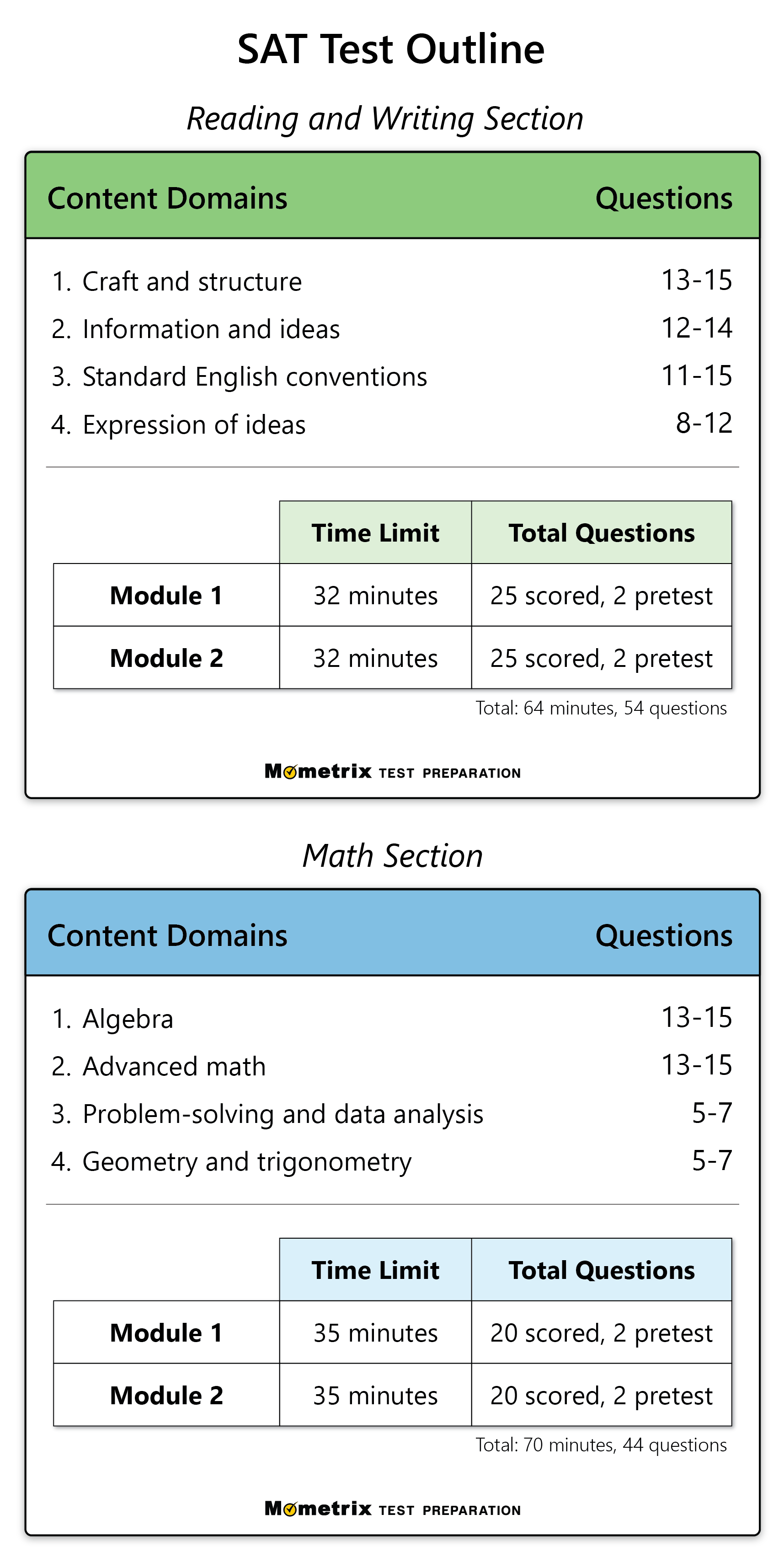
The SAT is split into two tests: a reading and writing test and a math test. There are a total of 98 questions on the SAT, most of which are multiple-choice questions, and you are given 134 minutes to finish the test.
Here’s a quick breakdown of the SAT:
Reading and Writing
This section contains 54 questions covering four main topics:
- Information and ideas
- Craft and structure
- Expression of ideas
- Standard English conventions
Part of the craft and structure element is knowing vocabulary words, ensuring that you understand and can use high-utility words in context and make connections between related texts. Get a head start on boosting your vocabulary by checking out the top 50 SAT vocab words below:
Math
This section contains 44 questions covering four main topics:
- Algebra
- Advanced Math
- Problem-solving and data analysis
- Geometry and trigonometry
You will have access to a calculator and reference sheet with commonly used formulas for all math questions.
Check Out Mometrix's SAT Study Guide
Get practice questions, video tutorials, and detailed study lessons
Get Your Study Guide
Top 5 Most Challenging SAT Questions
Now that you know more about the test, try your hand at some targeted practice!
Over the last year, we’ve compiled the data from about 22,000 test-takers who tried their hand at the practice test at the top of this page. According to the data, around 70% of people answered these five questions incorrectly.
Answer each question and read through the answer explanation, whether you got the answer right or wrong. This will help you ensure you’ve got the topic mastered.
Whether you struggled with these questions or aced them on your first try, be sure to take the full practice test to get a better idea of how prepared you really are!
1. Nurseries A, B, and C offer various plants for sale, as well as landscaping services to plant the trees and bushes. Prices are listed in the table below.
| A | B | C | |
|---|---|---|---|
| Trees | $25 | $30 | $20 |
| Bushes | $15 | $20 | $15 |
| Landscaping (per hour) | $45 | $55 | $50 |
Isabella plans to hire one of the companies to plant 10 trees and 8 bushes. This project will take \(x\) hours. Which of the following inequalities represents \(x\) if Nursery A offers a better deal than Nursery C?
We can calculate the cost of each nursery’s trees and bushes.
Nursery A’s cost is:
\(25(10)+15(8)=250+120=$370\)
Nursery C’s cost is:
\(20(10)+15(8)=200+120=$320\)
So, we can set up an inequality, letting \(x\) be the number of hours to plant the bushes and trees. For Nursery A’s services to be a better deal, they must cost less than Nursery C’s:
\(370+45x \lt 320+50x\)
We solve for \(x\) by subtracting \(45x\) and 320 from each side:
\(50 \lt 5x\)
We rewrite this as \(5x \gt 50\) and divide each side by 5 to obtain \(x \gt 10\).
The relationship stays the same; we are only rewriting the inequality with the variable on the left.
2. The equation below shows Emma’s savings plan. She set aside an initial lump sum and adds to it on a monthly basis. If \(i\) is the total investment in cents and \(m\) is the number of months since she began, how much does she save each month in dollars?
\(\text{investment}=(\text{initial lump sum})+4{,}500\times (\text{number of months since beginning})\)
In other words, it grows 4,500 cents every month. The answer choices are in dollars, so we divide by 100 to obtain $45 per month.
3. Which choice completes the text so that it conforms to the conventions of Standard English?
Never, never marry, my dear fellow! That’s my ________ marry till you can say to yourself that you have done all you are capable of, and until you have ceased to love the woman of your choice and have seen her plainly as she is, or else you will make a cruel and irrevocable mistake.
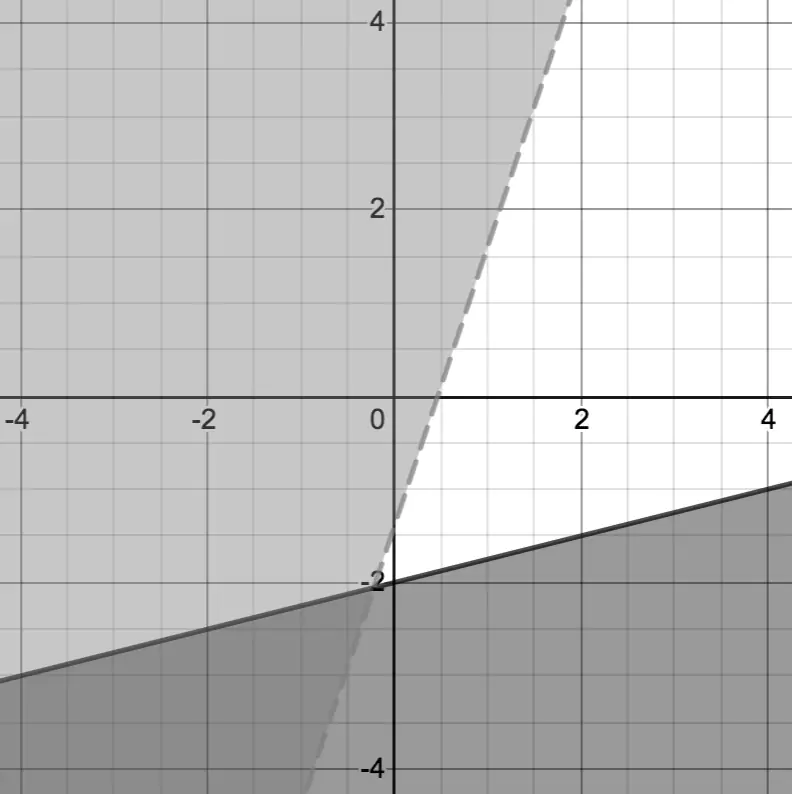
4. The graph of the system of inequalities \(y \leq \frac{1}{4}x-2\) and \(y \gt 3x-\frac{7}{5}\) has solutions in which quadrants on the \(xy\)-plane below?
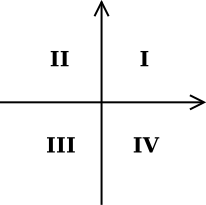
For the first equation, the \(y\)-intercept is −2, so we plot the point \((0,-2)\). Then, we use the slope \(\frac{1}{4}\) to plot another point by moving up one and four to the right, to \((4,-1)\). Now we can draw a line passing through the two points. It is a solid line because the solution is less than or equal to the equation.
Next, we graph the second line. The \(y\)-intercept is \(-\frac{7}{5}\), so we plot the point to \((0,-\frac{7}{5})\). Then, we use the slope 3 to plot another point by moving up three and over one, to \((1,\frac{8}{5})\). Now we can draw a line passing through the two points. It is a dotted line because the solution is greater than the equation.
We shade the area that is both below the graph of the first line and above the graph of the second line. When we do this, we can see that the overlap of the shaded area is only in quadrant 3.
5. Which choice completes the text so that it conforms to the conventions of Standard English?
The balcony scene in William Shakespeare’s Romeo and Juliet is one of the most iconic moments in literature. As Romeo stands in the Capulets’ garden, he overhears Juliet confessing her love for him. The scene is ______ exploration of the intensity of young love as Romeo and Juliet declare their feelings for each other in poetic language. The balcony scene captures the passion, secrecy, and longing that define the love story of Romeo and Juliet, making it a cornerstone of Shakespearean tragedy.
How to Study for the SAT
Start with an SAT Practice Test
Before creating your study schedule, take an SAT practice test to establish a starting point. You don’t need to wait until you have reviewed every topic. At this stage, the goal is to identify where your preparation time will have the greatest effect.
Review your results by section and content area:
- Reading and Writing: Do you struggle with identifying main ideas, interpreting words in context, connecting ideas, improving the organization of a passage, or applying grammar and punctuation rules?
- Math: Do you need more work with algebra, advanced math, data analysis, geometry, or trigonometry?
Identifying those specific weaknesses will show you where to devote more attention during your study time.
Review Difficult Questions
After each practice session, review every question you answered incorrectly AND every question you guessed on or answered with low confidence. Guessing correctly does not necessarily mean that you have mastered the skill.
For each difficult question, determine which of the following caused the problem:
- You did not understand the concept or rule being tested.
- You misread the passage, graph, table, or question.
- You selected an answer that sounded reasonable but was not fully supported.
- You made a calculation or algebra error.
- You used the calculator inefficiently or entered something incorrectly.
- You spent too much time trying to determine the answer.
Then, outline a specific plan for improvement based on what you discovered. In other words, don’t just say, “I need to study math more.” Specify that you need to practice solving systems of equations, interpreting exponential functions, or answering geometry questions involving circles.
For the Reading and Writing section, replace a general goal such as “study grammar” with something more useful, like reviewing sentence boundaries, transitions, or subject-verb agreement.
Utilize Answer Explanations
Answer explanations are an underutilized studying resource. To take full advantage of them, read the explanation for every question you found difficult, including questions you answered correctly.
For each one, make sure you can confidently explain:
- Why the correct answer is correct
- Why each incorrect option is wrong
- What rule, concept, or skill is being tested
- How the same skill might appear in a different question
For Reading and Writing questions, identify the exact wording, evidence, or grammar rule that supports the answer. An answer should not be considered correct merely because it “sounds better.”
For Math questions, work through the complete solution again without copying the explanation. Make sure you understand why each step is necessary and whether the problem could be solved using a different method.
Study Concepts, Not Individual Questions
Memorizing the answer to an SAT practice question will not prepare you for a new question testing the same skill with a different passage, equation, graph, or set of numbers. Your goal should be to recognize and apply the underlying skill to any question that asks you to use it.
For example, don’t memorize which transition worked in one particular passage. Learn how transitions communicate relationships such as contrast, continuation, cause and effect, and examples.
Similarly, don’t memorize the steps used to solve one quadratic equation. Make sure you can recognize and solve quadratic equations presented in different forms, including equations, graphs, tables, and word problems.
The exact questions on your test will be different from the ones you encounter during practice. If you can explain a skill without looking at your notes and then apply it correctly to a new question, that is a good indication that you have mastered it.

College Success: A Guide for High School Students
Get expert tips on acing college applications, preparing for tests, managing finances, and navigating college life. Your guide to success starts here!

SAT Online Prep Course
If you want to be fully prepared, Mometrix offers an online SAT prep course designed to give you everything you need to succeed!
Here’s what you’ll find in the SAT course:
- 60+ Review Lessons Covering Every Topic
- Over 950 SAT Practice Questions
- 350+ Digital Flashcards
- 250+ Instructional Videos
- Money-back Guarantee
- Mobile Access
Everyone learns differently, so we’ve tailored the SAT online prep course to ensure every learner has what they need to prepare for the SAT exam.
Click below to check it out!
Check Out Mometrix's SAT Flashcards
Get complex subjects broken down into easily understandable concepts
Get Your Flashcards


All test-related information is checked against current College Board data.
SAT® is a trademark registered by the College Board, which is not affiliated with, and does not endorse, this page.