
Hey, guys! Welcome to this Mometrix video on multiplying decimals.
Multiplying decimals may seem like a daunting challenge, but in this video, we’ll show you the techniques you need to decimate this decimal dilemma.
Place Value
In order to understand decimals, you first have to understand place value. Every number has a value based on its place relative to the other numbers.
Let’s look at the number 1,762. Based on place value, the number to the far left has the largest value. In this case, the number farthest to the left is in the thousands place.
The second number farthest to the left, our 7, is in the hundreds place.
The third number, 6, is in the tens place.
And then our last number here, which is farthest to the right, is in the ones place.
Here’s another way to think of this:
Hundreds place: \(7\times 100=700\)
Tens place: \(6\times 10=60\)
Ones place: \(2\times 1=2\)
Total: \(1,762\)
So what we see when we do that, is we should be able to multiply whatever number is in a specific place value, we should be able to take that number and multiply it times its place value. So, in this case, it’s in the thousands place, so we should be able to multiply it by a thousand, multiply 7 by 100, 6 by 10, and then 2 by 1. And so again, we’re multiplying every number by its place value. And then when we add it all up, we should get the total, which is equal to our number.
So now, any number behind our last number, so in this case 2, is called the “tenths” place. And this is where decimals come into play.
Let’s look at 1,762.8. The .8 behind the number 2 equals \(\frac{8}{10}\) of one whole.
So that was a review of numbers and their place value. Let’s take a look at how to actually multiply decimals.
Multiplying Decimals
You multiply decimals just like you would normal whole numbers. The trick is understanding how and when to move the decimal point so you get the right answer.
We’ll use this equation to show how it’s done:
Remember place value. That means 45 and 18 hundredths multiplied by 0.5, or five-tenths. So let’s figure this out.
In solving the problem, pretend (for just a moment) that the decimal point isn’t there. That would give you this equation:
You don’t need the 0 since it doesn’t add anything to the equation. If we solve this equation, we get:
| \(4,518\) | |
| \(\times\)\(5\) | |
| \(22,590\) |
But we’re not done. We have to figure out where to place the decimal. Here’s how you do that.
Go back to the original equation and count how many numbers are behind each decimal point. In this case, there are three. Two here (45.18) and one here (0.5).
We’re almost done. Now that we know there are three numbers behind the decimals, we go back to our answer and place the decimal three places from the last number. So the first answer we got was 22,590. But remember, we have to move our decimal point three places to the left because we had 3 places behind our decimal points here. So when we do that, our decimal point ends up right after our 22.
So our final answer is 22.59.
So that’s our look at multiplying decimals. As you can see, the concept seems much harder than it actually is. If you understand place value and how to move the decimals in the right place, you’ll do just fine.
I hope this video was helpful! See you guys next time!
Frequently Asked Questions
Q
How do you multiply decimals?
A
Multiply decimals by treating them as whole numbers first. Then, count how many digits are after the decimal point in the multiplier and multiplicand, and put the decimal point in the product that many places from the end.
First, ignore the decimals completely. Treat the numbers as whole numbers.
- 1.4 → 14
- 0.23 → 23
Now, multiply as normal:
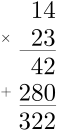
There is one digit after the decimal point in the original multiplicand (1.4) and two digits after the decimal point in the original multiplier (0.23). Since there are three digits appearing after decimal points, that means that we need to move the decimal point in our final product three places from the end of the number, which gives us 0.322. Therefore:
\(1.4 \times 0.23 = 0.322\)
Q
How do you multiply decimals by whole numbers?
A
Multiply decimals by whole numbers by treating them as whole numbers first. Then, place the decimal point in the same place as in the original decimal number.
First, ignore the decimal completely. Treat the multiplicand as a whole number.
- 1.74 → 174
Now, multiply as normal:
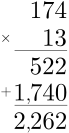
Since the multiplicand has two digits after the decimal, move the decimal two places to the left in the final product. This gives us a final product of 22.62:
\(1.74\times 13=22.62\)
Q
How do you multiply repeating decimals?
A
There are two ways to multiply repeating decimals:
- Round the repeating decimal to a fixed number of decimal places
- Convert the repeating decimal to a fraction and then multiply the fractions
First, round the repeating decimal to a fixed number of decimal places.
\(3. \overline{3} \approx 3.33\)
Now, ignore the decimal points and multiply as normal:
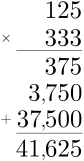
Since there are four total digits after the decimal point in 1.25 and 3.33, move the decimal in the final product four places to the left to get 4.1625.
Since this method uses rounding, the result is an approximation.
\(1.25 \times 3. \overline{3} \approx 4.1625\)
Multiplying Decimals Practice Questions
Which statement correctly describes the place value of each digit in 126.34?
In the number 126.34, each digit has a specific place value based on its position relative to the decimal point:
- 1 represents 1 group of one hundred
- 2 represents 2 groups of ten
- 6 represents 6 groups of one
- 3 represents 3 tenths
- 4 represents 4 hundredths
Calculate the product of \(62.5 \times 1.3\).
When multiplying decimal values, apply the standard algorithm for multiplication as though there are no decimals. In other words, calculate \(625 \times 13\), which is equal to 8,125.
Now, determine where to place the decimal point. In the original problem, 62.5 shows one decimal movement to the left, and 1.3 shows the same thing. This means that a total of two decimal movements to the left are needed to reach the final answer of 81.25.
Calculate the product of \(3.8×1.96\).
The correct answer is 7.448. When multiplying decimal values, apply the standard algorithm for multiplication as though there are no decimals. In other words, simply calculate \(38×196\), which is equal to 7,448.
Now, determine where to place the decimal point. In the original problem, 3.8 shows one decimal movement to the left, and 1.96 shows two decimal movements to the left. This means that a total of three decimal movements to the left are needed to reach the final answer of 7.448.
Calculate the product of \(0.5 \times 1.03\).
When multiplying decimal values, apply the standard algorithm for multiplication as though there are no decimals. In other words, simply calculate \(5 \times 103\), which is equal to 515.
Now, determine where to place the decimal point. In the original problem, 0.5 shows one decimal movement to the left, and 1.03 shows two decimal movements to the left. This means that a total of three decimal movements to the left are needed to reach the final answer of 0.515.
Calculate the product of \(22 \times 5.6\).
When multiplying decimal values, apply the standard algorithm for multiplication as though there are no decimals. In other words, simply calculate \(22 \times 56\), which is equal to 1,232.
Now, determine where to place the decimal point. In the original problem, 22 shows no decimal movement to the left, and 5.6 shows one decimal movement to the left. This means that only one decimal movement to the left is needed to reach the final answer of 123.2.


