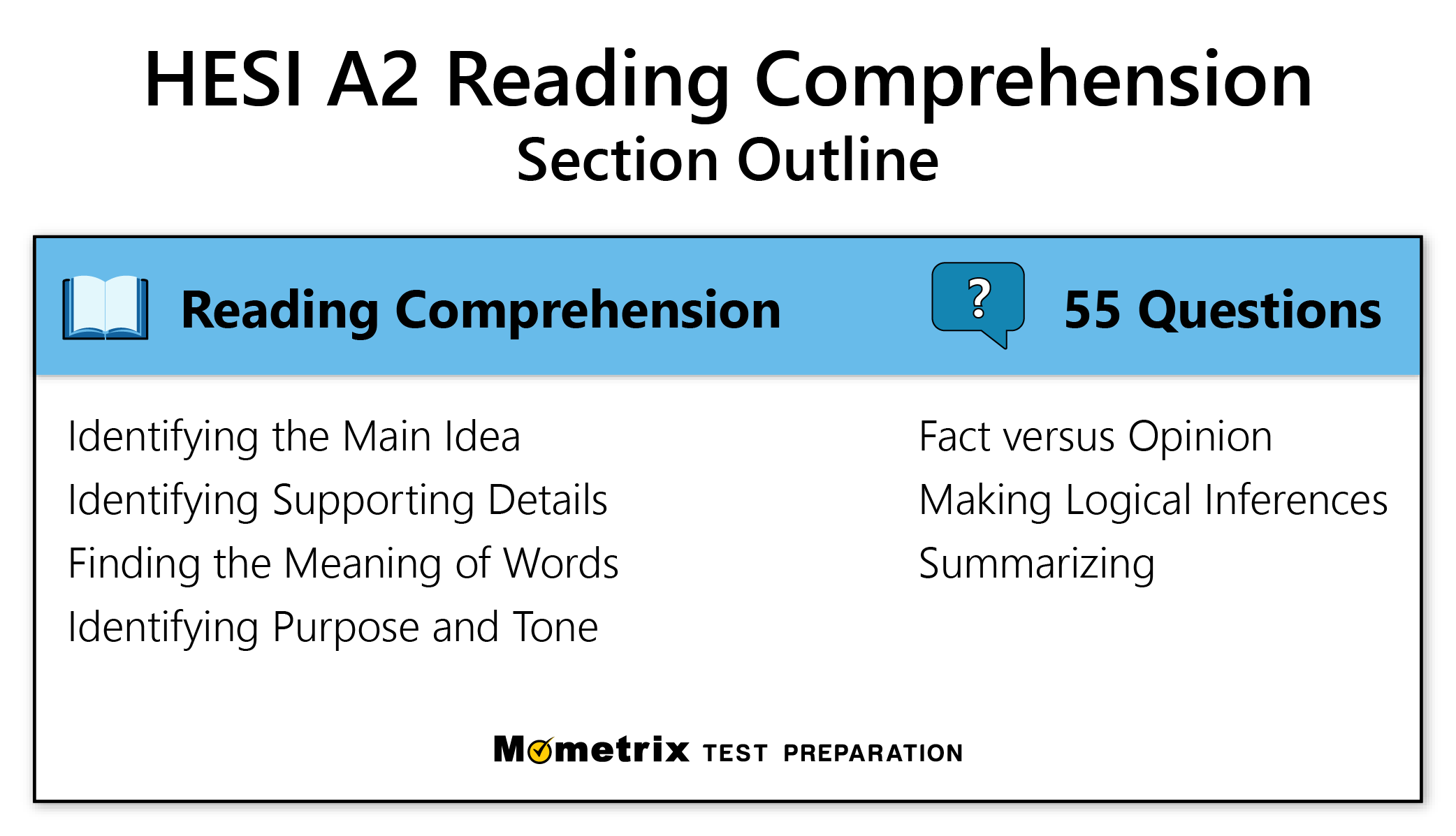
The HESI® A2 Reading Comprehension Test covers identifying main ideas, supporting details, purpose, and tone, as well as topics like facts vs. opinions and making logical inferences.
To help you prepare for this section of the HESI, this page contains everything you need to know, including what topics are covered, how many questions there are, and how you can study effectively.
What’s on the HESI Reading Comprehension Section?
HESI A2 Reading Practice Questions
One of the best ways to test your knowledge is by taking a practice test. Evaluate your reading comprehension skills by trying your hand at the three practice questions below!
Answer each question and read through the answer explanation, whether you got the answer right or wrong. This will help you ensure you’ve got the topic mastered.
Whether you struggled with these questions or aced them on your first try, be sure to take the full practice test to get a better idea of how prepared you really are!
1. Read the passage below before answering the question:
 Read Passage
The stomach is a frequent site of bleeding. Infections with Helicobacter pylori (H. pylori), alcohol, aspirin, aspirin-containing medicines, and various other medicines (such as nonsteroidal anti-inflammatory drugs [NSAIDs]—particularly those used for arthritis) can cause stomach ulcers or inflammation (gastritis). The stomach is often the site of ulcer disease. Acute or chronic ulcers may enlarge and erode a blood vessel, causing bleeding. Also, patients suffering from burns, shock, head injuries, cancer, or those who have undergone extensive surgery may develop stress ulcers. Bleeding can also occur from benign tumors or cancer of the stomach, although these disorders usually do not cause massive bleeding.
Which statement is not a detail mentioned in the passage?
The three other answer choices can be found within the passage. The surest way to answer a question like this is to comb through the passage, looking for each detail in turn. This is a time-consuming process, however, so you may want to follow any initial intuition you have. In other words, if you are suspicious of one of the answer choices, see if you can find it in the passage. Often you will find that the detail is expressly contradicted by the author, in which case you can be sure that this is the right answer.
2. Read the passage below before answering the question:
Read PassageWhat is the meaning of the word signs as it is used in the paragraph?
A stomachache, for instance, is not technically considered a sign, since it cannot be observed by anyone other than the person who has it, and therefore must be expressed by the individual experiencing it. This would be known as a symptom. Change in vital signs, a failed hearing test, or a low Snellen (vision) chart score, however, would all be considered signs because practitioners can measure or observe them.
3. Read the passage below before answering the question:
Read PassageThe immune system is amazingly complex. It can recognize and remember millions of different enemies, and it can secrete fluids and cells to wipe out nearly all of them. The secret to its success is an elaborate and dynamic communications network. Millions of cells, organized into sets and subsets, gather and transfer information in response to an infection. Once immune cells receive the alarm, they produce powerful chemicals that help to regulate their own growth and behavior, enlist other immune cells, and direct the new recruits to trouble spots.
Although scientists have learned much about the immune system, they continue to puzzle over how the body destroys invading microbes, infected cells, and tumors without harming healthy tissues. New technologies for identifying individual immune cells are now allowing scientists to determine quickly which targets are triggering an immune response. Improvements in microscopy are permitting the first-ever observations of living B cells, T cells, and other cells as they interact within lymph nodes and other body tissues.
In addition, scientists are rapidly unraveling the genetic blueprints that direct the human immune response, as well as those that dictate the biology of bacteria, viruses, and parasites. The combination of new technology with expanded genetic information will no doubt reveal even more about how the body protects itself from disease.
What is the main idea of the passage?

HESI A2 Online Prep Course
If you want to be fully prepared, Mometrix offers an online HESI prep course designed to give you everything you need to succeed!
Here’s what you’ll find in the HESI A2 course:
- 80+ Review Lessons Covering Every Topic
- Over 3,200 HESI A2 Practice Questions
- 550+ Digital Flashcards
- 180+ Instructional Videos
- Money-back Guarantee
- Mobile Access
Everyone learns differently, so we’ve tailored the HESI online prep course to ensure every learner has what they need to prepare for the HESI exam.
Click below to check it out!
FAQs
Q
How many questions are on the Reading Comprehension section of the HESI A2?
A
There are 50 questions on the Reading Comprehension section of the HESI A2 exam.
Q
How long is the Reading Comprehension section of the HESI A2?
A
Each school sets their own time limit for each section of the exam.
Q
What is a passing score for the Reading Comprehension section of the HESI A2?
A
There are no official passing scores or failing scores on the HESI exam.


HESI is a registered trademark of Elsevier, Inc., which was not involved in the production of, and does not endorse, this page.