
TSI Reading Practice Test

Prepare for your test with realistic questions.

TSI Reading Practice Test (updated 2026)

The ELAR section of the TSI tests your foundational reading and writing abilities, focusing on reading comprehension, reading analysis, and text editing and revision. To help you prepare for this section of the TSI, this page contains everything you need to know, including what topics are covered, how many questions there are, and how you can study effectively.

Click “Start Test” above to take a free TSI ELAR practice test!

What’s on the TSI ELAR Assessment?
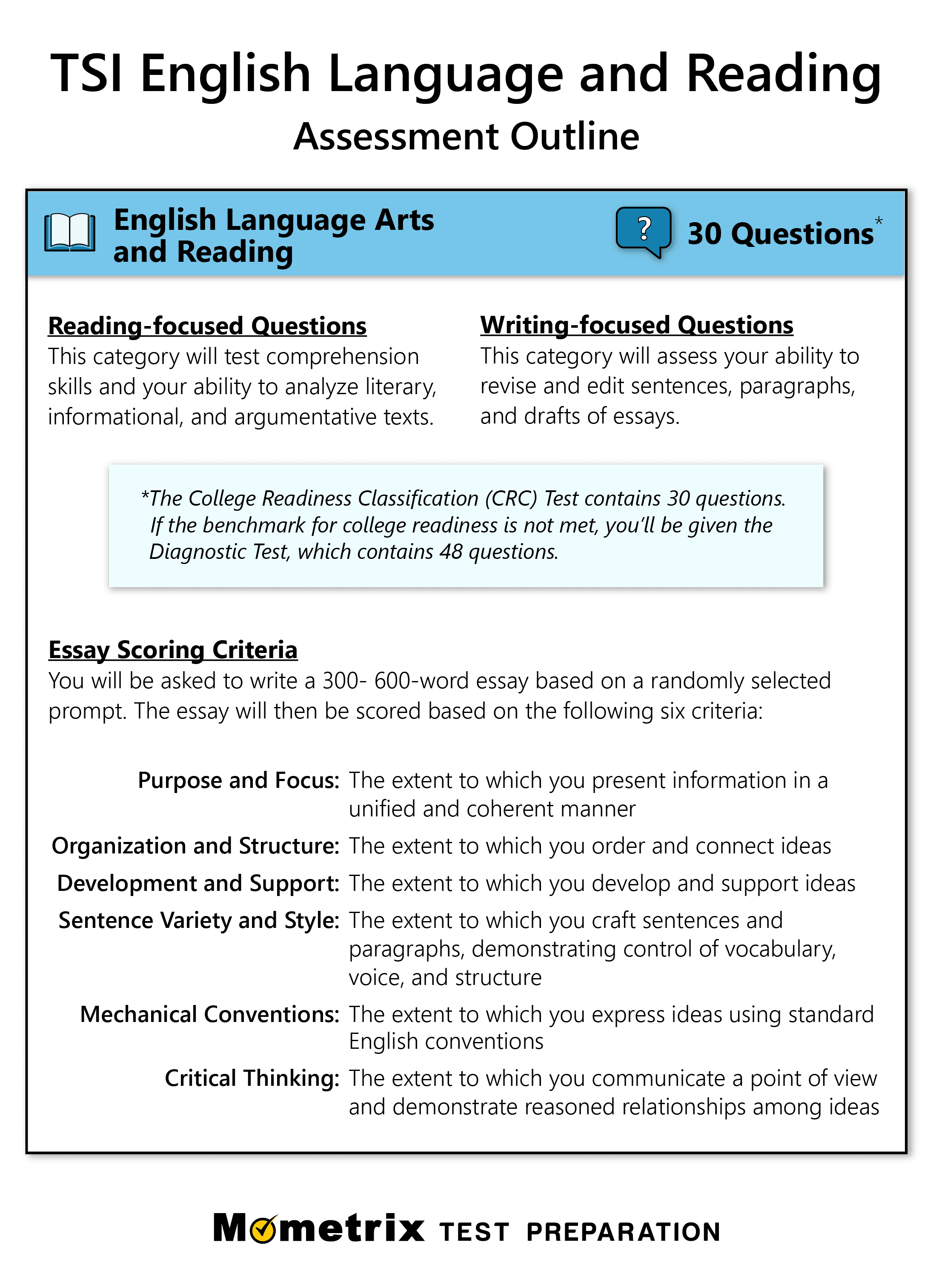
exam outline for the TSI English Language and Reading assessment, which contains 30 questions

TSI ELAR Practice Questions

One of the best ways to check your understanding is by taking a practice test. Try the five practice questions below to test your reading skills!

After each question, review the answer explanation, whether you answered correctly or not. This will help you reinforce the concept and identify anything you may need to review.

Whether these questions felt easy or showed you where you need more practice, be sure to take the full practice test to get a better sense of how prepared you really are!

1. Read the passage below before answering the question:

Closed Book Icon Read Passage
The Amazon rainforest is one of the most important ecosystems in the world. However, it is slowly being destroyed. Areas of the rainforest are being cleared for farms and roads, and much of the wood is also being harvested and sold.

There are several compelling reasons to protect this area. First, a significant number of pharmaceuticals are made from plants that have been discovered in the rainforest, and it’s quite possible there are still important plants that have not yet been discovered. Secondly, the rainforest provides a significant portion of the world’s oxygen and also absorbs great amounts of carbon dioxide. Without rainforests, global warming could accelerate.

What is the main purpose of this passage?


The concepts in answer choices A and C are mentioned only briefly. The idea shown in choice D is discussed, but it is one of two subpoints that serve the main purpose, which is to discuss why the Amazon rainforest is a valuable area that should be protected.
Found a bug? Let us know!

2. Read the passage below before answering the question:

Closed Book Icon Read Passage
One of the earliest known fabrics is cotton. Remnants have been found dating to 6,000 BC in South America, and use of cotton in the Middle East and India also dates back millennia. Cotton reached Europe later but quickly became a popular trade item. The industrial revolutions of the US and Britain, particularly Eli Whitney’s invention of the cotton gin, allowed production of cloth to increase enormously. In the southern US, plantations produced mass quantities of cotton, relying heavily on slave labor to grow and harvest the crops.

Cotton tended to be “king” in the south, even after the Civil War, until boll weevils were introduced in the late nineteenth century. These insects wreaked havoc on cotton fields for decades until pesticides and other control methods were developed to manage the problem. Cotton continues to be manufactured in huge quantities today, in both genetically modified and organic forms.

Which of the following resulted from the invention of the cotton gin?


The fourth sentence of the passage states that the cotton gin led to increased production of cotton. Answer choice A states the opposite. There is no mention of US independence (B) in the passage. While the passage mentions finding solutions to the boll weevil problem (C), these solutions did not result from the invention of the cotton gin.
Found a bug? Let us know!

3. Read the passage below before answering the question:

Closed Book Icon Read Passage
Feudalism was a social system that existed in parts of Europe during the Middle Ages. Essentially, there were several different classes within a feudal society. The king controlled all of the land in his jurisdiction. He divided this among a few barons. The barons then divided up the land they were given and distributed it to knights. It was then split up again and distributed to serfs, the lowest members of feudal society. They were permitted to farm small sections of land but had to give a portion of their food to the knights in exchange for this privilege. They also had to give free labor to the knights in exchange for using their land. Serfs had very few rights; they couldn’t even leave their land without permission from the knight who controlled it. The system of feudalism ended when money began to be used as currency instead of land.

What can be concluded from this passage?


The passage states, “The king controlled all of the land in his jurisdiction. He divided this among a few barons. The barons then divided up the land they were given and distributed it to knights.” If the barons divided up their lands, it would stand to reason that each baron would distribute his land to more than one knight. Therefore, there would have to be more knights than barons.

Choice A seems to be suggested by the last sentence and could be a point made later in the work, but it cannot be concluded from this excerpt alone. Whether knights had any duties to perform in exchange for their land (C) is never made clear. Choice D directly contradicts the passage.
Found a bug? Let us know!

5. Select the best replacement for the underlined word in the sentence below

Likewise his favorite ice cream flavor was chocolate, he enjoyed strawberry as well.


The two clauses in the sentence are contradictory; the first one makes a statement, and the second modifies it by adding new information. To reflect this, we need a word that shows this contrast, like “although.” Choices A and C do not imply contrast. Choice D does show contrast but does not fit grammatically in the original sentence. It would need to be “His favorite ice cream flavor was chocolate; however, he enjoyed strawberry as well.”
Found a bug? Let us know!

Ad for a Mometrix online course

TSI Test Online Prep Course

If you want to be fully prepared, Mometrix offers an online TSI prep course designed to give you everything you need to succeed!

Here’s what you’ll find in the TSI course:

  • 100+ Review Lessons Covering Every Topic
  • Over 1,500 TSI Practice Questions
  • 500+ Digital Flashcards
  • 250+ Instructional Videos
  • Money-back Guarantee
  • Mobile Access

Everyone learns differently, so we’ve tailored the TSI online prep course to ensure every learner has what they need to prepare for the TSI exam.

Click below to check it out!

FAQs

Q

How many questions are on the TSI ELAR test?

A

The College Readiness Classification (CRC) version of the test contains 30 questions, while the Diagnostic version contains 48 questions.

Q

How long is the TSI ELAR test?

A

The TSI ELAR test does not have a set time limit; you must simply complete the exam within 14 days after starting it.

Q

What is a passing score for the TSI ELAR test?

A

A passing score for the TSI ELAR test is a CRC score of 945-990 plus a minimum of 5 on the Essay Test, OR a CRC score under 945 with a Diagnostic Test score of 5-6 and an Essay score of at least 5.


Aaron Lanni profile pic

Edited by Aaron Lanni

Aaron is the content manager and lead editor for Mometrix Academy. He regularly produces, updates, proofreads, and edits content to ensure it meets Mometrix’s quality and accessibility standards.

Mometrix Test Preparation is not affiliated with or endorsed by any official testing organization. All organizational and test names are trademarks of their respective owners.


by Mometrix Test Preparation | Last Updated: June 16, 2026