The Society for Human Resource Management (SHRM®), which is the largest HR membership organization in the world, administers the SHRM Certified Professional (SHRM-CP®) exam for those pursuing a credential in human resource management.
Click “Start Test” above to take a free SHRM-CP practice test!
SHRM-CP Question of the Day
SHRM-CP Exam Eligibility
There are no strict eligibility requirements for the SHRM-CP. The exam is intended for people who perform general HR-related duties, or for those who are pursuing a career in human resource management as a student.
Exam Format
The SHRM-CP exam contains 134 multiple-choice questions, 24 of which are unscored, and has a time limit of 3 hours and 40 minutes. The unscored questions are used by SHRM to evaluate questions for future versions of the exam.
There are two types of multiple-choice questions on the exam: knowledge-based questions and situational judgment questions.
There are two types of knowledge questions on the exam: HR-specific (KI) and foundational (FKI). The KIs pertain to the concepts covered in the 14 HR functional areas, while the FKIs pertain to concepts covered in the 9 behavioral competencies.
Situational Judgment Questions
The situational judgment questions (SJIs) evaluate your decision-making skills and quality of judgment. These questions present you with a work-related situation and ask you to choose which of several possible strategies will most effectively resolve any conflict and address any issues presented in the scenario.
SHRM-CP Outline
The exam divides the questions into two groups: behavioral competencies and technical competencies. The 9 behavioral competencies are grouped into three clusters, while the single technical competency is split into three domains containing the 14 functional areas.
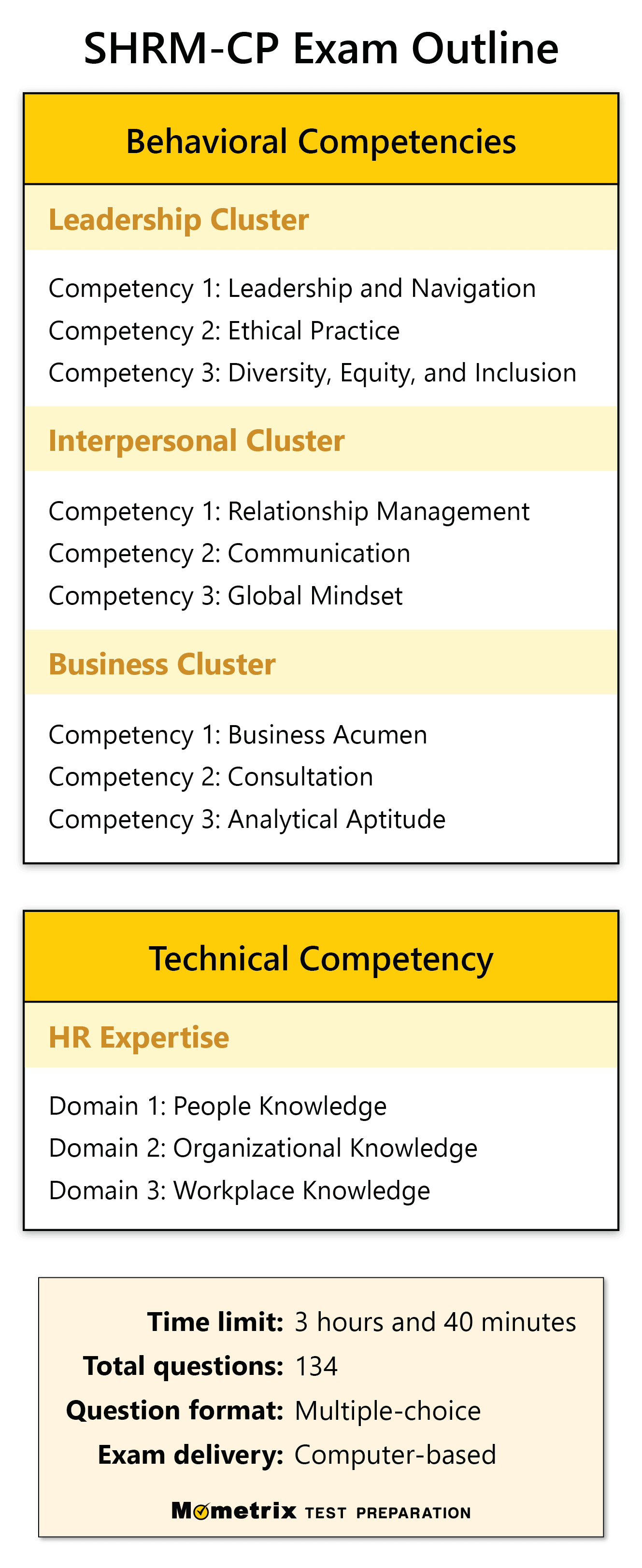
Behavioral Competencies
The three competencies in the Leadership cluster assess your knowledge of the attributes, behaviors, and base knowledge needed to effectively lead an HR team.
Competency 1: Leadership and Navigation
- Navigating the Organization
- Vision
- Managing HR Initiatives
- Influence
Competency 2: Ethical Practice
- Personal Integrity
- Professional Integrity
- Ethical Agent
Competency 3: Diversity, Equity, and Inclusion
- Creating a Diverse and Inclusive Culture
- Ensuring Equity Effectiveness
- Connecting DE&I to Organizational Performance
CLUSTER 2: INTERPERSONAL
The three competencies in the Interpersonal cluster assess your knowledge of the attributes, behaviors, and base knowledge needed to effectively collaborate and perform the interpersonal aspects of an HR professional’s job.
Competency 1: Relationship Management
- Networking
- Relationship-Building
- Teamwork
- Negotiation
- Conflict Management
Competency 2: Communication
- Delivering Messages
- Exchanging Organizational Information
- Listening
Competency 3: Global Mindset
- Operating in a Culturally Diverse Workplace
- Operating in a Global Environment
- Advocating for a Culturally Diverse and Inclusive Workplace
CLUSTER 3: BUSINESS
The three competencies in the Business cluster assess your knowledge of the attributes, behaviors, and base knowledge needed to meet business objectives by implementing various HR solutions.
Competency 1: Business Acumen
- Business and Competitive Awareness
- Business Analysis
- Strategic Alignment
Competency 2: Consultation
- Evaluating Business Challenges
- Designing HR Solutions
- Advising on HR Solutions
- Change Management
- Service Excellence
Competency 3: Analytical Aptitude
- Data Advocate
- Data Gathering
- Data Analysis
- Evidence-Based Decision-Making
Technical Competency
The one technical competency is the HR Expertise competency, which outlines 14 functional areas grouped into three domains.
Domain 1: People Knowledge
- HR Strategy
- Talent Acquisition
- Employee Engagement and Retention
- Learning and Development
- Total Rewards
Domain 2: Organizational Knowledge
- Structure of the HR Function
- Organizational Effectiveness and Development
- Workforce Management
- Employee Labor and Relations
- Technology Management
Domain 3: Workplace Knowledge
- Managing a Global Workforce
- Risk Management
- Corporate Social Responsibility
- US Employment Law and Regulations
Check Out Mometrix's SHRM-CP Study Guide
Get practice questions, video tutorials, and detailed study lessons
Get Your Study Guide
Top 5 Most Challenging SHRM-CP Questions
Now that you know more about the exam, try your hand at some targeted practice!
Over the last year, we’ve compiled the data from about 3,000 test-takers who tried their hand at the practice test at the top of this page. According to the data, around 75% of people answered these five questions incorrectly.
Answer each question and read through the answer explanation, whether you got the answer right or wrong. This will help you ensure you’ve got the topic mastered.
Whether you struggled with these questions or aced them on your first try, be sure to take the full practice test to get a better idea of how prepared you really are!

1. Read the passage below before answering the question:
 Read Passage
The manager is shocked that the company is still using paper time sheets to track time due to its environmental impact. What should she do next?
2. If a company reports on details of its ongoing investigations in its weekly leadership meeting that includes representation from each of its 68 offices, this illustrates:
3. Read the passage below before answering the question:
Read PassageAn HR team member has a sister who coauthored the leading book on the impact of workplace violence on employee engagement. He offers to arrange to bring his sister to the meeting with the CEO to discuss the impact that ignoring the issue will have on the current workplace and on the pool of future candidates. How should the team respond?
4. An employee presents data to her employer to support her position that she is paid $3,000 below market rate. She asks for an adjustment and the company said they value her work and understand she is underpaid but they simply do not have the budget to increase her salary. If the parties agree that the employee will continue to be paid her current salary but will be given an additional week of paid vacation, what type of conflict resolution mode will the parties have used?
5. Read the passage below before answering the question:
Read PassageWhat is the first step HR should take once leadership informs them that they want to eliminate these jobs?
Registration
To register for the SHRM-CP exam, you must first create an online SHRM account and submit an application.
Along with your application, you will need to send the $499 testing fee.
Once your application and fee have been approved, you will receive an Authorization to Test (ATT), which will provide you with details on how to schedule your exam with Prometric.
Test Day
On the day of the test, you should arrive at the testing center 15 to 30 minutes before your exam is scheduled to begin. If you are late, you will not be admitted, and your test will be canceled.
Before the exam begins, you will be asked to provide your photo ID and sign a candidate agreement. Then, you must store all personal items (cell phone, notebook, backpack, etc.) in a provided locker outside the testing area.
During the exam, you can take one 15-minute break whenever you need to, but the timer will not stop while you are away.
How the SHRM-CP is Scored
Your SHRM-CP score is based on a modified Angoff method. This means that your score is determined based solely on your performance on the exam, with no prior work experience or variables factored into your score.
The score range for this exam is 120-200, with the passing score being 200.
Check Out Mometrix's SHRM-CP Flashcards
Get complex subjects broken down into easily understandable concepts
Get Your Flashcards
How to Pass the Test
Start with a SHRM-CP Practice Test
Before creating your study schedule, take a SHRM practice test to establish a starting point. You don’t need to wait until you have reviewed every HR law, compensation concept, and behavioral competency. At this stage, the goal is to identify where your preparation time will have the greatest effect.
Review your results across the three HR Knowledge Domains:
- People: Do you need more work with HR Strategy, Talent Acquisition, Employee Engagement & Retention, Learning & Development, or Total Rewards?
- Organization: Can you apply concepts involving the Structure of the HR Function, Organizational Effectiveness & Development, Workforce Management, Employee & Labor Relations, and Technology Management?
- Workplace: Do you understand Managing a Global Workforce, Risk Management, Corporate Social Responsibility, and U.S. Employment Law & Regulations?
Identifying those specific weaknesses will show you where to devote more attention during your study time.
Review Difficult Questions
After each practice session, review every question you answered incorrectly AND every question you guessed on or answered with low confidence. A correct guess does not demonstrate that you understood the HR principle or selected the answer for the right reason.
For each difficult question, determine which of the following caused the problem:
- You didn’t know the HR concept, law, process, or terminology.
- You knew the concept but couldn’t apply it to the workplace situation.
- You acted before gathering enough information.
- You focused on the immediate symptom instead of the underlying problem.
- You escalated a problem unnecessarily instead of handling it at the appropriate level.
- You failed to recognize a legal, ethical, safety, or organizational risk.
- You overlooked relevant data or evidence.
- You selected an answer based on what your current employer does rather than the principles described in the SHRM BASK.
- You confused a technically possible action with the best action.
- You spent too long debating between two plausible responses.
Then, outline a specific plan for improvement based on what you discovered. In other words, don’t just say, “I need to study recruiting.” Note that you need to review selection validity, structured interviews, adverse impact, or the differences among internal and external sourcing methods.
Similarly, replace “practice situational judgment” with something specific, such as identifying relevant stakeholders or addressing root causes rather than symptoms.
Utilize Answer Explanations
Answer explanations are an underutilized studying resource. To take full advantage of them, read the explanation for every question you found difficult, including questions you answered correctly.
For each one, make sure you can confidently explain:
- Why the correct answer is correct
- Why each incorrect option is less appropriate
- What HR knowledge or behavioral competency is being tested
- Which facts in the scenario matter
- Why one response is better than another reasonable response
- How the same principle could appear in a different workplace situation
If the question involves talent acquisition, ask how the concept would affect an actual recruiting or selection decision.
If it involves HR technology, determine not only what the technology does but also what risks or implementation considerations are involved. The 2026 SHRM BASK specifically incorporates technologies such as AI-supported recruiting, generative AI, automation, HR information systems, and workforce analytics across multiple HR areas.
Study HR Decisions, Not Individual Questions
Memorizing the answer to a SHRM-CP question will not prepare you for another workplace scenario involving different employees, managers, policies, data, or organizational circumstances. Your goal should be to understand how HR principles guide decisions.
For example, don’t just blindly memorize that one recruiting scenario required a structured interview. Understand how validity and reliability affect selection and what legal requirements apply.
The exact questions on your test will be different from the ones you encounter during practice. If you can apply a topic to a new organizational problem and explain why the decision is appropriate, it’s a good sign that you’ve mastered the topic.

SHRM-CP Online Prep Course
If you want to be fully prepared, Mometrix offers an online SHRM-CP prep course designed to give you everything you need to succeed!
Here’s what you’ll find in the SHRM-CP course:
- 150+ Review Lessons Covering Every Topic
- Over 1,200 SHRM-CP Practice Questions
- 550+ Digital Flashcards
- Money-back Guarantee
- Mobile Access
Everyone learns differently, so we’ve tailored the SHRM-CP online prep course to ensure every learner has what they need to prepare for the SHRM-CP exam.
Click below to check it out!
FAQs
Q
How long is the SHRM-CP exam?
A
The time limit for the exam is 3 hours and 40 minutes.
Q
How many questions are on the SHRM-CP exam?
A
There are 134 multiple-choice questions on the exam, 24 of which are unscored.
Q
How hard is the SHRM-CP exam?
A
The SHRM-CP exam is considered to be a moderately difficult exam that requires a lot of studying and preparation in order to pass.
Q
What is the passing score for the SHRM-CP exam?
A
To pass the exam, you must achieve a score of 200.
Q
How much does the SHRM-CP exam cost?
A
The cost of the exam is $499.


SHRM and SHRM-CP are registered trademarks of Society for Human Resource Management, which is not affiliated with Mometrix Test Preparation and does not endorse this page.