A passing score on the National Clinical Mental Health Counseling Examination (NCMHCE®) is required for licensure in some states. It is one of the requirements for both the National Certified Counselor (NCC) and Certified Clinical Mental Health Counselor (CCMHC) certification. Successful completion of the exam and certification demonstrates your commitment to the profession and dedication to continued learning within the field.
Click “Start Test” above to take a free NCMHCE practice test!
A new version of the NCMHCE will take effect July 1, 2027. The current exam contains 11 case studies, while the updated exam will contain 10 case studies and use a new content outline and scoring scale. If your exam date is July 1, 2027, or later, make sure you’re preparing with materials aligned to the new examination specifications.
NCMHCE Format
The NCMHCE consists of 11 counseling cases designed to evaluate your capability to make vital clinical decisions that pertain to the health and well-being of simulated mental health clients you may encounter in real-world situations. Each case will include one narrative and 9-15 multiple-choice questions.
The exam is split into three parts:
Component 1: Intake
This part of the exam provides you with basic, introductory client information such as how old they are, whether they are male or female, and what problems they are presenting with. You will also be given the setting, as well as the presenting concerns and diagnosis of the client.
Component 2: Clinical Session I
In this part of the exam, you will work on the presenting concerns with the client by using evidence-based approaches.
Component 3: Clinical Session II
In this part of the exam, you will simply be continuing the work that you began in the last component.
At the beginning of each counseling case, you will be provided with the client’s initial diagnosis. You will then be asked to evaluate how that judgment was initially made. In some instances, you may have to either provide one or more co-occurring diagnoses or monitor the therapeutic relationship and change the diagnosis as it evolves and changes.
NCMHCE Exam Outline
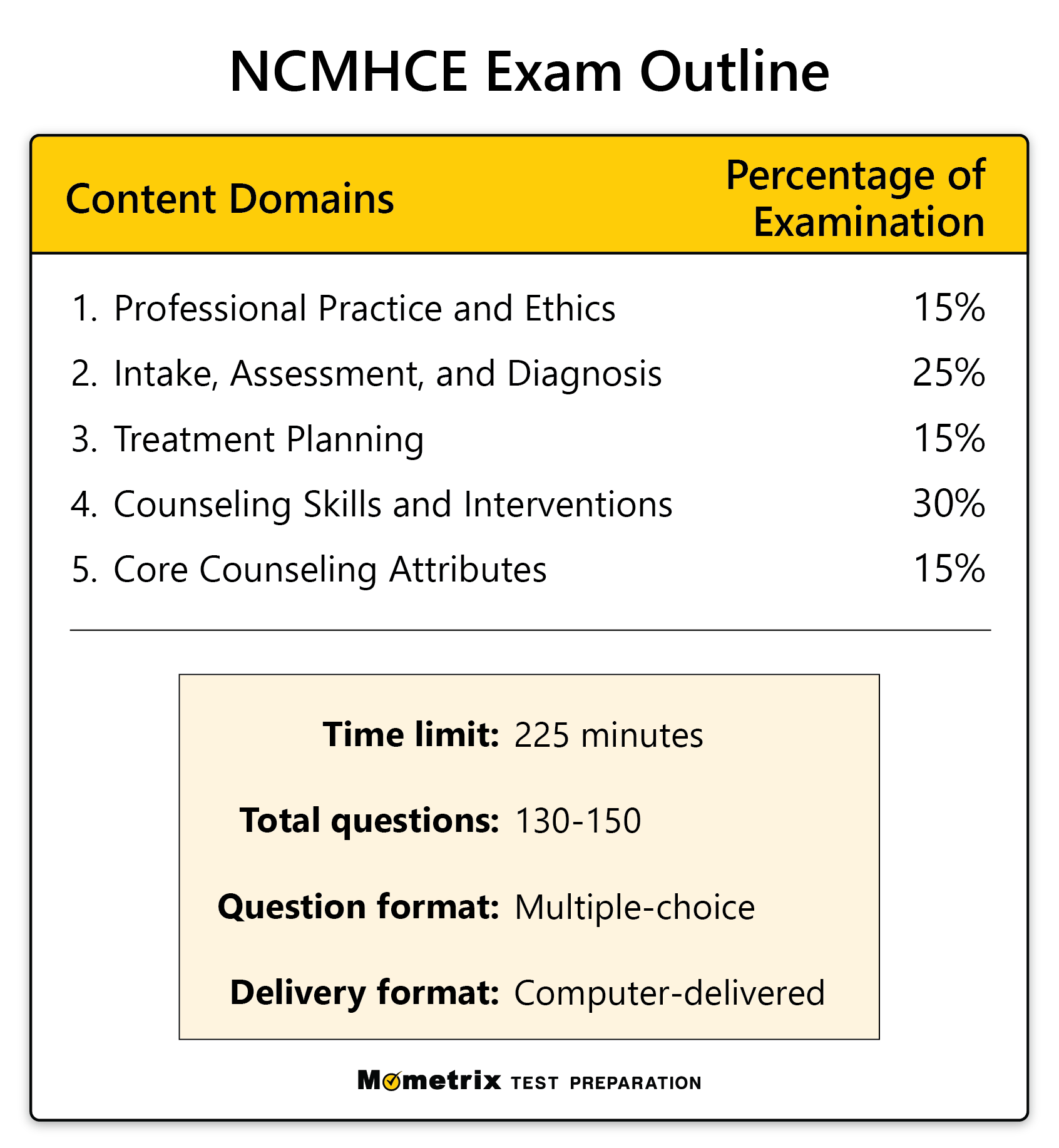
In total, the NCMHCE contains between 130 and 150 questions and has a time limit of 225 minutes.
The questions on the exam cover the following five content domains.
1. Professional Practice and Ethics (15%)
The questions in this domain assess your ability to maintain proper administrative and clinical protocols.
These are some of the specific topics that are covered:
Statistical concepts and methods in research
Uses and limits of social media
Reviewing client records
Legal and ethical counseling
Advocation of client and professional issues
Supervision
Obtaining informed consent
Reviewing fees, payments, and insurance benefits
Confidentiality in the space of electronic communication
Provision of information to third parties
Counselor and client roles
2. Intake, Assessment, and Diagnosis (25%)
The questions in this domain assess your knowledge and skills regarding the conduction of client intake, assessment, and diagnosis.
These are some of the specific topics that are covered:
Conducting a biopsychosocial interview
Determining the level of care needed
Assessing for trauma
Evaluating counseling effectiveness
Conducting an initial interview
Using formal and informal observations
Assessing for substance abuse
Evaluation of interactional dynamics
Considering co-occurring diagnoses
Screening clients for appropriate services
Obtaining client self-reports
3. Treatment Planning (15%)
The questions in this domain assess your knowledge and skills regarding the development of an effective course of treatment.
These are some of the specific topics that are covered:
Establishing treatment goals and objectives by collaborating with the client
Identifying strengths and barriers related to goal attainment
Referring to different treatment levels
Guiding treatment planning
Following up after client discharge
Reviewing the treatment plan and making any necessary revisions
Integrating and maintaining therapeutic progress
4. Counseling Skills and Interventions (30%)
The questions in this domain assess your knowledge and skills pertaining to effective counseling strategies.
These are some of the specific topics that are covered:
Aligning intervention with counseling modalities and with the client’s developmental level
Addressing addiction issues
Exploring religious values
Facilitating trust and safety
Developing safety plans and conflict-resolution strategies
Providing psychoeducation for the client
Modeling appropriate feedback reception
Using structured activities
Explaining phases in the group process
Using self-disclosure
Creating an intervention based on the group development stage
Challenging harmful group behaviors
Addressing the impact of a social support network
5. Core Counseling Attributes (15%)
The questions in this domain assess your overall traits, behaviors, and disposition.
These are some of the specific topics that are covered:
Genuineness
Empathy
Respect for and acceptance of diversity
Congruence
Positive regard
Resolution and tolerance of conflict
Foundational listening, reflecting, and attending skills
Sensitivity to multicultural issues, as well as gender orientation and gender issues
Check Out Mometrix's NCMHCE Study Guide
Get practice questions, video tutorials, and detailed study lessons.
Now that you know how to approach practice tests, try your hand at some targeted practice on your own!
Over the last year, we’ve compiled the data from nearly 2,000 test-takers who tried their hand at the practice test at the top of this page. According to the data, there’s one case study that around 70% of people struggled to answer questions about.
Each question refers to a single case study, split into three parts. Answer each question and read through the answer explanation, whether you got the answer right or wrong. This will help you ensure you’ve got the topic mastered.
Whether you struggled with these questions or aced them on your first try, be sure to take the full practice test to get a better idea of how prepared you really are!
Hardest Question
Only 13% answered correctly
1. Read Part One of the case study before answering the question:
Part One: Intake
CLIENT
Age: 45
Sex: Male
Gender: Male
Sexuality: Heterosexual
Ethnicity: Caucasian
Relationship Status: Divorced, single
Counseling Setting: Private practice
Type of Counseling: Individual counseling
Presenting Problem: The client is experiencing difficulty in functioning in all areas of his life due to inhalant use.
Diagnosis: Inhalant use disorder, severe (F18.20)
PRESENTING PROBLEM
You are a licensed counselor working in a private practice. You specialize in substance use disorders. The client comes into the session, is very friendly, and states that although his sessions are court ordered, he wants to get help with his inhalant use. The client spent the first half of the session explaining what happened to lead to him getting his third charge of driving under the influence of inhalants. The client says that he had twin sons 13 years ago and they both were in the ICU; one of his sons died after about a month. The client began drinking alcohol to excess daily for about 6 months, which then transitioned to inhalant use. The client says that he uses contact cement, model glue, paint, and permanent markers to become intoxicated. The client identified the following symptoms of inhalant use disorder: increase in frequency and amount of use over the past 5 years, several failed attempts at cessation of inhalant use, craving inhalants throughout every day, losing several jobs because of his inability to get to work on time due to inhalant use, use that has affected his ability to have visits with his children and maintain employment, use that increases the risk of harm to himself and others such as driving under the influence, increased tolerance, and continued use even when he knows it is negatively affecting his life. The client wants to become sober, improve his relationship with his children, and maintain employment.
MENTAL STATUS EXAM
The client is oriented to person, place, time, and situation. The client does not appear to be under the influence of inhalants because he does not display any symptoms of use. The client is friendly and engaged in the session.
FAMILY HISTORY
The client has three sons that are 11, 13, and 16 years old. The client is divorced as of 3 years prior and reports a contentious relationship with his ex-wife due to his difficulty following through with visits with their children. The client and his ex-wife were married for 17 years and dated for about 5 years before they were married. The client states that he loves his ex-wife but that she has currently been dating another man for the past 2 years and he knows they likely will not reconcile. He says that he understands why she does not want to be with him, and he thinks that he is not good for her or his children at this time.
When discussing the informed consent form, you cover the risks of counseling. Which one of the following is NOT an expected risk of counseling?
The client may choose to discontinue therapy early; however, this is not a risk of the counseling process, rather, a decision on the part of the client. Therapy can make things worse initially because the client may have to discuss or confront situations, thoughts, and feelings that may cause distress. This is an expected part of the therapeutic process. The client may need to meet with multiple counselors prior to finding a match who meets his needs for building rapport and who also has the skill set needed to best support the client.
2. Read Part One of the case study before answering the question:
Part One: Intake
CLIENT
Age: 45
Sex: Male
Gender: Male
Sexuality: Heterosexual
Ethnicity: Caucasian
Relationship Status: Divorced, single
Counseling Setting: Private practice
Type of Counseling: Individual counseling
Presenting Problem: The client is experiencing difficulty in functioning in all areas of his life due to inhalant use.
Diagnosis: Inhalant use disorder, severe (F18.20)
PRESENTING PROBLEM
You are a licensed counselor working in a private practice. You specialize in substance use disorders. The client comes into the session, is very friendly, and states that although his sessions are court ordered, he wants to get help with his inhalant use. The client spent the first half of the session explaining what happened to lead to him getting his third charge of driving under the influence of inhalants. The client says that he had twin sons 13 years ago and they both were in the ICU; one of his sons died after about a month. The client began drinking alcohol to excess daily for about 6 months, which then transitioned to inhalant use. The client says that he uses contact cement, model glue, paint, and permanent markers to become intoxicated. The client identified the following symptoms of inhalant use disorder: increase in frequency and amount of use over the past 5 years, several failed attempts at cessation of inhalant use, craving inhalants throughout every day, losing several jobs because of his inability to get to work on time due to inhalant use, use that has affected his ability to have visits with his children and maintain employment, use that increases the risk of harm to himself and others such as driving under the influence, increased tolerance, and continued use even when he knows it is negatively affecting his life. The client wants to become sober, improve his relationship with his children, and maintain employment.
MENTAL STATUS EXAM
The client is oriented to person, place, time, and situation. The client does not appear to be under the influence of inhalants because he does not display any symptoms of use. The client is friendly and engaged in the session.
FAMILY HISTORY
The client has three sons that are 11, 13, and 16 years old. The client is divorced as of 3 years prior and reports a contentious relationship with his ex-wife due to his difficulty following through with visits with their children. The client and his ex-wife were married for 17 years and dated for about 5 years before they were married. The client states that he loves his ex-wife but that she has currently been dating another man for the past 2 years and he knows they likely will not reconcile. He says that he understands why she does not want to be with him, and he thinks that he is not good for her or his children at this time.
When considering treatment goals, all of the following are indicated areas to explore, EXCEPT:
Depression is not indicated based on the presenting symptoms. Although depression may co-occur with inhalant use because the use of substances may alleviate depressive symptoms, the client did not report any depression symptoms. Grief and trauma related to the client’s son passing away are important areas to explore because these appear to be the triggering symptoms that led to his substance use. The client’s relationship with his ex-wife would be important to explore because the client is not able to see his children as much as he wants due to his substance use. The client also wants to maintain employment, so it would be helpful to focus on barriers to maintaining employment.
3. Read Part Two of the case study before answering the question:
Part Two: Sixth Session, 3 Weeks After the Initial Intake
The client comes into the session and looks tired, as evidenced by the darkness under his eyes, and he is walking slowly. The client starts talking immediately about 2 days prior when he went to his ex-wife’s house to pick up his kids for a visit and she told him that although she cannot stop this visit, due to recent inhalant use a few weeks ago, she talked with her lawyer about changing the status of his future visits to supervised visits, and she will be returning to court to do so.
The client says that he spent time with his kids and that when he left, he stopped by a store to get acetone and that he used this substance that night. The client expresses guilt and shame surrounding using, which led to him using the acetone the next day. The day after he used inhalants, the client stated that he was thinking, “I already broke my sobriety; I may as well huff so that I can feel better.” You empathize with the client regarding the situation because you can see how this would be distressing for him. The client says that his children seem bored when they are with him, as if they want to go home, which induces feelings of shame and sadness.
All of the following are possible symptoms of inhalant use, EXCEPT:
Insomnia is not typically associated with inhalants. Rather, inhalants generally slow down the body’s movement, slow reflexes, and cause a stupor, likely leading to sleepiness. Nystagmus (uncontrollable eye movement), euphoria (feelings of great happiness or excitement), and muscle weakness are common symptoms of inhalant intoxication.
4. Read Part Two of the case study before answering the question:
Part Two: Sixth Session, 3 Weeks After the Initial Intake
The client comes into the session and looks tired, as evidenced by the darkness under his eyes, and he is walking slowly. The client starts talking immediately about 2 days prior when he went to his ex-wife’s house to pick up his kids for a visit and she told him that although she cannot stop this visit, due to recent inhalant use a few weeks ago, she talked with her lawyer about changing the status of his future visits to supervised visits, and she will be returning to court to do so.
The client says that he spent time with his kids and that when he left, he stopped by a store to get acetone and that he used this substance that night. The client expresses guilt and shame surrounding using, which led to him using the acetone the next day. The day after he used inhalants, the client stated that he was thinking, “I already broke my sobriety; I may as well huff so that I can feel better.” You empathize with the client regarding the situation because you can see how this would be distressing for him. The client says that his children seem bored when they are with him, as if they want to go home, which induces feelings of shame and sadness.
Which one of the following BEST defines acceptance and commitment therapy?
Acceptance and commitment therapy focuses on accepting present emotions and staying present in those thoughts and emotions without judgment. Accepting the situation and realizing the ability to change it is a CBT approach. The focus on human abilities and limitations is key to existential therapy. A focus on repressed emotions and experiences is a feature of psychoanalysis.
5. Read Part Three of the case study before answering the question:
Part Three: Fourteenth Session, 7 Weeks After the Initial Intake
You meet with the client after he requested an emergency appointment. The client says that he had a supervised visit with his children and he had used inhalants prior to the visit because he was anxious. The supervisor noted the intoxication and ended the visit early. The client says that this was 3 days ago and that he has used inhalants several times daily since the visitation. Due to his intoxication at the visit, all future visits have been canceled until the next hearing in court regarding visitations. The client says that he has been very depressed and that is why he is using inhalants.
During the session, the client asks if he can go to the lobby to get water and you tell him that this is fine. The client returns, sits down, and appears listless because he is not displaying any emotion and has a very flat affect. You suspect that he is now intoxicated.
The client’s probation officer requests session progress notes from the time with your client due to it being court-ordered therapy. Which one of the following statements is TRUE regarding court-ordered therapy?
The client does retain rights in court-ordered therapy, and you must get a release of information to provide the probation officer with the requested notes if a subpoena is not provided. Even when a client, including a minor, does not retain rights, it is important to get the client’s consent to services in order to preserve trust in the counseling relationship.
Registration procedures for the NCMHCE depend on why you are taking the exam.
Candidates testing for state licensure should follow the requirements of their state licensing agency, while candidates taking the exam as part of the NCC or CCMHC certification process register through NBCC.
After you are approved to test, Pearson VUE will provide your authorization information and you can schedule an appointment at a Pearson VUE testing center or, when eligible, through the OnVUE online testing platform. Fees, authorization periods, and retake requirements can vary by registration route and state.
Rescheduling
You may reschedule your appointment any time up to 24 hours prior. However, there will be a $50 fee to reschedule your appointment if you do so within 7 days of the originally scheduled appointment. In the event that you need or plan to reschedule your appointment but fail to do so at least 24 hours before your scheduled time, arrive more than 15 minutes late for your appointment or fail to report to your designated testing center at your scheduled appointment time for any reason, you will forfeit both your registration and paid fees. To reregister for the examination, you will be required to submit a separate registration and fees.
If the examination needs to be rescheduled due to inclement weather, an emergency, or a power outage, you will be notified by email or telephone with rescheduling procedures. Cancellation is up to the discretion of the respective testing centers and is usually determined based on whether testing center personnel are able to open the facility. In the event of a power failure in the middle of an exam administration, you will be able to restart the exam where you left off before the interruption.
Test Day
On your testing day, try to arrive at least 15 minutes prior to your scheduled appointment time. You will be required to present two forms of identification, one of which must have a photograph. If you fail to provide appropriate identification and are not admitted to the testing center, it will be written as a missed appointment and result in forfeiture of your examination fee. Know that the name you used on your test registration and the name presented on your current photo ID must match, both must be current, and both should have your signature as you will be required to sign a roster for the testing center administrator to verify your identity. The administrator can accept the following forms of identification, but note that whichever form you use must be current:
Driver’s license
State ID card
Passport
Military ID card
Temporary identification, including employment and student ID cards, is not acceptable.
After confirming your identity, you will be directed to a testing carrel. When you begin the examination, you will first be required to agree to the terms of the nondisclosure agreement (NDA) before proceeding to take the NCMHCE examination. It is important to note that you may not bring any personal items into the testing room with you, including cell phones or cameras, and no testing materials may leave the testing location as all questions are copyrighted. All testing materials must be returned to the proctor upon completion of the exam or you will not receive your score report.
Receiving Your Scores
If you complete the exam successfully, you will receive an unofficial score report from the exam proctor which will indicate a pass or fail. Of the 130–150 questions on the current NCMHCE, only 100 are scored. Each scored question is worth one point.
Passing scores and additional requirements for licensure are determined by the State Board, so be sure to verify what requirements you will need to meet prior to beginning the registration process. Passing scores will be sent to your state licensure board within 30 days. If you do not pass the exam, you may take it again after a 30-day waiting period.
Check Out Mometrix's NCMHCE Flashcards
Get complex subjects broken down into easily understandable concepts.
The NCMHCE and NCE are both counselor licensure exams, but there are some notable differences between them. Wondering which exam is right for you?
Take a look at the details of each exam here:
NCMHCE
NCE
Time
3 hours and 45 minutes
3 hours and 45 minutes
Question Count
130–150
200
Domains
5 domains
6 domains
Subjects
Professional Practice and Ethics
Intake, Assessment, and Diagnosis
Treatment Planning
Counseling Skills and Interventions
Core Counseling Attributes
Professional Practice and Ethics
Intake, Assessment, and Diagnosis
Areas of Clinical Focus
Treatment Planning
Counseling Skills and Interventions
Core Counseling Attributes
Prerequisites
Graduate-level degree or higher from a counseling program
Graduate-level degree or higher from a counseling program
Fee
$275
$275
Option to Retake
3 attempts within 2 years
3 attempts within 2 years
Pass or Fail
Yes
Yes
Time
NCMHCE
NCE
3 hours and 45 minutes
3 hours and 45 minutes
Question Count
NCMHCE
NCE
130–150
200
Domains
NCMHCE
NCE
5 domains
6 domains
Subjects
NCMHCE
NCE
Professional Practice and Ethics
Intake, Assessment, and Diagnosis
Treatment Planning
Counseling Skills and Interventions
Core Counseling Attributes
Professional Practice and Ethics
Intake, Assessment, and Diagnosis
Areas of Clinical Focus
Treatment Planning
Counseling Skills and Interventions
Core Counseling Attributes
Prerequisites
NCMHCE
NCE
Graduate-level degree or higher from a counseling program
Graduate-level degree or higher from a counseling program
Fee
NCMHCE
NCE
$275
$275
Option to Retake
NCMHCE
NCE
3 attempts within 2 years
3 attempts within 2 years
Pass or Fail
NCMHCE
NCE
Yes
Yes
NCMHCE Online Prep Course
If you want to be fully prepared, Mometrix offers an online NCMHCE prep course designed to give you everything you need to succeed!
Here’s what you’ll find in the NCMHCE course:
80+ Review Lessons Covering Every Topic
Over 750 NCMHCE Practice Questions
500+ Digital Flashcards
30+ Instructional Videos
Money-back Guarantee
Mobile Access
Everyone learns differently, so we’ve tailored the NCMHCE online prep course to ensure every learner has what they need to prepare for the NCMHCE exam.
Click below to check it out!
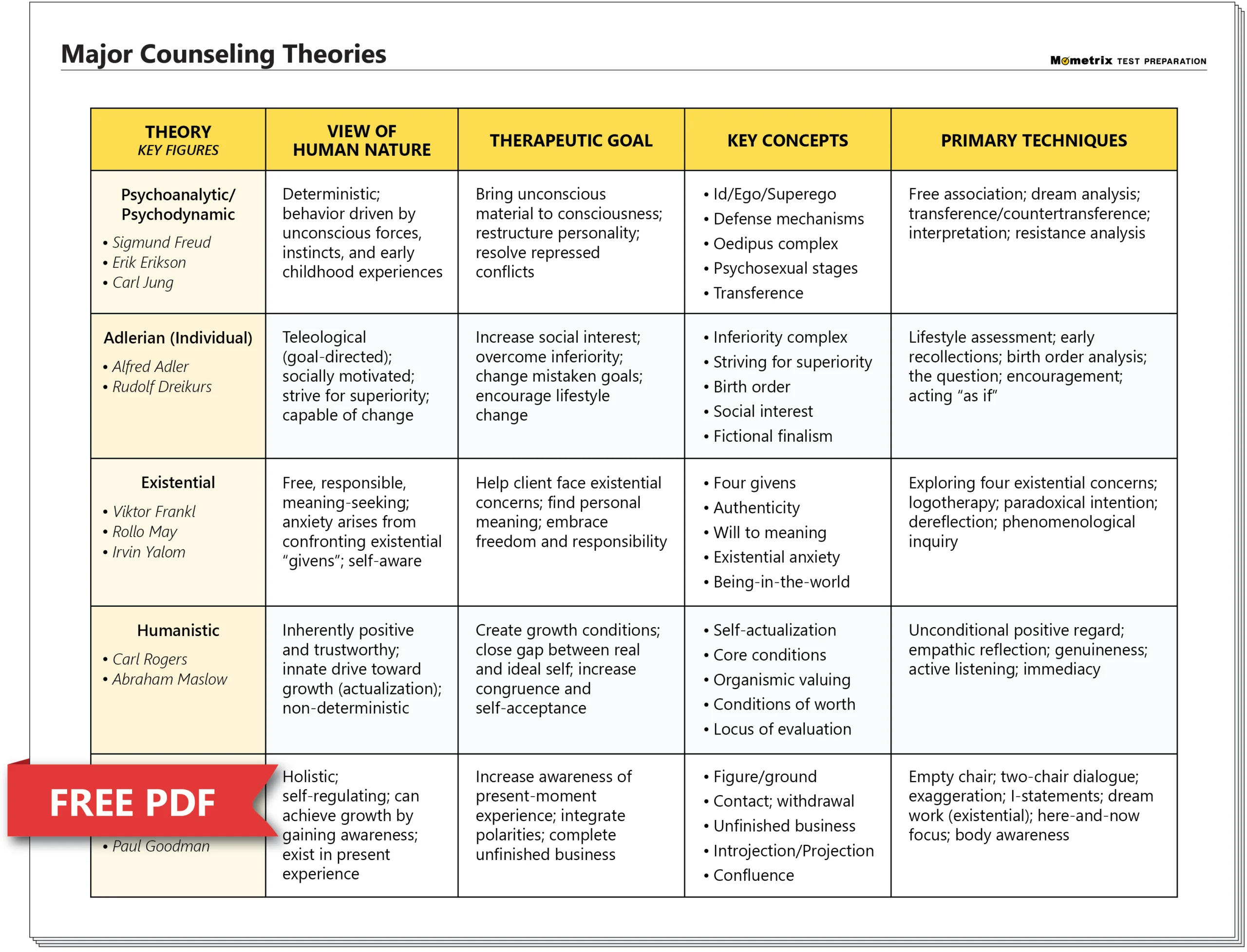
Comparing Counseling Theories
To excel on the NCMHCE, you need to be familiar with several counseling theories, and trying to remember the similarities and differences can quickly become overwhelming.
To help you compare major counseling theories quickly and accurately, we’ve compiled the most important theories in one place, including key founders, core ideas, goals, and common techniques.
Of the 130–150 questions on the NCMHCE, 100 are scored. Your raw score is based on the number of scored questions you answer correctly. The passing score is established through a standard-setting process and may vary slightly between exam forms because of differences in difficulty.
Q
How much does it cost to take the NCMHCE?
A
To register to take the NCMHCE, you will be required to pay $275. This fee is nontransferable and nonrefundable.
Q
What does NCMHCE stand for?
A
NCMHCE stands for National Clinical Mental Health Counseling Examination.
Q
What is the NCMHCE exam?
A
The NCMHCE exam is a national exam that is required for those who wish to become a Certified Clinical Mental Health Counselor.
Q
How long do you have to take the NCMHCE?
A
The time limit for the exam is 3 hours and 45 minutes.
By Peter Rench
Peter Rench joined Mometrix in 2009 and serves as Vice President of Product Development, responsible for overseeing all new product development and quality improvements. Mr. Rench, a National Merit Scholar, graduated magna cum laude with a Bachelor of Science in Mechanical Engineering and a minor in mathematics from Texas A&M University.
Edited by Aaron Lanni
Aaron is the content manager and lead editor for Mometrix Academy. He regularly produces, updates, proofreads, and edits content to ensure it meets Mometrix’s quality and accessibility standards.
NCMHCE is a registered trademark of National Board for Certified Counselors, Inc., which is not affiliated with Mometrix Test Preparation and does not endorse this page.