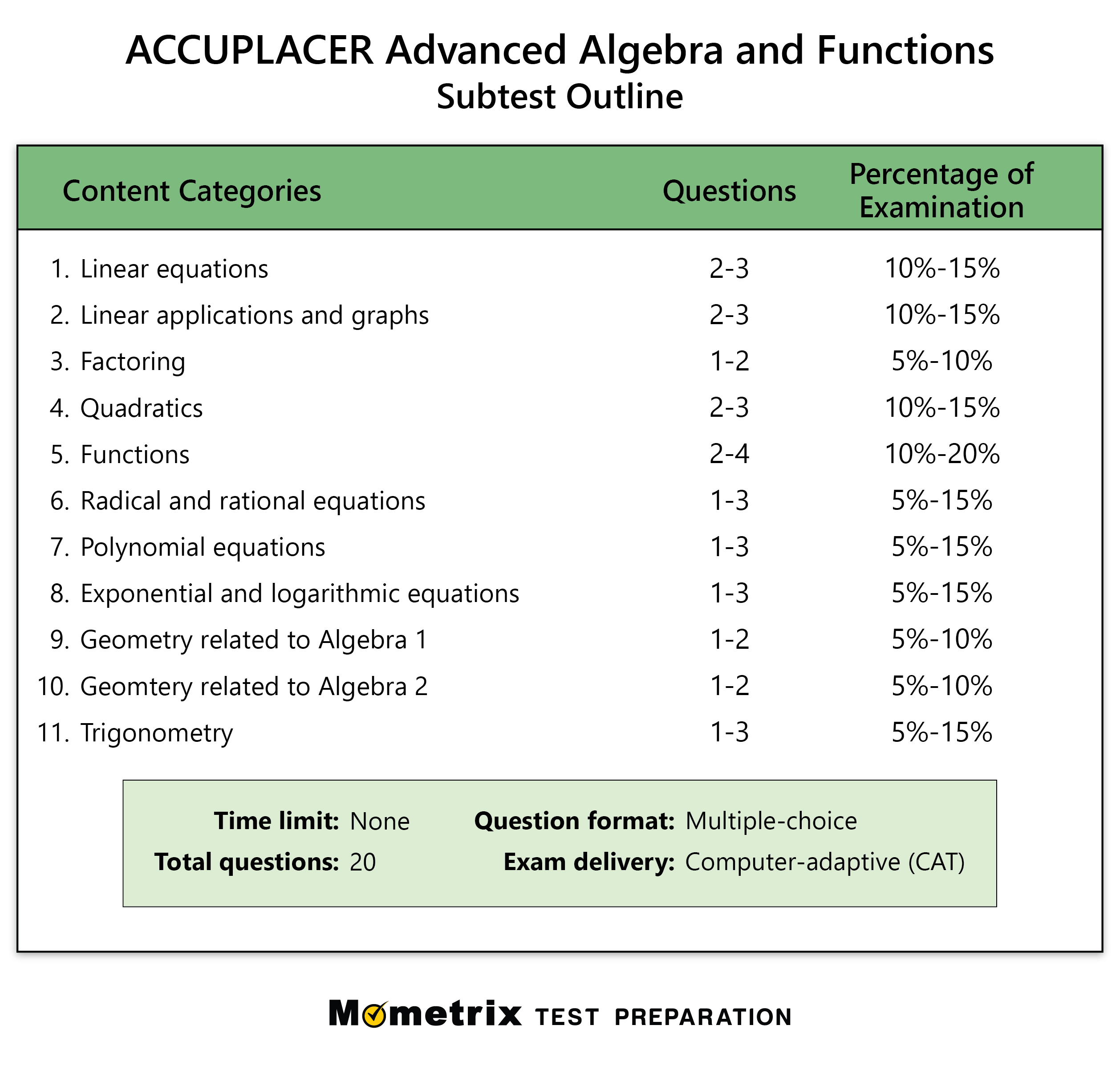
The ACCUPLACER® Advanced Algebra and Functions test is a computer-adaptive test comprised of 20 questions that assess your advanced algebra knowledge. To help you prepare for this section of the ACCUPLACER, this page contains everything you need to know, including what topics are covered, how many questions there are, and how you can study effectively.
Click “Start Test” above to take a free ACCUPLACER Advanced Algebra and Functions practice test!
What’s on the Test?
ACCUPLACER Advanced Algebra Practice Questions
One of the best ways to test your knowledge is by taking a practice test. Evaluate your algebra skills by trying your hand at the four practice questions below!
Answer each question and read through the answer explanation, whether you got the answer right or wrong. This will help you ensure you’ve got the topic mastered.
Whether you struggled with these questions or aced them on your first try, be sure to take the full practice test to get a better idea of how prepared you really are!
1. Two companies offer monthly cell phone plans, both of which include free text messaging. Company A charges a $25 monthly fee plus five cents per minute of phone conversation, while Company B charges a $50 monthly fee and offers unlimited calling.
At what total duration of monthly calls do both companies charge the same amount?
\($25+$0.05m=$50\)
\($0.05m=$25\)
\(m=500\)
2. In the triangle below, which of the following is equal to \(\sin \theta\) ?

\(\frac{\sin A}{a}=\frac{\sin B}{b}=\frac{\sin C}{c}\)
In this case, \(\angle \theta\) is opposite side \(a\), and the angle with a measure of 30° is opposite side \(b\), so we can write \(\frac{\sin \theta}{a}=\frac{\sin 30°}{b}\). Since \(\sin 30°=\frac{1}{2}\), this becomes \(\frac{\sin \theta}{a}=\frac{\frac{1}{2}}{b}\), or \(\sin \theta=\frac{a}{2b}\).3. What is \(\log_5(5^3)\) ?
Therefore, \(\log_5 (5^3 )=3\).
4. If \(3^x=2\), then what is the value of \(x\) ?
Then we have \(\log_3(3^x)=\log_32\), or simply \(x=\log_32\).
Alternatively, just keep in mind that \(a^b=c\) is equivalent to \(\log_ac=b\) for any positive \(a\) and \(c\), so \(3^x=2\) is equivalent to \(\log_32=x\).

ACCUPLACER Online Prep Course
If you want to be fully prepared, Mometrix offers an online ACCUPLACER prep course designed to give you everything you need to succeed!
Here’s what you’ll find in the ACCUPLACER course:
- 70+ Review Lessons Covering Every Topic
- Over 1,750 ACCUPLACER Practice Questions
- 550+ Digital Flashcards
- 270+ Instructional Videos
- Money-back Guarantee
- Mobile Access
Everyone learns differently, so we’ve tailored the ACCUPLACER online prep course to ensure every learner has what they need to prepare for the ACCUPLACER exam.
Click below to check it out!
FAQs
Q
How many questions are on the test?
A
There are 20 questions in total on the ACCUPLACER Advanced Algebra and Functions subtest.
Q
How do you pass the ACCUPLACER Advanced Algebra and Functions test?
A
There is no "pass/fail" scoring system for this subtest. Your score will be placed on a score range of 200-300. Your placement on that range will indicate your mathematics knowledge and abilities.
To achieve a high score, you will need to spend an adequate amount of time studying for the test.
Q
What is a good score on the ACCUPLACER Advanced Algebra and Functions test?
A
Your test score will be placed on a score range of 200-300. Within that range are five score bands:
- 200-236
- 237-249
- 250-262
- 263-275
- 276-300
A good score to aim for is the 263-275 score band.


ACCUPLACER® is a trademark registered by the College Board, which is not affiliated with, and does not endorse, this page.