The TOEFL iBT® test, which is administered by the Educational Testing Service (ETS), is used to assess the English-speaking skills of non-native learners of English, primarily in the college enrollment process. The TOEFL iBT is administered via the internet and tests how strong an English speaker’s reading, listening, speaking, and writing skills are.
If you need some extra practice in a specific subject, click one of the subjects below to get started on a subject-specific TOEFL practice test!
TOEFL Test Outline
The TOEFL iBT test contains 120 questions, and it takes about 2 hours to complete. The test is adaptive, so the actual testing time and number of questions varies.
The exam is split into four sections:
1. Reading (50 questions | 30 minutes)
The questions in the Reading section are designed to test your reading comprehension skills. Within the 50 questions, there are a few different task types:
Complete the Words
For these tasks, you’ll be tested on your ability to comprehend the overall meaning and form of a paragraph (70-100 words). The first sentence of the paragraph is fully intact, while the rest of the paragraph contains 10 words with missing letters. You’ll be asked to fill in those missing letters.
The missing words were: might, that, people, only, basic, However, is, from, record, dancing.
Read in Daily Life
For these tasks, you’ll be shown a short, non-academic text that you might encounter during daily life (menu, email, receipt, etc.). The text will be 15-150 words long, and you’ll be given a few multiple-choice questions to answer for each one.
From: East Hall Package Center
Subject: Change to Friday pickup hours
Hello residents,
The East Hall Package Center will close at 3:00 p.m. this Friday so the staff can complete inventory. If you receive a delivery notice on Friday, collect your package before 3:00 p.m. or wait until the center reopens at 9:00 a.m. Monday. Packages already placed in electronic lockers are not affected; you may retrieve those at any time using the code sent to your phone.
The email explains that the package center will close early on Friday and tells residents when and how they can collect their packages.
Read an Academic Passage
For these tasks, you’ll be asked to read short expository passages and answer five questions about each one. The passages are about 200 words in length and cover topics such as art, economics, history, and science.
Cities are often warmer than the rural areas surrounding them, a phenomenon known as the urban heat island effect. One cause is the widespread use of materials such as asphalt and concrete. These materials absorb solar energy during the day and release it slowly after sunset. Cities also tend to have fewer plants than rural areas. Plants cool the air through shade and through evapotranspiration, a process in which water moves from the soil through plants and into the atmosphere. Human activities, including transportation and air-conditioning, add still more heat. Because several factors contribute to urban warming, researchers generally recommend using several cooling strategies together. Planting trees and installing green roofs can increase shade and evapotranspiration, while light-colored roofs and pavement can reflect more solar energy. The effectiveness of each strategy varies with local climate, available water, and the design of the surrounding buildings.
The passage describes several causes of the urban heat island effect and explains that a combination of strategies is generally needed to reduce it.
2. Listening (47 questions | 29 minutes)
The questions in the Listening section are designed to test your ability to understand spoken conversations in English, including your ability to identify the speaker’s attitude/tone. Within the 47 questions, there are a few different task types:
Listen and Choose a Response
For these tasks, you’ll be tested on your ability to understand a short, spoken question or statement and respond accordingly. You’ll hear an audio recording of someone asking a question or saying a statement, then select the best response from four given choices.
Audio: “Does the bookstore close at eight?”
Choice A directly answers the question by explaining that the bookstore closes earlier on Fridays.
Listen to a Conversation
For these tasks, you’ll be tested on your ability to understand a conversation in modern academic situations, make inferences and predictions, and respond accordingly. You’ll hear an audio recording of a conversation between two people, then select the best response from four given choices.
Woman: I just found out the economics review session was moved from Wednesday afternoon to Thursday morning.
Man: That’s when I have my chemistry lab. Did the professor say whether she’ll post the material online?
Woman: She’ll post the notes, but she said the session will cover some exam questions that aren’t in them.
Man: In that case, I’ll see if my lab partner can switch times with me.
The man says he will ask his lab partner to switch times, so he will probably try to change his laboratory schedule.
Listen to an Announcement
For these tasks, you’ll be tested on your ability to understand a short academic-related announcement and respond accordingly. You’ll hear an audio recording of a broadcasted message (40-85 words), then select the best response from four given choices.
Announcement:
“Attention students using the west parking lot. Beginning Tuesday, the pedestrian bridge connecting the lot to campus will be closed for repairs. The lot itself will remain open, but drivers must walk to campus using the path beside the science building. Please allow about ten extra minutes. The bridge is expected to reopen Friday morning, and campus buses will follow their regular routes throughout the week.”
Students are told that the alternate walking route will take longer, so they should allow extra time to reach campus.
Listen to an Academic Talk
For these tasks, you’ll be tested on your ability to understand an academic talk given by a teacher and respond accordingly. You’ll hear an audio recording of a talk (100-250 words) about history, art, music, science, or economics, then select the best response from four given choices.
Academic Talk:
“Today we’re going to look at the role of fire in forest ecosystems. People often think wildfire only destroys habitat, but some forests depend on periodic, low-intensity fires. These fires clear dead leaves and small plants from the forest floor, returning nutrients to the soil and allowing sunlight to reach young growth. Certain trees have adapted directly to fire. Lodgepole pines, for example, produce cones sealed with resin. Heat from a fire melts the resin, so the cones open and release seeds onto newly cleared ground. However, this doesn’t mean every fire benefits a forest. When fires are suppressed for many years, branches and other fuel accumulate. A later fire may burn so intensely that it damages the soil and kills mature trees that might survive smaller fires. For that reason, land managers sometimes use carefully controlled burns to imitate the natural fire cycle and reduce the chance of a severe wildfire.”
The lodgepole pine illustrates how some trees have adapted to fire: heat opens their cones and allows them to release seeds.
3. Writing (12 questions | 23 minutes)
The Writing section requires you to express your thoughts and opinions clearly and cohesively in writing. Within this section, there are a few different task types:
Build a Sentence
For these tasks, you’ll be given two sentences. The first sentence is fully intact, while the second sentence contains words or phrases that are out of order. You’ll be tasked with moving the words and phrases around to form a grammatical sentence that makes sense in context with the first sentence.
First sentence: Lena had to miss the study group because of work.
Your sentence
Available phrases
She asked her classmates to send her the notes they had taken.
Write an Email
For these tasks, you’ll be given an academic or social scenario. You’ll then have seven minutes to share information in a specific communicative way (a recommendation, an invitation, a solution to a problem, etc.).
Your campus environmental club is planning a volunteer event. The club president, Elena Ruiz, has asked members to suggest an activity.
Write an email to Elena. In your email:
- recommend a volunteer activity
- explain how it would benefit the community
- suggest when and how club members could participate
Dear Elena,
I recommend organizing a Saturday cleanup at Riverside Park. The park is used by many families, but litter often collects near the walking paths and picnic area. Removing it would make the park safer and more pleasant while also protecting local wildlife.
We could hold the cleanup from 9:00 a.m. to noon next month. Club members could work in small groups, and the city’s parks department might provide gloves, trash bags, and recycling bins.
Best,
Jordan Lee
Self-review checklist
- Did you address all three instructions?
- Is your recommendation specific and clearly explained?
- Does your email use an appropriate, courteous tone?
- Are your ideas organized and easy to understand?
This is one effective response, not the only acceptable answer.
Write for an Academic Discussion
For these tasks, you’ll be provided with a simulated online class discussion forum containing a post from the professor and two brief posts from students. The professor’s post frames the topic/issue at hand and suggests a related opinion to be discussed, and the students’ posts provide different positions on the topic/issue. You’ll have 10 minutes to write out your own opinion on the topic/issue, usually around 100 words.
Some universities require students to take at least one course outside their major in an area such as art, literature, or music. Do you think this type of requirement benefits students? Why or why not?
I support the requirement because students may discover interests they would not explore on their own. Studying another subject can also help them approach problems from a different perspective.
I disagree. Degree programs are already expensive, and students should be able to spend their limited time and money on courses that directly prepare them for their careers.
I agree with Mina that taking a course outside one’s major can expose students to new perspectives. It can also develop skills that remain useful in many careers. For example, an engineering student who takes a literature course may become better at interpreting complex ideas and explaining them clearly. Although Daniel is right that college is expensive, one carefully chosen course is unlikely to delay graduation if it is included in the degree requirements. Universities should therefore keep the requirement but offer a broad selection of qualifying courses. That would give students the benefits of exploring another field while allowing them to choose a subject that fits their interests and goals.
Self-review checklist
- Did you clearly state your position?
- Did you support it with a reason or example?
- Did you add to the discussion instead of merely repeating another student?
- Is your response organized and easy to understand?
This is one effective response, not the only acceptable answer.
4. Speaking (11 questions | 8 minutes)
The Speaking section requires you to express your thoughts and opinions clearly and cohesively through speech. Within this section, there are two different task types:
Listen and Repeat
For these tasks, you’ll be tested on your ability to comprehend what you hear and intelligibly reproduce it. You’ll hear a series of sentences, and after each sentence, there will be a pause for you to repeat what was said. The sentences become longer and more complex as you go.
Speaking prompt
Listen carefully
The student orientation schedule has been updated to include a library tour on Thursday afternoon.
Self-review checklist
- Did you repeat the complete sentence without adding or omitting words?
- Was your speech clear and easy to understand?
- Did you keep a natural pace rather than rushing?
Take an Interview
For this task, you’ll take part in a simulated conversation with an interviewer (who is pre-recorded). You’ll be asked four questions related to the topic at hand, and you’ll have 45 seconds to answer each question, drawing from personal experience, factual information, and personal opinions when necessary.
Interview question
Listen, then respond
Practice timer only. No microphone access is requested and no audio is saved.
Some students prefer studying alone, while others prefer studying with a group. Which do you prefer, and why?
Self-review checklist
- Did you answer the question directly?
- Did you give at least one clear reason?
- Did you include a specific example or useful detail?
- Was your response organized and easy to follow?
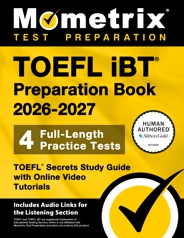
Check out Mometrix's TOEFL Study Guide
Get practice questions, video tutorials, and detailed study lessons.
Registration
You can register for the TOEFL test by visiting the ETS website and creating an account. There, you will have two test-taking options to choose from: internet-based testing at a testing center or internet-based testing at home. Once you choose your testing method, you will be able to schedule your exam date and location. The examination fee, which varies depending on where you take the exam, must be paid at this time.
How to Pass
Think you aren’t a good test-taker? Maybe on a study-time crunch? Or just don’t know how to begin studying? Mometrix has designed a new Study Secrets course to help every student, no matter what study scenario you are in. Here’s what you’ll find in the Study Secrets Course:
- Techniques to Conquer Procrastination
- Steps to building a Study Plan custom to your learning style
- 7 Effective Note-Taking Methods
- Test-Taking Tips
- Memory Techniques and Mnemonics
- And much more!
Everyone learns differently, so we’ve tailored our Study Secrets Course to ensure every learner has what they need to prepare for their upcoming exam or semester. Click below to check it out!
Test Day
Regardless of your test-taking method of choice, you should be at your designated area at least 30 minutes prior to the scheduled exam time to allow time for the check-in process. You will be asked to provide a valid, government-issued photo ID. If you fail to bring your ID or your ID is invalid, you will not be permitted to take the test. Your photo will then be taken and will appear on the screen during your exam.
In-person Testing
Before you enter the testing room, you will be asked to leave all personal items, such as your cell phone, in a secure locker. You will also be asked to sign a confidentiality agreement.
Once the proctor has determined you are ready, they will assign you a seat in the testing room and provide you with pencils and scratch paper for notes.
Remote Testing
You will be asked to scan your testing area with your webcam so the proctor can ensure that there are no prohibited items in the room and that there are no other people in the room with you. You will also be asked to sign a confidentiality agreement.
Once the proctor has determined you are ready, they will begin the exam for you.
How the TOEFL Exam is Scored
TOEFL scores are reported on a 1–6 scale in half-point increments. You will receive a score for each of the four main sections as well as an overall score.
Your overall score is calculated by averaging your four section scores and rounding that average to the nearest half band. For example, if your four section scores average 5.25, your overall score is reported as 5.5.
Your official score report will also include a comparable overall score on the previous 0–120 scaled scoring system. This comparable score is provided to help schools and test takers during the transition to the new scoring scale. Each institution sets its own TOEFL score requirements, so the score you need depends on the schools, programs, or agencies where you plan to apply.
Check out Mometrix's TOEFL Flashcards
Get complex subjects broken down into easily understandable concepts.

How to Study for the TOEFL
How to Study Effectively
Your success on TOEFL test day depends not only on how many hours you put into preparing but also on whether you prepared the right way. It’s good to check along the way to see whether your studying is paying off. One of the most effective ways to do this is by taking TOEFL practice tests to evaluate your progress. Practice tests are useful because they show exactly where you need to improve. Every time you take a free TOEFL practice test, pay special attention to these three groups of questions:
- The questions you got wrong
- The ones you had to guess on, even if you guessed right
- The ones you found difficult or slow to work through
This will show you exactly what your weak areas are and where you need to devote more study time. Ask yourself why each of these questions gave you trouble. Was it because you didn’t understand the material? Was it because you didn’t remember the vocabulary? Do you need more repetitions on this type of question to build speed and confidence? Dig into those questions and figure out how you can strengthen your weak areas as you go back to review the material.
Answer Explanations
Additionally, many TOEFL practice tests have a section explaining the answer choices. It can be tempting to read the explanation and think that you now have a good understanding of the concept. However, an explanation likely only covers part of the question’s broader context. Even if the explanation makes sense, go back and investigate every concept related to the question until you’re positive you have a thorough understanding.
Comprehend Each Topic
As you go along, keep in mind that the TOEFL practice test is just that: practice. Memorizing these questions and answers will not be very helpful on the actual test because it is unlikely to have any of the same exact questions. If you only know the right answers to the sample questions, you won’t be prepared for the real thing. Study the concepts until you understand them fully, and then you’ll be able to answer any question that shows up on the test.
Strategy for TOEFL Practice
When you’re ready to start taking practice tests, follow this strategy:
- Remove Limitations. Take the first test with no time constraints and with your notes and TOEFL study guide handy. Take your time and focus on applying the strategies you’ve learned.
- Time Yourself. Take the second practice test “open book” as well, but set a timer and practice pacing yourself to finish in time.
- Simulate Test Day. Take any other practice tests as if it were test day. Set a timer and put away your study materials. Sit at a table or desk in a quiet room, imagine yourself at the testing center, and answer questions as quickly and accurately as possible.
- Keep Practicing. Keep taking practice tests on a regular basis until you run out of practice tests or it’s time for the actual test. Your mind will be ready for the schedule and stress of test day, and you’ll be able to focus on recalling the material you’ve learned.
FAQs
Q
What is TOEFL?
A
TOEFL iBT stands for "Test of English as a Foreign Language (internet-based test)" and is used to test the English skills of non-native English learners.
Q
What is a good TOEFL score?
A
A good TOEFL score is the score required by the schools or programs where you plan to apply.
Q
How long is the TOEFL test?
A
The time limit for the exam is about 2 hours.
Q
How many questions are on the TOEFL test?
A
There are 120 questions on the exam.
Q
How long is my TOEFL score valid?
A
Your TOEFL score will remain valid for 2 years.
Q
How much is the TOEFL test?
A
The exam fee for the TOEFL varies depending on where you take it.


TOEFL and TOEFL iBT are registered trademarks of Educational Testing Service, which is not affiliated with Mometrix Test Preparation and does not endorse this page.