The Quantitative Reasoning test on the GRE® assesses your knowledge of basic arithmetic, algebra, geometry, and data analysis. To help you prepare for this section of the GRE, this page contains everything you need to know, including what topics are covered, how many questions there are, and how you can study effectively.
Click “Start Test” above to take a free GRE Quantitative Reasoning practice test!
What’s on the GRE Quantitative Reasoning Test?
| Section | Questions | Time Limit |
|---|---|---|
| Section 1 | 12 | 21 minutes |
| Section 2 | 15 | 26 minutes |
There are three types of quantitative reasoning questions.
- Quantitative Comparison: You must compare two given quantities and determine which quantity is greater (or if they are equal).
- Multiple-Choice: You must choose one or more correct answers from a list of five answer choices.
- Numeric Entry: You must enter your answer into a single box as a decimal or as an integer, or you must enter your answer as a fraction into two separate boxes.
Click below to see all of the formulas you should know:
GRE Formulas
- Arithmetic and Number Properties
- Types of Numbers
- Order of Operations: PEMDAS
- Commutative, Associative, and Distributive Properties
- Prime Numbers
- Factorization
- Divisibility
- Absolute Values
- Fast Fractions
- Percentages
- Ratios
- Powers and Roots
- Exponents
- Roots
- Algebra
- Simplifying Expressions
- Factoring
- Solving Equations
- Geometry
- Angles
- Polygons
- Triangles
- Circles
- Squares
- Rectangles
- Trapezoids
- Quadrilaterals
- 3-D Shapes
- Coordinate Geometry
- Lines
- The Distance Formula
- Quadratics
- Word Problems
- Distance, Rate, and Time
- Work Rate
- Sequences
- Interest
- Statistics
- Counting
- Probability
GRE Quantitative Practice Questions
One of the best ways to test your knowledge is by taking a practice test. Evaluate your math skills by trying your hand at the three practice questions below!
Answer each question and read through the answer explanation, whether you got the answer right or wrong. This will help you ensure you’ve got the topic mastered.
Whether you struggled with these questions or aced them on your first try, be sure to take the full practice test to get a better idea of how prepared you really are!
1. How many odd prime factors does 368 have?
\(368=2\times 2\times 2\times 2\times 23\)
The number 23 is the only odd prime factor, so the correct answer is 1.2. Based on the rounded percentage data in the chart below, assuming a total of 125 students were polled, which of the following statements is definitely NOT true?
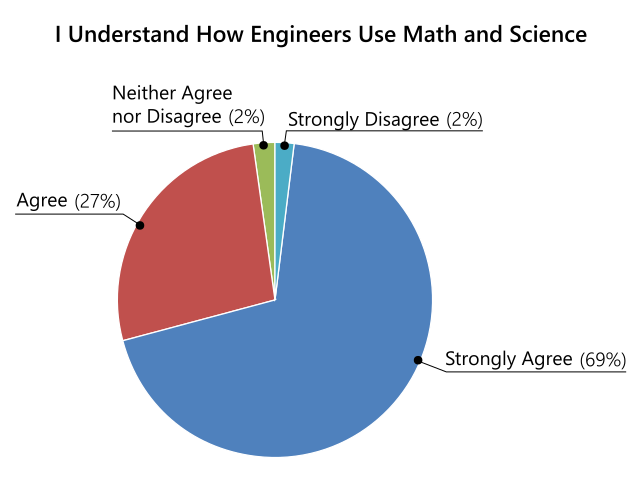
“Strongly disagree” and “neither agree nor disagree” students would each be \(\frac{3}{125}=2.4\%\) of the total. “Agree” students would be \(\frac{34}{125}=27.2\%\). “Strongly agree” students would be \(\frac{86}{125}=68.8\%\).
All these percentages round to the numbers shown in the chart, so none are definitely false.
3. Octagon \(ABCDEFGH\) contains five squares (\(S\)) and four triangles (\(T\)). The length of side \(AB\) is 6. What is the sum of the areas of the five squares?
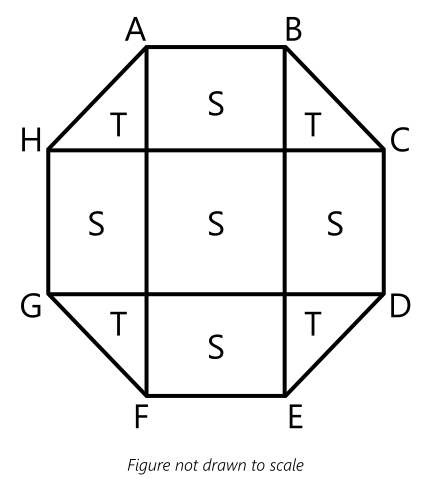
The sum of the areas of the five squares is \(5A=(5)(36)=180\).

GRE Online Prep Course
If you want to be fully prepared, Mometrix offers an online GRE prep course designed to give you everything you need to succeed!
Here’s what you’ll find in the GRE course:
- 70+ Review Lessons Covering Every Topic
- Over 600 GRE Practice Questions
- 300+ Digital Flashcards
- 270+ Instructional Videos
- Money-back Guarantee
- Mobile Access
Everyone learns differently, so we’ve tailored the GRE online prep course to ensure every learner has what they need to prepare for the GRE exam.
Click below to check it out!
FAQs
Q
How many questions are on the exam?
A
There are 27 questions on the Quantitative Reasoning test.
Q
How long is the exam?
A
The Quantitative Reasoning test is timed at 47 minutes.
Q
What is a passing score?
A
There is no set passing score for the Quantitative Reasoning test.


GRE and Graduate Record Examinations are registered trademarks of Educational Testing Service, which is not affiliated with Mometrix Test Preparation and does not endorse this page.