
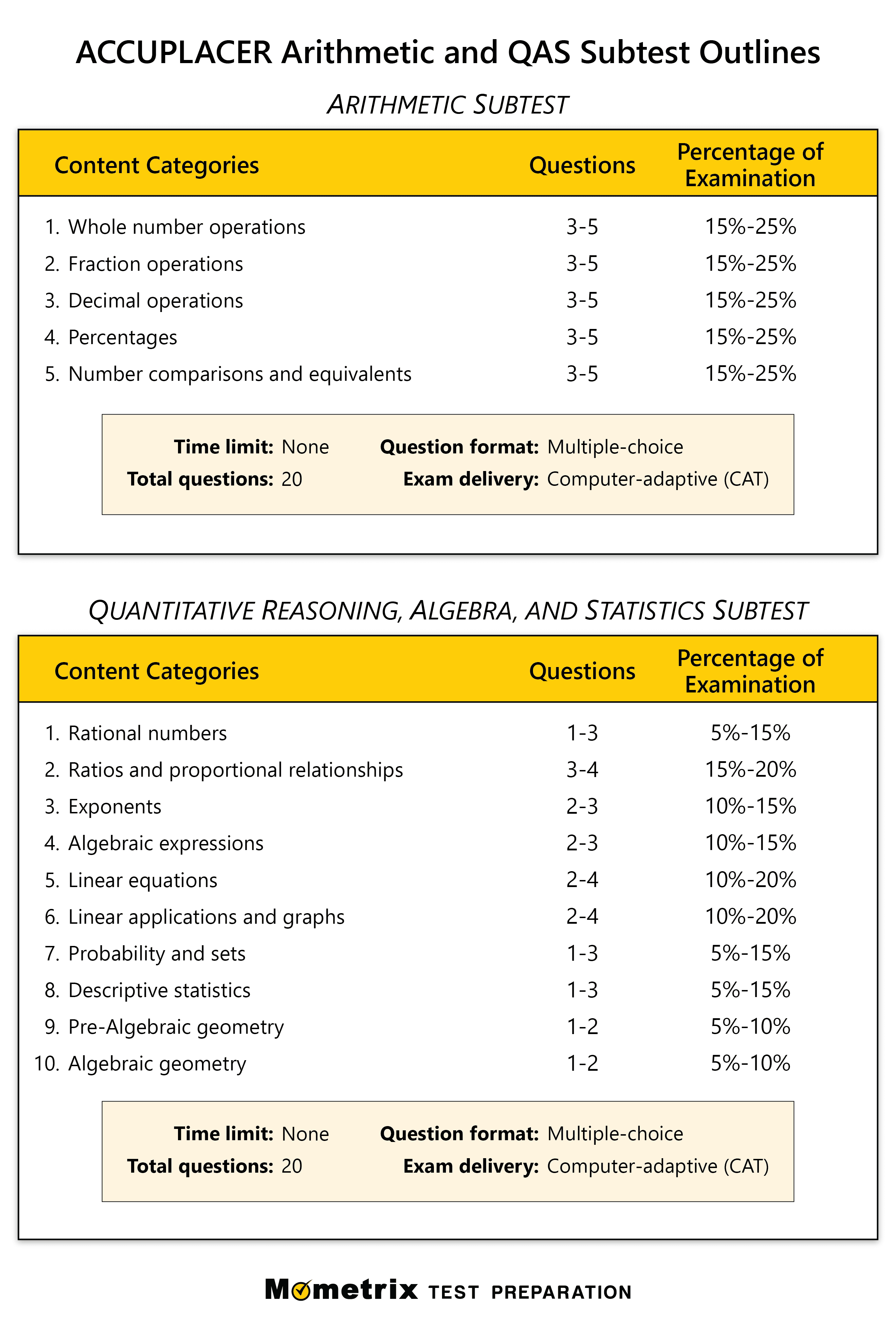
The ACCUPLACER® Arithmetic, Quantitative Reasoning, Algebra, and Statistics tests are computer-adaptive tests comprised of 20 questions of varying complexities. To help you prepare for these sections of the ACCUPLACER, this page contains everything you need to know, including what topics are covered, how many questions there are, and how you can study effectively.
Click “Start Test” above to take a free ACCUPLACER Arithmetic practice test!
What’s on the Test?
ACCUPLACER Arithmetic Practice Questions
One of the best ways to test your knowledge is by taking a practice test. Evaluate your math skills by trying your hand at the five practice questions below!
Answer each question and read through the answer explanation, whether you got the answer right or wrong. This will help you ensure you’ve got the topic mastered.
Whether you struggled with these questions or aced them on your first try, be sure to take the full practice test to get a better idea of how prepared you really are!
1. Which of the following is NOT equal to the others?
\(dfrac{10}{3}=dfrac{(10times 3)}{(3times 3)}\)\(:=dfrac{30}{9}\)
To convert a mixed number to a fraction, multiply the integer part by the denominator and add the product to the numerator; this becomes the numerator of the improper fraction, while the denominator remains the same.\(2 large{frac{4}{3}}normalsize{:=dfrac{(2times 3+4)}{3}}\)\(:=dfrac{10}{3}\)
Note that \(2 frac{4}{3}\) is a nonstandard mixed number because it has an improper fractional component; nevertheless, it is equivalent to \(frac{10}{3}\) and \(frac{30}{9}\). The mixed number \(3 frac{2}{3}\) is a nonequivalent mixed number:\(3 large{frac{2}{3}}normalsize{:=dfrac{(3times 3+2)}{3}=dfrac{11}{3}}\)\(: neq dfrac{10}{3}\)
As a standard mixed number, \(frac{10}{3}\) would be equal to \(3 frac{1}{3}\).2. A reporter for a school newspaper surveys the students at the school to ask if they prefer chocolate, vanilla, or strawberry ice cream. Of the students who answer her question, 35% prefer vanilla, and 40% prefer chocolate.
What percent of the students she surveyed prefer strawberry?
\((35%+40%)=100%-75%=25%\)
3. Simplify the following expression:
\(dfrac{2}{3} (3-2)+dfrac{1}{2} (2-4)\)
\(dfrac{2}{3} (1)+dfrac{1}{2} (-2)\)
Then, simplify the multiplication.\(dfrac{2}{3}-dfrac{2}{2}\)
Next, simplify the fraction \(frac{2}{2}\).\(dfrac{2}{3}-1\)
Since we are subtracting fractions, change 1 to the equivalent fraction \(frac{3}{3}\) so the two fractions have the same denominator, and subtract the two fractions.\(dfrac{2}{3}-dfrac{3}{3}=-dfrac{1}{3}\)
4. 9.5% of the people in a town voted for a certain proposition in a municipal election. If the town’s population is 51,623, about how many people in the town voted for the proposition?
Therefore, about 5,000 people voted for the proposition.
5. Which of the following is the best estimate for the following:
To round 23.97124, look at the tenths place (9). Since this number is greater than or equal to 5, 23.97124 rounds up to 24.
To round 8.023 to the nearest whole number, look again at the tenths place (0). Since it is less than 5, 8.023 rounds down to 8.
Now these rounded numbers can be divided to find the best estimate: \(24div 8=3\). This means that 3 is the best estimate.

ACCUPLACER Online Prep Course
If you want to be fully prepared, Mometrix offers an online ACCUPLACER prep course designed to give you everything you need to succeed!
Here's what you'll find in the ACCUPLACER course:
- 70+ Review Lessons Covering Every Topic
- Over 1,750 ACCUPLACER Practice Questions
- 550+ Digital Flashcards
- 270+ Instructional Videos
- Money-back Guarantee
- Mobile Access
Everyone learns differently, so we've tailored the ACCUPLACER online prep course to ensure every learner has what they need to prepare for the ACCUPLACER exam.
Click below to check it out!
FAQs
Q
How many questions are on the test?
A
The arithmetic subtest contains 20 questions, and the QAS subtest contains 20 questions.
Q
How do you pass the ACCUPLACER math test?
A
There is no “pass/fail” scoring system for the ACCUPLACER math test. Your score will be placed on a score range of 200-300. Your placement on that range will indicate your mathematics knowledge and abilities.
To achieve a high score on the ACCUPLACER math test, you will need to spend an adequate amount of time studying for the test.
Q
What is a good score on the ACCUPLACER math test?
A
Your ACCUPLACER math test score will be placed on a score range of 200-300. Within that range are five score bands:
- 200-236
- 237-249
- 250-262
- 263-275
- 276-300
A good score to aim for is the 263-275 score band.


ACCUPLACER® is a trademark registered by the College Board, which is not affiliated with, and does not endorse, this page.