
Click “Start Test” above to start a free LSAT practice test with realistic Logical Reasoning and Reading Comprehension questions! This mock LSAT test is designed to help you practice the sections that count since the current LSAT no longer includes Logic Games.
LSAT Question of the Day
LSAT Practice Tests by Subject
If you need some extra practice in a specific subject, click one of the subjects below to get started on a subject-specific LSAT practice test.
Exam Eligibility
The only eligibility requirement for taking the LSAT is that you must be at least 18 years old.
What is on the LSAT Test?
The LSAT is split into two parts: a multiple-choice portion and a writing portion. The multiple-choice portion contains two Logical Reasoning (LR) sections and one Reading Comprehension (RC) section, plus an unscored section that covers either LR or RC content.

Argumentative Writing Section
The LSAT Argumentative Writing section is available to take separately from the rest of the exam, starting eight days before your scheduled test appointment. You are encouraged to take the writing test before taking the multiple-choice sections. Most schools require a writing sample as a part of their application packet.
In the writing section, you are presented with a situation, and you must choose between two positions or courses of action and defend your choice. This section provides you with an opportunity to demonstrate your argumentative writing skills. Your position must be clear and decisive with strong, supported criticism of the opposite position. Law schools are not looking for your expertise in law; they are evaluating your ability to organize your thoughts with clarity, using appropriate grammar and language, that shows an ability to defend your position.
Your full writing sample is sent to every school you apply to.
Multiple-Choice Sections
You have 35 minutes to complete each section (including the unscored section).
This section tests your ability to read and understand complex materials. Lawyers spend countless hours poring over lengthy documents, and law schools want to be certain their students possess the ability to read and comprehend various types of expository texts. Schools expect you to be able to make sense of unfamiliar and difficult information similar to what is found in cases, briefs, codes, contracts, decisions, and evidence.
There are four passages, each with 5-8 questions to answer. Your ability to understand structure, purpose, comparing and contrasting, and points of view are evaluated rather than your understanding of the facts.
Logical Reasoning (2 sections)
These sections, sometimes called the “argument” sections, present an array of arguments from an assortment of sources such as magazines, newspapers, professional journals, advertisements, and informal debates. You should be able to deconstruct the argument into its parts and recognize how those parts work together.
A lawyer’s success centers on the capacity to build a convincing argument based on the evidence available, as well as tearing down opposing viewpoints. As such, these questions assess your capability of disproving example theories and replacing them with rational conclusions of your own.
Top 5 Most Challenging LSAT Questions
Now that you know more about the test, try your hand at some targeted practice!
Over the last year, we’ve compiled the data from about 25,000 test-takers who tried their hand at the practice test at the top of this page. According to the data, around 65% of people answered these five questions incorrectly.
Answer each question and read through the answer explanation, whether you got the answer right or wrong. This will help you ensure you’ve got the topic mastered.
Whether you struggled with these questions or aced them on your first try, be sure to take the full practice test to get a better idea of how prepared you really are!
1. Read the passage below before answering the question:
 Read Passage
Marcel: But natural cleaning products are not as strong as the mainstream products and often fail to provide the same level of cleanliness. If parents keep the cleaning products out of reach, the products will not create a serious risk for children. And the mainstream cleaning products are more affordable for families.
Marcel responded to Adelaide’s argument by doing which of the following?
2. Read the passage below before answering the question:
Read PassageWhy did the author most likely mention the birds’ behavior at the bird feeder?
3. Read the passage below before answering the question:
Read PassageWhich of the following, if true, would do the LEAST to explain the lack of a rise in the averages wages in France following the drought?
4. Read the passage below before answering the question:
Read PassageWhich of the following may be inferred strictly based on the information provided in the passage?
5. Read the passage below before answering the question:
Read PassageWhich of the following, if true, would weaken the above conclusion?
Check Out Mometrix's LSAT Study Guide
Get practice questions, video tutorials, and detailed study lessons
Get Your Study Guide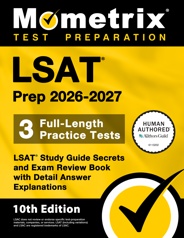
Registration
For test-takers in the US (including Puerto Rico and the US Virgin Islands) and Canada, the exam is offered from January through November, excluding March and May. For international test-takers, the exam is offered in January, April, June, and October. The LSAT registration deadline is one month before the exam date.
To register for the exam, you will create an account on the LSAC website. Through your account, you can complete the application, choose your test date, and pay the testing fee of $248.
LSAT Online Prep Course
If you want to be fully prepared, Mometrix offers an online LSAT prep course designed to give you everything you need to succeed!
Here’s what you’ll find in the LSAT course:
- 30+ Review Lessons Covering Every Topic
- Over 600 LSAT Practice Questions
- 250+ Digital Flashcards
- Money-back Guarantee
- Mobile Access
Everyone learns differently, so we’ve tailored the LSAT online prep course to ensure every learner has what they need to prepare for the LSAT exam.
Click below to check it out!

Test Day
You should arrive at the testing center at least 30 minutes before the scheduled start time to leave enough time for the check-in process. You will be asked to present two forms of valid identification, one of which must contain your photo.
Once your ID is checked, your picture will be taken and a digital image of your fingerprint will be taken. You will then be asked to put any personal items in a locker.
Remote Testing
There are three steps to prepare for the live remote-proctored test.
The first step is verifying that you have a compatible laptop or desktop computer with Chrome or Firefox web browser, a webcam, and a microphone. Your computer must have the Windows or Mac operating system with at least 1024 MB of RAM, administrative rights to install the proctoring software, and a strong internet connection.
The second step is to ensure you have a quiet, well-lit place to take the test with a table or desk to place your computer. Your testing area must be out of traffic, where you can take the test without interruption.
Lastly, you’ll need a valid photo ID to verify your identity. Your ID’s first and last name must match the legal name associated with your LSAC account.
LSAT Scores
Your LSAT score is based on your raw score, which is the number of questions you answered correctly. To determine your final score, your raw score is converted to a scaled score. The LSAT score range is 120 to 180. The LSAT does not have a passing score, but law schools may have a minimum score to be considered for admission. For example, an acceptable LSAT score for Yale or Harvard is 170-175.
Your score is released to your account and the schools you apply to three weeks after your test date.
There is an option to preview your LSAT score before it is released. This option lets you preview your score before it is released to your school. This program is called the LSAT Score Preview and costs $45 if you register for it before the first day of the test or $80 if you sign up after you take the test and before the score release date.
Retaking the LSAT
You can retake the LSAT three times in a testing year, five times within the last five testing years, or seven times over a lifetime. You have to pay the full registration fee with each retake. The admission committee of your school receives all reportable LSAT scores earned during the current testing year and the previous five testing years.
It is advisable to contact your school and discuss the influence multiple test scores may have on your prospect for admittance.
Check Out Mometrix's LSAT Flashcards
Get complex subjects broken down into easily understandable concepts
Get Your Flashcards
LSAT Test Study Tips
How to Study Effectively
Your success on LSAT test day depends not only on how many hours you put into preparing but also on whether you prepared the right way. It’s good to check along the way to see whether your studying is paying off. One of the most effective ways to do this is by taking LSAT practice tests to evaluate your progress. Practice tests are useful because they show exactly where you need to improve. Every time you take a free LSAT exam practice test, pay special attention to these three groups of questions:
- The questions you got wrong
- The ones you had to guess on, even if you guessed right
- The ones you found difficult or slow to work through
This will show you exactly what your weak areas are and where you need to devote more study time. Ask yourself why each of these questions gave you trouble. Was it because you didn’t understand the material? Was it because you didn’t remember the vocabulary? Do you need more repetitions on this type of question to build speed and confidence? Dig into those questions and figure out how you can strengthen your weak areas as you go back to review the material.
Answer Explanations
Additionally, many LSAT practice tests have a section explaining the answer choices. It can be tempting to read the explanation and think that you now have a good understanding of the concept. However, an explanation likely only covers part of the question’s broader context. Even if the explanation makes sense, go back and investigate every concept related to the question until you’re positive you have a thorough understanding.
Comprehend Each Topic
As you go along, keep in mind that the LSAT practice test is just that: practice. Memorizing these questions and answers will not be very helpful on the actual test because it is unlikely to have any of the same exact questions. If you only know the right answers to the sample questions, you won’t be prepared for the real thing. Study the concepts until you understand them fully, and then you’ll be able to answer any question that shows up on the test.
Strategy for LSAT Practice
When you’re ready to start taking practice tests, follow this strategy:
- Remove Limitations. Take the first test with no time constraints and with your notes and LSAT study guide handy. Take your time and focus on applying the strategies you’ve learned.
- Time Yourself. Take the second practice test “open book” as well, but set a timer and practice pacing yourself to finish in time.
- Simulate Test Day. Take any other practice tests as if it were test day. Set a timer and put away your study materials. Sit at a table or desk in a quiet room, imagine yourself at the testing center, and answer questions as quickly and accurately as possible.
- Keep Practicing. Keep taking practice tests on a regular basis until you run out of practice tests or it’s time for the actual test. Your mind will be ready for the schedule and stress of test day, and you’ll be able to focus on recalling the material you’ve learned.
FAQs
Q
What is the LSAT?
A
The Law School Admission Test (LSAT) is taken by law school applicants in the United States. It tests your knowledge and skills related to critical reasoning, argumentative writing, and reading comprehension.
Q
How long is the LSAT?
A
The multiple-choice section of the exam is timed at 140 minutes (2 hours and 20 minutes).
Q
What is a good LSAT score?
A
The average score for the LSAT is 150. Most law schools require a minimum score of 154-162 for admittance, with more prestigious schools like Stanford and Columbia requiring a score of 169 to 174.
Q
How hard is the LSAT?
A
The LSAT is considered to be a very difficult and rigorous exam, as it requires a lot of logical reasoning.
Q
How many times can you take the LSAT?
A
You can take the LSAT up to three times in a single testing year, five times within five years, and seven times total over your lifetime.
Q
What does LSAT stand for?
A
LSAT stands for Law School Admission Test.
Q
How many questions are on the LSAT?
A
There are approximately 100 multiple-choice questions on the exam.
Q
How much does the LSAT cost?
A
The examination fee is $248.
Q
Is there Analytical Reasoning on the LSAT?
A
As of August 2024, the Analytical Reasoning section has been removed from the exam.
Q
Does the LSAT still have Logic Games?
A
No. The Logic Games were removed from the LSAT beginning in August 2024.
Q
Is the LSAT taken online or in person?
A
The LSAT is offered in both remote (online) and in-person testing center formats.
Q
Is LSAT Writing scored?
A
No, LSAT Argumentative Writing is not scored, but your writing sample is sent to every law school you apply to.


LSAC does not review or endorse specific test-preparation materials, companies, or services. LSAT (including variations) and LSAC are registered trademarks of LSAC.


