Click “Start Test” above to start a free ACCUPLACER® practice test with realistic Reading, Writing, Arithmetic, QAS, and Advanced Algebra questions!
ACCUPLACER Practice Tests by Subject
If you need some extra practice in a specific subject, click one of the subjects below to get started on a subject-specific ACCUPLACER practice test.
ACCUPLACER Exam Outline
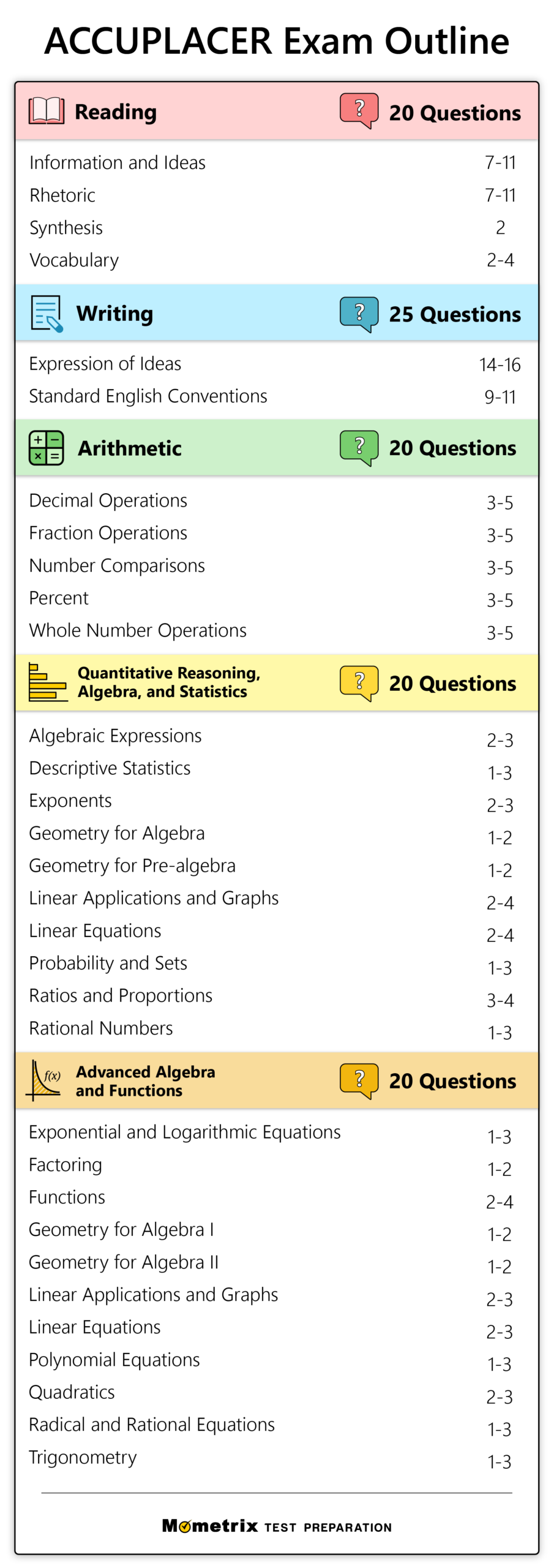
The ACCUPLACER is divided into the following placement tests:
- Reading
- Writing
- Arithmetic
- Quantitative Reasoning, Algebra, and Statistics (QAS)
- Advanced Algebra and Functions
Depending on your school’s policies, you may be asked to write an ACCUPLACER WritePlacer® Essay to further assess your writing skills.
Reading Placement Test
Broad knowledge and skill categories on the ACCUPLACER reading subtest include:
- Information and Ideas (7-11 questions)
- Determining central ideas and themes
- Reading closely
- Summarizing
- Understanding relationships
- Rhetoric (7-11 questions)
- Analyzing arguments
- Analyzing point of view
- Analyzing purpose
- Analyzing text structure
- Analyzing word choice rhetorically
- Synthesis (2 questions)
- Analyzing multiple texts
- Vocabulary (2-4 questions)
Writing Placement Test
Broad knowledge and skill categories on the ACCUPLACER writing subtest include:
- Expression of Ideas (14-16 questions)
- Development
- Effective Language Use
- Organization
- Standard English Conventions (9-11 questions)
- Conventions of Punctuation
- Conventions of Usage
- Sentence Structure
Arithmetic Placement Test
The knowledge and skills categories on the ACCUPLACER arithmetic subtest include:
- Decimal Operations (3-5 questions)
- Fraction Operations (3-5 questions)
- Number Comparisons and Equivalents (3-5 questions)
- Percent (3-5 questions)
- Whole Number Operations (3-5 questions)
Quantitative Reasoning, Algebra and Statistics Placement Test
The knowledge and skills categories on the ACCUPLACER quantitative reasoning, algebra, and statistics subtest include:
- Algebraic Expressions (2-3 questions)
- Descriptive Statistics (1-3 questions)
- Exponents (2-3 questions)
- Geometry Concepts for Algebra I (1-2 questions)
- Geometry Concepts for Pre-Algebra (1-2 questions)
- Linear Applications and Graphs (2-4 questions)
- Linear Equations (2-4 questions)
- Probability and Sets (1-3 questions)
- Ratio and Proportional Relationships (3-4 questions)
- Rational numbers (1-3 questions)
Advanced Algebra and Functions Placement Test
The knowledge and skills categories on the ACCUPLACER advanced algebra and functions subtest include:
- Exponential and Logarithmic Equations (1-3 questions)
- Factoring (1-2 questions)
- Functions (2-4 questions)
- Geometry Concepts for Algebra I (1-2 questions)
- Geometry Concepts for Algebra II (1-2 questions)
- Linear Applications and Graphs (2-3 questions)
- Linear Equations (2-3 questions)
- Polynomial Equations (1-3 questions)
- Quadratics (2-3 questions)
- Radical and Rational Equations (1-3 questions)
- Trigonometry (1-3 questions)
What is Computer-Adaptive Testing?
Each ACCUPLACER placement test is computer-adaptive, which means the difficulty of the questions changes based on how you answer them.
Here’s a look at how the system works:
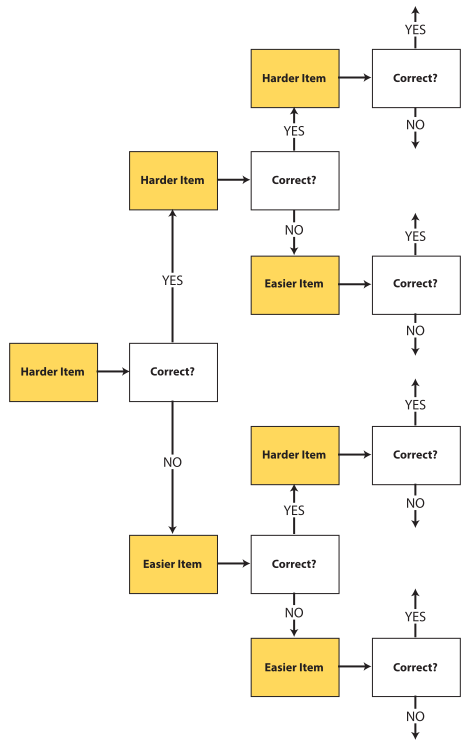
The first question is judged to be of medium difficulty, and depending on your performance, the next question may be easier or harder. If you do well on the first question, the second question will be harder; conversely, if you do poorly on the first question, the second question will be easy.

Check out Mometrix's ACCUPLACER Study Guide
Get practice questions, video tutorials, and detailed study lessons
Get Your Study Guide
Top 5 Challenging ACCUPLACER Questions
Now that you know more about the test, try your hand at some targeted practice!
Over the last year, we’ve compiled the data from about 10,000 test-takers who tried their hand at the practice test at the top of this page. According to the data, around 76% of people answered these five questions incorrectly.
Answer each question and read through the answer explanation, whether you got the answer right or wrong. This will help you ensure you’ve got the topic mastered.
Whether you struggled with these questions or aced them on your first try, be sure to take the full practice test to get a better idea of how prepared you really are!

1. What is the product of three consecutive odd integers, if the one in the middle is \(x\)?
\(x(x-2)(x+2)=x(x^2-4)\)\(\:=x^3-4x\)
2. The numbers of volunteers in different states (Texas and New Mexico) for 15 different events are shown in the table below. Which of the following statements best describes the number of volunteers that should be expected at the next event?


3. Read the passage below before answering the question:
This speech connects ideas about the American Revolution and the Civil War by saying that the ideas of the Civil War ___________.
Four score and seven years ago our fathers brought forth, upon this continent, a new nation, conceived in Liberty, and dedicated to the proposition that all men are created equal.
This introduces the point that Lincoln is trying to make about the battle at hand and the war as a whole: the Civil War is threatening the ideas upon which the nation was created.4. Which of the following represents the largest number?
\((\large{\frac{1}{3}}\normalsize{)}^{\large{-4}}\normalsize{\:=3}^{\large{4}}\)
\(9^{\Large{\frac{3}{2}}}\normalsize{\:=3}^{\large{3}}\)
\(27^{\Large{\frac{2}{3}}}\normalsize{\:=3}^{\large{2}}\)
\(3^{-\Large{\frac{25}{3}}}\normalsize{\: \lt 1}\)
Of the options, 34 is the highest positive power and hence represents the largest number.5. Students at Sunnyside High School participate in football and band. 35% of students play football and play in the band. 42% of students play football. Of the 42% of students that play football, approximately what percentage also play in the band?
Registration
If you would like to schedule an appointment to take the ACCUPLACER test, you will need to contact or visit your college advising and counseling office. In the event your institution is in another state, they will be able to advise you further on options and alternatives.
Test Day
Before you begin the test, you will be asked to provide a test administrator with your legal photo ID for safety and security purposes. Your college may ask you to bring special materials as well, so contact your test center for further details as part of your ACCUPLACER test prep.
You will also need to contact the test center in advance if you will require any disability accommodations.
ACCUPLACER Scores
As you prepare to take any of the ACCUPLACER subtests, it is important to remember there are no passing or failing scores. Instead, you will receive a score reflective of your personal skill and knowledge level in order to accurately place you into classes appropriate for your level.
For the Reading, Writing, Arithmetic, Quantitative Reasoning and Statistics, and Advanced Algebra and Functions tests, you’ll receive a score somewhere between 200 and 300.
Study Tips
Start with an ACCUPLACER Practice Test
Before creating your study schedule, contact your college or testing center and confirm which ACCUPLACER assessments you will take. Once you know your assigned tests, complete matching practice questions to establish a starting point.
Review your results by section and content area:
- Reading: Can you determine central ideas, identify supporting information, make reasonable inferences, analyze how a text is organized, synthesize information, and determine the meanings of words and phrases in context?
- Writing: Can you revise and edit multi-paragraph texts for organization, development, sentence structure, grammar, usage, and punctuation?
- Arithmetic: Are you comfortable with whole numbers, fractions, decimals, percentages, order of operations, estimation, and comparing equivalent numerical values?
- Quantitative Reasoning, Algebra, and Statistics: Can you work with rational numbers, ratios, exponents, algebraic expressions, linear equations, graphs, probability, descriptive statistics, and basic geometry?
- Advanced Algebra and Functions: Do you need more work with factoring, quadratics, functions, polynomial equations, rational and radical equations, exponentials, logarithms, or trigonometry?
- WritePlacer: Can you develop a focused position, organize your ideas, support them with relevant reasoning and examples, and maintain control of sentence structure and written English?
Identifying those specific weaknesses will show you where to devote more attention during your study time.
Review Difficult Questions
After each practice session, review every question you answered incorrectly AND every question you guessed on or answered with low confidence. Guessing correctly does not necessarily mean that you have mastered the skill.
For each difficult question, determine which of the following caused the problem:
- You did not understand the underlying reading, writing, or mathematical concept.
- You misunderstood the question or overlooked an important condition.
- You selected an answer that sounded reasonable but was not supported by the text.
- You confused the author’s main point with a supporting detail.
- You relied on how a sentence sounded instead of applying an editing rule.
- You corrected one part of a sentence while creating an error somewhere else.
- You selected the wrong mathematical operation or equation.
- You understood the math but made an arithmetic, algebra, sign, or unit error.
- You relied on a calculator without checking whether the result was reasonable.
- You had difficulty interpreting a graph, table, or real-world problem.
- You answered too quickly because the question appeared easy.
- You spent excessive time second-guessing a reasonable answer.
Then, outline a specific plan for improvement based on what you discovered. In other words, don’t just say, “I need to study math.” Note that you need to practice adding fractions with unlike denominators, solving linear equations, interpreting slope, or distinguishing exponential functions from linear functions.
For Writing, identify the exact type of editing decision involved. You may need to work on sentence boundaries, subject-verb agreement, pronoun clarity, modifier placement, logical transitions, paragraph organization, or removing irrelevant information.
Utilize Answer Explanations
Answer explanations are an underutilized studying resource. To take full advantage of them, read the explanation for every question you found difficult, including questions you answered correctly.
For each one, make sure you can confidently explain:
- Why the correct answer is correct
- Why each incorrect option is wrong
- What rule, concept, or skill is being tested
- How the same skill might appear in a different question
For Reading questions, return to the passage and identify the exact language supporting the answer. Separate what the text states from what you know or believe about the subject. An answer can sound logical while still going beyond the information provided.
For Math questions, solve the problem again from the beginning without copying the explanation. Write out the relevant relationship, show the calculations, confirm that the units are consistent, and check whether the result is reasonable.
Study College-Readiness Skills, Not Individual Questions
Memorizing the answer to one ACCUPLACER question will not prepare you for another question that tests the same skill using a different passage, sentence, equation, graph, or set of values.
For QAS and AAF, practice recognizing mathematical relationships in several forms. A linear relationship may appear as an equation, graph, table, or real-world description. A quadratic may be presented in standard form, factored form, through its zeros, or as a graph. Understanding only one presentation of a concept is not enough.
For Reading, practice identifying how information functions within a text. The objective is not to memorize facts from the passage’s subject. It’s to derive meaning from the text presented.
The exact questions on your test will be different from the ones you encounter during practice. If you can explain a skill without looking at your notes and then apply it correctly to a new question, that is a good indication that you have mastered it.

High School Student Toolkit: A Guide to College Success
Get expert tips on acing college applications, preparing for tests, managing finances, and navigating college life. Your guide to success starts here!
Online ACCUPLACER Test Prep Course
If you want to be fully prepared, Mometrix offers an online ACCUPLACER prep course designed to give you everything you need to succeed!
Here’s what you’ll find in the ACCUPLACER course:
- 70+ Review Lessons Covering Every Topic
- Over 1,750 ACCUPLACER Practice Questions
- 550+ Digital Flashcards
- 270+ Instructional Videos
- Money-back Guarantee
- Mobile Access
Everyone learns differently, so we’ve tailored the ACCUPLACER online prep course to ensure every learner has what they need to prepare for the ACCUPLACER test.
Click below to check it out!
Check out Mometrix's ACCUPLACER Flashcards
Get complex subjects broken down into easily understandable concepts
Get Your Flashcards
FAQs
Q
What is on the ACCUPLACER?
A
The main ACCUPLACER placement tests are Reading, Writing, Arithmetic, Quantitative Reasoning, Algebra, and Statistics, and Advanced Algebra and Functions. Some schools may also use the WritePlacer essay or ESL tests.
Q
Can you fail a placement test for college?
A
No, you cannot fail a placement test. However, a placement test will determine what courses you will need to be placed in when you begin college classes.
Q
Are you allowed to use a calculator on the ACCUPLACER?
A
You are allowed to use a calculator on the ACCUPLACER. However, you are not permitted to bring your own personal calculator. There will be an on-screen calculator provided for you.
Q
How long does it take to do the ACCUPLACER test?
A
The ACCUPLACER is an untimed exam. This allows you to work at a pace that is comfortable to you.
Q
Is the ACCUPLACER multiple choice?
A
The ACCUPLACER is a multiple-choice test.
Q
What is ACCUPLACER test for?
A
The ACCUPLACER exam uses your scores to help place you where you would be most likely to thrive in college, assessing which classes would be best for you.
Q
How many questions are on the ACCUPLACER math test?
A
There are three different ACCUPLACER math tests and each contains 20 questions.


ACCUPLACER® is a trademark registered by the College Board, which is not affiliated with, and does not endorse, this page.