
The Officer Aptitude Rating (OAR) test is a subset of the larger Aviation Selection Test Battery (ASTB-E) used by the Navy, Marine Corps, and Coast Guard. Your scores on this test will be used to decide whether you qualify for officer training. It will also be used to help decide which occupation(s) you will be most suited for.
Click “Start Test” above to take a free OAR practice test!
OAR Test Eligibility
Before scheduling the OAR, talk to an officer recruiter about the requirements for your intended program. Age limits, education requirements, and other qualifications vary by officer community, and taking the OAR is only one part of the application process. Some programs allow you to apply while finishing your degree.
OAR Test Outline
The OAR is one section of the ASTB-E. If you are not pursuing an aviation-related role, you will typically complete only the OAR section, which takes about 1 to 2 hours.

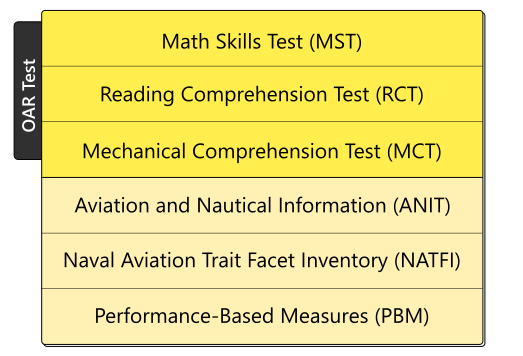
Math Skills Test (MST)
This section evaluates your knowledge of college-level math concepts. Topics covered include basic arithmetic operations, solving for variables, fractions, roots, exponents, and the calculation of angles, area, and perimeters of geometric shapes.
Reading Comprehension Test (RCT)
This section tests your ability to read and comprehend passages. You will often be asked to identify the main point of the passage, or whether it supports a particular statement.
Mechanical Comprehension Test (MCT)
This subtest measures your knowledge of basic principles of physics and mechanics. Topics covered include gases and liquids, pressure, volume, velocity, components and performance of engines, principles of electricity, gears, weight distribution, and the operation of simple machines.
Check Out Mometrix's OAR Printed Study Guide!
Get practice questions, video tutorials, and detailed study lessons.
Scores
The OAR is given a cumulative score ranging from 20 to 80. There is no single passing OAR score for every officer program. Your required minimum depends on the program you’re applying to, and some programs have specific waiver provisions.
Many officer training programs are competitive and have a limited number of available spots. Even if you do meet the minimum cutoff, you are not guaranteed admission. The higher your score, the stronger your application will be.

OAR Online Prep Course
If you want to be fully prepared, Mometrix offers an online OAR prep course designed to give you everything you need to succeed!
Here's what you'll find in the OAR course:
- 50+ Review Lessons Covering Every Topic
- Over 500 OAR Practice Questions
- 250+ Digital Flashcards
- 160+ Instructional Videos
- Money-back Guarantee
- Mobile Access
Everyone learns differently, so we've tailored the OAR online prep course to ensure every learner has what they need to prepare for the OAR exam.
Click below to check it out!
How Computer-Adaptive Testing Works
The OAR test uses a system called APEX, which utilizes a computer-adaptive format. This means that the test adapts to you as you answer questions. Correct answers are typically followed by harder questions, while incorrect answers are typically followed by easier ones.
It's important to note that this system prevents you from skipping questions or going back and changing answers to previous questions.
FAQs
What is the OAR test?
The Officer Aptitude Rating test is made of three sections of the Aviation Selection Test Battery (ASTB-E). The test is used to determine your eligibility for officer training.
How long is the OAR test?
The test takes 1–2 hours in total.
Is the OAR test hard?
How difficult you find the OAR will depend on your background in math, reading comprehension, and mechanics. Taking a practice test can help you identify which areas need the most review.
What is a passing score for the OAR test?
There is no single passing OAR score for every officer program. Your required minimum depends on the program you’re applying to, and some programs have specific waiver provisions.


Mometrix Test Preparation is not affiliated with or endorsed by any official testing organization. All organizational and test names are trademarks of their respective owners.


