
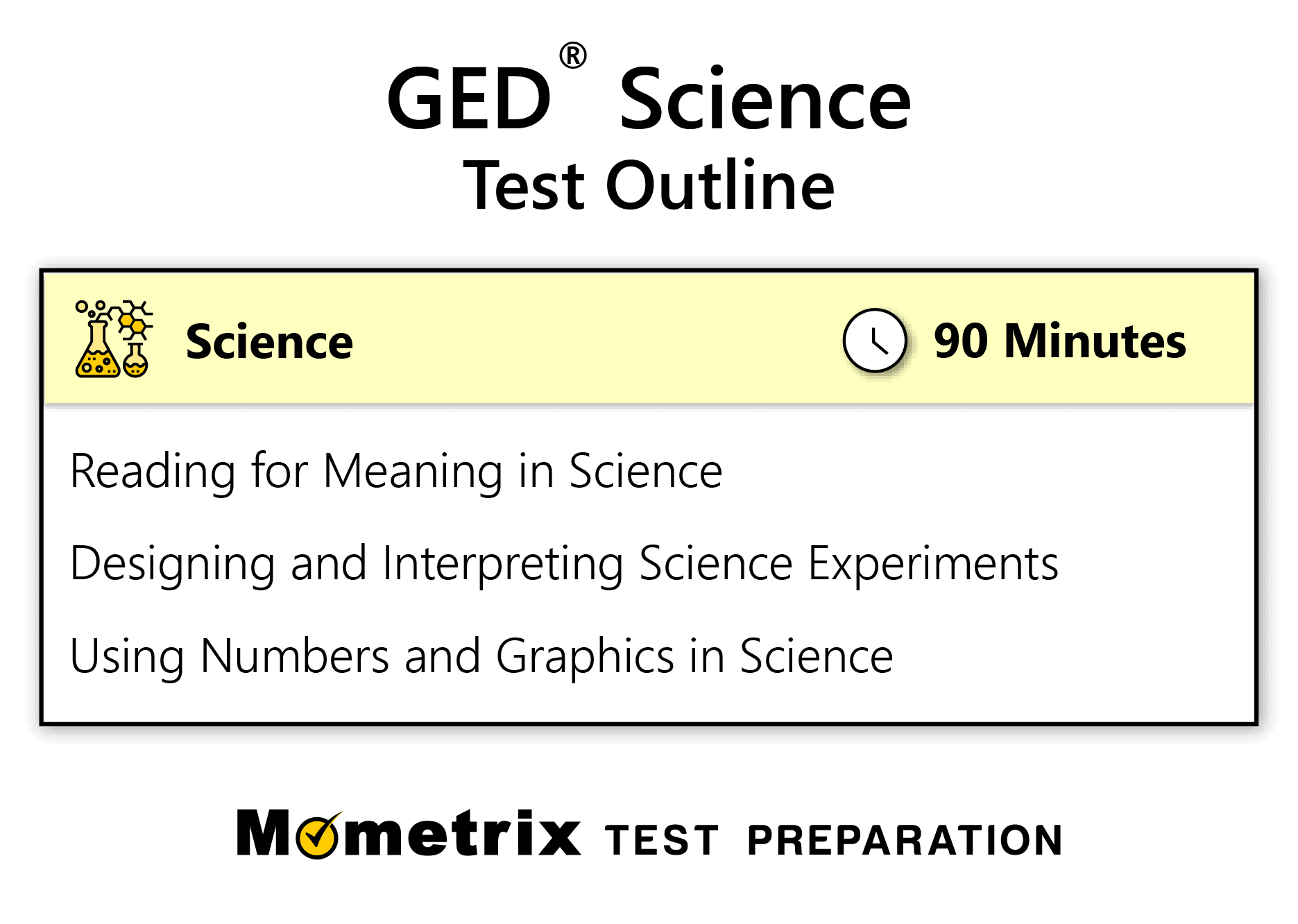
The Science section of the GED® tests your knowledge of the scientific method, as well as your ability to comprehend meaning in science-related texts and to use numbers and graphics in science. To help you prepare for this section of the GED, this page contains everything you need to know, including what topics are covered, how many questions there are, and how you can study effectively.
Click “Start Test” above to take a free GED Science practice test!
What’s on the GED Science Test?
GED Question of the Day
GED Science Practice Questions
One of the best ways to test your knowledge is by taking a practice test. Evaluate your science knowledge by trying your hand at the three practice questions below!
Answer each question and read through the answer explanation, whether you got the answer right or wrong. This will help you ensure you’ve got the topic mastered.
Whether you struggled with these questions or aced them on your first try, be sure to take the full science practice test to get a better idea of how prepared you really are!
1. In ladybugs, there are two alleles for the gene for spot color: s for black spots, and S for red spots. SS and Ss result in a ladybug with red spots, and ss results in a ladybug with black spots. If a population of 100 ladybugs includes 33 with an SS genotype, 38 with an Ss genotype, and 29 with an ss genotype, what percentage of those 100 ladybugs will have red spots?
To get the percentage, divide 71 by the total number of ladybugs (100) to get 0.71, then multiply that by 100 to get the percentage: 71%.
2. Read the paragraph below before answering the question:
In a chemical equation, each side of the equation should contain the same number of atoms. Select the number that balances the reactants and products in this equation for photosynthesis:
First, multiply the coefficient (6) and the subscript (2) in 6 CO2:
\(6\times 2=12\)
Then, in 6 H2O, the coefficient is 6 and there is no subscript, so there are six oxygen atoms. The total number of oxygen atoms on the left is 18. On the right, C6H12O6 = six oxygen atoms, and O2 = two oxygen atoms. Adding a coefficient of 6 in front of O2 will result in 12 oxygen atoms. Add that to the 6 in C6H12O6 and the total on the right will be 18.3. Which of the following is the waste product that is removed from the body by the process of respiration?

GED Test Online Prep Course
If you want to be fully prepared, Mometrix offers an online GED prep course designed to give you everything you need to succeed!
Here’s what you’ll find in the GED course:
- 90+ Review Lessons Covering Every Topic
- Over 2,100 GED Practice Questions
- 300+ Digital Flashcards
- 400+ Instructional Videos
- Money-back Guarantee
- Mobile Access
Everyone learns differently, so we’ve tailored the GED online prep course to ensure every learner has what they need to prepare for the GED exam.
Click below to check it out!
FAQs
Q
Who is eligible to take the GED Science Test?
A
In order to take the GED Science test, you must meet the following requirements:
- You are not enrolled in high school
- You are at least 16 years old
- You have not graduated from high school
- You meet all of your state’s additional requirements
Q
How much is the GED Science Test?
A
The GED administrators consider each subject a separate test, so applicants may pay for each test separately. Exam fees vary with each state but typically range from $3.75 to $30. (The cost per test is usually less than $30).
Q
How long is the GED Science Test?
A
You will have 90 minutes (1 hour and 30 minutes) to complete the GED Science test. There are no breaks for this exam.
Q
How many questions are on the GED Science Test?
A
There is no set amount of questions on the GED Science test; the number varies with each state.
Q
What do you have to score to pass the GED Science Test?
A
The passing score for the GED Science test or any GED test is 145.
Q
How many times can you retake the GED Science Test?
A
Although each state has different retake policies, students can retake the GED Science test or any other GED subject test as many times as needed. In most states, students can take the test 3 times, and after the 3rd attempt, there is a 60-day waiting period.


GED® is a registered trademark of the American Council on Education (ACE) and administered exclusively by GED Testing Service LLC under license. This material is not endorsed or approved by ACE or GED Testing Service.