The Math section of the ACT® evaluates your knowledge of various math concepts, including algebra, geometry, functions, and statistics.
To help you prepare for this section of the ACT, this page contains everything you need to know, including what topics are covered, how many questions there are, and how you can study effectively.
Click “Start Test” above to take a free ACT Math practice test!
What’s on the ACT Math Section?
ACT Math Practice Questions
One of the best ways to test your knowledge is by taking a practice test. Evaluate your math skills by trying your hand at the three practice questions below!
Answer each question and read through the answer explanation, whether you got the answer right or wrong. This will help you ensure you’ve got the topic mastered.
Whether you struggled with these questions or aced them on your first try, be sure to take the full practice test to get a better idea of how prepared you really are!
1. Each base of a triangular prism has a base length of 9 cm and a height of 12 cm. The height of the prism is 15 cm. What is the volume of the prism?
The area of each triangular base is represented by \(A=\frac{1}{2}(9)(12)\). So the area of each base is equal to 54 square centimeters.
Substituting 54 for the area of the base and 15 for the height of the prism gives \(V=(54)(15)\), or \(V=810\). Therefore, the volume of the prism is 810 cm3.
2. Jeremy put a heavy chalk mark on the tire of his bicycle. His bike tire is 27 inches in diameter. When he rolled the bike, the chalk left marks on the sidewalk. Which expression can be used to best determine the distance, in inches, the bike rolled from the first mark to the fourth mark?
Using the formula, \(C=\pi d\), we multiply 27 by \(\pi\), so \(C=27\pi\).
From the first mark to the fourth, the tire rolls three times. Then, you would multiply by 3, and the distance would be \(3(27\pi)\).
3. A regular deck of cards has 52 cards and four cards of each type. What is the probability of drawing three aces in a row?
\(P=\dfrac{4}{52}\times \dfrac{3}{51}\times \dfrac{2}{50}=\dfrac{24}{132{,}600}\)\(\:=\dfrac{1}{5{,}525}\)

ACT Online Prep Course
If you want to be fully prepared, Mometrix offers an online ACT prep course designed to give you everything you need to succeed!
Here’s what you’ll find in the ACT course:
- 80+ Review Lessons Covering Every Topic
- Over 1,150 ACT Practice Questions
- 350+ Digital Flashcards
- 310+ Instructional Videos
- Money-back Guarantee
- Mobile Access
Everyone learns differently, so we’ve tailored the ACT online prep course to ensure every learner has what they need to prepare for the ACT exam.
Click below to check it out!
ACT Math Formulas
Though you are able to use a calculator during the test, you won’t be given a formula sheet to reference.
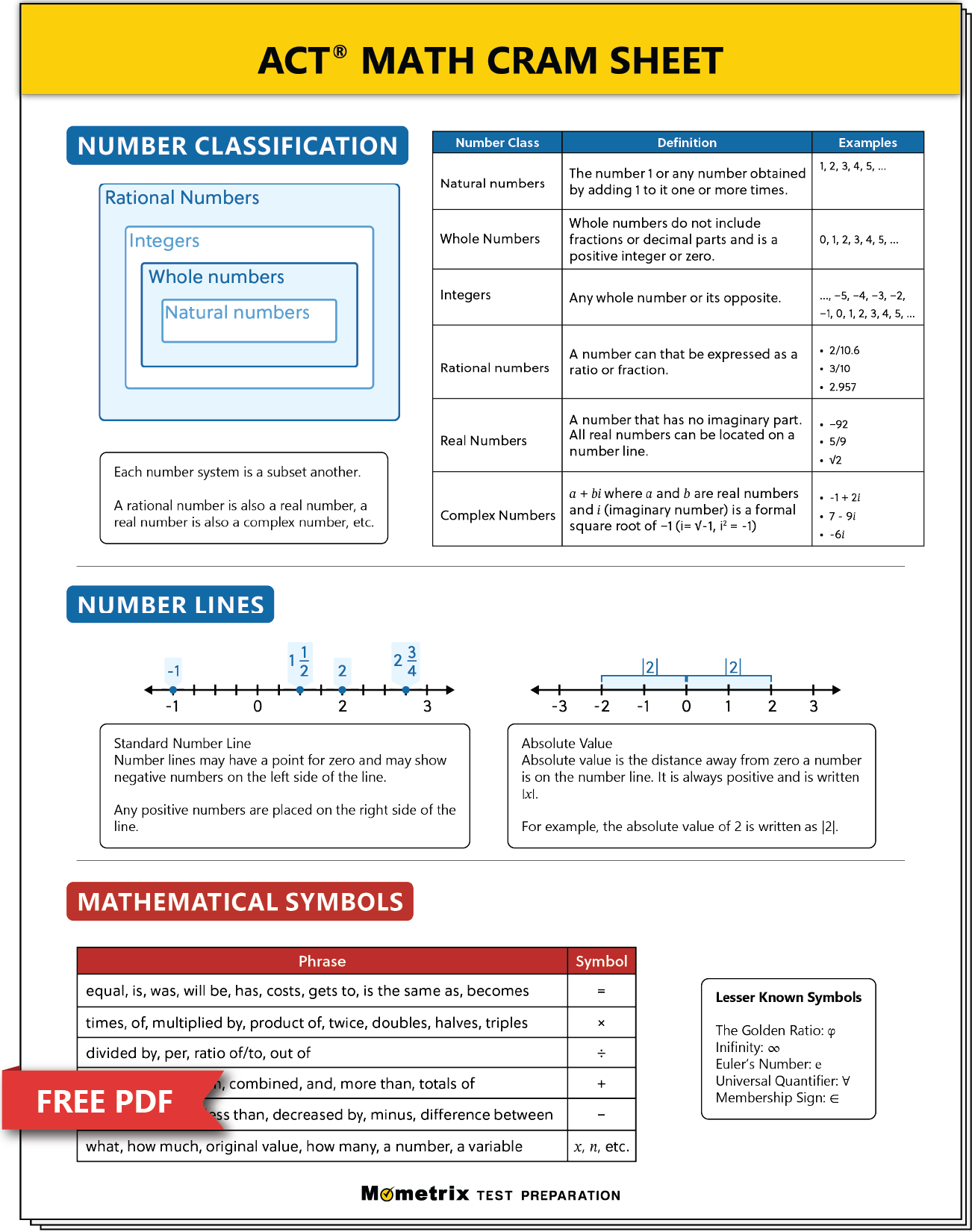
To help you out, we’ve compiled all of the formulas you need to know into one free PDF, including area and volume formulas, algebraic expressions, metric conversions, and more!

FAQs
Q
What math is on the ACT?
A
There is a wide range of math concepts covered on the ACT, including algebra, geometry, and statistics.
Q
How many math questions are on the ACT?
A
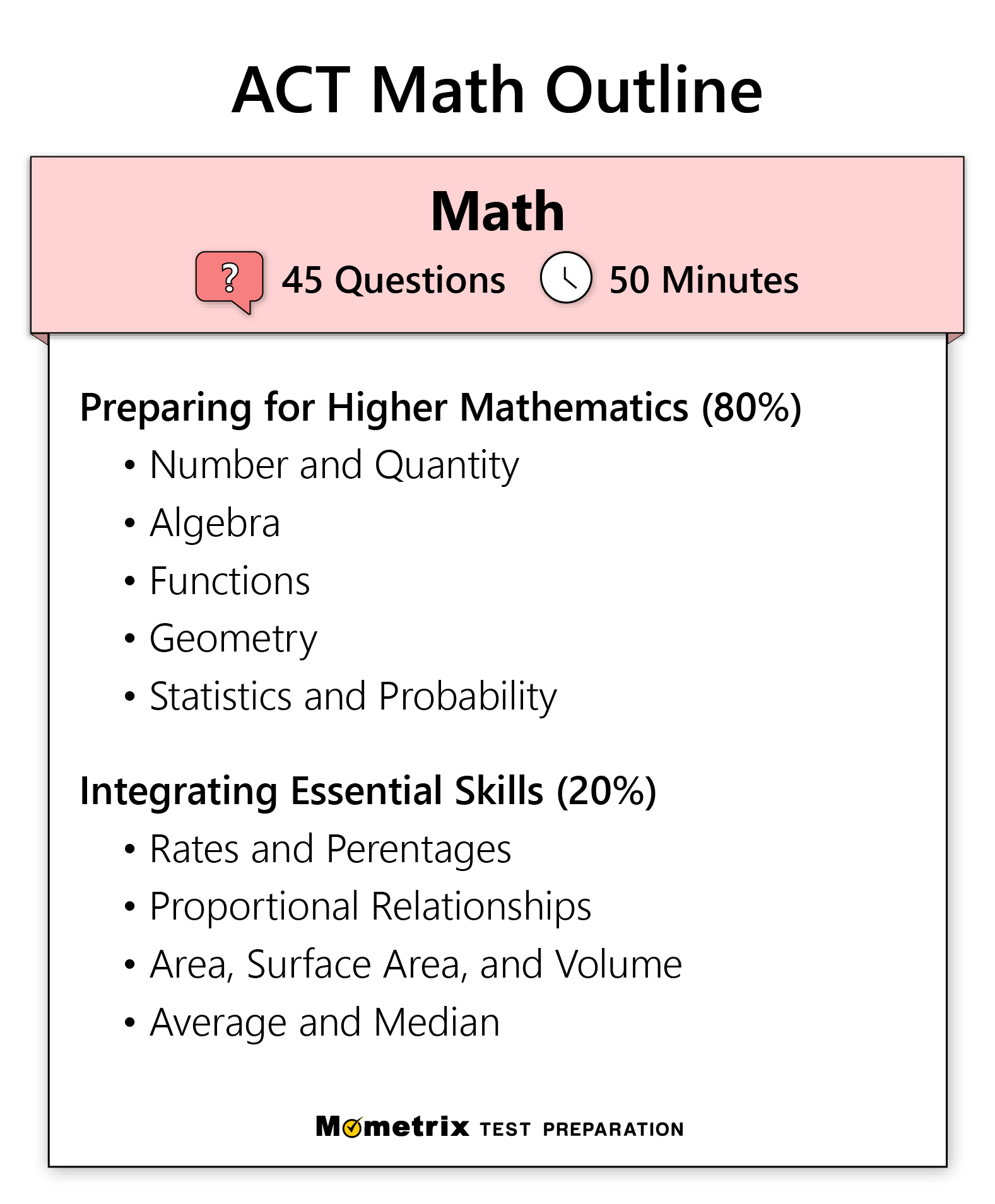
The ACT contains 45 math questions.
Q
How long is the Math section of the ACT?
A
The Math section is timed at 50 minutes.
Q
What is a passing score on the ACT Math section?
A
There is no set passing score for the Math section of the ACT. However, a score of at least 21 is generally recommended.


ACT® is a registered trademark belonging to ACT Education Corp. (“ACT”). ACT is not involved with or affiliated with Mometrix Media LLC, nor does ACT endorse or sponsor any of the products or services offered by Mometrix Media LLC.