The National Board Dental Hygiene Examination (NBDHE) is an exam required by state licensing agencies for those who are seeking to be a licensed dental hygienist in that state.
Click “Start Test” above to take a free NBDHE practice test, and check out our premium-quality NBDHE test prep resources by clicking the links below!
Eligibility
To be eligible for the exam, you must meet ONE of the following requirements:
- You must be a dental hygiene student in a program accredited by CODA and must be prepared in all NBDHE disciplines
- You must have graduated from a CODA-accredited dental hygiene program
- You must have graduated from a non-accredited dental hygiene program with a letter of recommendation from an accredited dean/director and from the secretary of a board of dentistry
NBDHE Outline
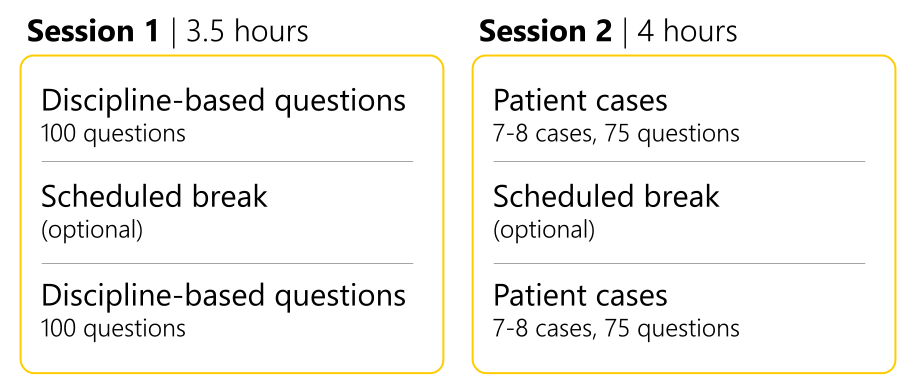
The NBDHE exam contains 350 multiple-choice questions and has a total time limit of 7.5 hours.
The exam is split into two sessions. The first session contains 200 discipline-based questions, while the second session contains 150 questions related to patient cases.
Session One
The discipline-based questions in this session fall under the following areas:
Scientific Basis for Dental Hygiene Practice (61 questions)
- Anatomy
- Physiology
- Nutrition and biochemistry
- Microbiology and immunology
- Pathology
- Pharmacology
Provision of Clinical Dental Hygiene Services (115 questions)
- Assessing patient characteristics
- Obtaining and interpreting radiographs
- Planning and managing dental hygiene care
- Performing periodontal procedures
- Using preventive agents
- Providing supportive treatment services
- Professional responsibility
Community Health/Research Principles (24 questions)
- Promoting health and preventing disease within groups
- Participating in community programs
- Analyzing scientific literature
- Understanding statistical data
Session Two
The case-based questions in this session pertain to 14 to 16 given dental hygiene patient cases. The questions are designed to assess your knowledge and skills in the following areas:
- Assessing patient characteristics
- Obtaining and interpreting radiographs
- Planning and managing dental hygiene care
- Performing periodontal procedures
- Using preventive agents
- Providing supportive treatment service
- Professional responsibility
Check out Mometrix's NBDHE Study Guide
Get practice questions, video tutorials, and detailed study lessons.
NBDHE Practice Questions
One of the best ways to test your knowledge is by taking a practice test. Evaluate your knowledge by trying your hand at the five practice questions below!
Answer each question and read through the answer explanation, whether you got the answer right or wrong. This will help you ensure you’ve got the topic mastered.
Whether you struggled with these questions or aced them on your first try, be sure to take the full practice test to get a better idea of how prepared you really are!
1. The sensation of touch, pain, pressure, or temperature is determined by the ____________.
2. Read the information below before answering the question:
Which is the best action for the dental hygienist to take?
3. Read the information below before answering the question:
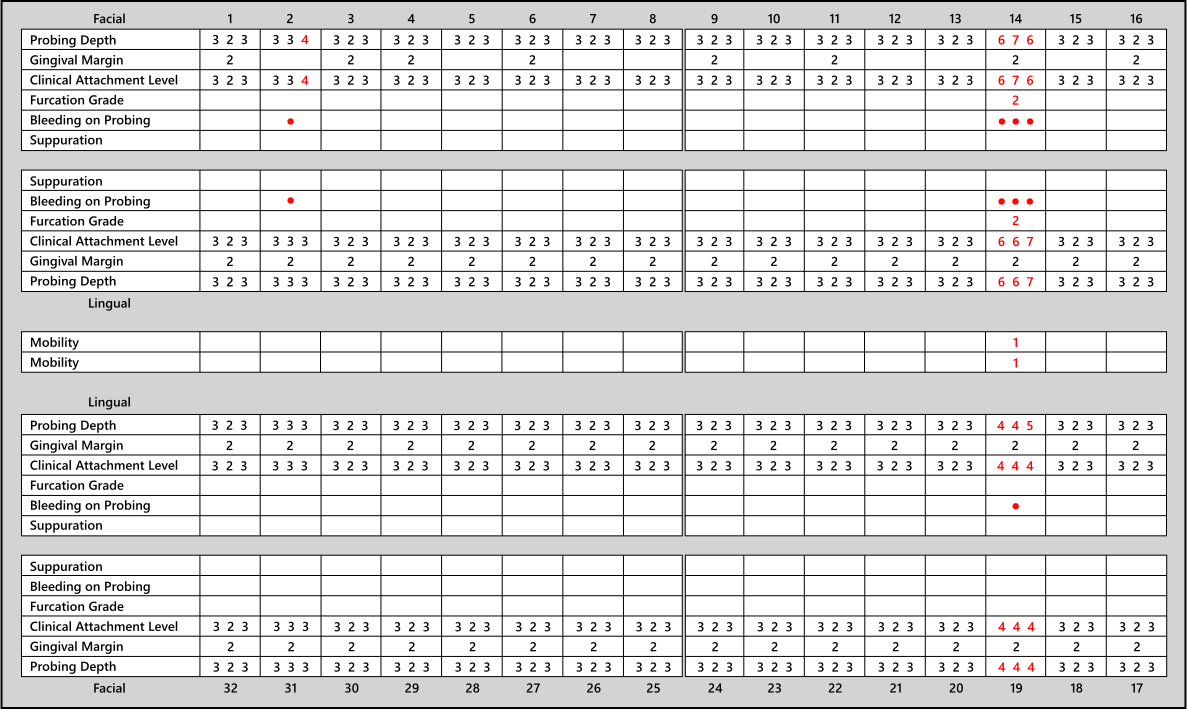
Based on the periodontal chart, which statement best compares the findings for teeth #14 and #19?
Tooth #19 shows less severe probing depths and attachment level measurements, reaching 5 mm and 4 mm respectively, with a single bleeding-on-probing site and no charted furcation involvement.
4. Which index is most appropriate for measuring the number of decayed, missing, and filled permanent teeth in an adult population?
5. A patient asks why fluoride is recommended for caries prevention. Fluoride primarily helps prevent caries by ________.
How to Pass
Think you aren’t a good test-taker? Maybe on a study-time crunch? Or just don’t know how to begin studying? Mometrix has designed a new Study Secrets course to help every student, no matter what study scenario you are in. Here’s what you’ll find in the Study Secrets Course:
- Techniques to Conquer Procrastination
- Steps to building a Study Plan custom to your learning style
- 7 Effective Note-Taking Methods
- Test-Taking Tips
- Memory Techniques and Mnemonics
- And much more!
Everyone learns differently, so we’ve tailored our Study Secrets Course to ensure every learner has what they need to prepare for their upcoming exam or semester. Click below to check it out!
Registration
To register for the NBDHE, you must create a DENTPIN and submit an application to the JCNDE. Your application must include the nonrefundable $600 examination fee.
Once your application is approved, you will receive an email from the JCNDE confirming your eligibility and providing information about scheduling an examination appointment.
Test Day
On test day, you should arrive at the Pearson VUE testing center 15-30 minutes before the scheduled appointment time to allow time for the check-in process. When you arrive, you must sign in and present your photo ID to the proctor. You will be photographed and asked to sign a roster and other rule forms.
Personal items are not allowed in the testing room, so they should be left at home or in your car. This includes all electrical devices, bags, books, keys, wallets, and accessories.
Just before the exam starts, you will be given a brief tutorial on the testing system. You will also be given everything you need to work out any calculations by hand (no calculator will be provided).
Scoring
Your NBDHE score is determined based on a scaled scoring system, in which your raw score (the number of questions you answered correctly) is converted to a scaled score on a range of 49 to 99. To pass, you will need to score a minimum of 75.
You should receive a score report within 4 weeks of your original testing date.
Retaking the NBDHE
If you did not pass the exam, you must wait at least 60 days before applying for retesting. You may take the exam up to four times in one year, after which the waiting period between retakes increases to 12 months.
Check out Mometrix's NBDHE Flashcards
Get complex subjects broken down into easily understandable concepts.

Study Tips
Start with an NBDHE Practice Test
Before creating your study schedule, take an NBDHE practice test to establish a starting point. You don’t need to wait until you have reviewed every concept. At this stage, the goal is to identify where your preparation time will have the greatest effect.
Review your results by section and content area:
- Scientific Basis for Dental Hygiene Practice: Do you need more work with anatomy, physiology, biochemistry, nutrition, microbiology, immunology, pathology, pharmacology, or local anesthesia?
- Provision of Clinical Dental Hygiene Services: Can you assess patients, interpret radiographs, plan care, manage periodontal disease, select preventive agents, provide supportive services, and apply professional responsibilities appropriately?
- Research Principles and Community Health: Can you interpret scientific literature and statistics, apply research findings, assess community needs, and design or evaluate oral-health programs?
Identifying those specific weaknesses will show you where to devote more attention during your study time.
Review Difficult Questions
After each practice session, review every question you answered incorrectly AND every question you guessed on or answered with low confidence. Guessing correctly does not necessarily mean that you have mastered the skill.
For each difficult question, determine which of the following caused the problem:
- You didn’t know the underlying biomedical or dental hygiene concept.
- You knew the concept but could not apply it to the patient.
- You overlooked an important medical-history finding.
- You failed to consider a medication, allergy, vital sign, or systemic condition.
- You misinterpreted a radiograph, clinical photograph, or dental chart.
- You overlooked an infection-control or emergency-management consideration.
- You made a statistical or research-interpretation error.
- You answered from memory without using information provided in the patient case.
- You changed a sound answer without identifying evidence that it was wrong.
Then, outline a specific plan for improvement based on what you discovered. In other words, don’t just say, “I need to study pharmacology.” Specify that you need to review anticoagulants and determine which findings, lab values, and treatment considerations matter during dental hygiene care.
Similarly, instead of saying “study periodontics,” create a precise goal like “practice interpreting probing depths” or “review nonsurgical periodontal therapy.”
Utilize Answer Explanations
Answer explanations are an underutilized studying resource. To take full advantage of them, read the explanation for every question you found difficult, including questions you answered correctly.
For each one, make sure you can confidently explain:
- Why the correct answer is correct
- Why each incorrect option is wrong
- What biomedical or dental hygiene principle is being tested
- Which patient information is relevant to the decision
- Whether the finding changes assessment, treatment, patient education, or follow-up care
- How the same concept could appear in a different NBDHE question
For patient-assessment questions, identify exactly which part of the history or examination changes the decision. Does the medical history require treatment modification? Is the vital sign within an acceptable range? Is consultation or referral indicated?
For radiography questions, return to the image and identify the evidence supporting your answer. Don’t just memorize what one radiograph supposedly showed. Practice locating anatomical landmarks, identifying abnormalities, evaluating bone levels, and integrating radiographic findings with the rest of the patient record.
Study Clinical Decisions, Not Individual Questions
Memorizing the answer to one NBDHE question won’t prepare you for another question that tests the same concept using a different medical history, periodontal condition, medication list, radiograph, or treatment need.
Your goal should be to understand how dental hygiene knowledge changes what you assess, plan, perform, recommend, or report.
The exact questions on your test will be different from the ones you encounter during practice. If you can explain a skill without looking at your notes and then apply it correctly to a new question, that is a good indication that you have mastered it.
FAQs
Q
How many questions are on the NBDHE exam?
A
There are 350 multiple-choice questions on the exam.
Q
How long is the NBDHE exam?
A
The time limit for the exam is 7.5 hours.
Q
What is the passing score for the NBDHE exam?
A
To pass the exam, you must achieve a scaled score of at least 75.
Q
How much does the NBDHE exam cost?
A
The examination fee is $600.


Mometrix Test Preparation is not affiliated with or endorsed by any official testing organization. All organizational and test names are trademarks of their respective owners.