The Reading section of the PERT evaluates your ability to determine word meanings, recognize relationships between sentences, and distinguish between facts and opinions. To help you prepare for this section of the PERT, this page contains everything you need to know, including what topics are covered, how many questions there are, and how you can study effectively.
Click “Start Test” above to take a free PERT Reading practice test!
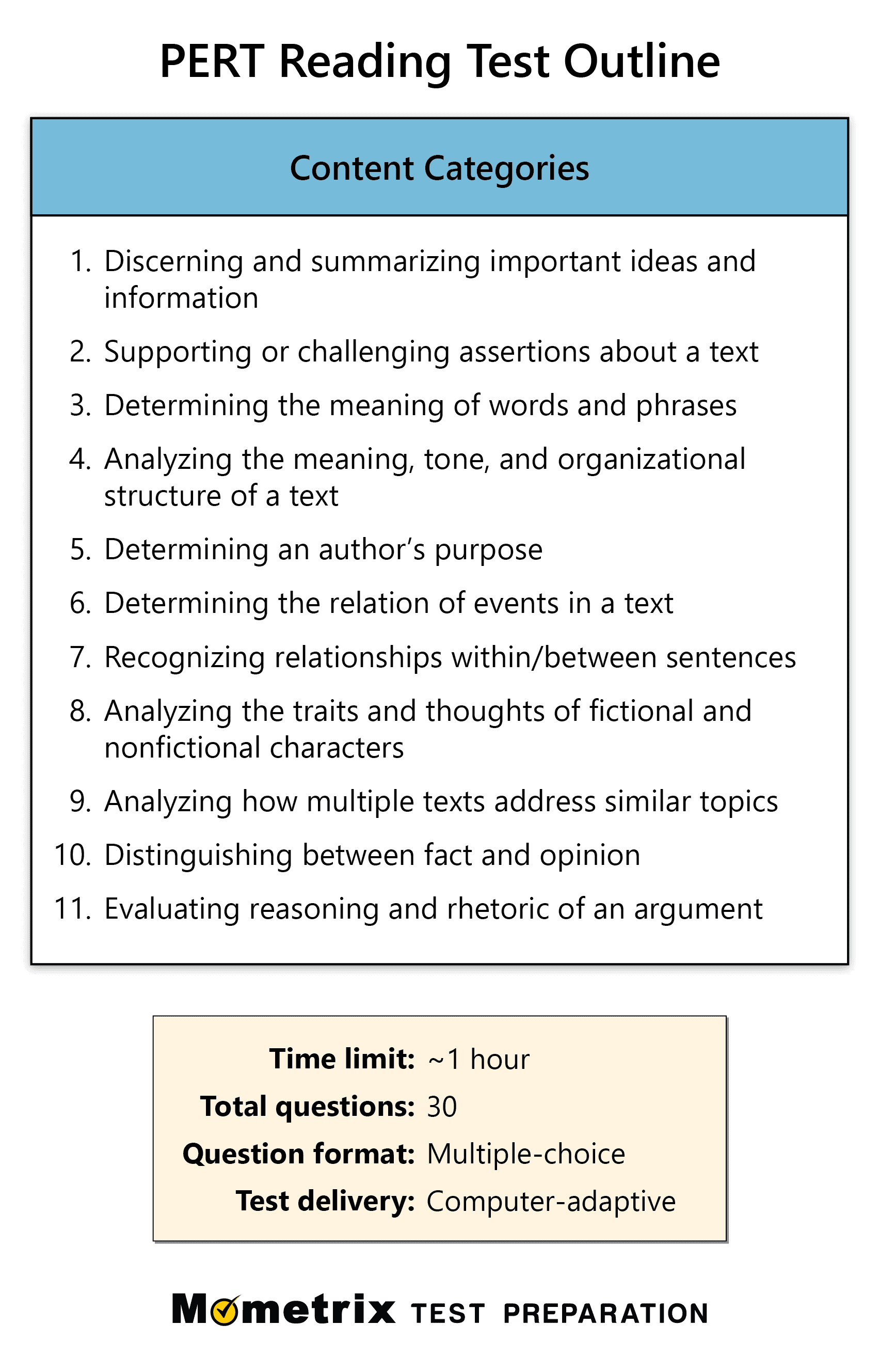
What’s on the PERT Reading Test?
PERT Reading Practice Questions
One of the best ways to test your knowledge is by taking a practice test. Evaluate your reading skills by trying your hand at the three practice questions below!
Answer each question and read through the answer explanation, whether you got the answer right or wrong. This will help you ensure you’ve got the topic mastered.
Whether you struggled with these questions or aced them on your first try, be sure to take the full practice test to get a better idea of how prepared you really are!
1. Read the passage below before answering the question:
 Read Passage
How to Choose and Purchase an Automobile
Choosing and purchasing an automobile in a volatile market is not simply a function of color or engine preference; on the contrary, consumers need to treat the purchase of an automobile as the investment that it is—they need to research the pros and cons of owning various automobiles, and they need to make an informed decision before arriving at the dealership. Failure to properly prepare for such an investment can result in an unnecessary economic loss for the consumer.
While there are many pros and cons associated with automobile ownership, many consumers do not adequately research the specific benefits and detriments associated with purchasing a particular vehicle. One of the most common concerns is economic: how much does it cost to own a particular vehicle over time? The cost of ownership is not limited to purchase price; it also includes things like insurance prices, repair costs, and gas consumption. While a given vehicle may have a higher sticker price, its low cost of ownership may, over time, offset this expense. Conversely, a vehicle may have a low sticker price but a high cost of ownership over time. Accordingly, consumers should thoroughly research vehicles before they visit an automobile dealership.
There are numerous ways for consumers to research the cost (defined broadly) of a vehicle before they ever step inside the vehicle. Most simply, there are a number of publications that list the relative depreciation of automobiles over time. Consumers can use these publications to track how a particular model tends to lose value over time and choose the vehicle that best retains its value. Consumers can also go directly to a manufacturer’s website to compare gas mileage or the cost of replacement parts. Furthermore, insurance agents can provide insurance quotes for customers before a purchase is made. Awareness of factors such as these can also simplify the purchasing process.
When a consumer is finally ready to purchase a vehicle, he or she is less likely to be pressured by a salesperson if he or she is equipped with the relevant data for that purchase; if a consumer knows the long-term costs of a particular vehicle, he or she is less likely to be swayed by short-term or cosmetic benefits. Arriving at a dealership unprepared can result in an impulse purchase, which, in turn, may result in increased automotive expenditure over time. Conducting even a modicum of research, however, can potentially save the average automotive consumer thousands of dollars in the long run.
According to the passage, which of the following is true?
For example, choice A is explicitly contradicted in the second paragraph. Choice B is doubly inappropriate because of its use of always and its irrelevance to the passage (SUVs are not discussed in the passage). While choice C does not use always, it is not a good choice because the relationship between color and cost is not discussed in the passage. Choice D is supported by the second paragraph and is the best overall choice.
2. Read the paragraph below before answering the question:
Read ParagraphWhat is the main idea of this paragraph?
Choice A is not appropriate because depression is mentioned only briefly. Choice B is mentioned but is not the central focus, and choice C is not discussed in this paragraph.
3. What is the meaning of the word vex as used in the following excerpt from Jane Austen's Emma?

PERT Online Prep Course
If you want to be fully prepared, Mometrix offers an online PERT prep course designed to give you everything you need to succeed!
Here’s what you’ll find in the PERT course:
- 50+ Review Lessons Covering Every Topic
- Over 1,250 PERT Practice Questions
- 300+ Digital Flashcards
- 200+ Instructional Videos
- Money-back Guarantee
- Mobile Access
Everyone learns differently, so we’ve tailored the PERT online prep course to ensure every learner has what they need to prepare for the PERT exam.
Click below to check it out!
FAQs
Q
How many questions are on the PERT Reading test?
A
There are 30 multiple-choice questions on the PERT Reading test.
Q
How long is the PERT Reading test?
A
There is no strict time limit for the PERT Reading test. It generally takes between 45 minutes and 1 hour to complete the test.
Q
What is a passing PERT score?
A
There is no set passing score for the PERT Reading test. The score you receive simply lets you know which classes are suitable for you.


Mometrix Test Preparation is not affiliated with or endorsed by any official testing organization. All organizational and test names are trademarks of their respective owners.