If you are considering a fascinating career as a certified phlebotomy technician, this review is designed to help you learn what you need to know to be prepared for the certification examination.
Click “Start Test” above to take a free CPT practice test, and check out our premium-quality CPT test prep resources by clicking the links below!
What is the NHA CPT Exam?
The CPT exam is the certification exam developed by the National Healthcareer Association to determine the skill levels and knowledge of applicants desiring to become certified phlebotomy technicians.
Phlebotomy technicians are essential parts of the healthcare system, needed in clinics, doctor offices, hospitals, and laboratories all across the country. These professionals draw blood and prepare the blood so the tests that doctors have ordered can be run.
The US Bureau of Labor Statistics projects that employment of phlebotomists will grow 7% from 2025 to 2035.
Check Out Mometrix's NHA Phlebotomy Study Guide!
Get practice questions, video tutorials, and detailed study lessons.
Requirements Before Taking the Exam
In order to register for the CPT examination, you have to meet the eligibility requirements.
Education Requirements
You must have a high school diploma or an equivalent credential, such as a GED.
If you haven’t graduated yet, you may qualify for provisional certification. Eligible CPT candidates may take the exam up to 18 months before completing high school or an equivalent program, provided they meet NHA’s other eligibility requirements. After graduation, you must apply to convert your active provisional certification to full certification. Candidates who passed before October 1, 2026, remain subject to the original 12-month deadline.
Training Program or Work Experience Requirements
In addition to the education requirement, you must qualify through one of two pathways:
- Training Program: Within the past five years, complete a qualifying training program in the healthcare field covered by the CPT exam. If you completed your training program five or more years before registering for the exam, you must instead qualify through the work-experience pathway.
- Work Experience: Have either at least one year of supervised work experience within the last three years or two years of supervised work experience within the last five years. The experience must be in the healthcare field covered by the CPT exam.
Evidence of Skills
During your certified training course, or through your work experience, you will have to have completed a minimum of 30 successful venipunctures and 10 successful capillary or finger sticks.
The blood draws will have to have been performed on live persons, and you will need to provide evidence of the punctures and sticks.
Certified Phlebotomy Technician Exam Outline
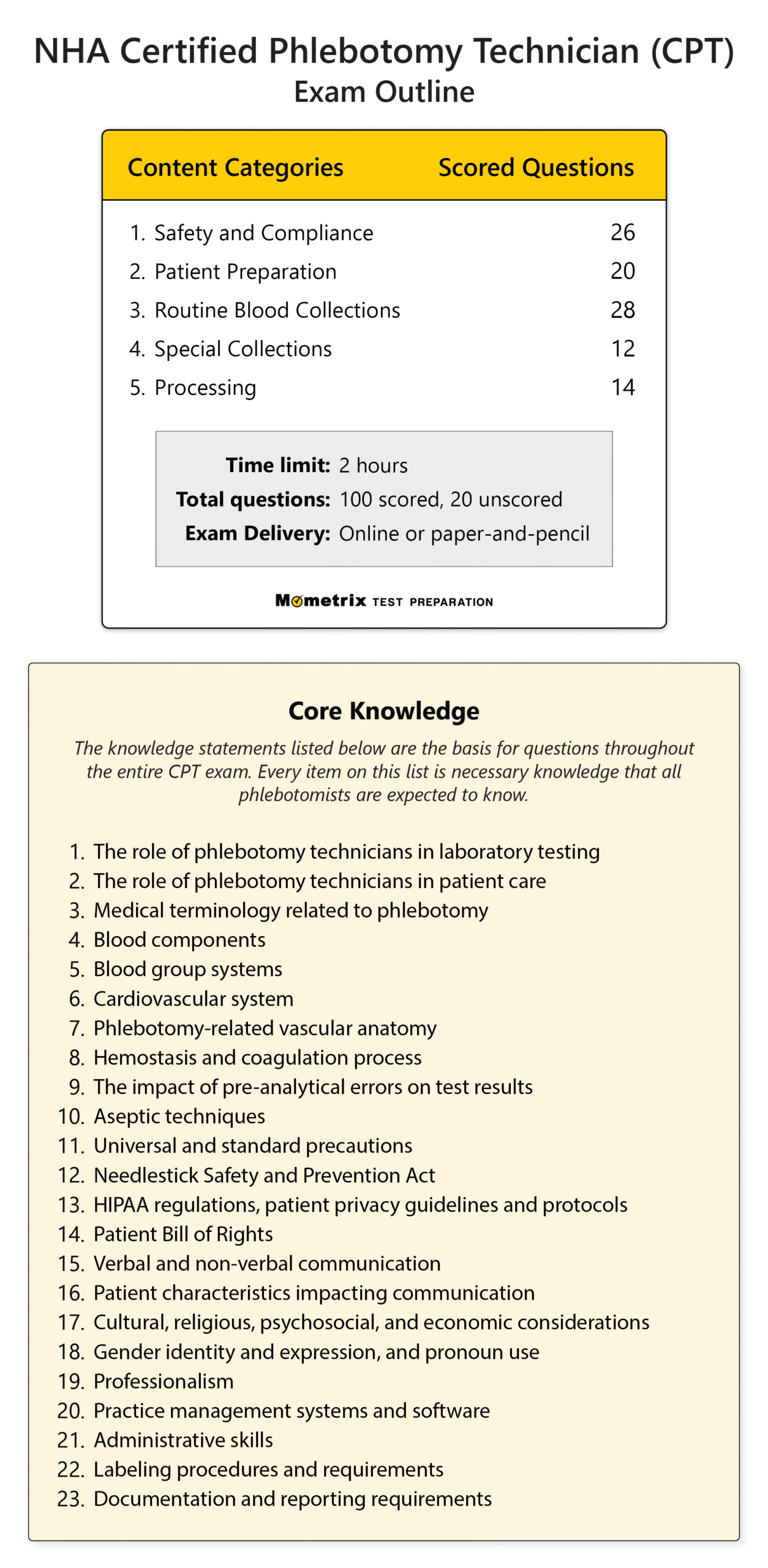
The NHA CPT exam includes 120 questions, 20 of which are unscored pretest questions, and the time limit is 2 hours.
You will need to have core knowledge that may be used in any portion or section of the test to assess your basic knowledge, including:
- The role of phlebotomy technicians in laboratory testing
- The role of phlebotomy technicians in patient care
- Medical terminology related to phlebotomy
- Blood components
- Blood group systems
- Cardiovascular system
- Phlebotomy-related vascular anatomy
- Hemostasis and coagulation process
- The impact of pre-analytical errors on test results
- Aseptic techniques
- Universal and standard precautions
- Needlestick Safety and Prevention Act
- HIPAA regulations, patient privacy guidelines and protocols
- Patient Bill of Rights
- Verbal and non-verbal communication
- Patient characteristics impacting communication
- Cultural, religious, psychosocial, and economic considerations
- Gender identity and expression, and pronoun use
- Professionalism
- Practice management systems and software
- Administrative skills
- Labeling procedures and requirements
- Documentation and reporting requirements
The exam is divided into five sections. Questions in each section will assess the knowledge, information, and concepts a phlebotomist must know, as well as tasks or duties that a phlebotomist must be able to perform.
I. Safety and Compliance
(26 scored questions)
The Safety and Compliance section of the CPT exam focuses on the various hazards of working with blood specimens and how to be in compliance with safety regulations. Here's a look at the details you'll be asked about in this section:
- Adherence to regulations such as OSHA, HIPAA, operational standards, ethical standards
- Quality control
- Sharps disposal
- PPE
- Hand hygiene
- Infection control
- Exposure control
II. Patient Preparation
(20 scored questions)
The Patient Preparation section of the CPT exam focuses on introducing yourself to the patient, explaining procedures, determining the best collection site, and verifying patient compliance. Here's a closer look at the details of this section:
- Interaction with patient
- Receiving consent
- Identifying special considerations
- Determining collection site
- Instructions to patients performing non-blood specimens
- Timing requirements
III. Routine Blood Collections
(28 scored questions)
The Routine Blood Collections section of the CPT exam focuses on day-to-day tasks, labeling specimens, post-procedure patient care, tourniquet application, and order of draw on a venipuncture. Here's a look at the details of this section:
- Equipment assembly
- Following order of draw on venipuncture
- Applying antiseptic agent
- Labeling
- Post-procedure care
IV. Special Collections
(12 scored questions)
The Special Collections section of the CPT exam focuses on atypical blood collections, peripheral blood smears, blood culture collections, and collections for blood donations. Here's a closer look at what this section of the test pertains to:
- Non-blood specimen
- Skin preparation
- Volume requirements
V. Processing
(14 scored questions)
The Processing section of the CPT exam focuses on the guidelines and procedures used after the specimen is obtained. Specifically, these are the main points that this section will cover:
- Chain of custody guidelines
- Handling, storage, and disposal of specimens
- Centrifugal techniques
- Input and retrieval of specimen data in the information system

NHA Phlebotomy Online Prep Course
If you want to be fully prepared, Mometrix offers an online NHA Phlebotomy prep course designed to give you everything you need to succeed!
Here's what you'll find in the NHA Phlebotomy course:
- 30+ Review Lessons Covering Every Topic
- Over 800 NHA Phlebotomy Practice Questions
- 300+ Digital Flashcards
- Money-back Guarantee
- Mobile Access
Everyone learns differently, so we've tailored the NHA Phlebotomy online prep course to ensure every learner has what they need to prepare for the NHA Phlebotomy exam.
Click below to check it out!
Check Out Mometrix's NHA Phlebotomy Flashcards!
Get complex subjects broken down into easily understandable concepts.
How to Register
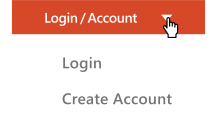
To register for the exam, visit the National Healthcareer Association’s website. At the top of the landing page, on the right-hand side, you will see an orange button that allows you to either log in to an existing account or create a new account.
When you create the account, you will provide your first and last name, email address, and mobile phone number. Additional information like your mailing address will also be required. When you are ready to register for the test, you simply log into your NHA account and follow the onscreen prompts.
Remember your login information; when you are ready to see your test scores, you will need to log into your account again.
What to Bring on Test Day
Taking the Online Test at an Educational Institution
You will need a current government-issued identification card or driver’s license with your photo. The name on your identification must be an exact match to the name you are registered under for the test.
Taking the Paper-and-pencil Test at Educational Institution
You will need a current government-issued identification card or driver’s license with your photo. You will also need to bring two sharpened No. 2 pencils.
Taking the Test at a PSI Testing Center
When you register for the exam, you will be allowed to choose at which approved location you will be taking the test. All locations will require a government-issued photo ID for verification before you begin the test.
Retaking the Test
First Retake
If you do not have a passing grade after the first attempt, you will need to wait thirty days before you will be eligible to retake the test.
Second Retake
If you do not have a passing grade after the second attempt, you will need to wait an additional thirty days before you will be eligible to retake the exam a second time.
Third Retake
If you fail your third attempt, you must wait one year before taking the exam again for your fourth attempt.
Fourth Retake
After the fourth attempt at taking the exam, you will have a mandatory waiting time of twelve months before you can apply to take the test again.
Study Tips
Start with a CPT Practice Test
Before creating your study schedule, take a CPT practice test to establish a starting point. You don't need to wait until you have reviewed every tube additive, order-of-draw rule, collection technique, or processing requirement. At this stage, the goal is to identify where your preparation time will have the greatest effect.
Review your results across the five content areas:
- Safety and Compliance: Do you understand infection control, PPE, sharps and biohazard disposal, exposure procedures, HIPAA, quality control, scope of practice, and responses to emergencies?
- Patient Preparation: Can you verify orders and patient identity, confirm testing requirements, obtain consent, recognize special considerations, position the patient, and select an appropriate collection site?
- Routine Blood Collections: Can you select equipment, choose and prepare the site, perform venipuncture and capillary collections, follow the correct order of draw, recognize complications, and provide post-procedure care?
- Special Collections: Do you understand blood cultures, pediatric and geriatric considerations, newborn screening, blood donation, point-of-care testing, tolerance tests, blood alcohol testing, drug screening, and other special collections?
- Processing: Can you maintain specimen integrity through centrifuging, aliquoting, storage, transport, chain of custody, data entry, and communication of critical or rejected results?
Identifying those specific weaknesses will show you where to devote more attention during your study time.
Review Difficult Questions
After each practice session, review every question you answered incorrectly AND every question you guessed on or answered with low confidence.
For each difficult question, determine which of the following caused the problem:
- You selected the wrong tube or collection equipment.
- You confused the venipuncture or capillary order of draw.
- You overlooked a patient identification.
- You selected an inappropriate collection site or technique for the patient.
- You didn't recognize a complication or chose the wrong response to it.
- You knew how to collect the specimen but mishandled labeling or storage.
- You confused routine collection procedures with requirements for a special collection.
- You overlooked an exposure-control requirement.
Then, outline a specific plan for improvement based on what you discovered. In other words, don't just say, "I need to study tubes." Note that you need to review which additives are used in common tubes and how those additives affect the specimen.
Similarly, replace “study venipuncture” with something specific, such as recognizing when to discontinue a draw because of hematoma formation, nerve pain, or patient symptoms.
Utilize Answer Explanations
Answer explanations are an underutilized studying resource. To take full advantage of them, read the explanation for every question you found difficult, including questions you answered correctly.
For each one, make sure you can confidently explain:
- Why the correct answer is correct
- Why each incorrect answer is less appropriate
- What collection, safety, or processing principle is being tested
- Which information in the scenario controls the answer
- What the phlebotomy technician should do next
- How the same problem could appear during a different collection
For collection questions, reconstruct the procedure instead of memorizing the answer. Determine what needs to happen before the draw, which equipment and site are appropriate, what happens during collection, and how the specimen should be handled afterward.
For safety questions, identify both the immediate risk and the action that prevents harm to the patient, the technician, or the specimen.
Study Blood Collection as a Workflow
Many CPT questions become easier when you understand where each step belongs in the complete collection process.
Use this framework:
Order → Identify Patient → Verify Preparation → Select Equipment and Site → Collect → Label → Process and Transport
Don't memorize individual steps without understanding what comes before and after them. For example, selecting the correct tube doesn't help if the wrong patient was identified, the specimen was mislabeled, or the sample was transported under the wrong conditions.
FAQs
Q
What is the time limit for the CPT exam?
A
There is a two-hour time limit to complete the CPT test.
Q
How much does the CPT exam cost?
A
The cost of the test is $134.
Q
What is considered a passing score?
A
A score of 390 or higher is required to pass the CPT exam.
Q
When will I know what I scored on the test?
A
For online CPT exams, NHA posts final certification results to your account within two days of scoring your test. You’ll receive an email when your results are available.
Q
How long will the certification be good for?
A
You will need to renew your certification every two years. You will have one year from the date your certification expires to reinstate it.


Mometrix Test Preparation is not affiliated with or endorsed by any official testing organization. All organizational and test names are trademarks of their respective owners.