The Pharmacy Technician Certification Board (PTCB®) has created a Pharmacy Technician Certification Exam (PTCE) for those wishing to become certified pharmacy technicians. With this credential, pharmacy technicians show that their knowledge of medication safety and effective patient care across pharmacy settings is up to the standards of any employer.
To help you practice for the PTCB exam, we’ve gathered all of the information you need to know right here on this page. To take a free PTCB practice test, click the “Start Test” button below.
Good luck with your studying!
PTCB Question of the Day
About the PTCB Exam
Here are a few statistics regarding the PTCE:
- According to the Pharmacy Technician Certification Board, 49,253 PTCE exams were administered in 2025, and the 2025 pass rate for the Certified Pharmacy Technician credential was 69%.
- PTCB has granted more than 876,000 pharmacy technician certifications since 1995 through the exam and transfer process.
- The US Bureau of Labor Statistics projects pharmacy technician employment to grow 6% from 2024 to 2034, faster than the average for all occupations.
- In PTCB’s 2025 workforce survey, 63% of pharmacy technicians reported long-term career commitment, up from 59% in 2022. PTCB also reported a 20% wage advantage for nationally certified pharmacy technicians over uncertified peers.
Eligibility Requirements
PTCB candidates need to first finish a PTCB-Recognized Education/Training Program OR have equivalent, eligible work experience:
- Option 1: A PTCB-Recognized Education/Training Program (or be expected to complete within 60 days). There are currently more than 1,400 approved education and training programs.
- Option 2: Minimum of 500 work hours as a pharmacy technician. This secondary option provides a path to certification for experienced technicians who cannot attend a PTCB-Recognized program. The PTCB accepts work experience from a wide variety of pharmacy practice settings.
Exam Outline
The PTCB test consists of 90 multiple-choice questions that are divided into four knowledge domains and areas. During the exam, you are given a total of two hours to answer each of the 90 questions (ten of which are unscored).
The PTCB questions are divided into four different knowledge domains that have been designed by pharmacy content experts to test potential candidates on the skills required for the position of pharmacy technician.
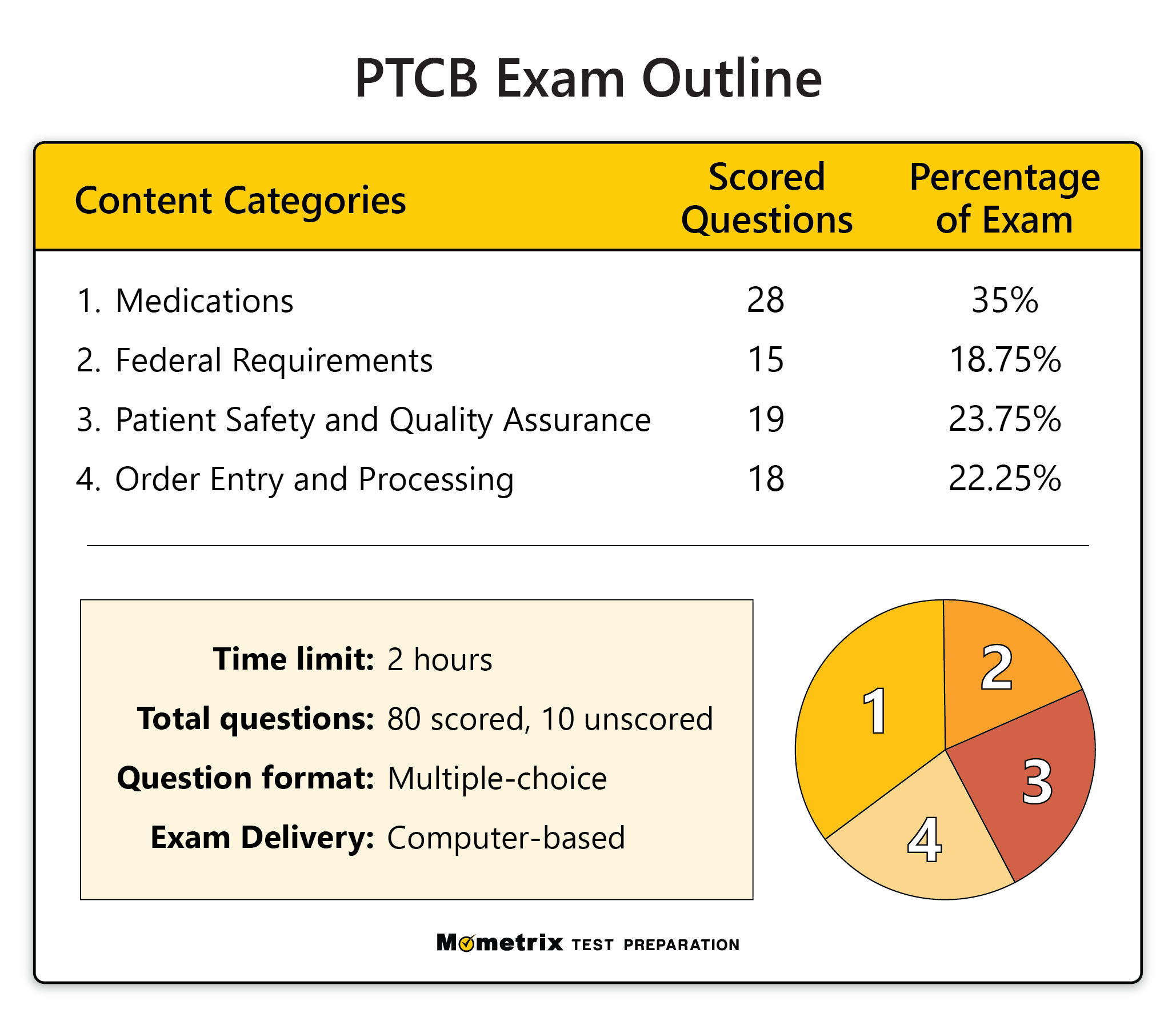
I. Medications (35%)
- Generic and brand names of medications, as well as their classifications
- Therapeutic equivalence
- Life-threatening drug interactions and contraindications
- Dosage forms, routes of administration, instructions for special handling and administration, and duration of drug therapy
- Medication side effects, adverse effects, and allergies
- Indications of medications
- Drug stability
- Proper medication storage
II. Federal Requirements (18.75%)
- Handling of hazardous, non-hazardous, and pharmaceutical substances
- Prescriptions for controlled substances and DEA controlled-substance schedules
- Receiving, storing, dispensing, ordering, and labeling controlled substances
- Restricted drug programs and processing pertinent medication
- Recall requirements from the FDA
- FDA product serialization, tracking, tracing, handling, and quarantining requirements
III. Patient Safety and Quality Assurance (23.75%)
- Medications that are high-risk and high-alert, as well as medications that look alike/sound alike
- Strategies to prevent errors
- Issues that require the intervention of a pharmacist
- Procedures for reporting events
- Prescription errors
- Infection prevention procedures and cleaning standards
IV. Order Entry and Processing (22.25%)
- Sig codes, formulas, proportions, alligations, conversions, ratios, and calculations
- Drug administration supplies and equipment
- NDC numbers, expiration dates, and lot numbers
- Identifying and returning supplies and medication which have expired, are dispensable, or are non-dispensable
Check Out Mometrix's PTCB Study Guide
Get practice questions, video tutorials, and detailed study lessons.
Top 3 Most Challenging PTCB Questions
Now that you know more about the test, try your hand at some targeted practice!
Over the last year, we’ve compiled the data from about 7,000 test-takers who tried their hand at the practice test at the top of this page. According to the data, around 75% of people answered these three questions incorrectly.
Answer each question and read through the answer explanation, whether you got the answer right or wrong. This will help you ensure you’ve got the topic mastered.
Whether you struggled with these questions or aced them on your first try, be sure to take the full practice test to get a better idea of how prepared you really are!

1. Your stock level of Percocet 5 mg/325 mg tablets is low, so the pharmacist places an order for five bottles of 100 tablets. There is a manufacturing shortage of these tablets, so your wholesaler only sends you two bottles. Within what timeframe must the wholesaler send you the remaining three bottles?
2. Which of the following products requires child-resistant packaging according to the Poison Prevention Packaging Act of 1970?
3. Prescription records can be kept at a central storage location so long as the DEA is notified beforehand and the records remain retrievable within ____ business day(s).
Prescriptions must be kept on file for at least two years from the date of their last dispensation according to federal law, but most state laws and insurance regulations require prescription records to be kept for longer. Inventories and ordering forms (DEA 222) for Schedule II drugs must be kept separate from other records. Certain records, such as inventories and executed DEA 222 forms, must be kept at the pharmacy and cannot be sent to a central location.
Registration
In order to register to take the examination, you will need to have your application approved. Once you have been approved, you will be authorized for 90 days to schedule to take the PTCE. To schedule an appointment time, you can either register online or call Pearson VUE. The examination is administered by Pearson Professional Centers throughout the nation. You will receive a confirmation once your appointment time has been sent.
There is a $129 application fee for the exam.
Exam Cancelation
After you have scheduled to take the exam, if you need to cancel or reschedule your appointment you will need to contact Pearson VUE. There are no fees for canceling or rescheduling, but you must do so at least 24 hours prior to your appointment time. If you fail to do so or do not appear for your appointment time, you will forfeit all exam-related fees.
What to Expect on Test Day
During the pharmacy tech certification tutorial, you will have the opportunity to learn the pharm tech exam format and how to navigate the testing screen. It is recommended to take pharmacy technician practice tests to familiarize yourself with this format prior to testing day as well.
On your designated testing day, you should plan to arrive 30 minutes prior to your appointment time. You will need to bring an approved form of identification with you to the pharmacy certification exam site. You will not be permitted to take the examination without proper identification that matches your name as it is written within your PTCB Account, so be diligent in checking your identification when you register.
Most personal items must be kept in a locker and will not be permitted within the testing room. You may not bring a personal calculator as one is built into the examination; however, a testing center staff member may be able to provide a physical calculator at your request. Bringing prohibited items into the testing room will result in your dismissal from the testing site and forfeiture of all fees.
Before you begin the examination, you will be asked to read and agree to all National Pharmacy Technician Certification policies, such as the Code of Conduct and Test Center Rules. You will then be presented with an optional tutorial.
During the exam, you are able to leave comments to challenge any questions that you feel may be inaccurate. You are also given 30 days following your examination date to submit a challenge in writing to the Certification Appeals Procedures.
PTCB Scores
Scored Questions vs. Unscored Questions
Of the 90 multiple-choice certified pharmacy technician questions, only 80 are scored. Ten of the questions are unscored, but these unscored questions are not identified. They are also randomly distributed throughout the PTCB exam to prevent identification of the unscored PTCB questions.
Your final score will not be influenced by these unscored questions but will be based on your answer selections for the remaining 80 scored exam questions. To get a feel for how the examination will be set up, be sure to test yourself with a PTCB practice test before your test date.
PTCB Score Range
A passing score is 1400 or above, with a range of possible scores between 1000 and 1600.
This score has been established by a panel of content experts based on a modified-Angoff method. Through this method, the panel of experts is required to evaluate each individual test item to determine what percentage of already qualified pharmacy technicians would be capable of correctly responding to the question. These estimates were then averaged to come up with the passing score.
All scores are scaled to compensate for ranging difficulties on the exam from year to year.
Receiving Your Exam Score
Your PTCB exam score report will reveal score information for each of the four knowledge domains. This information should be used to evaluate your strengths and areas for improvement. In the event that you do not receive a passing score, you will have the opportunity to retake the examination. In this case, you should carefully review your exam scores to identify which knowledge domains were more difficult so you can revisit these topic areas in your pharmacy technician study guide.
Retaking the Exam
You will be able to retake the exam after you receive your score report. After your third attempt, you will be required to wait six months for each retake thereafter. If you do not successfully pass the PTCB exam after four attempts, you will not be able to apply until you complete and provide evidence of preparation activities.
Check Out Mometrix's PTCB Flashcards
Get complex PTCB/PTCE subjects broken down into easily understandable concepts.
How to Prepare for the Pharmacy Technician Exam
Start with a PTCB Practice Test
Before creating your study schedule, take a PTCB practice test to establish a starting point. You don’t need to wait until you have memorized every medication, federal regulation, calculation, and pharmacy procedure. At this stage, the goal is to identify where your preparation time will have the greatest effect.
Review your results by section:
- Medications: Can you connect generic and brand names, recognize medication classes and indications, identify therapeutic duplications, and understand common interactions, contraindications, adverse effects, and stability?
- Federal Requirements: Do you understand federal rules involving controlled substances, hazardous and nonhazardous pharmaceutical waste, restricted drug programs, medication recalls, and take-back and destruction procedures?
- Patient Safety and Quality Assurance: Can you recognize high-alert and look-alike/sound-alike medications, identify prescription errors, apply error-prevention practices, and follow infection-prevention procedures?
- Order Entry and Processing: Can you interpret prescriptions and Sig codes, complete pharmacy calculations, determine quantities and days supply, work with concentrations and dilutions, identify administration supplies, and handle expired or non-dispensable products correctly?
Identifying those specific weaknesses will show you where to devote more attention during your study time.
Review Difficult Questions
After each practice session, review every question you answered incorrectly AND every question you guessed on or answered with low confidence. A correct guess does not demonstrate that you could process a prescription safely or accurately in a pharmacy.
For each difficult question, determine which of the following caused the problem:
- You didn’t know the medication’s generic name, brand name, class, or indication.
- You confused two medications with similar names.
- You confused a dosage form, route, strength, or administration instruction.
- You applied the wrong federal requirement or controlled-substance rule.
- You overlooked a high-alert or look-alike/sound-alike medication.
- You misunderstood the prescription or Sig code.
- You selected the wrong formula or conversion factor.
- You calculated the dose correctly but not the quantity or days supply.
- You used the wrong concentration or dilution relationship.
- You knew the material but worked too slowly.
- You changed a defensible answer without identifying a specific reason it was wrong.
Then, outline a specific plan for improvement based on what you discovered. In other words, don’t just say, “I need to study medications.” Specify that you need to learn the brand names, indications, major adverse effects, and storage requirements of common anticoagulants.
Similarly, replace “review pharmacy law” with a specific task such as comparing the federal prescription, refill, transfer, storage, and disposal rules for each controlled-substance schedule.
Utilize Answer Explanations
Answer explanations are an underutilized studying resource. To take full advantage of them, read the explanation for every question you found difficult, including questions you answered correctly.
For each one, make sure you can confidently explain:
- Why the correct answer is correct
- Why each incorrect option is wrong
- Which medication fact, federal requirement, safety principle, or calculation is being tested
- Which information in the question controls the answer
- Whether the technician should complete the task or refer the issue to the pharmacist
- How the same knowledge could appear in a different pharmacy scenario
For federal-requirement questions, identify the exact activity being tested. Receiving a controlled substance, refilling its prescription, transferring it, reporting a loss, returning it, and destroying it are separate processes.
For order-entry questions, trace the complete process. Identify how the prescription directions, dosage form, strength, quantity, days supply, administration equipment, NDC, lot number, expiration date, and storage conditions relate to one another.
Study Pharmacy Processes, Not Individual Questions
Memorizing the answer to one PTCB practice question will not prepare you for a different prescription, medication, patient profile, or safety concern. Your goal should be to understand the pharmacy process behind the answer.
For medication preparation, connect medications by therapeutic class and indication. Comparing related medications makes it easier to recognize common name endings, uses, dosage forms, storage requirements, adverse effects, and safety concerns.
For calculations, learn the relationships rather than memorizing isolated procedures. You should understand how dose, strength, concentration, volume, frequency, quantity, and days supply affect one another.
The exact questions on your test will be different from the ones you encounter during practice. If you can explain a skill without looking at your notes and then apply it correctly to a new question, that is a good indication that you have mastered it.

PTCB Online Prep Course
If you want to be fully prepared, Mometrix offers an online PTCB prep course designed to give you everything you need to succeed!
Here’s what you’ll find in the PTCB course:
- 60 Review Lessons Covering Every Topic
- 1,150 PTCB Practice Questions
- 300+ Digital Flashcards
- 20+ Instructional Videos
- Money-back Guarantee
- Mobile Access
Everyone learns differently, so we’ve tailored the PTCB online prep course to ensure every learner has what they need to prepare for the PTCB exam.
Click below to check it out!
FAQs
Q
How many questions are on the pharmacy tech exam?
A
The PTCB exam contains 90 multiple-choice questions. This includes 80 scored questions and 10 unscored questions. Each question will contain four possible answers.
Q
Are you allowed to use a calculator on the PTCB national certification exam?
A
You are allowed to use a calculator on the PTCB exam. However, you will not be allowed to bring in your own calculator. You will be provided an erasable board and a handheld calculator.
Q
How much does it cost to take the PTCB exam?
A
The application fee for the PTCB certification and to take the PTCB exam costs $129.
Q
How many times can you fail the PTCB?
A
If you fail, you must wait for your official score report before reapplying. There is no retake wait period for the second and third attempts. If you need a fourth attempt, you must wait six months.
Q
How long does it take to get the PTCB results?
A
After taking the PTCB exam, it takes about three weeks for you to receive your official score report. You will receive your certificate and wallet card four to six weeks after the exam.
Q
How do you become a pharmacy technician?
A
To become a pharmacy technician, a high school diploma and pharmacy technician certification is usually required. Many pharmacy technicians learn through on-the-job training. Many states may also require a pharmacy technician to have a license or certification.
Q
How long does it take to become a pharmacy technician?
A
If you decide to attend classes to become a pharmacy technician, some schools may have programs that can take as little as 15 weeks or up to two years if you wish to obtain an associates degree.
Q
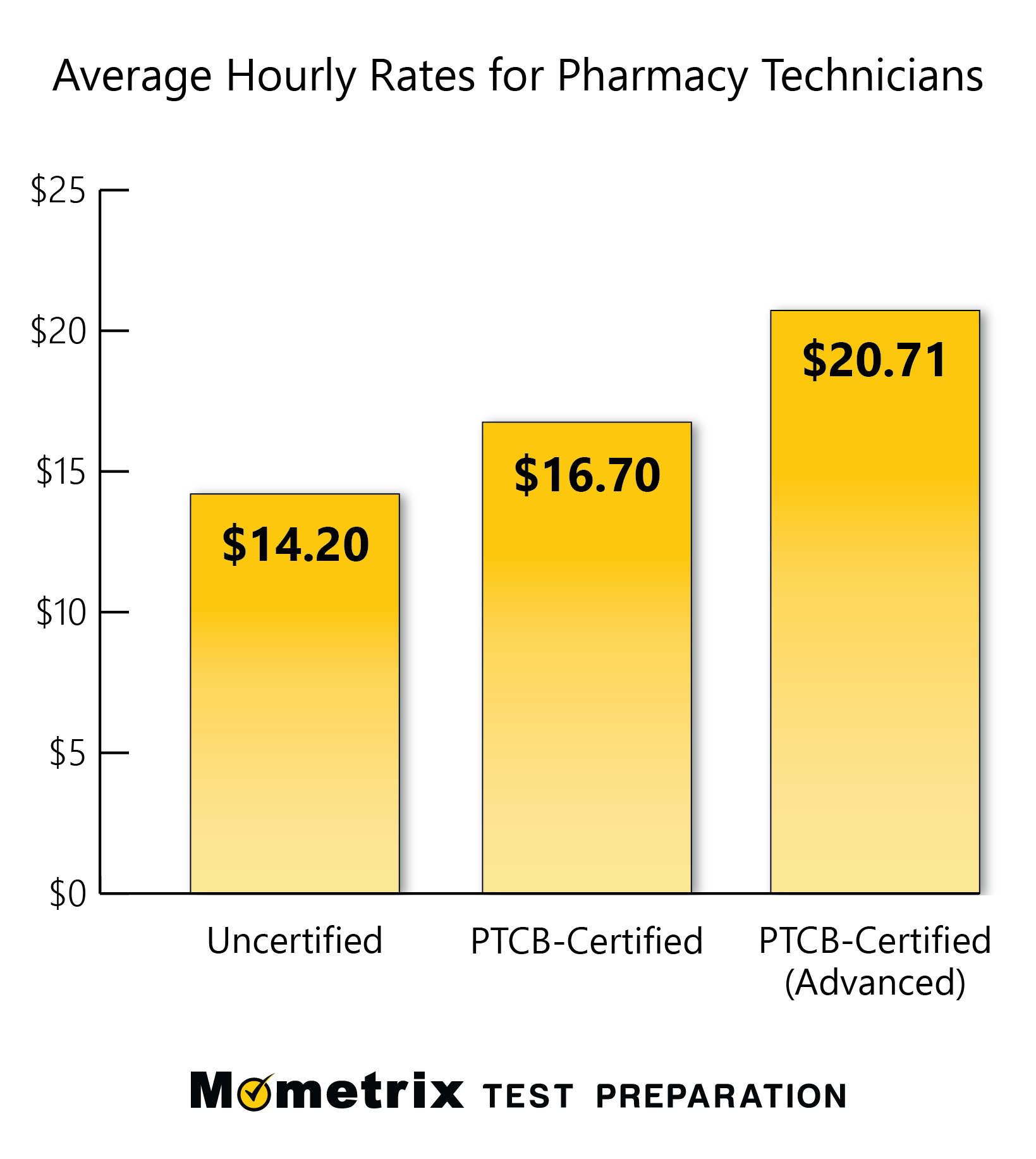
How much do pharmacy technicians make?
A
According to the PTCB, the average hourly rates for pharmacy technicians are as follows:


PTCB is a registered trademark of Pharmacy Technician Certification Board, Inc., which is not affiliated with Mometrix Test Preparation and does not endorse this page.