Click the “Start Test” button above to start a free AFOQT practice test for Air Force officer candidates! Get a head start by practicing verbal, math, aviation, table reading, and situational judgment questions before test day.
What is the AFOQT?
The AFOQT (Air Force Officer Qualifying Test) helps the Air Force select candidates for officer commissioning programs and certain specialized training programs. It measures verbal and math skills, along with abilities related to aviation and other officer career fields. Most officer candidates must take and pass the exam, but the requirements depend on how you plan to enter the Air Force.
AFOQT vs. ASVAB
The AFOQT and the ASVAB are somewhat similar tests, but there are some important differences. The AFOQT, which contains more subtests and more questions than the ASVAB, is specifically for those seeking to become officers in the Air Force, while the ASVAB is for those who want to enlist anywhere in the Armed Forces. The AFOQT is also aimed toward college students, while the ASVAB is intended for high-school students.
AFOQT Sections
The AFOQT exam is composed of 516 multiple-choice questions. The exam lasts about five hours including breaks, with 3 hours and 23 minutes to answer questions. Each section of the exam is timed, and the time limit for each section varies.
The AFOQT features 12 subtests in all. Each subtest caters to one of the skills an entry-level Air Force officer will need to utilize throughout their training as well as within the professional environment.
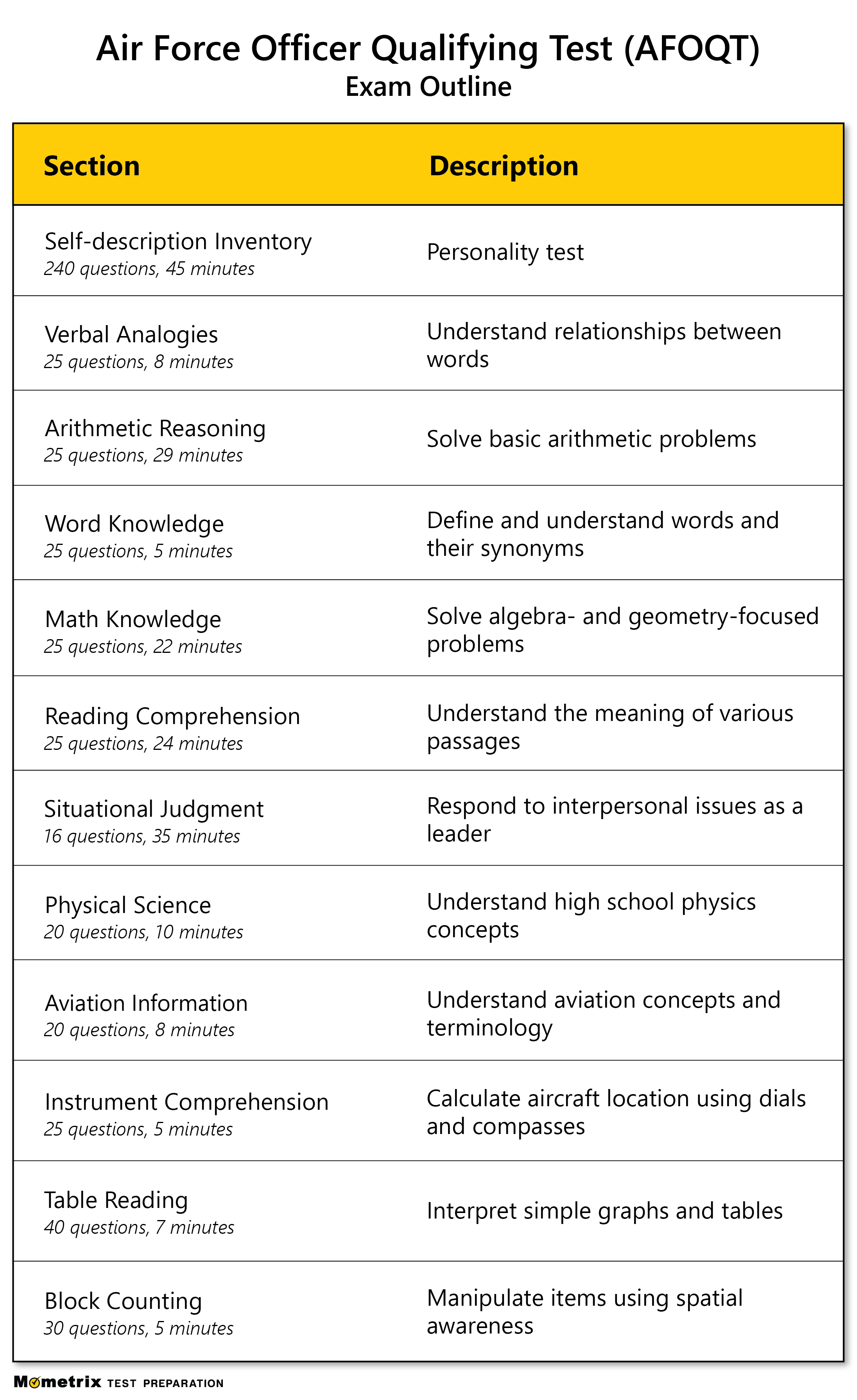
This subtest simply gauges your personality. Questions on this subtest are not graded.
Verbal Analogies (25 questions, 8 minutes)
This subtest is meant to evaluate your ability to identify how words can be used to establish assertions or illustrate certain principles (such as time or comparisons).
Arithmetic Reasoning (25 questions, 29 minutes)
This subtest assesses your ability to solve word problems. You will have to rely on your knowledge of geometry, proportions, ratios, mixtures, integers, percentages, and time-distance.
Word Knowledge (25 questions, 5 minutes)
This subtest focuses on your capability to define and understand the words used within written language. Questions featured on the subtest will generally offer a word, then ask you to find a synonymous word within the answer choices.
Math Knowledge (25 questions, 22 minutes)
This subtest centers on the basics of mathematics, including algebra, geometry, and arithmetic. To solve the questions contained on this subtest, you must answer algebra-based word problems, as well as comprehend inequalities, algebraic expressions, equations systems, absolute values, and exponents.
Reading Comprehension (25 questions, 24 minutes)
This subtest measures your ability to read a passage and understand its meaning, including the implied meaning.
Situational Judgment (16 questions, 35 minutes)
This subtest measures your ability to respond to interpersonal issues and serve as a leader.
Physical Science (20 questions, 10 minutes)
This subtest assesses your knowledge of high-school-level physical science concepts. You can expect to see questions relating to force relationships, physical laws, and simple machines.
Aviation Information (20 questions, 8 minutes)
This subtest concentrates on your comprehension of flight mechanics and aviation concepts. You must demonstrate your knowledge of rotary aircraft, the attributes of rudimentary aviation, aircraft with fixed wings, the security regulations enforced by modern US airports, and flight physics.
Instrument Comprehension (25 questions, 5 minutes)
This subtest measures your ability to read aircraft instruments. You’ll use an artificial horizon and a compass to determine which direction an airplane is heading and whether it is climbing, diving, or banking.
Table Reading (40 questions, 7 minutes)
This subtest measures how quickly and accurately you can find a value at the intersection of a specified row and column in a numerical table.
Block Counting (30 questions, 5 minutes)
This subtest addresses how well you understand the concept of spatial awareness. Questions under this category will present a group of blocks (rendered in 3D) and request that you count the number of blocks surrounding one individual block.
Check Out Mometrix's AFOQT Study Guide!
Get practice questions, video tutorials, and detailed study lessons.
Registration
If you are interested in sitting for the AFOQT, contact your recruiter, AFROTC detachment, or Test Control Officer to confirm your eligibility and arrange testing. Testing eligibility and commissioning requirements depend on your accession program. A completed bachelor’s degree is not a universal prerequisite for taking the AFOQT.
Once you are verified, you can work out a date for the exam with the recruiter. The test is free of charge. Two attempts are normally permitted; a third requires an approved waiver.
Test Day
When you show up to take your test, be prepared to be in the testing facility for about five hours. Every question is written in multiple-choice format with four or five answer choices. There is no penalty for choosing the incorrect answer. Each section of the test is timed, so it is best to be prepared and to work quickly.
How is the AFOQT Scored?
Your AFOQT results include several composite scores, each based on a combination of subtests. These scores are reported as percentiles from 1 to 99, which tell you how you performed compared to a reference group of test-takers. For example, a score of 60 means you performed as well as or better than approximately 60% of that group, not that you answered 60% of the questions correctly.
The main AFOQT score categories and their contributing subtests are:
| Score Category | Subtests |
|---|---|
| Verbal | Verbal Analogies, Word Knowledge, Reading Comprehension |
| Quantitative | Arithmetic Reasoning, Math Knowledge |
| Academic Aptitude | Verbal Analogies, Arithmetic Reasoning, Word Knowledge, Math Knowledge, Reading Comprehension |
| Pilot | Math Knowledge, Table Reading, Instrument Comprehension, Aviation Information |
| Combat Systems Officer (CSO) | Word Knowledge, Math Knowledge, Table Reading, Block Counting |
| Air Battle Manager (ABM) | Verbal Analogies, Math Knowledge, Table Reading, Instrument Comprehension, Block Counting, Aviation Information |
The scores you need depend on the career you want to pursue. For general commissioning, the minimum scores are 15 in Verbal and 10 in Quantitative. Pilot, CSO, and ABM applicants must also meet the minimum for their respective career category:
General Commissioning:
- Verbal: 15
- Quantitative: 10
- Additional AFOQT Minimum: None
Pilot, including Remotely Piloted Aircraft Pilot:
- Verbal: 15
- Quantitative: 10
- Pilot: 25
Combat Systems Officer:
- Verbal: 15
- Quantitative: 10
- CSO: 25
Air Battle Manager:
- Verbal: 15
- Quantitative: 10
- ABM: 25
Keep in mind that these are minimum qualifying scores. Meeting them doesn’t guarantee selection, so aim higher and check with your recruiter or commissioning program about what makes an application competitive.
If you decide to retake the exam, you normally must wait at least 90 days between attempts. Your results are superscored, meaning your highest composite scores across attempts are retained—even if you score lower in a category on a later attempt.
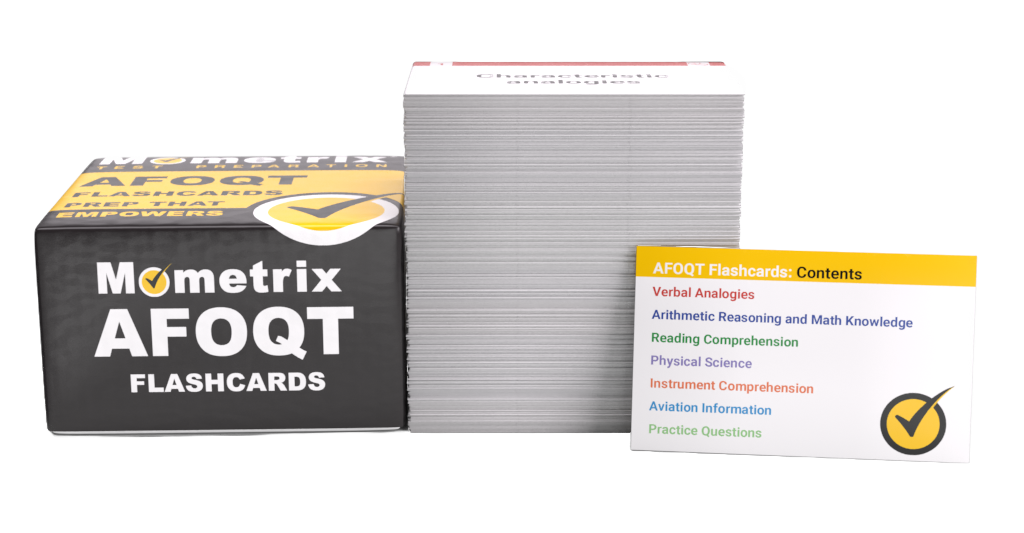
Check Out Mometrix's AFOQT Flashcards!
Get complex subjects broken down into easily understandable concepts.

AFOQT Online Prep Course
If you want to be fully prepared, Mometrix offers an online AFOQT prep course designed to give you everything you need to succeed!
Here's what you'll find in the AFOQT course:
- 30+ Review Lessons Covering Every Topic
- Over 1,900 AFOQT Practice Questions
- 300+ Digital Flashcards
- 130+ Instructional Videos
- Money-back Guarantee
- Mobile Access
Everyone learns differently, so we've tailored the AFOQT online prep course to ensure every learner has what they need to prepare for the AFOQT exam.
Click below to check it out!
Air Force Officer Qualifying Test Study Tips
How to Study Effectively
Your success on AFOQT test day depends not only on how many hours you put into preparing but also on whether you prepared the right way. It’s good to check along the way to see whether your studying is paying off. One of the most effective ways to do this is by taking AFOQT practice tests to evaluate your progress. Practice tests are useful because they show exactly where you need to improve. Every time you take a free AFOQT exam practice test, pay special attention to these three groups of questions:
- The questions you got wrong
- The ones you had to guess on, even if you guessed right
- The ones you found difficult or slow to work through
This will show you exactly what your weak areas are and where you need to devote more study time. Ask yourself why each of these questions gave you trouble. Was it because you didn’t understand the material? Was it because you didn’t remember the vocabulary? Do you need more repetitions on this type of question to build speed and confidence? Dig into those questions and figure out how you can strengthen your weak areas as you go back to review the material.
Answer Explanations
Additionally, many AFOQT practice tests have a section explaining the answer choices. It can be tempting to read the explanation and think that you now have a good understanding of the concept. However, an explanation likely only covers part of the question’s broader context. Even if the explanation makes sense, go back and investigate every concept related to the question until you’re positive you have a thorough understanding.
Comprehend Each Topic
As you go along, keep in mind that the AFOQT practice test is just that: practice. Memorizing these questions and answers will not be very helpful on the actual test because it is unlikely to have any of the same exact questions. If you only know the right answers to the sample questions, you won’t be prepared for the real thing. Study the concepts until you understand them fully, and then you’ll be able to answer any question that shows up on the test.
Strategy for AFOQT Practice
When you’re ready to start taking practice tests, follow this strategy:
- Remove Limitations. Take the first test with no time constraints and with your notes and AFOQT study guide handy. Take your time and focus on applying the strategies you’ve learned.
- Time Yourself. Take the second practice test “open book” as well, but set a timer and practice pacing yourself to finish in time.
- Simulate Test Day. Take any other practice tests as if it were test day. Set a timer and put away your study materials. Sit at a table or desk in a quiet room, imagine yourself at the testing center, and answer questions as quickly and accurately as possible.
- Keep Practicing. Keep taking practice tests on a regular basis until you run out of practice tests or it’s time for the actual test. Your mind will be ready for the schedule and stress of test day, and you’ll be able to focus on recalling the material you’ve learned.
FAQs
How many times can you take the AFOQT?
Two AFOQT attempts are normally permitted; a third requires an approved waiver. Retesting normally requires at least 90 days between attempts. AFOQT results are superscored, meaning your highest composite scores across attempts are retained as your scores of record.
How many questions are on the AFOQT?
There are a total of 516 questions on the exam.
How long is the AFOQT?
The time limit for the exam as a whole is 3 hours and 23 minutes.
Can you use a calculator on the AFOQT?
No, you may not use a calculator on this exam.
What are good AFOQT scores?
The score you need depends on which career path you choose.


Mometrix Test Preparation is not affiliated with or endorsed by any official testing organization. All organizational and test names are trademarks of their respective owners.


