
Knowing how to use the unit circle is a fundamental skill in trigonometry!
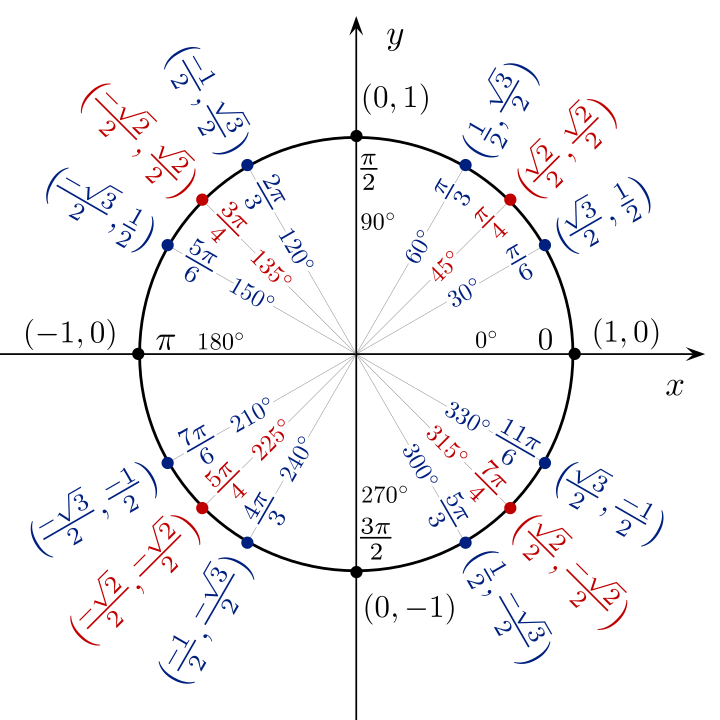
The unit circle is a circle of radius 1 centered at the origin. For any angle \(\theta\) (in degrees or radians), the coordinates of the point on the circle are \((x,y)=(\cos\theta,\ \sin\theta)\).
Angles are measured from the positive \(x\)-axis, counterclockwise positive.
Quick References
Full Turn
One full turn around the circle is \(360^\circ\), which equals \(2\pi\) radians.
Quadrants
The sign pattern of the coordinates follows the quadrant:
- Quadrant I: \((+,+)\)
- Quadrant II: \((-,+)\)
- Quadrant III: \((-,-)\)
- Quadrant IV: \((+,-)\)
On the unit circle, the Pythagorean identity always holds:
\(\sin^2\theta+\cos^2\theta=1\)
Tangent is defined by \(\tan\theta=\dfrac{\sin\theta}{\cos\theta}\) whenever \(\cos\theta\neq 0\).
Converting Units
To convert units, multiply degrees by \(\frac{\pi}{180}\) to get radians or multiply radians by \(\frac{180}{\pi}\) to get degrees:
\(\theta_{\text{rad}}=\theta^\circ\cdot\dfrac{\pi}{180}\)
\(\theta^\circ=\theta_{\text{rad}}\cdot\dfrac{180}{\pi}\)


