
The Series 7 exam, also called the General Securities Representative Qualification exam, is administered by FINRA® for individuals who wish to obtain a series 7 license to become an entry-level stockbroker.
Click “Start Test” above to take a free Series 7 practice test!
Series 7 Exam Eligibility
To be eligible to take the Series 7 exam, you must be associated with and sponsored by a FINRA member firm or another applicable self-regulatory organization (SRO) member firm.
To become registered as a General Securities Representative, you must pass both the Securities Industry Essentials (SIE) exam and the Series 7 exam. The SIE exam can be taken before you are sponsored, but passing the SIE alone does not qualify you for registration or allow you to conduct securities business.
If you aren’t currently sponsored by a member firm, you can still begin your licensing path by taking the SIE exam and studying for the Series 7 while you pursue a sponsored role.
Series 7 Exam Outline
The Series 7 exam contains 130 multiple-choice questions, five of which are unscored, and you will be given a time limit of 3 hours and 45 minutes.
The exam is split into four major job functions:
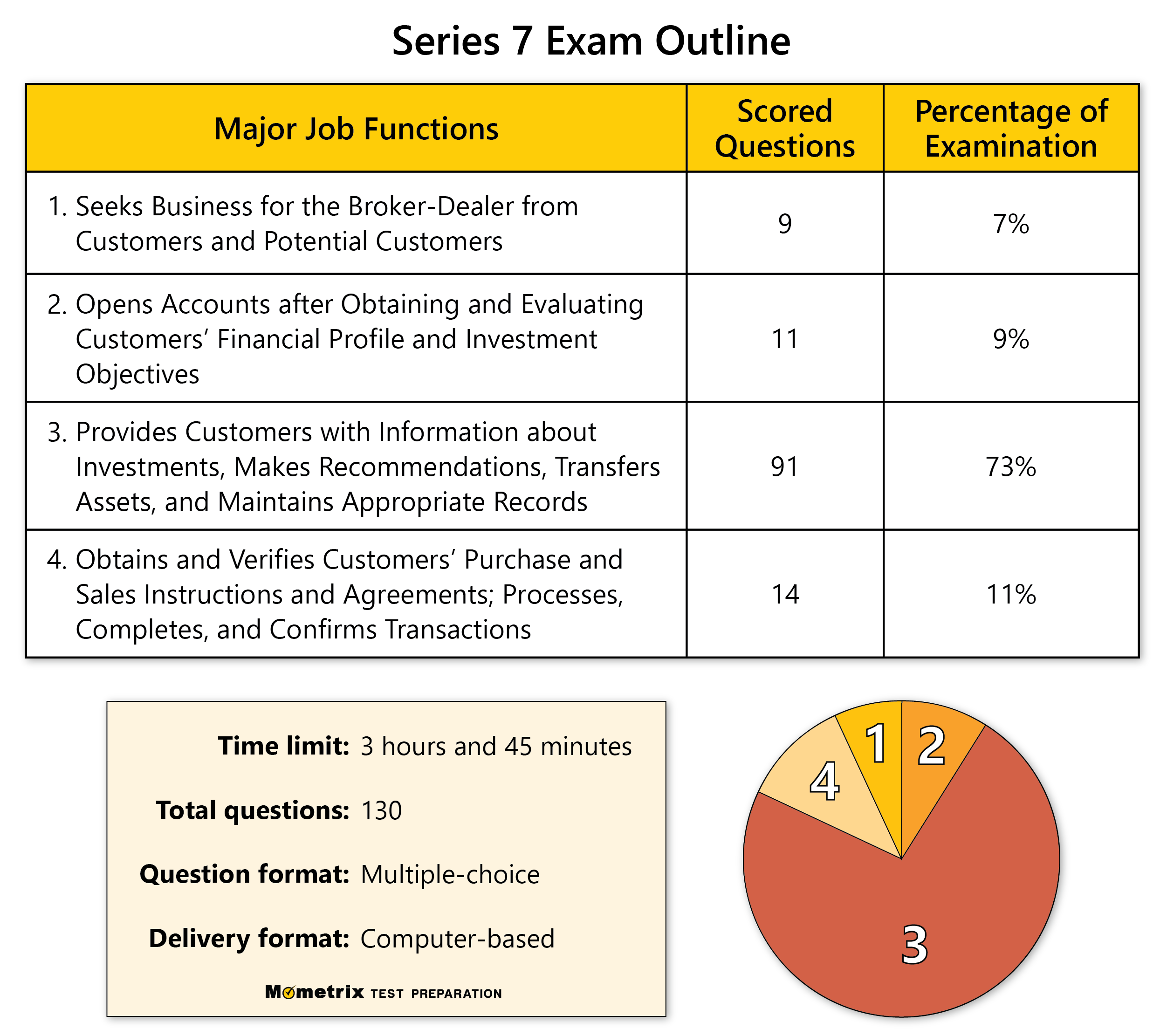
1. Seeks Business for the Broker-Dealer from Customers and Potential Customers
The nine scored questions under this function assess your ability to contact current and potential customers using various methods of communication as necessary, develop and seek approval to distribute advertising materials, and describe investment services to customers with the intent of soliciting business.
These are the FINRA rules you must be familiar with for this section:
- 2210: Communications with the public
- 2211: Communications with the public about variable life insurance and variable annuities
- 2212: Use of investment companies rankings in retail communications
- 2213: Requirements for the use of bond mutual fund volatility ratings
- 2216: Communications with the public about collateralized mortgage obligations (CMOs)
- 2220: Options communications
- 2330: Members’ responsibilities regarding deferred variable annuities
- 2360: Options
- 3160: Networking arrangements between members and financial institutions
- 3170: Tape recording of registered persons by certain firms
- 5110: Corporate financing rule — underwriting terms and arrangements
- 5121: Public offerings of securities with conflicts of interest
- 5130: Restrictions on the purchase and sale of initial equity public offerings
- 5131: New issue allocations and distributions
- 5141: Sale of securities in a fixed price offering
- 5160: Disclosure of price and concessions in selling agreements
- 5190: Notification requirements for offering participants
2. Opens Accounts After Obtaining and Evaluating Customers’ Financial Profile and Investment Objectives
The 11 scored questions under this function assess your ability to inform customers about the types of accounts available, provide disclosures about various account types, obtain and update customer information, make an effort to obtain customer investment profile information, and obtain supervisory approval to open accounts.
These are the FINRA rules you must be familiar with for this section:
- 2270: Day-trading risk disclosure statement
- 2130: Approval procedures for day-trading accounts
- 4512: Customer account information
- 4514: Authorization records for negotiable instruments drawn from a customer’s account
- 4515: Approval and documentation of changes in account name or designation
- 408T: Discretionary power in customers’ accounts
- 2090: Know your customer
- 3260: Discretionary accounts
- 2111: Suitability
- 2214: Requirements for the use of investment analysis tools
- 3110: Supervision
- 3120: Supervisory control system
3. Provides Customers with Information About Investments, Makes Recommendations, Transfers Assets, and Maintains Appropriate Records
The 91 scored questions under this function assess your ability to provide customers with investment strategy information, review and analyze customer investment profiles and product options, provide the required disclosures pertaining to investment products, and communicate with customers about their contact information and process requests.
These are the FINRA rules you must be familiar with for this section:
- 2114: Recommendations to customers in OTC equity securities
- 2121: Fair prices and commissions
- 2122: Charges for services performed
- 2124: Net transactions with customers
- 2310: Direct participation programs
- 2320: Variable contracts of an insurance company
- 2341: Investment company securities
- 2350 Series: Trading in index warrants, currency index warrants, and currency warrants
- 4210(f)(2): Definitions related to options, currency warrants, currency index warrants and stock index warrant transactions
- 2165: Financial exploitation of specified adults
- 409T: Statements of accounts to customers
- 2231: Customer account statements
- 2232: Customer confirmations
- 2273: Educational communication related to recruitment practices and account transfers
- 4510: Books and records requirements
- 11870: Customer account transfer contracts
4. Obtains and Verifies Customers’ Purchase and Sales Instructions and Agreements; Processes, Completes, and Confirms Transactions
The 14 scored questions under this function assess your ability to provide current quotes, process and confirm customer transactions, identify discrepancies and errors, resolve disputes and complaints, and address margin issues.
These are the FINRA rules you must be familiar with for this section:
- 4320: Short sale delivery requirements
- 4551: Requirements for alternative trading systems to record and transmit order and execution information for security futures
- 5210: Publication of transactions and quotations
- 5220: Offers and stated prices
- 5260: Prohibition on transactions, publication of quotations, or publication of indications of interest during trading halts
- 5290: Order entry and execution practices
- 5310: Best execution and interpositioning
- 6100 Series: Quoting and trading in NMS stocks
- 6400 Series: Quoting and trading in OTC equity securities
- 6600 Series: OTC reporting facility
- 11860: COD orders
- 5330: Adjustment of orders
- 6000 Series: Quotation, order, and transaction reporting facilities
- 6140: Other trading practices
- 6700 Series: Trade reporting and compliance engine
- 7000 Series: Clearing, transactions and order data requirements, and facility charges
- 11000 Series: Uniform practice code
- 4513: Records of written customer complaints
- 4530: Reporting requirements
- 8000 Series: Investigations and sanctions
- 11892: Clearly erroneous transactions in exchange-listed securities
- 11893: Clearly erroneous transactions in OTC equity securities
- 12000 Series: Code of arbitration procedure for customer disputes
- 13000 Series: Code of arbitration procedure for industry disputes
- 14000 Series: Code of mediation procedure
Check Out Mometrix's Series 7 Study Guide
Get practice questions, video tutorials, and detailed study lessons.
Top 5 Most Challenging Series 7 Questions
Now that you know more about the test, try your hand at some targeted practice!
Over the last year, we’ve compiled the data from about 1,000 test-takers who tried their hand at the practice test at the top of this page. According to the data, around 60% of people answered these five questions incorrectly.
Answer each question and read through the answer explanation, whether you got the answer right or wrong. This will help you ensure you’ve got the topic mastered.
Whether you struggled with these questions or aced them on your first try, be sure to take the full practice test to get a better idea of how prepared you really are!

1. On Monday, December 5, after trading for that day ceased, ABC Corporation declared that it would pay a $0.25 dividend, payable on December 15 to stockholders of record on December 10th. The December 5 closing price of ABC Corporation stock is $25.34.
Assuming rational market behavior, what will the opening price of ABC Corporation be on December 6?
2. A transfer of assets from one IRA to another like-titled IRA is called a(n) __________.
3. Which of the following is NOT a requirement for an investor to execute a short sale?
4. If a client wishes to donate a stock to a charity that has a brokerage account at another firm, which system is most likely used to make the transfer?
5. Which of the following statements is FALSE regarding an upward-sloping yield curve?
Registration
The firm you are connected with will need to register you with FINRA via the Central Registration Depository (CRD) Program to be able to take the Series 7 exam. An examination fee of $395 is due at the time of registration.

Series 7 Online Prep Course
If you want to be fully prepared, Mometrix offers an online Series 7 prep course designed to give you everything you need to succeed!
Here’s what you’ll find in the Series 7 course:
- 160+ Review Lessons Covering Every Topic
- Over 900 Series 7 Practice Questions
- 850+ Digital Flashcards
- Money-back Guarantee
- Mobile Access
Everyone learns differently, so we’ve tailored the Series 7 online prep course to ensure every learner has what they need to prepare for the Series 7 exam.
Click below to check it out!
Test Day
In-person Testing
On the day of your exam, you should arrive at the testing center at least 15 minutes earlier than the scheduled exam time. If you arrive late, you will not be permitted to sit for the exam. Once you arrive, you will be asked to show a valid, government-issued photo ID. If your ID is invalid or you forget to bring it, you will not be permitted to sit for the exam.
Once the check-in process is complete, you will be asked to leave all personal items in a secure locker, such as your cell phone, books, papers, notes, food, jacket, and hat.
Once the exam begins, you are permitted to take breaks, but the timer will not be stopped while you are away.
Remote Testing
The day before your exam, you will need to check the compatibility of your computer’s audio, video, and webcam. You will need to download and install an application that will perform a system check to ensure your laptop or desktop operating system meets the minimum requirements.
On the day of your exam, ensure that your testing area is clear of your cell phone, reference materials, scratch paper, and food or drink containers. Ensure you can move the webcam around for the proctor so they can view your area.
You can launch the examination up to 30 minutes before your scheduled appointment. You cannot leave the webcam’s view during your exam, use other monitors, or talk to anyone. If the proctor observes questionable behavior, your exam will be canceled.
Series 7 Scoring
The Series 7 exam is scored using the modified-Angoff method, which means that your final score is determined based only on your performance on the examination. Each version of the exam is different, so the number of correct responses needed to obtain a passing score will vary slightly.
A passing score for this exam is 72.
Check Out Mometrix's Series 7 Flashcards
Get complex subjects broken down into easily understandable concepts.
Study Tips
Start with a Series 7 Practice Test
Before creating your study schedule, take a Series 7 practice test to establish a starting point. You don’t need to wait until you have memorized every option strategy, bond formula, account rule, and tax treatment. At this stage, the goal is to identify where your preparation time will have the greatest effect.
After your practice test is over, don’t judge your readiness using only your overall practice percentage. Look for narrower weaknesses:
- Can you define a municipal bond but struggle to determine whether it is appropriate for a particular investor?
- Do you understand mutual-fund share classes but have difficulty comparing costs for customers with different investment horizons?
- Do you understand margin terminology but confuse equity, SMA, buying power, and maintenance requirements?
- Do you recognize a product’s features but overlook liquidity, tax status, time horizon, risk tolerance, or investment objectives?
- Can you recognize an order type but struggle to predict when and how it will execute?
Identifying those specific weaknesses will show you where to devote more attention during your study time.
Review Difficult Questions
After each practice session, review every question you answered incorrectly AND every question you guessed on or answered with low confidence.
For each difficult question, determine which of the following caused the problem:
- You confused two similar securities.
- You focused on potential return while ignoring risk.
- You selected a suitable product generally, but not the best choice for the customer described.
- You confused a recommendation rule with an account-opening requirement.
- You understood an option position individually but lost track of the combined strategy.
- You confused the buyer’s rights with the writer’s obligations.
- You reversed the relationship between bond prices and yields.
- You used the wrong tax treatment.
- You confused a cash-account requirement with a margin-account requirement.
- You misunderstood settlement, order handling, or trade-processing rules.
- You knew the material but took too long to solve the question.
Then, outline a specific plan for improvement based on what you discovered. In other words, don’t just say, “I need to study options.” Specify that you need to review maximum gain, maximum loss, and breakeven for long and short calls and puts.
Similarly, replace “study bonds” with a specific task such as ranking coupon rate, current yield, yield to maturity, and yield to call on premium and discount bonds.
Utilize Answer Explanations
Answer explanations are an underutilized studying resource. To take full advantage of them, read the explanation for every question you found difficult, including questions you answered correctly.
For each one, make sure you can confidently explain:
- Why the correct answer is correct
- Why each incorrect option is wrong
- What Series 7 concept or rule is being tested
- Which information in the question controls the answer
- How the product, strategy, or rule applies to the customer
- How the same concept could appear in a different scenario
For product questions, don’t stop at identifying the security. Ask yourself things like how the investor makes money, how liquid the investment is, and what type of investor might use it.
For calculation questions, use a consistent process:
- Identify what you are being asked to calculate.
- Write down the known values.
- Determine which relationship or formula applies.
- Complete the calculation.
- Check the units and direction.
- Explain what the result means.
Explaining what the result means is far more useful than just memorizing a formula. For example, if you calculate a bond’s current yield, determine what that number tells the investor. If you calculate equity in a margin account, determine whether the account meets maintenance requirements or whether additional funds or securities are required.
Don’t Study the Series 7 Like the SIE
The SIE and Series 7 are certainly related, but they serve different purposes.
The SIE tests fundamental securities-industry knowledge, while the Series 7 focuses more specifically on the knowledge required to perform the registered representative’s actual job.
If you already understand that common stock represents ownership, bonds represent debt, options are derivatives, and mutual funds pool investor assets move to the next level. Ask yourself which customer should own the product, how the product generates return, how it’s taxed, and what happens if market conditions change.
FAQs
Q
How long is the Series 7 exam?
A
The time limit for the exam is 3 hours and 45 minutes.
Q
What is the Series 7 exam?
A
The Series 7 exam is a certification exam for those wishing to obtain a credential as an entry-level stockbroker.
Q
How hard is the Series 7 exam?
A
The exam is considered to be moderately difficult, with an estimated pass rate of 65%.
Q
How many questions are on the Series 7 exam?
A
There are 130 multiple-choice questions on the exam, five of which are unscored.
Q
What is the passing score for the Series 7 exam?
A
To pass the exam, you must get a final score of at least 72.
Q
How much does the Series 7 exam cost?
A
The exam fee is $395.


FINRA is a registered trademark of Financial Industry Regulatory Authority, Inc., which is not affiliated with Mometrix Test Preparation and does not endorse this page.