Formerly known as Family Psychiatric–Mental Health Nurse Practitioner, the Psychiatric-Mental Health Nurse Practitioner (Across the Lifespan) certification exam allows nurse practitioners to become board-certified (PMHNP-BC) to work in a variety of settings and care for mental health patients of all ages.
Click “Start Test” above to take a free PMHNP practice test!
PMHNP Eligibility
To qualify for the exam, you must have:
- A current, active RN license in a U.S. state or territory, or the legally recognized equivalent in another country
- A PMHNP Across the Lifespan master’s, post-graduate certificate, or DNP from an accredited program
- At least 500 faculty-supervised clinical hours in the PMHNP role and population
- Graduate-level APRN coursework in advanced physiology/pathophysiology, advanced health assessment, and advanced pharmacology
- Training in at least two psychotherapeutic treatment modalities
PMHNP Exam Outline
The PMHNP exam contains 175 multiple-choice questions, 25 of which are unscored, and you will be given a 3.5-hour time limit. The unscored questions are used by the administrators to evaluate questions for future versions of the exam, and you will not know which questions are scored or unscored during the exam.
The exam is split into five content domains, and each domain contains some number of knowledge questions and skill questions.
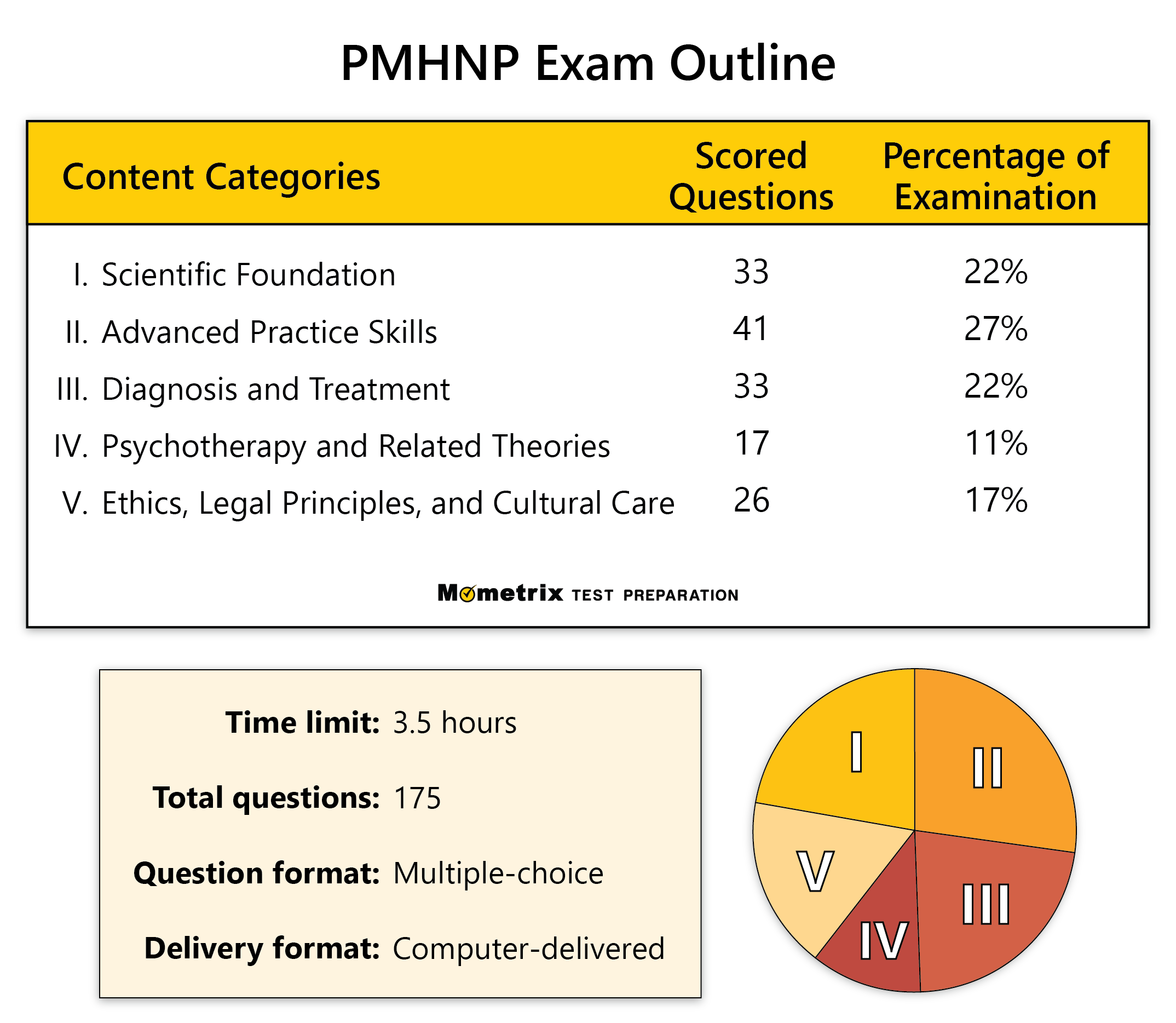
I. Scientific Foundation (33 scored questions)
The questions in this category assess your advanced physical assessment skills. You will also be tested on your knowledge of the following:
- Advanced pharmacology
- Advanced pathophysiology
- Advanced psychopharmacology
- Psychogenomics
- Neuroanatomy
- Neurodevelopment
- Neurophysiology
II. Advanced Practice Skills (41 scored questions)
The questions in this category assess your skills in the following areas:
- Mental status exams
- Clinical interviewing
- Risk assessment
- Psychiatric emergency management
- Psychoeducation
- Substance use screening tool selection and interpretation
- Mental health screening tool selection and interpretation
- Recovery and resilience promotion
- Health promotion and disease prevention
III. Diagnosis and Treatment (33 scored questions)
The questions in this category assess your knowledge of complementary/alternative treatments and DSM-5-TR diagnostic criteria. You will also be tested on your skills in the following areas:
- Evidence-based practice
- Diagnostic and lab test selection and interpretation
- Pharmacotherapeutic management
- Diagnosis
- Psychopharmacotherapeutic management
IV. Psychotherapy and Related Theories (17 scored questions)
The questions in this category assess your therapeutic alliance development and management skills. You will also be tested on your knowledge of the following:
- Change theories
- Family theories
- Psychotherapy principles
- Developmental theories
V. Ethics, Legal Principles, and Cultural Care (26 scored questions)
The questions in this category assess your knowledge of the Patient’s Bill of Rights, the scope of confidentiality, and the ANA Scope and Standards of Practice. You will also be tested on your skills in the following areas:
- Equity, diversity, and inclusion
- Patient advocacy
- Cultural and spiritual competence
- Ethics in clinical decision-making
Check Out Mometrix's Psychiatric-Mental Health Nurse Practitioner Study Guide
Get practice questions, video tutorials, and detailed study lessons.
Top 5 Most Challenging PMHNP Questions
Now that you know more about the test, try your hand at some targeted practice!
Over the last year, we’ve compiled the data from about 1,000 test-takers who tried their hand at the practice test at the top of this page. According to the data, around 80% of people answered these five questions incorrectly.
Answer each question and read through the answer explanation, whether you got the answer right or wrong. This will help you ensure you’ve got the topic mastered.
Whether you struggled with these questions or aced them on your first try, be sure to take the full practice test to get a better idea of how prepared you really are!

1. When using the LEARN model for cross-cultural health care, an important approach to the Explain step is to:
2. In a psychiatric unit, patients are primarily able to exercise power through:
Threats and intimidation as well as cooperation and lack of cooperation may bring about a response, but they are not exercises in real power. Rewards and punishments are not generally within the purview of patients.
3. According to Kohlberg’s theory of moral development, the stage at which a 9-year-old child may make moral judgments based on what the child gets from the decision is:
4. According to the general adaptation syndrome (Selye), an example of reaction to stress in the resistance stage is:
5. If the PMHNP plans to access the healthcare system’s data warehouse for research purposes, this is referred to as:
Registration
To register for the exam, you must submit an application via the ANCC website. Your application should include all of the necessary proof-of-eligibility documentation and the $395 examination fee.
Once your application is approved, you will receive a confirmation email containing your Authorization to Test (ATT) and information about scheduling your examination appointment.
Test Day
You should arrive at the testing center 15-30 minutes before your scheduled exam appointment time. Once you arrive, you will be asked to provide two forms of identification, one of which must be a government-issued photo ID.
You will be asked to leave all personal items such as cell phones, coats, wallets, food/drink, and notes in your car or in a secure locker outside the testing area.
Once the check-in process is complete, you will be led to your testing station and given a short tutorial on the testing system before beginning your exam.
Scoring
The PMHNP exam is scored using a criterion-based scoring system, which means that a group of ANCC subject-matter experts has evaluated the difficulty of the entire pool of questions and determined a passing score. The passing score is set using the modified-Angoff method, which means that your score is based solely upon your performance, and no other test-taker’s scores are taken into account.
Your score is reported on a scale of 1-500, with 350 being the minimum passing score.
You will be able to see your preliminary scores as soon as you complete the exam. You will have to sign into your ANCC account to view your final score report.
PMHNP Online Prep Course
If you want to be fully prepared, Mometrix offers an online PMHNP prep course designed to give you everything you need to succeed!
Here’s what you’ll find in the PMHNP course:
- 70+ Review Lessons Covering Every Topic
- 700 PMHNP Practice Questions
- 550+ Digital Flashcards
- 30+ Instructional Videos
- Money-back Guarantee
- Mobile Access
Everyone learns differently, so we’ve tailored the PMHNP online prep course to ensure every learner has what they need to prepare for the PMHNP exam.
Click below to check it out!
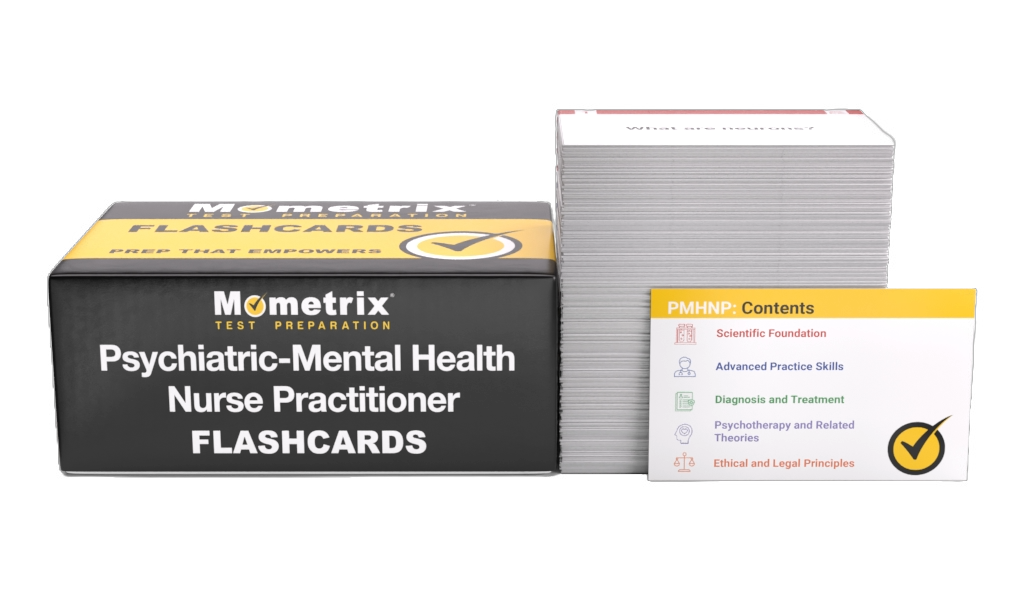
Check Out Mometrix's Psychiatric-Mental Health Nurse Practitioner Flashcards
Get complex subjects broken down into easily understandable concepts.
FAQs
Q
What is a PMHNP?
A
A psychiatric-mental health nurse practitioner (PMHNP) provides advanced care covering a large range of mental health services to a wide variety of patients and families.
Q
How many questions are on the PMHNP exam?
A
There are 175 multiple-choice questions on the exam.
Q
How long is the PMHNP exam?
A
The time limit for the exam is 3.5 hours.
Q
What is the passing score for the PMHNP exam?
A
To pass the exam, you must achieve a scaled score of at least 350.
Q
How much does the PMHNP exam cost?
A
The examination fee is $395.


Affiliate disclosure: As an Amazon Associate, we may earn commissions from qualifying purchases from Amazon.com.
Mometrix Test Preparation is not affiliated with or endorsed by any official testing organization. All organizational and test names are trademarks of their respective owners.