
The NES Elementary Education exam is used to assess the readiness of prospective teachers who wish to teach in elementary schools that follow the NES standards.
Click “Start Test” above to take a free NES Elementary Education practice test, and check out our premium-quality NES test prep resources by clicking the links below!
NES Elementary Education Exam Outline
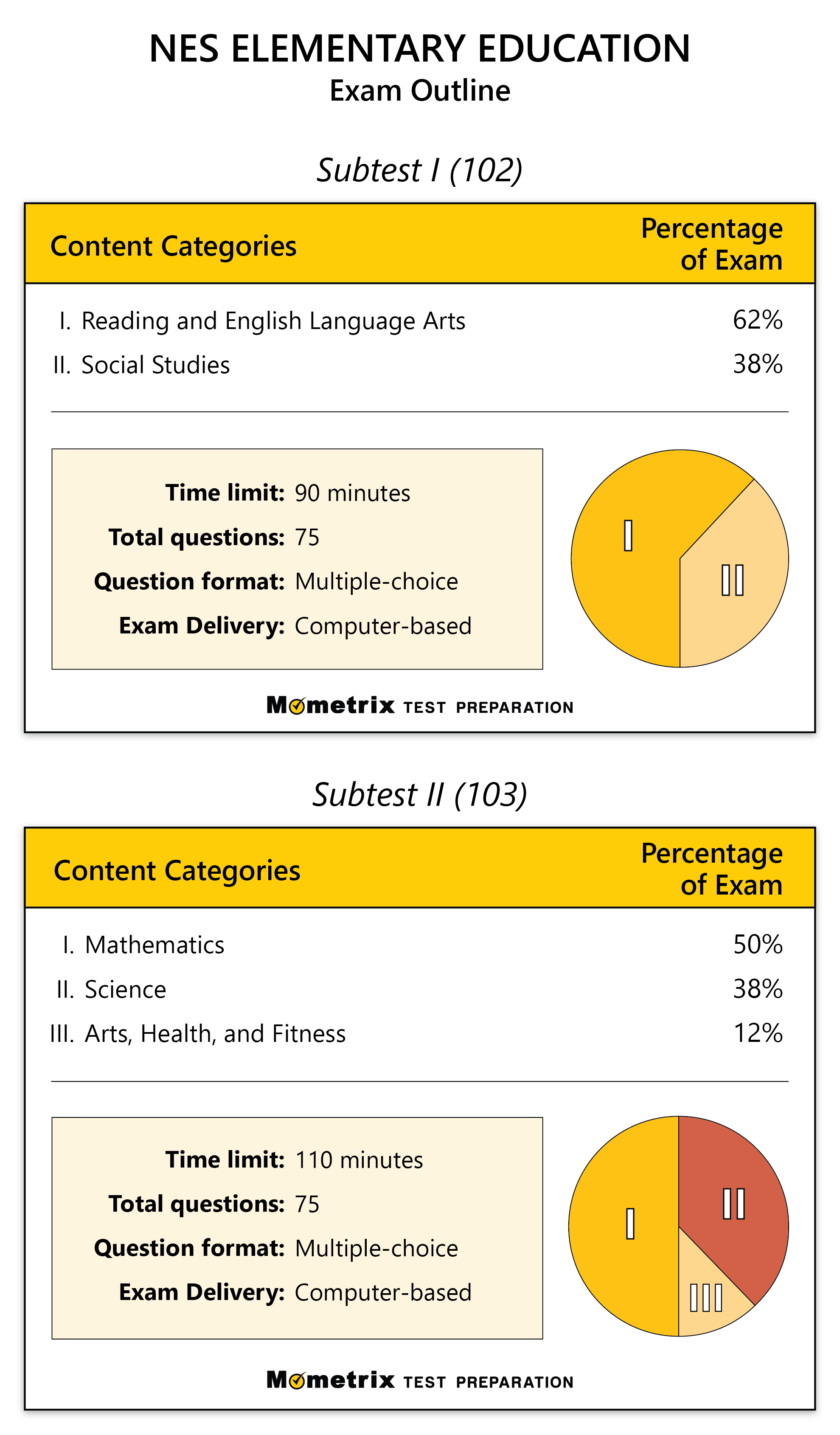
The NES Elementary Education exam is split into two subtests, each of which contains 75 multiple-choice questions. Subtest I is timed at 1.5 hours, while Subtest II is timed at 1 hour and 45 minutes.
Subtest I (102)
The first subtest is split into two domains:
I. Reading and English Language Arts (62%)
- Foundations of language development and emergent literacy
- Development of phonics, spelling, word analysis, and fluency
- Reading comprehension and vocabulary skills
- Literary, persuasive, functional, and informational texts and graphic resources
- Modes, processes, and conventions of written and oral communication
II. Social Studies (38%)
- Fundamental concepts related to government and economics
- Fundamental concepts and major developments related to US and world history
- Fundamental concepts related to geography and methods of social studies inquiry
Subtest II (103)
The second subtest is split into three domains:
I. Mathematics (50%)
- Concepts of numeration, mathematical operations, and number sense
- Problem-solving and mathematical reasoning
- Communication and representation
- Data analysis
- Basic concepts of algebra, functions, and patterns
- Basic concepts of geometry and measurement
II. Science (38%)
- Fundamental concepts of the life sciences
- Fundamental concepts of the Earth, space, and physical sciences
- The nature of science
- Processes of scientific inquiry
III. The Arts, Health, and Fitness (12%)
- Basic elements of the arts
- Fundamental concepts of health and fitness
Check Out Mometrix's NES Elementary Education Study Guide!
Get practice questions, video tutorials, and detailed study lessons.

Top 3 Most Challenging Questions
Now that you know more about the exam, try your hand at some targeted practice!
Over the last year, we've compiled the data from about 1,000 test-takers who tried their hand at the practice test at the top of this page. According to the data, around 65% of people answered these three questions incorrectly.
Answer each question and read through the answer explanation, whether you got the answer right or wrong. This will help you ensure you've got the topic mastered.
Whether you struggled with these questions or aced them on your first try, be sure to take the full practice test to get a better idea of how prepared you really are!

1. The stream of charged particles that escape the Sun’s gravitational pull is best described by which of the following terms?
2. Given the histograms shown below, which of the following statements is true?
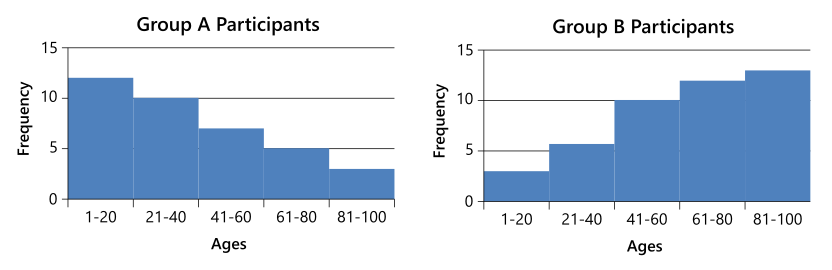
Conversely, data is skewed left (or negatively) when there is a higher frequency of larger values or when the mean is less than the median.
Group A is positively skewed because there is a higher number of low frequencies. Group B is negatively skewed because there is a higher value of high frequencies. Since Group B generally has higher frequencies than Group A, Group B has a mean that is more than Group A.
3. A triangular prism has a right triangle cross-section. The orthogonal sides are each 2 cm wide, and the total length of the prism is 10 cm. The total surface area of the prism and its volume are:
Multiplying this by the length gives the surface area of the sides, which is \((40+20\sqrt{2})\). The surface area of the two ends is calculated as \(2(\frac{1}{2}bh)\), which is 4 cm2. The total surface area of the prism is, therefore, \((44+20\sqrt{2})\text{ cm}^2\).
The volume is calculated by multiplying the area of the base by the height:
\(\dfrac{1}{2} bh\times l=2 \times 10=20 \text{ cm}^3\)
Registration
To register for the NES Elementary Education exam, you must first create an online account on the NES website. You may then register for your examination appointment with Pearson VUE.
The testing fee for both subtests together is $165.
Test Day
On test day, you should arrive at the Pearson VUE testing center 30 minutes before the exam is scheduled to begin. This will allow extra time for the check-in process. After you arrive, you must sign in and present your photo ID to the proctor. You will be photographed and asked to sign a roster and other rule forms.
Personal items are not allowed in the testing room, so they should be left at home or in your car. This includes your phone and any bags, books, keys, wallets, and accessories.
Just before the exam starts, you will be given a brief tutorial on the testing system. You will also be given everything you need to work out any calculations by hand (no calculator will be provided).
How the Exam is Scored
Your NES Elementary Education score is determined using a scaled scoring method. This method takes your raw score, which is the number of questions you answered correctly, and converts it to a numerical score on a scale of 100 to 300. To pass, your final score must be at least 220 on each subtest.
Check Out Mometrix's NES Elementary Education Flashcards!
Get complex subjects broken down into easily understandable concepts.

Study Tips
Start with an NES Practice Test
Before creating your study schedule, take an NES practice test to establish a starting point. Since the Elementary Education exam is split into two separately administered subtests, complete a diagnostic for each one. At this stage, the goal is to identify where your preparation time will have the greatest effect.
Review your results across the five content domains:
- Reading and English Language Arts: Do you understand language development, phonological and phonemic awareness, phonics, word analysis, fluency, vocabulary, comprehension, text types, and written and oral communication?
- Social Studies: Can you apply concepts from government, economics, U.S. and world history, geography, and social studies inquiry?
- Mathematics: Can you work with number sense, operations, fractions, ratios, probability, data, algebraic patterns, geometry, measurement, and mathematical reasoning?
- Science: Do you understand life science, physical science, Earth and space science, scientific inquiry, experimentation, and data analysis?
- The Arts, Health, and Fitness: Do you understand basic concepts in music, drama, dance, visual arts, human health, nutrition, fitness, movement, and safety?
Identifying those specific weaknesses will show you where to devote more attention during your study time.
Review Difficult Questions
After each practice session, review every question you answered incorrectly AND every question you guessed on or answered with low confidence.
For each difficult question, determine which of the following caused the problem:
- You confused phonological awareness, phonemic awareness, and phonics.
- You knew a literacy skill but didn't recognize the appropriate strategy for developing it.
- You understood a text but misidentified its purpose or main idea.
- You knew a historical fact but didn't understand its chronology or consequence.
- You made an error with a multistep calculation.
- You knew a scientific fact but couldn't apply it to a set of data.
- You overlooked a smaller topic because you focused only on the larger domains.
Then, outline a specific plan for improvement based on what you discovered. In other words, don't just say, “I need to study reading.” Note that you need to practice distinguishing phoneme segmentation from blending or selecting an appropriate strategy for improving reading fluency.
Similarly, replace “study math” with something specific, such as translating ratios and proportions from word problems or converting measurements within the same system.
Utilize Answer Explanations
Answer explanations are an underutilized studying resource. To take full advantage of them, read the explanation for every question you found difficult, including questions you answered correctly.
For each one, make sure you can confidently explain:
- Why the correct answer is correct
- Why each incorrect answer is less appropriate
- What concept or skill is being tested
- Which information in the question controls the answer
- What reasoning or process leads to the correct answer
- How the same concept could appear in a different elementary education scenario
For literacy questions, identify the specific reading or language skill involved and where it fits in literacy development. If the question describes a student's difficulty, determine what the student can already do, what skill is missing, and which strategy addresses that gap.
For mathematics and science questions, reproduce the reasoning yourself instead of memorizing the answer. Work through the calculation, representation, experiment, or cause-and-effect relationship until you can explain why it works.
Study Reading as a Developmental Process
Reading and English Language Arts makes up most of Subtest I, and many of its concepts are easier to understand when you connect them rather than study them as separate definitions.
For foundational reading, think about how skills build on one another:
Oral Language → Phonological Awareness → Phonemic Awareness → Phonics and Word Analysis → Fluency → Comprehension
Don't just memorize the definitions of phonemic awareness, decoding, fluency, vocabulary, and comprehension. Be able to recognize what a student is struggling with and which type of instruction would address that specific problem.
For example, a student who cannot segment the sounds in a spoken word has a different problem than a student who can identify the sounds but cannot connect them to letters.
Use the same approach with comprehension. Identify whether the difficulty involves vocabulary, locating explicit information, making an inference, recognizing text structure, determining the main idea, or evaluating an author's message.
Practice Mathematical Reasoning and Scientific Inquiry
Subtest II requires more than recalling formulas and science facts. The official framework emphasizes mathematical reasoning, representations, real-world problem solving, scientific investigations, and data analysis.
For mathematics, practice moving through the entire problem:
Problem → Representation → Strategy → Calculation → Check
Don't immediately reach for an operation because you recognize a number in the question. Determine what the quantities represent, how they relate to one another, and whether a diagram, model, equation, table, or other representation makes the relationship clearer.
For science, study experiments as a process:
Question → Investigation → Variables → Evidence → Conclusion
Practice identifying what is being changed, what is being measured, what should remain controlled, and whether the available evidence actually supports the conclusion.
Practice Each NES Subtest Separately
Don't prepare for NES Elementary Education as one 150-question exam. Subtest I and Subtest II are administered separately, have different time limits, and must each be passed independently.
Subtest I contains 75 questions in 90 minutes, giving you an average of about 72 seconds per question. Reading and English Language Arts makes up most of this subtest, so practice moving efficiently between short knowledge questions and questions that require you to analyze text or determine an appropriate instructional strategy.
Subtest II contains 75 questions in 105 minutes, giving you an average of about 84 seconds per question. Some mathematics and science problems will naturally require more time than straightforward knowledge questions, so don't force yourself to use the same amount of time on every item.
Build up from untimed practice to domain-specific sets, mixed sets, and finally full 75-question simulations using the correct time limit for the subtest you're preparing to take.
FAQs
How many questions are on the NES Elementary Education exam?
There is a total of 150 multiple-choice questions on the exam.
How long is the NES Elementary Education exam?
The total time limit for the exam is 3 hours and 15 minutes.
What is the passing score for the NES Elementary Education exam?
To pass the exam, you must achieve a minimum scaled score of 220 on each subtest.
How much does the NES Elementary Education exam cost?
The examination fee is $165 for the combined test.


NES and National Evaluation Series are trademarks of Pearson Education, Inc. or its affiliate(s). This page was developed by Mometrix Test Preparation. It was not developed in connection with Pearson Education, Inc., nor was it reviewed, approved or endorsed by these agencies.


