The Mortgage Loan Officer (MLO) exam is designed to assess the knowledge and skills of prospective state-certified loan officers.
Click “Start Test” above to take a free Loan Officer practice test, and check out our premium-quality Loan Officer test prep resources by clicking the links below!
Loan Officer Exam Outline
The MLO exam contains 120 multiple-choice questions, five of which are unscored, and you will be given a time limit of 190 minutes. The five unscored questions are used by the administrators to evaluate questions for future versions of the exam.
The exam is split into five content areas.
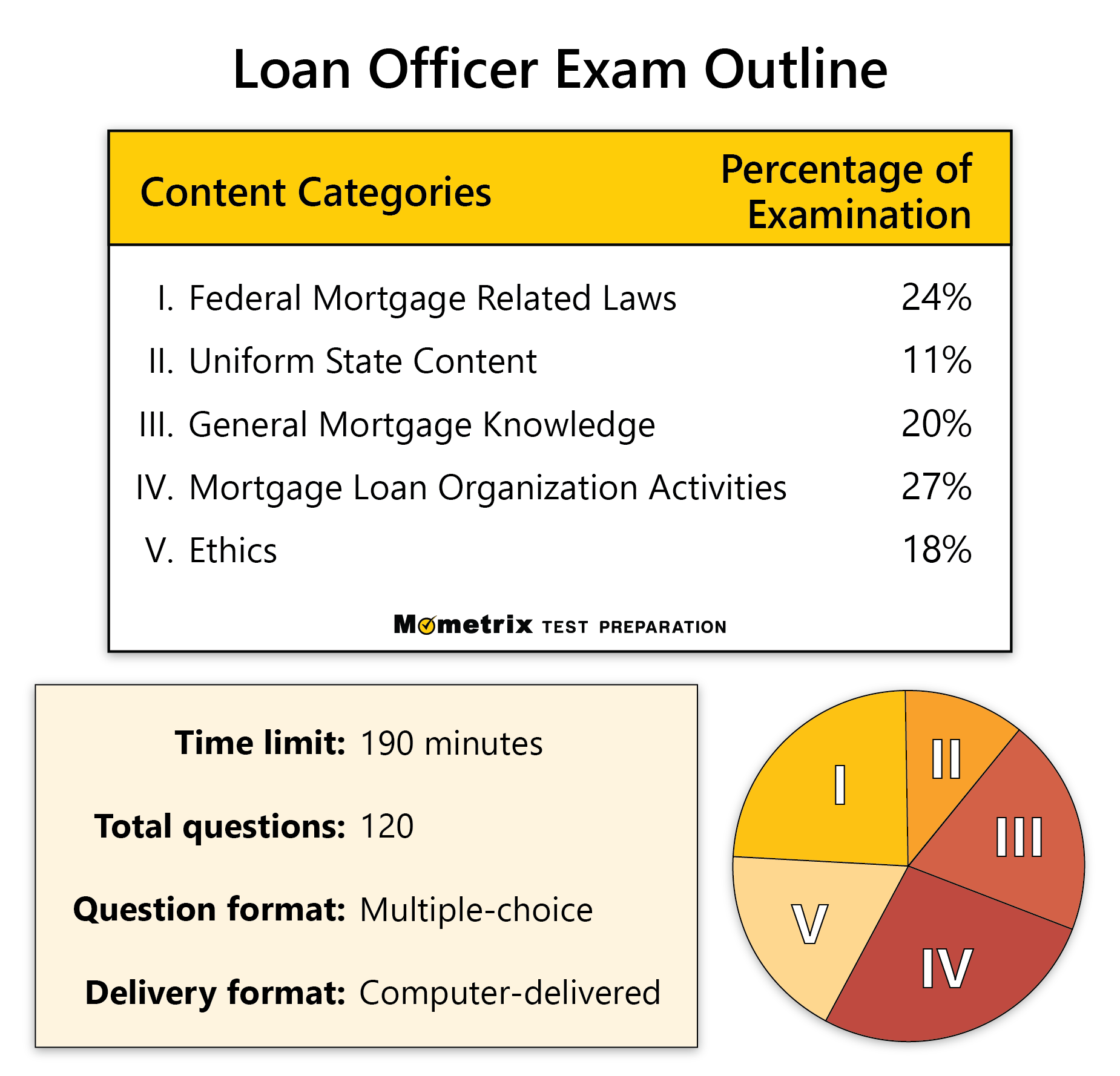
I. Federal Mortgage Related Laws (24%)
The questions in this area assess your knowledge of the following:
- Real Estate Settlement Procedures Act (RESPA), 12 CFR Part 1024 (Regulation X)
- Equal Credit Opportunity Act (ECOA), 12 CFR Part 1002 (Regulation B)
- Truth in Lending Act (TILA), 12 CFR Part 1026 (Regulation Z)
- TILA-RESPA Integrated Disclosure Rule (TRID)
- Other federal laws and guidelines
- Regulatory authority
II. Uniform State Content (11%)
The questions in this area assess your knowledge of the following:
- SAFE Act
- State mortgage regulatory agencies
- License law and regulation
- Compliance
III. General Mortgage Knowledge (20%)
The questions in this area assess your knowledge of the following:
- Qualified and non-qualified mortgage programs
- Mortgage loan products
- Terms used in the mortgage industry
IV. Mortgage Loan Origination Activities (27%)
The questions in this area assess your knowledge of the following:
- Loan inquiry and application process requirements
- Qualification: processing and underwriting
- Closing
- Financial calculations
V. Ethics (18%)
The questions in this area assess your knowledge of the following:
- Ethical issues
- Ethical behavior related to loan origination activities
Check Out Mometrix's Loan Officer Study Guide!
Get practice questions, video tutorials, and detailed study lessons.
Registration
Registration begins by establishing an online account with the National Mortgage Licensing System (NMLS). Once you have an account, you must create and pay for a testing window, which costs $110. You must then sign a confidentiality agreement, after which you will be able to schedule your examination appointment with Prometric.
Test Day
In-person Testing
On exam day, you should arrive at the testing center about 30 minutes before your scheduled appointment. Once you arrive, you will need to present one valid, government-issued ID with a signature. Your first and last name on the ID must match the first and last name you registered under.
All personal items, such as your cell phone, wallet, and keys, must be placed in a secure locker outside the testing room. Eyeglasses may be inspected before you enter the testing room.
Once you have completed the pre-test procedures, you are directed to your testing station, and your test begins.
Remote Testing
You can sign into the test delivery platform 30 minutes before your appointment. You will need the confirmation number from the email you received after registering, and you must present one valid, government-issued ID with a signature to the proctor. Your first and last name on the ID must match the first and last name you registered under.
Before beginning the exam, the proctor will direct you to move the webcam around your testing space, and your clothing will be inspected visually. You may be asked to pull your hair back, roll your sleeves up and turn your pockets inside out.
Once the proctor is satisfied with your space and workstation and you have completed the pre-test activities, your exam begins.
Scores
To be granted a license to work as a loan officer, the NMLS requires you to answer at least 75% of the questions correctly.
The exam is scored using the Linear On-the-Fly Testing (LOFT) method. The reason for this method is that all of the questions on the exam are not equal in difficulty. If you receive an exam that is created using questions that are more difficult than questions used on another version of the exam, the scoring takes this into account. This method of scoring allows each candidate to have the same opportunities to make a passing grade, even if one takes a test that is considered to be more difficult.
Retaking the Exam
It is possible to retake the MLO exam if you do not pass. You are allowed to take the exam several times, but there is a waiting period from the time you take the exam until you will be eligible to take the exam again.
If you fail to pass the exam after three attempts, you will have to wait a mandatory 180 days before you can try again. The test taken after the mandatory 180-day waiting period will count as an initial exam and start the process of 30-day waiting intervals should you fail to pass.
If you pass the exam, you cannot take it again in hopes of improving your score.
Check Out Mometrix's Loan Officer Flashcards!
Get complex subjects broken down into easily understandable concepts.
Study Tips
Start with an MLO Practice Test
Before creating your study schedule, take an MLO practice test to establish a starting point. You don't need to wait until you have reviewed every federal regulation, mortgage product, disclosure requirement, or financial calculation. At this stage, the goal is to identify where your preparation time will have the greatest effect.
Review your results across the five content areas:
- Federal Mortgage Related Laws: Do you understand how RESPA, ECOA, TILA, and other federal requirements affect mortgage applications, disclosures, advertising, and lending decisions?
- Uniform State Content: Do you understand SAFE Act licensing requirements, the role of state regulators and NMLS, unique identifier requirements, prohibited acts, and advertising requirements?
- General Mortgage Knowledge: Can you distinguish conventional, government, conforming, nonconforming, qualified, and non-qualified mortgages?
- Mortgage Loan Origination Activities: Can you move from inquiry and application through disclosures, qualification, underwriting, appraisal, title, insurance, closing, and funding?
- Ethics: Can you recognize discrimination, steering, fraud, kickbacks, misleading advertising, conflicts of interest, improper compensation, and other prohibited or unethical conduct?
Identifying those specific weaknesses will show you where to devote more attention during your study time.
Review Difficult Questions
After each practice session, review every question you answered incorrectly AND every question you guessed on or answered with low confidence.
For each difficult question, determine which of the following caused the problem:
- You knew the law but didn't recognize when it applied.
- You confused two similar disclosure or timing requirements.
- You knew a mortgage term but couldn't apply it to a borrower scenario.
- You selected the wrong loan product for the situation.
- You made an error calculating LTV, DTI, interest, or another financial figure.
- You overlooked a fraud or fair-lending red flag.
- You confused a federal requirement with a uniform state licensing requirement.
- You answered according to workplace habit instead of the rule being tested.
Then, outline a specific plan for improvement based on what you discovered. In other words, don't just say, “I need to study TRID.” Note that you need to review when a Loan Estimate must be provided, when it may be revised, and which charges are subject to tolerance restrictions.
Similarly, replace “study mortgage calculations” with something specific, such as calculating LTV from the correct property value and loan amount.
Utilize Answer Explanations
Answer explanations are an underutilized studying resource. To take full advantage of them, read the explanation for every question you found difficult, including questions you answered correctly.
For each one, make sure you can confidently explain:
- Why the correct answer is correct
- Why each incorrect answer is less appropriate
- Which law, regulation, loan principle, or ethical standard is being tested
- Which fact in the scenario triggers the requirement
- What the MLO should do next
- How the same rule could appear in a different mortgage scenario
For questions involving laws and disclosures, don't stop after memorizing the correct answer. Identify what triggers the requirement, who is responsible for complying with it, when the action must occur, and what information must be provided.
For loan qualification questions, reconstruct the decision using the borrower's income, assets, liabilities, credit, property information, and proposed loan terms.
Study Mortgage Laws as Processes
Knowing what RESPA, ECOA, TILA, and the other federal laws stand for isn't enough. You need to know what causes each requirement to apply and what the MLO or lender must do as a result.
For each major rule, study it using the same framework:
Trigger → Requirement → Timing → Responsible Party → Consequence
For example, when studying disclosures, don't memorize a deadline by itself. Determine what event starts the clock, which disclosure is required, who must receive it, and what happens if circumstances change.
Use the same approach for adverse action, rescission, servicing, advertising, compensation, privacy, and fair-lending requirements.
This is also important because mortgage laws and regulations can change. Study from current material and pay attention to the rule itself rather than relying on an old memorized number or procedure.
Follow the Loan from Application to Closing
Mortgage Loan Origination Activities is the largest content area on the exam, so understand how individual requirements fit into the complete loan process.
Practice following a loan through:
Inquiry → Application → Disclosures → Processing → Underwriting → Closing → Funding
At each stage, ask what information is collected, which documents or disclosures may be required, what must be verified, and which problems could prevent the loan from moving forward.
For qualification questions, connect the borrower's financial information instead of studying each item separately:
Income + Assets + Liabilities + Credit + Property → Qualification Decision
For example, don't just memorize the formula for LTV. Understand which loan amount and property value belong in the calculation and why the resulting ratio matters to the transaction.
Practice Ethics as Real Mortgage Decisions
Don't study ethics as a list of definitions. Practice recognizing what an MLO should do when a borrower, real estate professional, appraiser, employer, or other party creates an ethical or compliance problem.
Pay particular attention to scenarios involving:
- Discrimination, redlining, and steering
- Kickbacks, referral fees, and improper compensation
- Misleading advertising or loan representations
- Unreported income, unexplained deposits, occupancy issues, and other fraud indicators
- Pressure on appraisers or other independent parties
- Improper handling of borrower information or conflicts of interest
For each scenario, identify the red flag first. Then determine which action protects the consumer, maintains accurate loan information, and complies with the applicable rule.
Practice MLO Pacing
The SAFE MLO test contains 120 questions and allows 190 minutes, which works out to an average of about 95 seconds per question.
Some terminology and rule-recognition questions may take much less time, while calculation or scenario questions may require more. Don't allow one complicated mortgage calculation or unfamiliar regulation question to consume several minutes that you could use elsewhere.
The exam also includes five unscored questions mixed throughout the test. You won't know which questions are unscored, so approach every question as though it counts.
Build up from untimed practice to mixed timed sets and eventually complete a full 120-question practice test within the 190-minute limit.
FAQs
Q
How hard is the MLO exam?
A
The exam is considered to be moderately difficult, with a first-time passing rate of 53%.
Q
How many questions are on the MLO exam?
A
There are 120 multiple-choice questions on the exam.
Q
How long is the MLO exam?
A
The time limit for the exam is 190 minutes.
Q
What is the passing score for the MLO exam?
A
To pass the exam, you must answer at least 75% of the questions correctly.
Q
How much does the MLO exam cost?
A
The examination fee is $110.


Mometrix Test Preparation is not affiliated with or endorsed by any official testing organization. All organizational and test names are trademarks of their respective owners.