A certified nursing assistant (CNA) works under the supervision of an RN to meet the healthcare needs of patients, such as serving meals, measuring patients’ vital signs, and bathing patients.
Nursing assistants need to be certified in these skills and in the knowledge that will be applicable in their day-to-day operations.
Click the “Start Test” button above to begin your free CNA practice test. Good luck with your studying!
What is the CNA Test?
The CNA exam is available through a national testing service by Credentia in most states, which assumes scheduling, administration, and delivery of the exams.
It is important for you to know that the exam guidelines vary for each of these states. To ensure that you are reading the correct information related to the exam for your desired state of practice, read its corresponding candidate handbook for complete details.
The CNA exam is designed for entry-level nurse aides and nursing assistants (NAs), meaning those who have zero to 12 months of direct care experience after receiving certification. Eligibility varies per state but in general, applicants are required to have completed at least a state-approved nurse aide training program that usually includes classroom learning, practical training, and on-the-job training.
Once you pass the CNA test, you will be given a certification to practice as a nursing assistant and will be added to your state’s nurse aide registry.
Outline
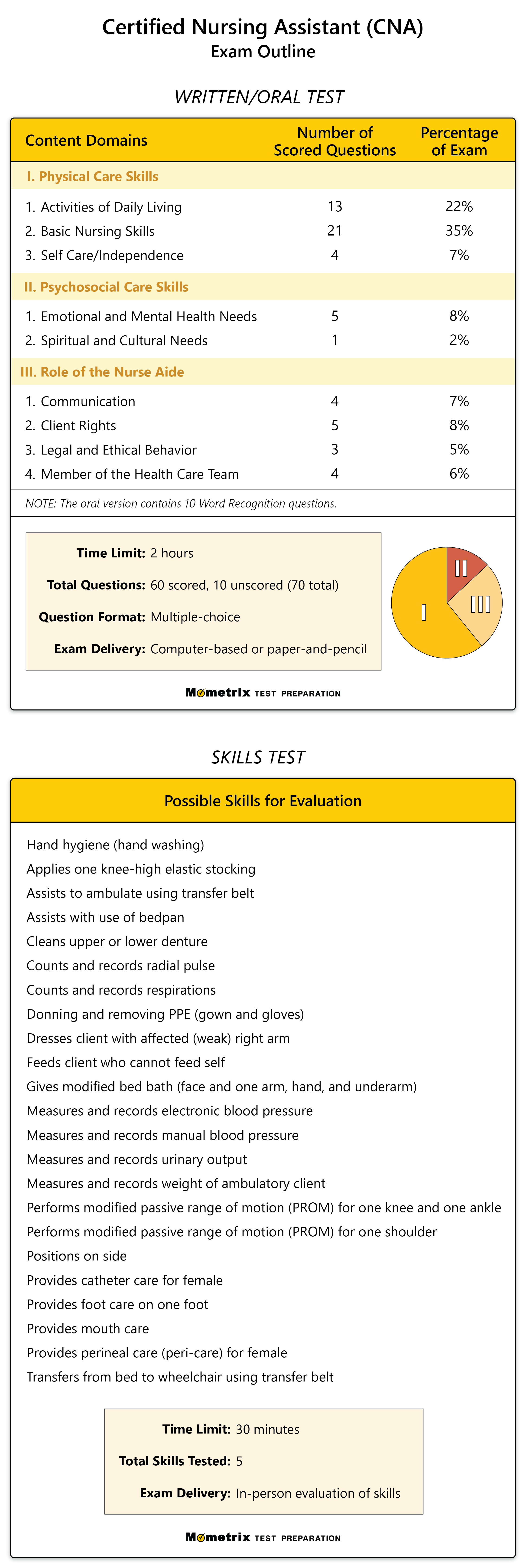
The CNA state exam is composed of two parts: 1) a written or oral portion and 2) a skills demonstration portion. You must complete and pass both assessments to gain a certification and for a state to add your name to the state nurse aide registry.
Written/Oral Test
Whether you take the written version of the exam or the oral version is entirely up to you. You will get to choose your preference during registration.
The written exam is composed of 70 multiple-choice items, 10 of which are non-scored items that will only collect statistical information.
The oral exam is composed of 60 multiple-choice items and 10 reading comprehension (word recognition) items. This is recommended for those who may have difficulty reading and answering a written exam. Instead, recordings of the questions will play on a headset and you will be asked to provide an answer from the list of choices.
The written and oral exam covers three main content domains: Physical Care Skills, Psychosocial Care Skills, and the Role of the Nurse Aide.
Physical Care Skills (64%)
This domain is divided into three categories:
- Activities of Daily Living takes up 22% of the exam with 13 questions. These questions cover the topics of hygiene, dressing and grooming, nutrition and hydration, elimination, and rest/sleep/comfort.
- Basic Nursing Skills takes up 35% of the exam with 21 questions. It covers infection control, safety in an emergency, therapeutic and technical procedures, and data collection and reporting.
- Self Care/Independence takes up 7% of the exam with four questions. It covers prevention, self-care, and independence for the client.
Psychosocial Care Skills (10%)
This domain tackles two categories that deal with the client’s non-physical needs:
- Emotional and Mental Health Needs takes up 8% of the exam with five questions.
- Spiritual and Cultural Needs takes up only 2% of the exam with one question.
Role of the Nurse Aide (26%)
This domain assesses your ability to fulfill your responsibilities as a nurse aide through your knowledge and skills in the following categories:
- Communication takes up 7% of the exam with four questions.
- Client Rights takes up 8% of the exam with five questions.
- Legal and Ethical Behavior takes up 5% of the exam with three questions.
- Member of the Health Care Team takes up 6% of the exam with four questions.
Skills Test
The skills demonstration portion of the exam will have you perform five key skills of a nurse aide in an area similar to your work setting where you will be evaluated by a Nurse Aide Evaluator. You will be given 30 minutes to finish all tasks. You will be performing these skills with a candidate volunteer who acts as a resident or client.
All skills are broken down into a series of tasks and will be measured by assessing your performance on these tasks. Each task has a Critical Step that must be performed correctly for you to pass that skill. Among the five skills, all examinees will be required to perform the Hand Hygiene skill along with four other random skills that will be assigned to you. One of the four random skills will involve a measurement skill and will ask you to measure and record certain vital signs or specimens (e.g. measures and records blood pressure or urinary output of the client).
There are 23 skills that may be evaluated during the exam:
- Hand hygiene
- Applies one knee-high elastic stocking
- Assists in ambulation using a transfer belt
- Assists with use of bedpan
- Cleans upper or lower denture
- Counts and records radial pulse
- Counts and records respirations
- Donning and removing PPE (gown and gloves)
- Dresses client with affected (weak) right arm
- Feeds client who cannot feed self
- Gives modified bed bath (face and one arm, hand, and underarm)
- Measures and records electronic blood pressure
- Measures and records manual blood pressure
- Measures and records urinary output
- Measures and records the weight of an ambulatory client
- Performs modified passive range of motion (PROM) for one knee and one ankle
- Performs modified passive range of motion (PROM) for one shoulder
- Positions on side
- Provides catheter care for female
- Provides foot care on one foot
- Provides mouth care
- Provides perineal care (peri-care) for female
- Transfers from bed to wheelchair using a transfer belt
Top 5 Most Challenging CNA Questions
Now that you know more about the exam, try your hand at some targeted practice!
Over the last 10 months, we’ve compiled the data from over 25,000 test-takers who tried their hand at the practice test at the top of this page. According to the data, around 60%-70% of people answered these five questions incorrectly.
Answer each question and read through the answer explanation, whether you got the answer right or wrong. This will help you ensure you’ve got the topic mastered.
Whether you struggled with these questions or aced them on your first try, be sure to take the full practice test to get a better idea of how prepared you really are!
1. When feeding a bedbound patient, the patient should, if possible, have the head elevated to at least what level?
2. When assisting a patient to ambulate with a walker after hip replacement surgery, the nurse aide should remind the patient to move the walker forward about how far?
3. When transferring a patient from a bed to a wheelchair, how high should the bed be?
4. When the nurse aide observes another nurse aide mishandling and swearing at a confused patient, what should be the initial action?
5. Which of the following abbreviations is appropriate to use in documentation?
Registration
You must register to take the exam through Credentia, the official testing vendor for the CNA exam. You must first choose the state in which you plan to practice and the website will lead you to its specific platform. Note that one major prerequisite to taking the CNA exam is the completion of a state-approved nurse aide training program at the least.
You will be asked to sign up or sign in to a Credentia CNA365 account on their website. After signing up or signing in to your new account, you may start a new application, select the applicable eligibility route for you, and enter the required information and submit any supporting documents that may be asked from you. You will receive an email confirming whether your application is approved after which you can register for the exam.
Once registered, you can select your preferred date for both the written or oral exam and the skills demonstration exam. You may also choose how you want to take the written or oral exam, whether it will be conducted online remotely or on-site in a testing center near you. If you plan to take an exam online, you may schedule an exam until the day before your preferred date depending on exam availability.
If you decide to take the exam at a testing center, make sure to register at least 10 calendar days before your desired schedule to ensure ample time. Finally, you will be asked to pay for the exam through their online platform using a credit card or a pre-paid credit card.
Consult your state’s Candidate Handbook so you are reading the appropriate information for your chosen state. Exam fees also vary per state, but in general, be prepared to spend around $100 for exam fees.
Check Out Mometrix's CNA Printed Study Guide
Get practice questions, video tutorials, and detailed study lessons
Get Your Study Guide
Test Day
Identification requirements vary by state. In many states, you must bring current, unexpired identification that matches the name on your registration, and some states require two forms of ID or a Social Security card/ITIN card. Check your state’s candidate handbook before test day so you bring the correct documents.
Taking the Exam Online
If you plan to take the online exam, you will be asked to prepare your computer or laptop accordingly by performing a system test so that everything works smoothly on the day of the exam.
You will also need a mobile device that can download Credentia’s free mobile app to complete a 360-degree scan of your planned testing room on the day. Your testing room should be private with a clean workspace and no one else should be in the room with you during the exam.
Read the onboarding procedure beforehand so you don’t run into problems on the day.
CNA Scores
Your official Score Report will indicate whether you have passed or failed the exam. For your results in the skills demonstration exam, the Score Report will indicate a score of Satisfactory or Unsatisfactory for each skill. Any skill with an Unsatisfactory rating is considered a failed skill. You must have a Satisfactory rating on all five skill demonstrations to pass this portion of the exam.
Receiving Your Scores
Your exam results will be available a few hours after you finish the exam. You will be notified via email once the results are available in your CNA365 account. For some states, your exam results will be mailed to you physically which you should receive within five to seven business days.
If you have passed both exams, your name will be registered in the state’s nurse aide registry a few weeks to a few months after you pass. On the other hand, if you failed the exam, you can submit a written grievance or complaint through the state’s appropriate channels, or you may opt to retake the exam after a period of time.

CNA Online Prep Course
If you want to be fully prepared, Mometrix offers an online CNA prep course designed to give you everything you need to succeed!
Here’s what you’ll find in the CNA course:
- 40 Review Lessons Covering Every Topic
- Over 650 CNA Practice Questions
- 300+ Digital Flashcards
- Money-back Guarantee
- Mobile Access
Everyone learns differently, so we’ve tailored the CNA online prep course to ensure every learner has what they need to prepare for the CNA exam.
Click below to check it out!
Check Out Mometrix's CNA Flashcards
Get complex subjects broken down into easily understandable concepts
Get Your Flashcards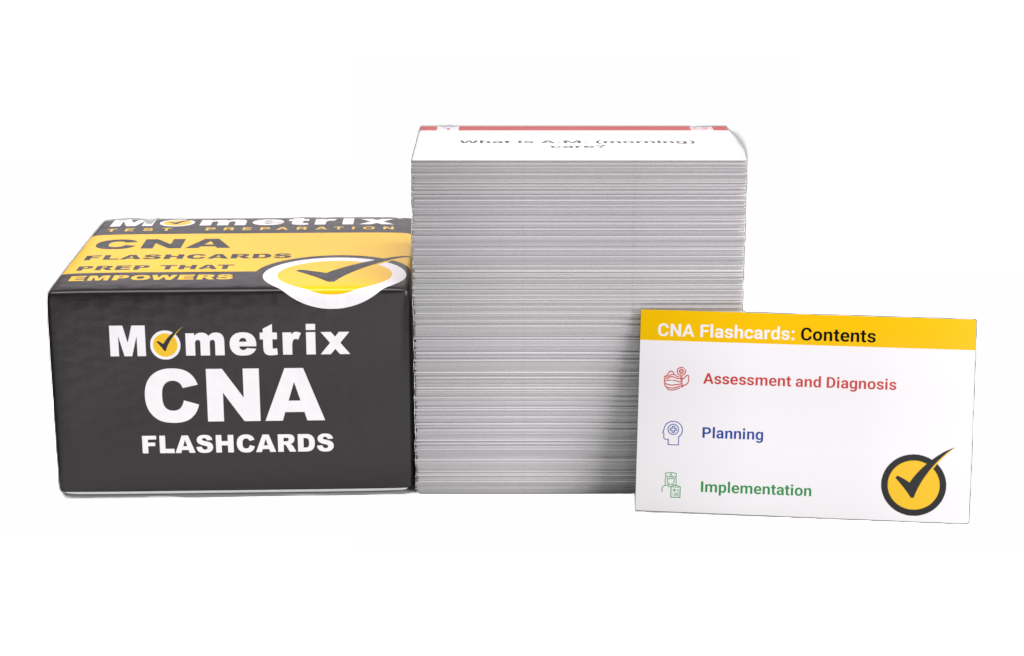
How to Study for the CNA Exam
Start with Your State’s CNA Exam Information
Before creating your study schedule, locate the current nurse aide candidate handbook for the state in which you plan to become certified. CNA testing requirements are established and administered at the state level, so the testing provider, exam format, available skills, time limits, passing requirements, and retesting rules may differ.
Once you understand those requirements, take a CNA practice test to establish a starting point. Review your results in areas such as:
- Basic Nursing Skills: Do you understand infection control, resident safety, vital signs, observation, reporting, and emergency procedures?
- Activities of Daily Living: Can you provide appropriate assistance with hygiene, dressing, eating, hydration, elimination, mobility, and comfort?
- Resident Independence: Can you provide appropriate assistance with hygiene, dressing, eating, hydration, elimination, mobility, and comfort?
- Psychosocial Care: Can you respond appropriately to residents’ emotional, mental, cultural, and spiritual needs?
- Role of the Nurse Aide: Do you understand communication, resident rights, privacy, legal and ethical conduct, abuse reporting, and your role on the healthcare team?
- Clinical Skills: Can you perform each skill in your state handbook accurately, safely, and in the required order?
Identifying those specific weaknesses will show you where to devote more attention during your study time.
Review Difficult Questions and Skill Mistakes
After each practice session, review every question you answered incorrectly AND every question you guessed on or answered with low confidence. A correct guess does not demonstrate that you understand how to provide safe resident care.
For each difficult question, determine which of the following caused the problem:
- You did not know the nursing concept or procedure.
- You confused the nurse aide’s responsibilities with those of a nurse.
- You overlooked a safety or infection-control concern.
- You selected an action that reduced the resident’s independence.
- You failed to protect the resident’s privacy or rights.
- You missed an important change that should have been reported.
- You chose an answer based on personal preference rather than proper care.
- You misread what the question was asking.
Review skills practice with the same level of detail. Do not settle for saying that a transfer or bed-bath practice attempt “went pretty well.” Identify the exact step that was missed, completed incorrectly, or performed out of sequence.
For example, record that you forgot to lock the wheelchair, failed to place the call light within reach, did not wash your hands at the required time, or measured a value incorrectly. Then repeat the entire skill correctly rather than practicing only the missed step.
Your improvement plan should be specific. Instead of saying “practice vital signs,” specify “practice locating and counting a radial pulse accurately while recording the result in the required format.” Replace “review resident rights” with “practice identifying when privacy, confidentiality, choice, or informed consent is being violated.”
Utilize Answer Explanations
Answer explanations are an underutilized studying resource. To take full advantage of them, read the explanation for every question you found difficult, including questions you answered correctly.
For each one, make sure you can confidently explain:
- Why the correct answer provides the safest and most appropriate care
- Why each incorrect option is less appropriate
- What nursing-assistant responsibility or care principle is being tested
- What the nurse aide should observe, do, and report
- How the correct action protects the resident’s safety, dignity, rights, or independence
Pay particular attention to scope-of-practice questions. A nurse aide observes, assists, records, and reports within the responsibilities established by the care plan and supervising nurse. Don’t assume that an action is appropriate merely because it appears helpful.
Study Safe Care Routines, Not Isolated Questions
Memorizing the answer to one CNA question will not prepare you for a different resident, situation, or skill assignment. Your goal should be to understand the care principles that apply across multiple scenarios.
For example, don’t memorize only that hand hygiene was required in one question. Learn when hand hygiene is necessary, how contamination occurs, and how to prevent transferring microorganisms between yourself, equipment, and the resident.
When reviewing any procedure, ask yourself:
- How do I explain the procedure and obtain the resident’s cooperation?
- How do I provide privacy?
- What infection-control precautions are required?
- How do I protect the resident from falls or injury?
- How do I encourage independence?
- What observations should I report?
- What equipment must be cleaned or disposed of?
- What should I do before leaving the resident?
- What information must be measured or recorded?
A skill is not mastered until you can perform the entire procedure correctly without coaching, prompts, or an open checklist.
FAQs
Q
What is a CNA?
A
A CNA is a certified nursing assistant. CNAs help patients with basic care under RN or LPN supervision.
Q
How do I become a CNA?
A
You will first need to enroll in a training program that is approved by your state. After completing the state-approved program, you will then be ready to take the exam for your CNA certification.
Q
How long does it take to become a CNA?
A
Depending on where you live and which training program you will be taking, you can expect to complete the CNA program between six and 12 weeks.
Q
What does a CNA do?
A
A CNA who works in a hospital can expect to aid the nursing staff in every aspect regarding patient care. CNAs may be required to monitor blood pressure and vital signs, help move and clean patients, as well as respond to calls.
Q
How much does a CNA make?
A
The median annual wage for a CNA is $39,530.
Q
How long is a CNA program?
A
Each program differs, but they generally last anywhere from one month to six months.
Q
What training or education is required for CNA?
A
It varies from state to state, but you will generally need to complete a state-approved training program and pass the CNA exam.
Q
How do you renew a CNA license?
A
You will likely need to contact your state licensing board and complete a renewal application. This usually involves verifying your employment and providing proof of your continuing education hours.
Q
How many hours do you work as a CNA?
A
Depending on your facility, anywhere from 32 to 40 hours per week is considered full time.
Q
What is the CNA exam?
A
The CNA exam is a certification for those who wish to become a certified nursing assistant. The CNA exam will consist of a written/oral portion and a clinical skills test.
Q
What is the cost of the exam?
A
The cost of the CNA exam depends on the state in which it is taken. On average, it is $100.
Q
What score do you have to get to pass the CNA test?
A
Each state has its own passing score regarding the CNA test. Some states require you to achieve 70%–75% while others may require you to achieve 80%.


Mometrix Test Preparation is not affiliated with or endorsed by any official testing organization. All organizational and test names are trademarks of their respective owners. As an Amazon Associate, I earn from qualifying purchases.