
The Certified Medical Administrative Assistant (CMAA) exam is developed and presented by the National Healthcareer Association (NHA). The nationally recognized certification demonstrates the recipient’s ability to perform the administrative tasks to keep a physician’s office or medical clinic running smoothly and efficiently. CMAA certification can improve your employment and income potential.
Click “Start Test” above to take a free CMAA practice test, and check out our premium-quality CMAA test prep resources by clicking the links below!
CMAA Exam Eligibility
To be eligible for the NHA Certified Medical Administrative Assistant exam, you must have a high school diploma or equivalent credentials and meet one of NHA’s eligibility routes.
You may qualify if you’ve successfully completed a medical administrative assistant training or education program within the last five years.
Route 2: Work Experience
You may qualify if you have supervised work experience in a medical administrative assistant field. NHA lists two work-experience options:
- At least one year of supervised work experience in a medical administrative assistant field within the last three years
- Two years of supervised work experience in a medical administrative assistant field within the last five years
Once you have met the eligibility requirements via one of these routes, you can apply to take the CMAA examination.
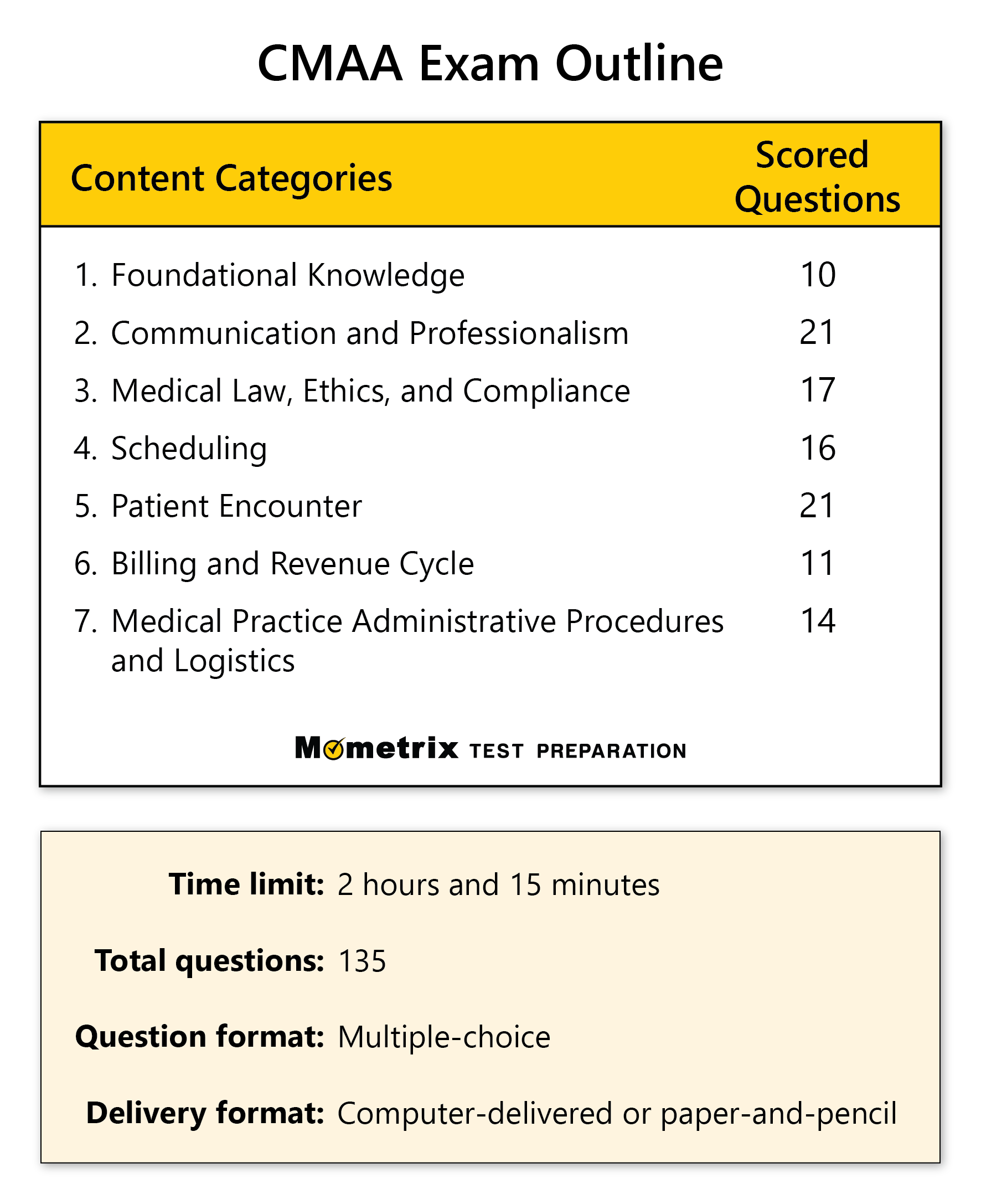
CMAA Exam Outline
The NHA Certified Medical Administrative Assistant exam is a computer-based test consisting of 135 multiple-choice questions, which you will be given 2 hours and 15 minutes to answer.
The questions evaluate your critical thinking and recall abilities, enabling you to perform your duties effectively. Questions may include knowledge statements you need to know, while task statements assess your application of the skills required to perform those tasks successfully.
The CMAA test is divided into seven domains:
1. Foundational Knowledge (10 scored questions)
The concepts in this section cover the following:
- Types of healthcare organizations and delivery
- The relationship between front office staff and clinical processes and procedures
- The types of health records and their uses
- The electronic health record (EHR) and electronic medical record (EMR) components
- Medical terminology
- Basic anatomy and physiology
2. Communication and Professionalism (21 scored questions)
The concepts in this section cover the following:
- Communication styles
- Nonverbal communication
- Interviewing and questioning techniques
- De-escalation techniques
- Barriers to communication
- Gender identity and expression
- Communication styles and skills
- Cause-and-effect analysis
- Electronic communication
- Business correspondence
- Teamwork
- The communication cycle
You are also evaluated on your ability to foster collaboration, enhance team engagement, and demonstrate professionalism.
3. Medical Law, Ethics, and Compliance (17 scored questions)
The concepts in this section cover the following:
- Informed consent
- Advanced directives
- Power of attorney
- Storage of medical records
- Legal regulations and obligations
- The Hippocratic Oath
- Adhering to a professional code of ethics
- Reviewing and understanding medical directives
- Patient privacy
- Healthcare proxies
- Legal requirements
- Identifying your personal biases to minimize their impact on your ability to provide unbiased care to diverse populations
4. Scheduling (16 scored questions)
The concepts in this section cover the following:
- Scheduling
- Patient intake
- Office logistics
- Compliance
- Billing and insurance
- General office policies and procedures
- Telehealth platforms and technology
- Provider preferences
- Patient portals
- Protocols for appointments (no-show, missed, canceled, follow-up, diagnostic testing, and procedures)
- Conducting pre-appointment screening and confirmation
5. Patient Encounter (21 scored questions)
The concepts in this section cover the following:
- Insurance collection
- Patient financial responsibilities
- Patient intake forms
- Data entry of patient information
- Patient information verification
- Procedures for new and established patients
- Special considerations and accommodations
- The referral and certification process
- Knowledge of code sets
- Recognizing commercial insurance plan types and government insurance plans
- Documentation required for patient confidentiality, insurance, and safety
6. Billing and Revenue Cycle (11 scored questions)
The concepts in this section cover the following:
- Phases of the revenue cycle
- Healthcare payment models
- Financial assistance programs
- The difference between Medicare and Medicaid
- Third-party payer
- Clearinghouse and claim scrubbing processes
- Charge reconciliation
- Billing documentation
- Resolution of billing issues
7. Medical Practice Administrative Procedures and Logistics (14 scored questions)
The concepts in this section cover the following:
- Policies and procedures
- Filing systems
- Petty cash management
- Reconciliation
- Telephone procedures
- Business correspondence
- Americans with Disabilities Act Amendments Act (ADAAA) compliance procedures
- Inventory management
- Data storage and backup requirements
- Medical record quality checks
- Financial procedures
- Opening and closing procedures
- Delivery management
- Basic computer skills
Check Out Mometrix's CMAA Study Guide
Get practice questions, video tutorials, and detailed study lessons.
Top 3 Most Challenging CMAA Questions
Now that you know more about the test, try your hand at some targeted practice!
Over the last year, we’ve compiled the data from about 3,000 test-takers who tried their hand at the practice test at the top of this page. According to the data, around 60% of people answered these three questions incorrectly.
Answer each question and read through the answer explanation, whether you got the answer right or wrong. This will help you ensure you’ve got the topic mastered.
Whether you struggled with these questions or aced them on your first try, be sure to take the full practice test to get a better idea of how prepared you really are!

1. Which of the following is a legal document that must be retained for at least 5 years?
2. The type of healthcare insurance that pays in the form of predetermined payments for loss or damages rather than for healthcare services is __________.
3. While an answering service takes calls during the night, numerous patients have complained that telephone calls during working hours are often unanswered. The best solution for the office is likely to __________.
Registration
To register for the CMAA exam, you must have an account with NHA. There are two types of registration: individual and organization. If you are not taking the exam through a school or employer partnered with NHA (the school or employer provides the payment for your exam), select “registering individually” from the drop-down menu. If your school or employer sponsors your exam, select the organization or school in the drop-down menu.
The exam is offered through NHA-affiliated schools, at nationwide PSI testing centers, and via live remote proctoring (LRP).
Individual Registration
When your registration is complete and the $129 examination fee is accepted, contact PSI Services to select your testing date and location for on-site examinations or your testing date for remote proctored examinations. You have six months from the date of registration to schedule your test. If you do not take your exam in six months, the exam cost is forfeited, and you must register and pay for the exam again.
Sponsored Registration
From your NHA account, select the CMAA exam, agree to the attestation, and select your exam date. Available exam dates are highlighted in blue on the displayed calendar. Select your exam date and click on the “continue” button. After answering additional questions, finalize your application on the checkout menu.
Sponsored exams may have pre-purchased materials, exams, or discounts available to you, including the exam fee. Ask your sponsoring organization for information on what is included and if you’re responsible for the $129 exam fee. If you are required to pay the fee, submit your payment with your registration.
Test Day
Test day requirements differ slightly between the two delivery methods (in-person testing or Live Remote Proctoring). Both formats require a valid, government-issued ID and two No. 2 pencils.
In-person Testing
You will be given two pieces of scratch paper before the exam begins. After the exam begins, breaks are at the discretion of the proctor. If you need a break, contact the proctor and follow the directions.
Study materials, guides, cellphones, calculators, and personal items are not allowed inside the testing area, including food or drinks. If you have a medical or physical accommodation, the accommodation request form must be completed and approved before reporting to the testing facility.
Stay at your station until the proctor releases you when you finish your exam. You will be asked to give the proctor your scratch papers, after which you will be free to go.
Live Remote Proctoring
Before you sign on to check in for your exam, clear your workspace of everything but your ID, two pieces of blank paper, a writing utensil, a keyboard, and a mouse. There should be nothing on or around your workspace, including cell phones, recording devices, water bottles, drinks, or food.
You will need to conduct a test of your equipment, ensuring the webcam and microphone are working and your internet is stable. Disconnect extra screens if you have them; you are prohibited from using more than one monitor. If your laptop is connected to another monitor, your laptop must remain closed during your exam.
If you share your space with someone, let them know they cannot come in or around your work area during your exam. Someone walking into your testing area is grounds for dismissal.
When you sign on for your exam, you will be asked to present your government-issued ID to the proctor, and then the front and back of your scratch paper and writing utensil. The proctor will ask for you to move the camera around your workspace, and you may be asked to remove items from your desk, adjust lighting, or adjust your microphone and webcam. Once the proctor is satisfied with your testing space, your exam begins.
During your exam, you must keep the microphone and webcam on and remain in view of the webcam at all times. Breaks are not permitted during the exam. If you have a medical reason for requiring a break, you must register for on-site test administration and request accommodation.
When you finish your exam, you must tear up your scratch paper in view of the proctor. The pieces must be small enough to discourage anyone from piecing them together. The proctor will tell you when you are clear to sign off from the testing platform.
Scoring
The CMAA exam score results are weighted. Your raw score (the number of questions answered correctly) is converted to a scaled score. Scaled scores range from 200 to 500, and the minimum passing score is 390.
If you take the exam at your institution, a preliminary report is provided when you finish the exam. If you take the exam via live proctor or at a PSI testing center, your preliminary report is available within 48 hours of completion. If you take the pencil-and-paper exam, your preliminary report is available ten days after your exam. Your official score report is posted to your NHA account, and an email notification is sent when your score is available.
Your official score report provides performance indicators on each of the domains. The performance indicators include “above passing standard,” “near the passing standard,” or “below the passing standard.” The indicators are designed to provide you with the feedback necessary for self-improvement.
Retaking the Exam
If you don’t pass the CMAA exam on your first attempt, you may retake the exam after a 30-day waiting period. NHA allows three attempts to pass the exam, with a minimum waiting period of 30 days between each attempt.
If you don’t pass after your third attempt, you must wait one year before taking the exam again. You must re-register and pay the full exam fee for each retake.
Check Out Mometrix's CMAA Flashcards
Get complex subjects broken down into easily understandable concepts.
Study Tips
Start with a CMAA Practice Test
Before creating your study schedule, take a CMAA practice test to establish a starting point. You don’t need to wait until you have reviewed every insurance term, scheduling method, privacy rule, and office procedure. At this stage, the goal is to identify where your preparation time will have the greatest effect.
Review your results by section:
- Foundational Knowledge: Do you understand healthcare delivery models, electronic health records, medical terminology, common abbreviations, and basic anatomy, physiology, and disease concepts?
- Communication and Professionalism: Can you communicate appropriately with patients, caregivers, providers, coworkers, and payers; adapt communication to different needs; handle difficult interactions; and maintain professional boundaries?
- Medical Law, Ethics, and Compliance: Can you apply HIPAA, consent, patient-rights, mandatory-reporting, security, OSHA, fraud-and-abuse, and scope-of-practice requirements?
- Scheduling: Can you select appropriate scheduling methods, identify appointment needs, manage provider schedules, arrange referrals and diagnostic testing, and handle telehealth, cancellations, and no-shows?
- Patient Encounter: Can you register and check in patients, verify demographic and insurance information, explain financial responsibilities, manage required forms, maintain accurate records, and complete checkout procedures?
- Billing and Revenue Cycle: Can you support billing, payment collection, charge reconciliation, claims, denials, appeals, and other stages of the revenue cycle?
- Medical Practice Administrative Procedures and Logistics: Can you manage medical records, office finances, supplies, telephone communications, correspondence, computer systems, opening and closing procedures, and technology downtime?
Identifying those specific weaknesses will show you where to devote more attention during your study time.
Review Difficult Questions
After each practice session, review every question you answered incorrectly AND every question you guessed on or answered with low confidence. A correct guess doesn’t demonstrate that you could perform the task safely and accurately in a medical office.
For each difficult question, determine which of the following caused the problem:
- You confused two insurance concepts.
- You knew the rule but applied it incorrectly to the patient scenario.
- You selected the wrong scheduling method.
- You failed to consider the urgency or purpose of an appointment.
- You failed to verify enough patient information.
- You violated a confidentiality or security requirement.
- You selected an action outside the administrative assistant’s role.
- You failed to recognize when a difficult interaction should be escalated.
- You focused on customer service but overlooked legal or office policy requirements.
- You knew the information but spent too long deciding between two answers.
Then, outline a specific plan for improvement based on what you discovered. In other words, don’t just say, “I need to study insurance.” Specify that you need to practice determining coordination of benefits and reading information contained on an EOB.
Similarly, replace “study HIPAA” with a specific task such as determining when PHI can be released, identifying appropriate authorization procedures, or practicing how to respond when someone requests information about a patient.
Utilize Answer Explanations
Answer explanations are an underutilized studying resource. To take full advantage of them, read the explanation for every question you found difficult, including questions you answered correctly.
For each one, make sure you can confidently explain:
- Why the correct answer is correct
- Why each incorrect option is wrong
- What administrative process or rule is being tested
- Which information in the scenario controls the answer
- What the CMAA should do next
- How the same concept could appear in a different medical-office situation
For scheduling questions, reconstruct the entire situation. Ask yourself if the patient is new or established, how urgent the request is, what is permitted by the provider’s scheduling template, and what instructions must be given before the visit.
For insurance questions, identify each part of the patient’s coverage.
Study Workflows, Not Individual Questions
Memorizing the answer to one CMAA question will not prepare you for another patient with a different insurance plan, appointment need, account balance, or privacy concern. Instead, learn the complete workflow of a medical-office encounter.
A typical administrative patient encounter might involve:
- Receive the appointment request.
- Determine the appropriate appointment type and provider.
- Register the patient when necessary.
- Verify demographic and contact information.
- Verify insurance eligibility and benefits.
- Obtain referrals or authorizations when required.
- Provide preappointment instructions.
- Check the patient in.
- Verify identification and insurance information.
- Obtain required forms and acknowledgments.
- Determine applicable patient financial responsibility.
- Maintain accurate documentation in the EHR.
- Complete checkout.
- Schedule required follow-up.
- Provide appropriate post-visit documents.
- Support billing and payment processing.
FAQs
Q
How many questions are on the exam?
A
There are 135 questions on the CMAA exam.
Q
How long is the exam?
A
The CMAA exam is timed at 2 hours and 15 minutes.
Q
What is a passing score?
A
A passing score for the CMAA exam is 390.
Q
How much does the exam cost?
A
The CMAA exam costs $129.
Q
Can I take the exam remotely?
A
Yes, NHA provides a remote test-taking option, called Live Remote Proctoring (LRP).


Mometrix Test Preparation is not affiliated with or endorsed by any official testing organization. All organizational and test names are trademarks of their respective owners.