The Classic Learning Test (CLT) is a college entrance exam that assesses Verbal Reasoning, Grammar/Writing, and Quantitative Reasoning. It is an alternative to the SAT and ACT.
Click “Start Test” above to take a free CLT practice test, and check out our premium-quality CLT test prep resources by clicking the links below!
CLT Eligibility
The CLT exam is promoted as a college entrance examination for high school juniors and seniors. However, the exam is open to candidates who have completed high school and have yet to attend college.
Test Outline
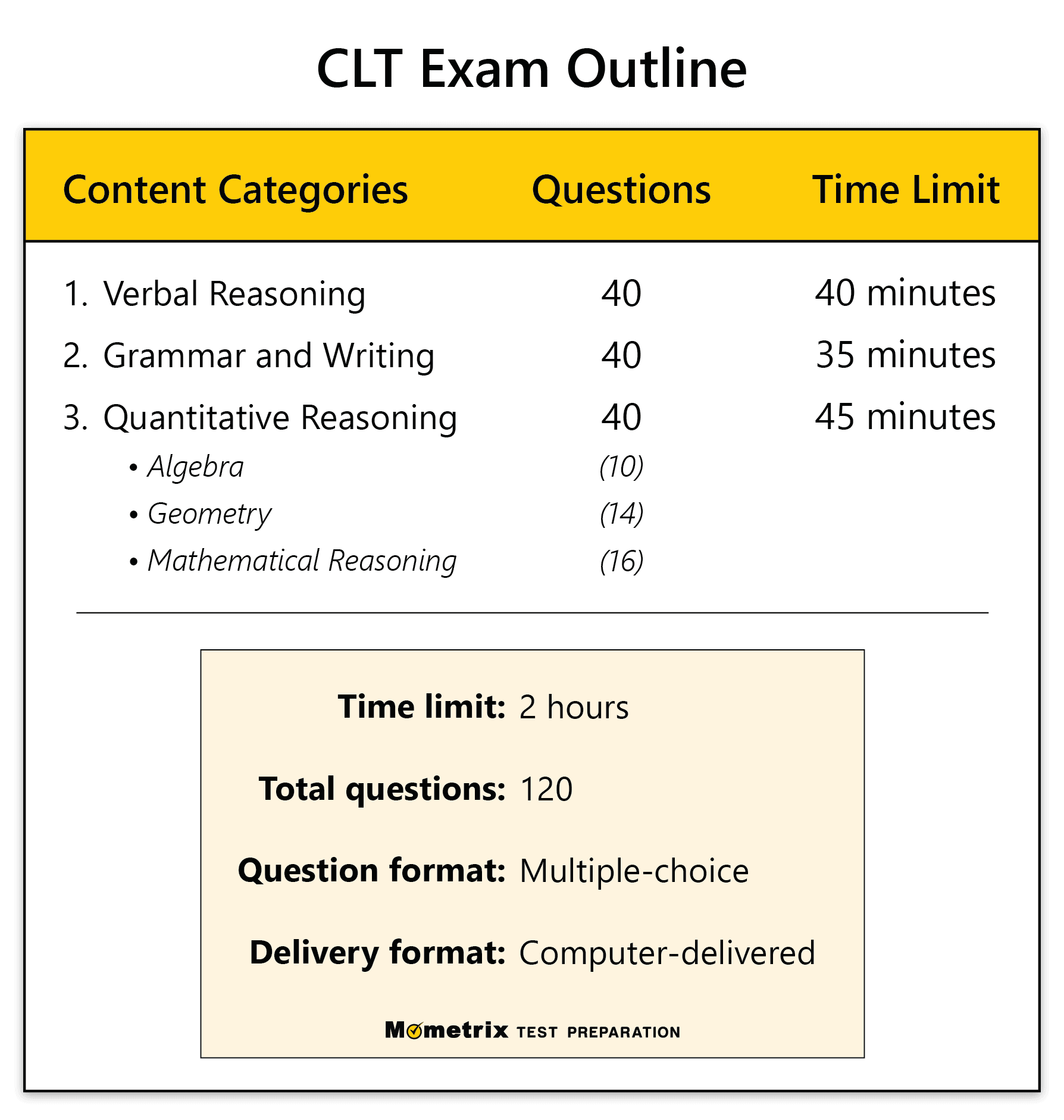
The CLT contains 120 multiple-choice questions and has a time limit of 2 hours.
The questions are based on a liberal arts education, with questions about human nature and the physical world, lessons from history, and universal mathematical concepts.
The exam is split into three sections, with an optional unscored essay for in-person test administrations.
1. Verbal Reasoning (40 questions)
In this section, which is timed at 40 minutes, you will be asked to read four passages that are taken from four categories: literature, science, philosophy/religion, and historical/American founding documents. Each category has 10 questions.
Each passage is connected to ten questions, which are designed to assess your understanding of the passage as a whole, your knowledge of the details of that passage, and your ability to identify relationships between different passages. Additionally, you will be asked to analyze the elements of the text (figurative language, analogies, cause-and-effect) and interpret that information based on the evidence presented in the text.
2. Grammar and Writing (40 questions)
In this section, which is timed at 35 minutes, you will be asked to read four passages and answer the questions that follow.
Each passage is connected to ten questions, which evaluate your knowledge and understanding of sentence structure, sentence style, word choice, grammar agreement, and punctuation. The writing questions examine your ability to identify and correct errors, while the grammar questions assess your ability to identify and correct agreement, punctuation, and sentence structure.
3. Quantitative Reasoning (40 questions)
In this section, which is timed at 45 minutes, the questions are split into three areas:
These questions assess your understanding of arithmetic, operations, and algebraic expressions and equations.
Geometry (14 questions)
These questions evaluate your knowledge of coordinate geometry, the properties of shapes, and trigonometry.
Mathematical Reasoning (16 questions)
These questions test your ability to use logic and solve word problems.
A list of math formulas is provided, and you will be able to access it throughout this section.
Optional Essay
(Not available for the remote-proctored CLT)
If you choose to complete the essay section, you have 30 minutes to answer one prompt. While the essay is not scored and not included in your overall results, the text of your written response is included with your test results. The essay enables you to provide colleges with a sample of your writing ability under a time limit.
Check Out Mometrix's Classic Learning Test Study Guide
Get practice questions, video tutorials, and detailed study lessons.
Top 3 Most Challenging CLT Questions
Now that you know more about the test, try your hand at some targeted practice!
Over the last year, we’ve compiled the data from about 2,000 test-takers who tried their hand at the practice test at the top of this page. According to the data, around 70% of people answered these three questions incorrectly.
Answer each question and read through the answer explanation, whether you got the answer right or wrong. This will help you ensure you’ve got the topic mastered.
Whether you struggled with these questions or aced them on your first try, be sure to take the full practice test to get a better idea of how prepared you really are!
1. What change should be made to the underlined portion of the following sentence?

2. What change should be made to the underlined portion of the following sentence?
3. The word near in the following paragraph most nearly means:
Registration
Before registering for the CLT, you will need to decide which mode of delivery works best for you.
The exam is offered throughout the year (including the summer!), whether you take it at home or in person at a partner school. You can find specific test dates on CLT’s website.
To register for the CLT, create an account on the CLT website. Registration is only available online unless you take the exam through your high school. If you take the exam at school, your school counselor or advisor will complete your registration.
Once you’ve created your account, select the test type (remote or on-site) and test date to register, and pay the $112 fee. The registration fee is payable online only by credit or debit card. Some colleges offer a fee waiver for the CLT, and financial assistance for the exam is provided to those who qualify through the Classic Learning Test website. You must complete registration and pay for the exam before the registration deadline.
The registration deadline for remote-proctored exams is usually a week or more before the test administration date. For in-person exams, the deadline is about a month before the testing date.
Test Day
For an in-school administration, follow your school’s arrival and identification instructions. For remote testing, have an approved, unexpired physical photo ID with a name matching your CLT account. Accepted options include qualifying school IDs and CLT’s completed Student ID Form, as well as approved government-issued IDs.
In-person Testing
When you report to the partner school testing center, present your ID and testing equipment, if required.
Outside resources, cell phones, and anything that might be considered a recording device (including smart watches) are not allowed. Calculators are not allowed, nor are they needed for the CLT. Scratch paper is provided, and you can bring a pen or pencil.
After you check in, the test administrator will lead you to your assigned seat. You then have a few minutes to set up your equipment and prepare for the exam. If you have issues connecting to the internet or loading the exam to your computer, consult the test facilitator for options.
Remote Testing
Before test day, install and verify CLT’s LockDown Browser on a compatible laptop or desktop computer with a working camera and microphone. Complete the test simulation in your CLT dashboard to check your setup. Tablets and phones cannot be used for the remotely proctored CLT.
Test alone in a closed room at a desk or table, and follow CLT’s current rules for permitted items and room setup. Your video, screen, and audio will be recorded and reviewed afterward.
CLT Test Scores
Each question on the CLT is worth one point. If you answer a question incorrectly, that question receives zero points.
There is no passing or failing score for this test; your college of choice will decide what scores they accept.
For the remotely proctored CLT, scores are normally released on the third Wednesday after testing. In-school online scores are generally released the following Wednesday, or the following Friday for Saturday administrations. Paper-test scores are released approximately 30 days after CLT receives the answer documents. Check the score-release date for your administration.
If you are happy with your results, you can send them directly to any college or university!
Check Out Mometrix's Classic Learning Test Flashcards
Get complex subjects broken down into easily understandable concepts.
CLT Online Prep Course
If you want to be fully prepared, Mometrix offers an online CLT prep course designed to give you everything you need to succeed!
Here’s what you’ll find in the CLT course:
- 70+ Review Lessons Covering Every Topic
- Over 750 CLT Practice Questions
- 300+ Digital Flashcards
- 250+ Instructional Videos
- Money-back Guarantee
- Mobile Access
Everyone learns differently, so we’ve tailored the CLT online prep course to ensure every learner has what they need to prepare for the CLT exam.
Click below to check it out!
How to Prepare
Start with a CLT Practice Test
Before creating your study schedule, take a CLT practice test to establish a starting point. You don’t need to wait until you have reviewed every topic. At this stage, the goal is to identify where your preparation time will have the greatest effect.
Review your results by section and content area:
- Verbal Reasoning: Can you identify main ideas, understand important details, analyze an author’s viewpoint, interpret evidence, determine the meaning of words in context, recognize relationships within a passage, and complete passage-based analogies?
- Grammar/Writing: Can you improve passages by correcting agreement, punctuation, sentence structure, word choice, style, organization, and relationships among ideas?
- Quantitative Reasoning: Can you apply arithmetic, algebra, geometry, logic, and mathematical reasoning without relying on a calculator?
Identifying those specific weaknesses will show you where to devote more attention during your study time.
Review Difficult Questions
After each practice session, review every question you answered incorrectly AND every question you guessed on or answered with low confidence. Guessing correctly does not necessarily mean that you have mastered the skill.
For each difficult question, determine which of the following caused the problem:
- You misunderstood the main idea or purpose of the passage.
- You confused the author’s viewpoint with a position the author was describing.
- You selected an answer that sounded reasonable but was not supported by the passage.
- You recognized the words in an analogy but misunderstood the relationship between them.
- You focused on sentence-level correctness but missed a problem with organization or style.
- You did not understand the mathematical concept being tested.
- You treated a figure as though it were necessarily drawn to scale.
- You depended on calculator-style computation rather than mathematical reasoning.
Then, outline a specific plan for improvement based on what you discovered. In other words, don’t just say, “I need to improve Verbal Reasoning.” Specify that you need to practice distinguishing the author’s central claim from supporting examples or identifying the relationship used in passage-based analogies.
Similarly, replace “practice math” with something actionable, such as practicing geometry problems involving circles and triangles.
Utilize Answer Explanations
Answer explanations are an underutilized studying resource. To take full advantage of them, read the explanation for every question you found difficult, including questions you answered correctly.
For each one, make sure you can confidently explain:
- Why the correct answer is correct
- Why each incorrect option is wrong
- What skill, rule, or concept the question tests
- Which information in the question supports the answer
- How the same skill could appear in a different CLT question
For questions involving a chart or table, determine how the quantitative evidence relates to the written passage. The correct answer may require you to integrate both rather than interpret either source in isolation.
For grammar/writing questions, identify the exact problem and the purpose of the correction. Determine whether the question concerns punctuation, style, transitions, subject-verb agreement, etc.
Study Concepts, Not Individual Questions
Memorizing the answer to a CLT practice question will not prepare you for a new question testing the same skill with a different passage, sentence, equation, or graph. Your goal should be to recognize and apply the underlying skill.
For instance, study mathematical relationships rather than memorizing procedures. Don’t assume that a problem requiring several lines of computation must be approached through brute force. The CLT’s Quantitative Reasoning section is designed to assess mathematical and logical reasoning rather than complex calculator work.
FAQs
Q
How many questions are on the CLT exam?
A
There are 120 multiple-choice questions on the exam.
Q
How long is the CLT exam?
A
The time limit for the exam is 2 hours.
Q
What colleges accept the CLT test?
A
Hundreds of colleges across the United States and Canada accept CLT test scores. Click below to see the current list of CLT partner colleges.
Q
What is the passing score for the CLT?
A
There is no set passing score for this exam.
Q
How much does the CLT exam cost?
A
The examination fee is $112.

Mometrix Test Preparation is not affiliated with or endorsed by any official testing organization. All organizational and test names are trademarks of their respective owners.