
The Certified Biomedical Equipment Technician (CBET) exam is used by the Association for the Advancement of Medical Instrumentation (AAMI) to demonstrate a person’s command of the theory, principles, and procedures for safely using biomedical equipment. While it’s not a legal requirement, certification can make you a more competitive candidate for employment.
Click “Start Test” below to take a free CBET practice test!
CBET Eligibility
To qualify for the Certified Biomedical Equipment Technician (CBET) certification, you must meet AAMI’s eligibility requirements for either Full Status or Candidate Status.
To apply for full CBET certification, you must meet one of the following requirements by the application deadline:
- Have an associate degree or higher in an electronics, technology, or science program and at least two years of full-time biomedical equipment technician (BMET) work experience.
- Have completed a US military biomedical equipment technology program and have at least two years of full-time BMET work experience.
- Have at least four years of full-time BMET work experience.
If you do not yet have enough work experience to qualify for Full Status, you may be eligible to take the CBET exam under Candidate Status.
To qualify for Candidate Status, you must meet one of the following requirements by the application deadline:
- Have an associate degree or higher in an electronics, technology, or science program.
- Have completed a US military biomedical equipment technology program.
- Have at least two years of full-time BMET work experience.
If you pass the CBET exam under Candidate Status, you have five years to meet the Full Status eligibility requirements and obtain full CBET certification.
CBET Exam Outline
The CBET exam contains 165 multiple-choice questions and has a time limit of 3 hours.
The exam is split into six sections:
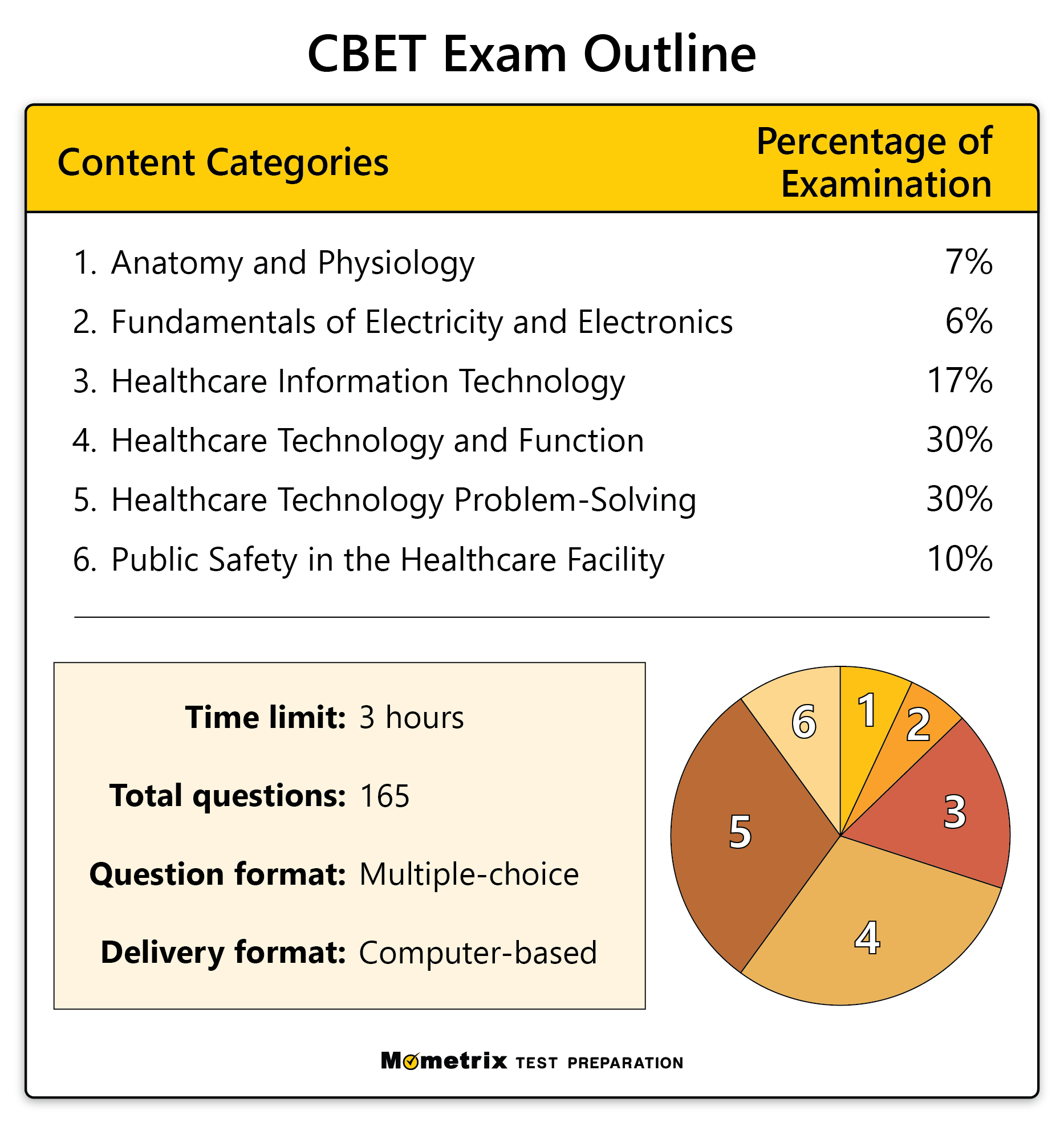
1. Anatomy and Physiology (7%)
In this section, you will be tested on your knowledge of the following:
- Functions and abnormal functions of physiological systems
- Major components and functions of the primary organs
- Basic medical terminology
2. Fundamentals of Electricity and Electronics (6%)
In this section, you will be tested on your knowledge of the following:
- Foundational electronic theories as applied to voltage, resistance, current, power, and devices
- The purpose and usage of various power conditioning, distribution, and storage systems
3. Healthcare Information Technology (17%)
In this section, you will be tested on your knowledge of the following:
- Protective standards and regulations for protected data
- Troubleshooting system hardware
- Troubleshooting, updating, and patching system software
- Troubleshooting wired and wireless networks and related components
- Troubleshooting the integration of medical devices direct to EMR
- Basic system identifiers and terms
4. Healthcare Technology and Function (30%)
In this section, you will be tested on your knowledge of the following:
- Physiological concepts applicable to healthcare technology
- Normal function, use, and technology of test equipment
- Physiological measurements
- Normal function of monitoring systems, diagnostic equipment, therapeutic equipment, life support equipment, perioperative equipment, lab equipment, and infusion equipment
5. Healthcare Technology Problem-Solving (30%)
In this section, you will be tested on your knowledge of the following:
- Identifying and resolving fault conditions of modules including power supplies
- Prioritizing repairs of medical devices based on level of risk, urgency, and potential downtime
- Device errors vs. use errors
- Educating staff on proper equipment use
- Localized issues vs. system-wide problems
- Identifying fault conditions and taking appropriate action for diagnostic, infusion, therapeutic, perioperative, and lab equipment
6. Public Safety in the Healthcare Facility (10%)
In this section, you will be tested on your knowledge of the following:
- Electrical safety requirements for the use of medical equipment
- Safety data sheets
- Standard hazard symbolism and signage
- Universal precautions
- Proper use of PPE
- Appropriate infection control procedures
- The role and function of CMS
- ANSI/AAMI standards
- Efficiently navigating and utilizing the CMMS to document maintenance activities, track equipment history, and generate reports
Check out Mometrix's CBET Study Guide
Get practice questions, video tutorials, and detailed study lessons.
Registration
To register for the CBET exam, you must first create an AAMI account and complete the CBET application. Candidates who are approved will generally receive an acceptance email within 3–5 business days, which includes instructions for scheduling an exam appointment.
The exam fee is $460, with AAMI members receiving a discount. Exam fees apply only to the testing window for which you register and cannot be transferred to another testing window.
Test Day
You should arrive at the testing location at least 15 minutes before the scheduled start time of the exam. Latecomers will be regarded as “no shows” and will forfeit all exam fees paid.
When you arrive, you will be asked to present two forms of valid identification, one of which must be a government-issued photo ID.
Before you enter the testing area, you will be asked to leave behind all personal items (bags, wallets, phone, hats, books, paper, etc.).
Once the check-in process is complete, you will be shown to your testing area, and the exam will begin.
Scoring
The CBET exam uses a criterion-referenced scoring method. This means your performance is compared with a predetermined standard for the knowledge and skills an entry-level biomedical equipment technician is expected to have, rather than with the performance of other test-takers.
You earn credit for each question you answer correctly. Because different versions of the CBET exam may vary slightly in difficulty, AAMI uses its established scoring process to maintain a consistent passing standard across exam forms.
In most cases, you will receive a preliminary pass or fail result immediately after completing the exam. AAMI also sends preliminary results by email within 24 hours.
Candidates who pass the exam and meet the certification requirements are notified of their official passing status within 45 days after the end of the testing window. ACI provides successful candidates with an electronic certificate.
Retaking the Exam
If you failed the exam and wish to retake it, you must wait at least 60 days. You will be permitted to take the exam three times in a two-year period, and if you fail on the third attempt, you must wait one year before reapplying to take the exam.
Check out Mometrix's CBET Flashcards
Get complex subjects broken down into easily understandable concepts.
Study Tips
Start with a CBET Practice Test
Before creating your study schedule, take a CBET practice test to establish a starting point. You don’t need to wait until you have reviewed every monitor, pump, ventilator, electrical circuit, and AAMI standard. At this stage, the goal is to identify where your preparation time will have the greatest effect.
Review your results across the six content categories:
- Anatomy and Physiology: Do you understand body system functions, basic medical terminology, and common abnormal conditions relevant to medical equipment?
- Fundamentals of Electricity and Electronics: Do you understand voltage, current, Ohm’s law, power supplies, batteries, and UPS systems?
- Healthcare Information Technology: Are you able to work with computer hardware, cloud systems, middleware, EMRs, NIST, HITRUST, and access points?
- Healthcare Technology and Function: Do you understand how major categories of medical equipment normally operate?
- Healthcare Technology Problem-Solving: Are you able to identify a fault, prioritize repairs, verify repairs, communicate with clinicians, and provide staff education?
- Public Safety: Do you understand electrical safety, PPE, infection control, GFCI protection, hazard symbols, and safety data sheets?
Identifying those specific weaknesses will show you where to devote more attention during your study time.
Review Difficult Questions
After each practice session, review every question you answered incorrectly AND every question you guessed on or answered with low confidence.
For each difficult question, determine which of the following caused the problem:
- You didn’t know how the equipment normally operates.
- You recognized the alarm but didn’t understand what could cause it.
- You skipped the simplest troubleshooting step.
- You replaced a component before isolating the fault.
- You confused device failure with use error.
- You misunderstood the electrical circuit.
- You failed to follow appropriate infection-control procedures.
- You treated a network problem as though it were purely a device problem.
- You failed to consider software or firmware.
- You did not verify the equipment after completing the repair.
Then, outline a specific plan for improvement based on what you discovered. In other words, don’t just say, “I need to study monitors.” Note that you need to review NIBP measurement principles and common causes of inaccurate readings.
Similarly, replace “study networking” with something specific, such as distinguishing a local-device problem from a system-wide network failure.
Utilize Answer Explanations
Answer explanations are an underutilized studying resource. To take full advantage of them, read the explanation for every question you found difficult, including questions you answered correctly.
For each one, make sure you can confidently explain:
- Why the correct answer is correct
- Why each incorrect answer is less appropriate
- What system or device principle is being tested
- Which evidence points toward the fault
- What the technician should check next
- How the repair or corrective action should be verified
- How the same failure could appear on another device
If the question involves medical equipment, ask yourself what the equipment is designed to do, what the major subsystems are, what input the device receives, what alarms or safety systems are present, and what failure would produce the described symptom.
For electrical questions, don’t stop after reaching the correct numerical answer. Determine if the answer is electrically reasonable, what effect the fault would have on the rest of the circuit, and what measurement should be taken next.
Study Normal Operation Before Troubleshooting Failure
You can’t troubleshoot a system effectively if you do not understand what normal operation looks like!
For every device category, study in this order:
Purpose → Physiology → Components → Normal operation → Measurements → Alarms → Common failures → Troubleshooting → Verification
FAQs
Q
How many questions are on the CBET exam?
A
There are 165 multiple-choice questions on the exam.
Q
How long is the CBET exam?
A
The time limit for the exam is 3 hours.
Q
What is the passing score for the CBET exam?
A
AAMI uses a criterion-referenced passing standard rather than publishing a fixed number of questions you must answer correctly.
Q
How much does the CBET exam cost?
A
The exam fee is $460, with AAMI members receiving a discount.


Mometrix Test Preparation is not affiliated with or endorsed by any official testing organization. All organizational and test names are trademarks of their respective owners.


