
The International Association of Administrative Professionals (IAAP) administers the Certified Administrative Professional® (CAP®) examination. This exam tests the skills and knowledge that an administrative professional would need to know in order to be competent at their job.
Click “Start Test” above to take a free CAP practice test, and check out our premium-quality CAP test prep resources by clicking the links below!
CAP Exam Eligibility
To be eligible for the CAP exam, you must meet the following qualifications, which will differ depending on your level of education:
- No Degree: You must have accumulated at least 7,072 hours of relevant work experience.
- Associate Degree: You must have accumulated at least 5,304 hours of relevant work experience.
- Bachelor’s Degree: You must have accumulated at least 3,536 hours of relevant work experience.
The hour requirements are based on a 34-hour work week (1,768 hours per year).
CAP Exam Outline
The CAP exam contains approximately 200-225 multiple-choice questions and has a time limit of 3 hours.
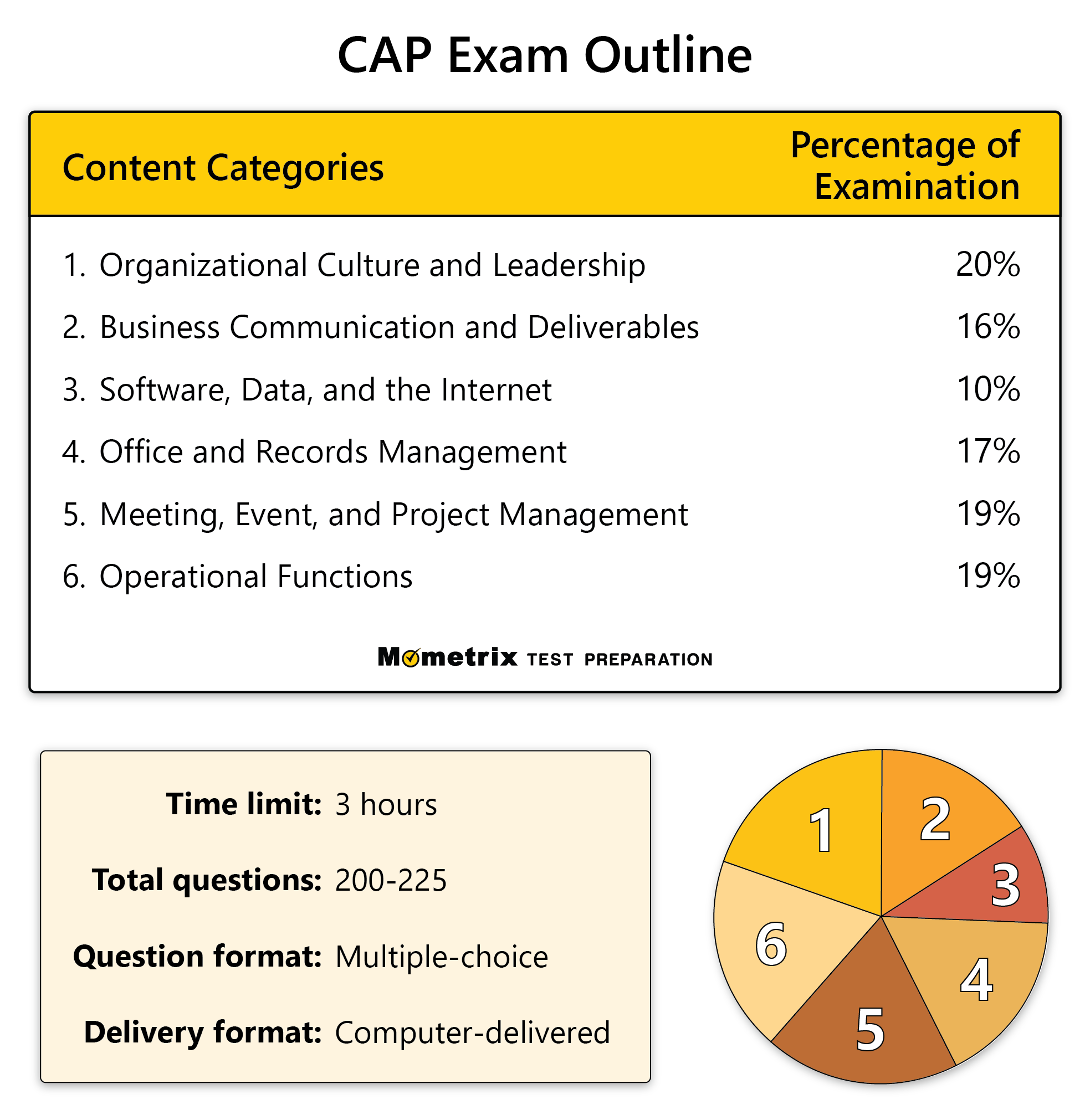
The exam is split into six content domains, and each domain is split into multiple performance outcomes (POs). Performance outcomes are measurable competencies that are based on the knowledge and abilities of a professional administrator.
1. Organizational Culture and Leadership (20%)
The questions in this domain are split into nine performance outcomes:
- Management models within organizations and individuals’ leadership styles
- Effective interactions with stakeholders of an organization
- Team dynamics within organizations
- Business and strategic planning
- Benefits and strategies of professional development
2. Business Communication and Deliverables (16%)
The questions in this domain are split into eight performance outcomes:
- Concepts and applications of communication
- Techniques of presenting information
- Proofreading, editing, and finishing documents
3. Software, Data, and the Internet (10%)
The questions in this domain are split into nine performance outcomes:
- The process and techniques of gathering, compiling, and analyzing data
- Using online platforms
- Common file types and required software for accessibility
4. Office and Records Management (17%)
The questions in this domain are split into nine performance outcomes:
- Basic records management
- Necessary resources for efficiently managing an office
- Necessary resources for efficiently supporting others
5. Meeting, Event, and Project Management (19%)
The questions in this domain are split into five performance outcomes:
- Meetings and event management
- Travel coordination
- Project management
6. Operational Functions (19%)
The questions in this domain are split into seven performance outcomes:
- Human Resources processes
- The importance of DEI for an organization
- Basic financial functions of an organization
- Elements of the banking process and transactions
Check Out Mometrix's CAP Study Guide!
Get practice questions, video tutorials, and detailed study lessons.

Registration
To register for the exam, you must first create an IAAP account on their website. Through this account, you can submit an application, which includes the $575 exam fee ($375 for IAAP members).
Once your application has been approved, you will be able to schedule your exam. If you are taking the in-person exam, you will need to schedule an exam date with your local testing center. If you are taking the remote-proctored exam, you will need to perform a system check and schedule an exam date with Kryterion.
Test Day
In-person Testing
On the day of your exam, you should arrive at the testing facility at least 15 minutes before your scheduled exam time. Once you arrive, you will be asked to present two forms of valid identification, one of which must be a photo ID.
Personal items will not be allowed into the testing center, so it is best to leave things like bags, notebooks, and food items at home or in your car.
Remote Testing
On the day of your exam, you should log in to your Webassessor account and click on your exam, which will be listed in the Scheduled Exams section. Before your exam begins, you will be asked to show two forms of valid identification to the remote proctor via your webcam. You will also be asked by the remote proctor to use your webcam to scan your testing area.
Personal items will not be allowed on your desk/table while you take the exam. This includes your cell phone, notebooks, and food items.
How the Test is Scored
The CAP exam is scored using a criterion-referenced scoring method. This means that a team of subject-matter experts has decided upon a baseline standard that all test-takers must meet in order to pass the exam.
The passing score for the CAP exam is a scaled score of 500. You will receive your scores 4-6 weeks after you finish the exam.
Check Out Mometrix's CAP Flashcards!
Get complex subjects broken down into easily understandable concepts.

Study Tips
Start with a CAP Practice Test
Before creating your study schedule, take a CAP practice test to establish a starting point. You don't need to wait until you have reviewed every management model, records-management term, financial report, or project-management process. At this stage, the goal is to identify where your preparation time will have the greatest effect.
Review your results across the six content domains:
- Organizational Culture and Leadership: Can you apply management models and leadership styles, understand team dynamics and organizational structures, manage conflict, and connect strategic planning to organizational performance?
- Business Communication and Deliverables: Can you choose an appropriate communication channel, prepare business documents and presentations, create agendas and minutes, and proofread for grammar and readability?
- Software, Data, and the Internet: Can you choose appropriate software, gather and organize data, interpret visualizations, evaluate online information, and work with common file types?
- Office and Records Management: Do you understand filing, records retention, information security, inventory and purchasing, calendar management, and conflicting priorities?
- Meeting, Event, and Project Management: Can you plan meetings and events, coordinate domestic and international travel, manage time, and identify project stages and resource requirements?
- Operational Functions: Do you understand HR processes, onboarding and offboarding, hiring practices, DEI concepts, financial reports, reconciliation, and basic banking procedures?
Identifying those specific weaknesses will show you where to devote more attention during your study time.
Review Difficult Questions
After each practice session, review every question you answered incorrectly AND every question you guessed on or answered with low confidence.
For each difficult question, determine which of the following caused the problem:
- You answered according to how your own workplace handles a task instead of the principle being tested.
- You chose a communication method without considering the audience, purpose, or situation.
- You knew the terminology but couldn't apply it to a practical workplace scenario.
- You confused two similar management, HR, records, or financial concepts.
- You overlooked a confidentiality, security, or reporting requirement.
- You knew the individual steps of a process but put them in the wrong order.
- You selected a software tool without considering what the task actually required.
- You spent too much time on an unfamiliar topic instead of making the best-supported choice and moving on.
Then, outline a specific plan for improvement based on what you discovered. In other words, don't just say, “I need to study records management.” Note that you need to review the difference between retention, archiving, backup, and secure disposal.
Similarly, replace “study project management” with something specific, such as identifying the resources required during planning or distinguishing planning activities from execution.
Utilize Answer Explanations
Answer explanations are an underutilized studying resource. To take full advantage of them, read the explanation for every question you found difficult, including questions you answered correctly.
For each one, make sure you can confidently explain:
- Why the correct answer is correct
- Why each incorrect answer is less appropriate
- What business or administrative principle is being tested
- Which details in the scenario actually control the answer
- What the administrative professional should do next
- How the same principle could appear in a different workplace situation
For scenario questions, identify the goal before evaluating the answer choices. Ask whether the situation is primarily about communication, confidentiality, efficiency, documentation, conflict, resource management, or another responsibility.
Then, determine which response best supports that goal while following appropriate business practices.
Study Administrative Work as Processes
Many CAP topics are easier to apply when you study them as workflows instead of isolated facts.
For meetings and events, think through the entire process:
Purpose → Requirements → Logistics → Communication → Execution → Follow-Up
For records management:
Create or Receive → Classify → Store → Protect → Retain → Dispose or Archive
For projects:
Objective → Plan → Resources → Execution → Monitoring → Completion
This approach helps when a question asks what should happen next, which step was skipped, or which action best supports the desired outcome.
Separate Best Practice from Workplace Habit
The CAP is designed for administrative professionals working across many types of organizations. Your own experience is valuable, but don't assume your employer's procedures are automatically the standard the exam is testing.
For example, your organization may use a particular filing system, approval chain, meeting process, or software platform. Instead of memorizing one company's procedure, understand the broader principle behind it.
Ask yourself:
- What problem is this process designed to prevent?
- Who needs the information or action?
- What confidentiality, security, or documentation requirements apply?
- What resources and priorities need to be considered?
- Which response produces the most professional and efficient outcome?
This is especially important for questions involving communication, conflict, records management, HR processes, calendar management, and projects.
Practice CAP Pacing
The CAP exam contains approximately 200-225 multiple-choice questions that must be completed within 3 hours. That gives you an average of roughly 48-54 seconds per question.
Don't force yourself to spend the same amount of time on every question. A straightforward terminology or grammar question may take only a few seconds, while a workplace scenario may require more careful comparison of the answer choices.
When practicing, learn to recognize when you know enough to make a decision. If two answers seem reasonable, return to the exact issue being tested and choose the option that best addresses the situation rather than adding assumptions that aren't in the question.
Build up from untimed practice to mixed timed sets and eventually complete full-length practice under the 3-hour limit.
FAQs
Q
How many questions are on the IAAP CAP exam?
A
There are between 200 and 225 multiple-choice questions on the exam.
Q
How long is the IAAP CAP exam?
A
The time limit for the exam is 3 hours.
Q
What is the passing score for the IAAP CAP exam?
A
To pass the exam, you must achieve a scaled score of at least 500.
Q
How much does the IAAP CAP exam cost?
A
The examination fee is $575.


CAP and Certified Administrative Professional are registered trademarks of the International Association of Administrative Professionals, which is not affiliated with Mometrix Test Preparation and does not endorse this product.


