The American Chemical Society (ACS®) is a nonprofit organization based in the US, whose goal is to support students, teachers, and general scientific advancements and research. If the college you attend offers an ACS-approved chemistry program, you may be required to take the ACS college chemistry exam as one of your final exams.
Click “Start Test” above to take a free ACS General Chemistry practice test, and check out our premium-quality ACS General Chemistry study guide by clicking below!
ACS General Chemistry Exam Outline
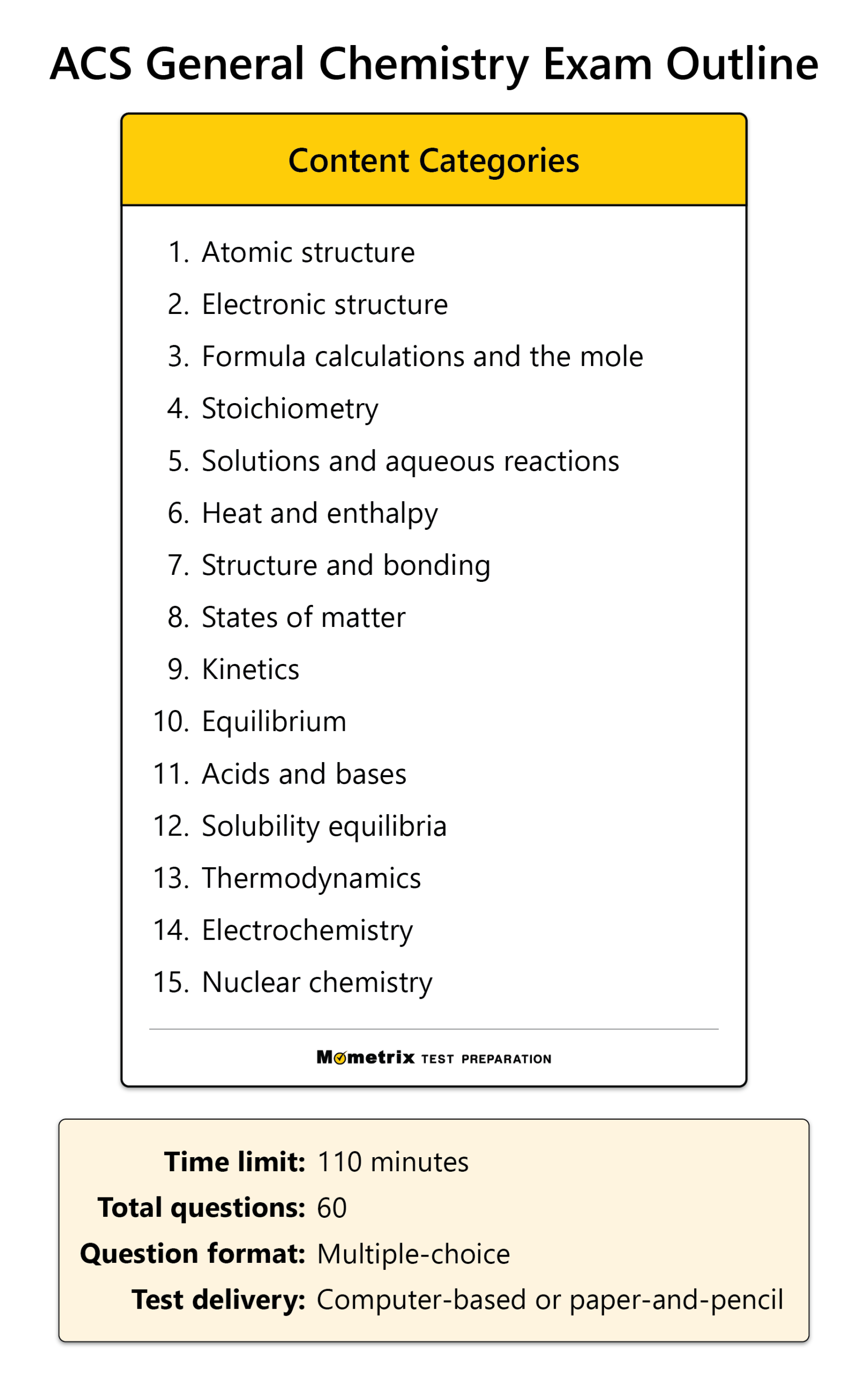
The ACS General Chemistry exam contains 60 multiple-choice questions and has a time limit of 110 minutes.
These are the main content categories on the exam:
- Atomic structure
- Electronic structure
- Formula calculations and the mole
- Stoichiometry
- Solutions and aqueous reactions
- Heat and enthalpy
- Structure and bonding
- States of matter
- Kinetics
- Equilibrium
- Acids and bases
- Solubility equilibria
- Thermodynamics
- Electrochemistry
- Nuclear chemistry
These are the topics you should be familiar with before taking the ACS exam:
Basic Chemistry
- Vocabulary/terminology
Intermolecular Forces
- Lattice energy
- Phase transitions
- Phase diagrams
- Relation of boiling points and melting points to intermolecular forces
- Types of solids
- Unit cell calculations
Types of Solutions
- Solution concentrations
- Solubility curves
- Colligative properties
- Colloids
- Solubility curves for gases vs. curves for solids
Kinetics
- Experimental determination of rate
- Determining the rate law using the initial rate method
- Rate constants
- Elementary reactions
- Catalysis
- Reaction mechanisms
- Collision and transition state theory
- Activation energy, concentration-time calculations
- Temperature and rate
- Half-lives
- Graphical determinations of reaction order and rate constant
- Potential energy diagrams
Chemical Equilibrium
- Equilibrium constant
- Reaction quotient
- Le Chatelier’s Principle
- Predicting reaction direction
- Calculating equilibrium concentrations
- ICE tables
Acid-base Theories
- Arrhenius and Brønsted–Lowry
- Acid-base strength and relation to molecular structure
- Self-ionization of water
- pH
- Strong and weak acids and bases
Acid and Base Ionization
- Polyprotic acids
- Salt solutions
- Common ion effect
- Buffers
- Titration curves
Solubility Product Constant
- Common ion effect
- pH and solubility
- Precipitation calculations
- Solubility rules (and exceptions to the rules)
Second and Third Laws of Thermodynamics
- Entropy and change in entropy (∆S)
- Free energy and Gibbs free energy (∆G)
- Spontaneity
- Relation to the equilibrium constant
- Work
- Extensive property
- Enthalpy and change in enthalpy (∆H)
- Hess’s Law
- Specific heat capacity
Balancing Redox Reactions
- Voltaic and electrolytic cells
- Cell notation
- Electromagnetic fields
- Electrochemical cells
- Electrode potentials
- Oxidation numbers
- Oxidizing and reducing agents
- The strength of these agents
- Applications of electrochemistry
- Electrolysis
Fission
- Fusion
- Radioactivity
- Nuclear bombardment reactions
- Radioactive decay
- Half-lives
- Mass-energy calculations
- Isotopes and nuclide symbols
- Mass numbers and atomic weights
- Subatomic particles
Chemicals’ Physical Change/Properties
- Significant figures
- SI units and prefixes
Nomenclature
- Polyatomic ions and Greek prefixes
- Molecular compounds
- Ionic compounds
- Acids
- Binary compounds
- Ion charge based on position in the periodic table
- Diatomic elements
Combustion and Double Replacement Reactions
- Net ionic equations
- Spectator ions
- Molecular equations
- Gas-producing reactions
Basic Stoichiometry
- Molar masses
- Molar ratios
- Limiting reactant
- Percent composition
- Molarity
- Percentage yield
- Empirical and molecular formulas
Gas Laws
- Empirical
- Ideal
- Effusion
- Partial pressures
- STP
- Kinetic-molecular theory
- Barometers and manometers
Energy
- Frequency
- Wavelength
- Emission spectra
- Electron configurations
- Orbital diagrams
- Quantum numbers
Periodic Trends
- Atomic radii
- Ionization energies
- Electronegativities
- Ionic radii
Lewis Structures
- Resonance
- Formal charges
- Bond polarity
- Bond order
- Exceptions to the octet rule
VSEPR Model
- Hybridization
- Polarity of molecules
- Lone pairs
- Bonding pairs
- σ and π bonds
Check Out Mometrix's ACS General Chemistry Study Guide
Get practice questions, video tutorials, and detailed study lessons
Get Your Study Guide

ACS General Chemistry Online Prep Course
If you want to be fully prepared, Mometrix offers an online ACS General Chemistry prep course designed to give you everything you need to succeed!
Here’s what you’ll find in the ACS General Chemistry course:
- 50+ Review Lessons Covering Every Topic
- 350 ACS General Chemistry Practice Questions
- 300+ Digital Flashcards
- 50+ Instructional Videos
- Money-back Guarantee
- Mobile Access
Everyone learns differently, so we’ve tailored the ACS General Chemistry online prep course to ensure every learner has what they need to prepare for the ACS General Chemistry exam.
Click below to check it out!
Test Day
Depending on where you take the exam, you may be required to bring different items along with you, so check with the school administrators to ensure you’re prepared. Generally, you will be asked to bring two sharpened No. 2 pencils. A scratch piece of paper will be provided, and you are allowed to bring a non-programmable calculator if you would like.
If you do not know how to answer a particular question, it is best to skip it and go back to it once you complete the questions you do know.
How the Exam is Scored
To pass the ACS exam, you must answer at least 50% of the questions correctly.
Your score is based on a percentile ranking. In percentile rankings, there is a good chance that the questions you do not know how to answer are also questions that several other students have trouble answering.
With percentile rankings, the ranking you get, such as a 90th percentile, indicates that you scored higher than 90% of the students on the national norm.
The chart below outlines the general percentile rankings estimated for the ACS test on a national level.
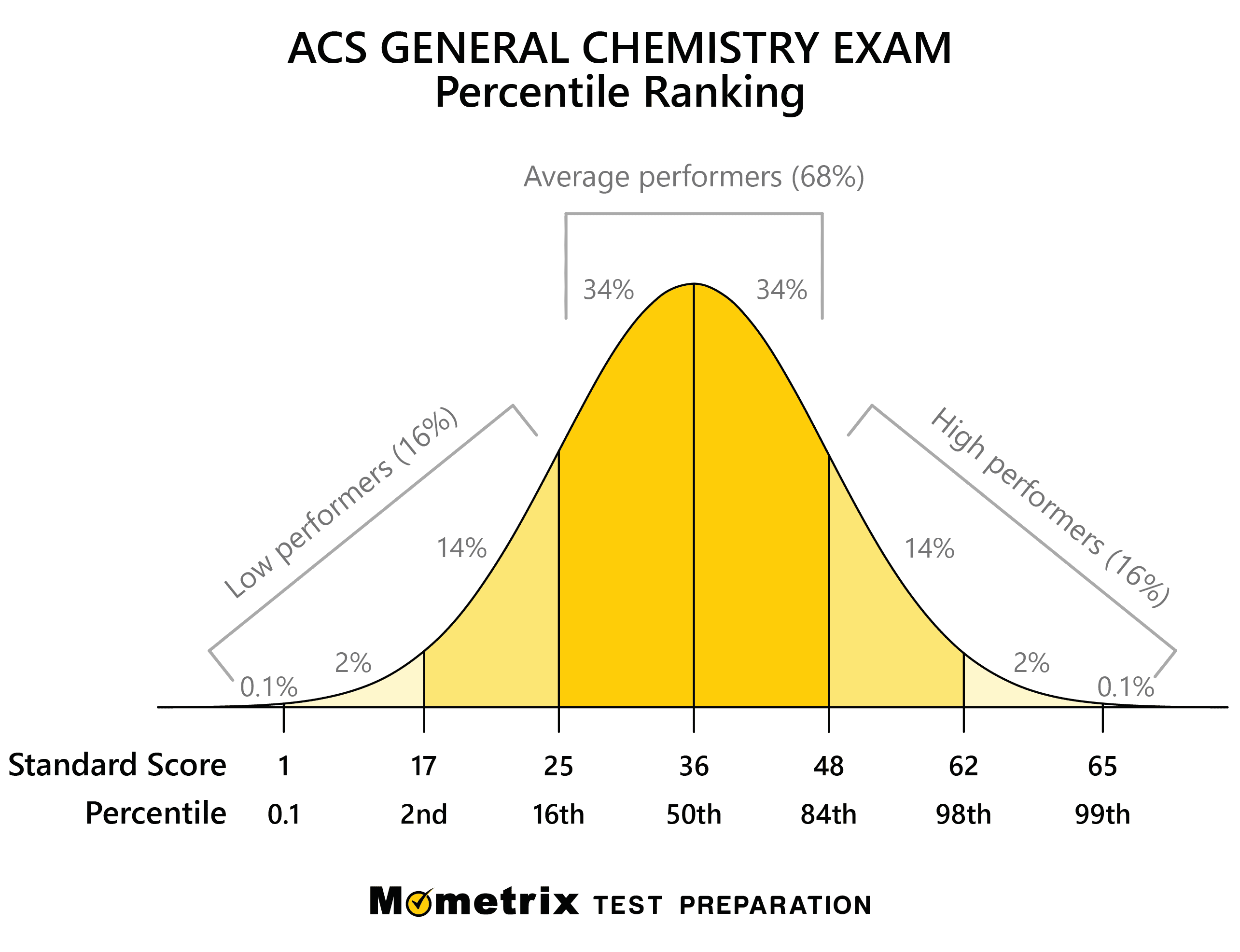
Note that the methods used in grading this ACS exam will depend on the professor’s preferences and the college guidelines for this type of grading. Some professors will use a curving method while grading, while others do not.
How to Study
Start with a Practice Test
Before creating your study schedule, take an ACS General Chemistry practice test to establish a starting point. You don’t need to wait until you have reviewed every topic. At this stage, the goal is to identify where your preparation time will have the greatest effect.
Review your results by topic:
- Atomic and Electronic Structure: Can you work with isotopes, electron configurations, quantum numbers, periodic trends, and relationships among atomic properties?
- Formulas, Reactions, and Stoichiometry: Can you write and balance equations, convert among particles, moles, mass, and volume, identify limiting reactants, and calculate reaction yields?
- Bonding and Molecular Structure: Can you draw Lewis structures, determine molecular geometry and polarity, compare bond types, and connect intermolecular forces with physical properties?
- States of Matter and Solutions: Can you apply gas laws, interpret phase behavior, calculate solution concentrations, and understand how solutes and solvents interact?
- Thermochemistry and Thermodynamics: Can you interpret heat flow, enthalpy, entropy, free energy, calorimetry, and the signs associated with chemical and physical changes?
- Kinetics and Equilibrium: Can you interpret rate information, determine how conditions affect a reaction, write equilibrium expressions, and apply equilibrium principles?
- Acids, Bases, and Solubility: Can you calculate pH, compare acid and base strength, analyze buffers, and work with acid-base and solubility equilibria?
- Electrochemistry and Nuclear Chemistry: Can you analyze oxidation-reduction reactions, electrochemical cells, radioactive decay, and related calculations?
Identifying those specific weaknesses will show you where to devote more attention during your study time.
Review Difficult Questions
After each practice session, review every question you answered incorrectly AND every question you guessed on or answered with low confidence. A correct guess does not demonstrate that you understand the chemistry.
For each difficult question, determine which of the following caused the problem:
- You did not know the underlying concept or relationship.
- You recognized the topic but selected the wrong equation.
- You could not translate the wording, diagram, graph, or molecular representation into a workable problem.
- You failed to balance the equation before completing a stoichiometric calculation.
- You used the wrong units, conversion factor, sign, or significant figure.
- You confused two related ideas, such as reaction rate and equilibrium position.
- You completed the calculation correctly but interpreted the result incorrectly.
- You relied on calculator output without checking whether the answer was chemically reasonable.
- You understood the question but used a method that took too long.
Then, outline a specific plan for improvement based on what you discovered. In other words, don’t just say, “I need to study stoichiometry.” Note that you need to practice identifying limiting reactants, converting from grams to moles, or using coefficients as mole ratios.
Similarly, replace “review acids and bases” with a precise task such as distinguishing strong and weak acids, calculating the pH of a buffer, or predicting the direction of an acid-base reaction.
Utilize Answer Explanations
Answer explanations are an underutilized studying resource. To take full advantage of them, read the explanation for every question you found difficult, including questions you answered correctly.
For each one, make sure you can confidently explain:
- Why the correct answer is correct
- Why each incorrect option is wrong
- Which chemical principle, equation, or relationship is being tested
- Which information in the question is relevant
- How the answer can be checked for chemical and mathematical reasonableness
- How the same concept might appear in a different question
Don’t just read the explanation, agree with it, and move on. Close it and solve the problem again from the beginning.
For an equilibrium or acid-base question, write the appropriate expression before substituting numbers. Explain what the value represents and whether the result agrees with the expected direction of the chemical change.
For a bonding question, draw the structure yourself and connect the arrangement of electrons to molecular geometry, polarity, and intermolecular forces.
Study Chemical Relationships, Not Individual Questions
Memorizing the answer to one practice question will not prepare you for a new question that presents the same chemistry through a different equation, graph, particle diagram, experiment, or set of values.
For example, memorizing the ideal gas law is not enough. You should understand how pressure, volume, temperature, and amount of gas are related and recognize when a different gas-law relationship would be more efficient.
Likewise, don’t memorize isolated periodic trends. Connect atomic structure to effective nuclear charge, atomic radius, ionization energy, electron affinity, bonding, and chemical behavior.
The exact questions on your test will be different from the ones you encounter during practice. If you can explain a skill without looking at your notes and then apply it correctly to a new question, that is a good indication that you have mastered it.
FAQs
Q
How many questions are on the ACS General Chemistry exam?
A
There are 60 multiple-choice questions on the ACS General Chemistry exam.
Q
How long is the ACS General Chemistry exam?
A
The exam lasts a total of 110 minutes.
Q
What is a passing score on the ACS General Chemistry exam?
A
You must answer at least 50% of the 60 questions correctly to pass this exam. The exam is generally scored using a percentile ranking system.


ACS is a registered trademark of the American Chemical Society, which is not affiliated with Mometrix Test Preparation and does not endorse this page.