
The American Institute of Certified Planners® (AICP®) exam is a nationwide verification of an individual’s qualifications, provided by the American Planning Association (APA). The certification shows an individual’s pledge to uphold the high standards of practice, ethics, conduct, and continuing education required by the APA.
Click “Start Test” above to take a free AICP practice test!
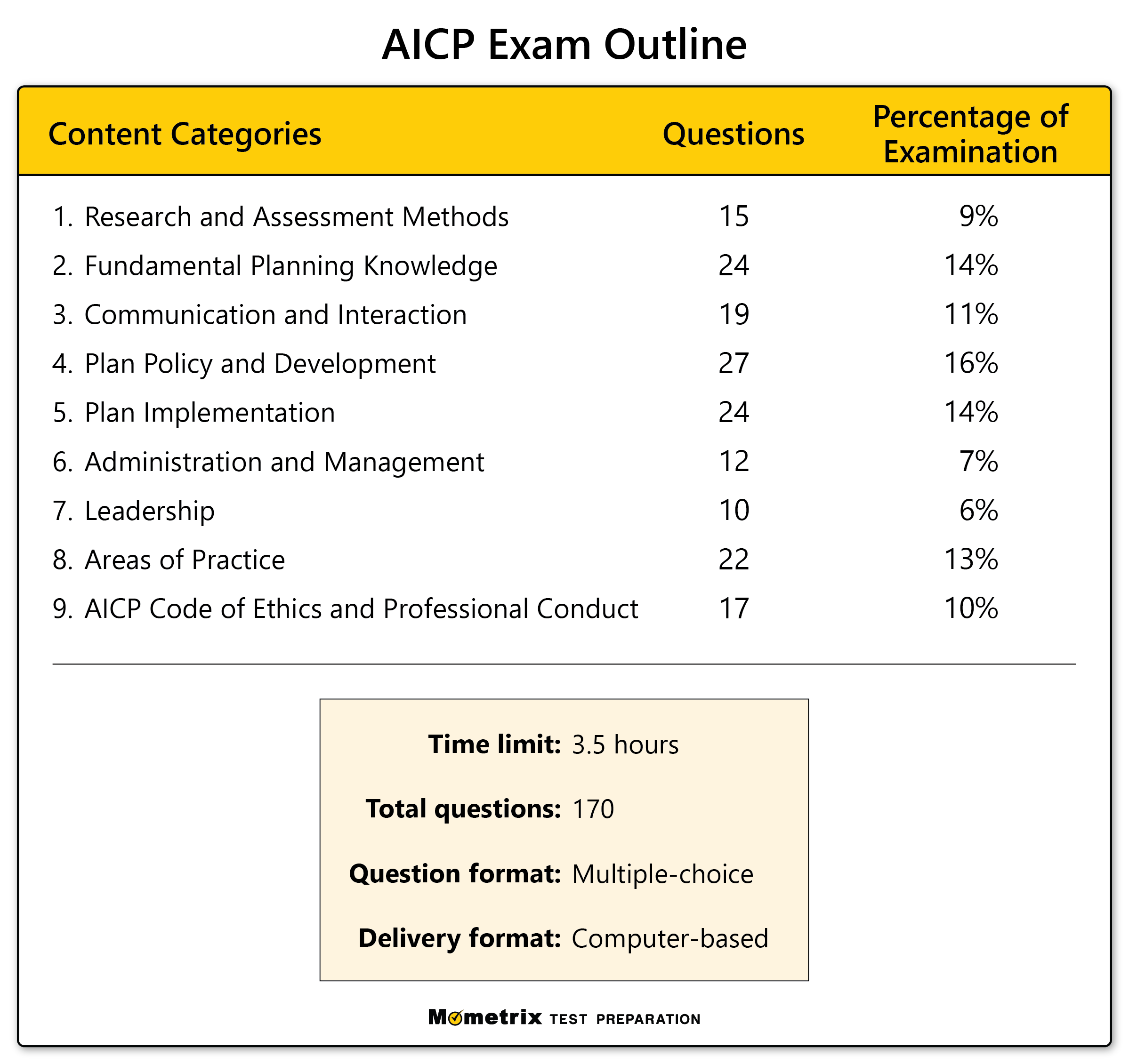
AICP Exam Outline
The AICP exam is computer-based, containing 170 multiple-choice questions and being timed at 3.5 hours. The questions utilize varied methods of introducing information, such as tables, graphs, word problems, and yes-or-no responses.
The APA published the revised AICP exam outline in October 2026 for the November 2026 pilot. The topic areas and percentages below come from that revised outline:
1. Research and Assessment Methods (9%)
- Choosing qualitative and quantitative research methods
- Selecting authoritative data sources and documenting why they are appropriate
- Interpreting data in context and checking for gaps, bias, and unreliable results
- Analyzing geographic data with GIS, maps, and models
- Choosing accessible ways to engage communities and gather information about residents’ experiences
- Protecting privacy and confidentiality, and documenting, validating, and disclosing the use of AI and machine learning
2. Fundamental Planning Knowledge (14%)
- Planning history, major movements, and the people and perspectives that shaped modern practice
- Planning theories
- Factors that shape settlement patterns
- Legal foundations of planning
- How related professions contribute to planning projects
- Natural, social, and economic patterns
- Uses of emerging technology in planning
- Using GIS, visualization, and modeling tools to compare planning scenarios
3. Communication and Interaction (11%)
- Running meetings, building relationships, working with the media, and adapting communication to the audience
- Handling sensitive communications
- Creating accessible public information materials that avoid discrimination
- Listening to community members, documenting their ideas accurately, and incorporating their input into planning
- Helping teams work together and build consensus on decisions that serve the public
- Communicating across cultures with attention to social justice and community history
- Understanding the roles of public agencies, nonprofits, and businesses
- Evaluating who participated in outreach and what the outreach accomplished
- Navigating politically sensitive situations and understanding the roles of planners, elected officials, and the media
- Presenting data in ways that different audiences can access and understand
- Tracking and reporting progress using metrics, benchmarks, and follow-up reviews
4. Plan and Policy Development (16%)
- Defining the planning context, identifying issues and opportunities, and setting a vision and goals
- Writing scopes of work that specify roles, budgets, deliverables, schedules, and public engagement
- Identifying and involving community members and other interested parties when defining the scope of a plan, policy, or project
- Understanding relevant laws and court decisions
- Analyzing and drafting policies with attention to equity and economic and environmental impacts
- Connecting the vision, goals, objectives, and policies of a plan
- Setting objectives and choosing actions that address community priorities equitably
- Using negotiation and facilitation to address competing interests
- Choosing innovations and established practices that fit local conditions
- Comparing the likely benefits and drawbacks of potential outcomes
- Evaluating budgets, return on investment, and municipal and real estate financing options
- Considering community character and physical form through context-sensitive design, historic architecture, and form-based codes
5. Plan Implementation (14%)
- Applying regulations, policies, and programs when reviewing projects
- Identifying funding sources
- Securing and administering funding through grant writing, budget advocacy, and negotiations
- Building partnerships and using engagement and education to support equitable implementation
- Addressing barriers to implementation
- Defining action steps, assigning responsibilities, and coordinating work on a schedule
- Measuring results and using them to update adopted plans, policies, and implementation actions
- Coordinating related projects to use resources efficiently and distribute benefits equitably
6. Administration and Management (7%)
- Managing projects and programs
- Organizing teams, training staff, and managing budgets in line with organizational goals
- Working with clients, partners, boards, and commissions while balancing transparency, public information requirements, and privacy
- Giving staff equitable access to mentoring and opportunities to build skills
- Setting performance benchmarks, analyzing variation in results, and checking the quality of work
7. Leadership (6%)
- Supporting planning and public participation through education, partnerships, and ethical advocacy
- Introducing and championing effective planning practices and tools
- Taking responsibility for professional conduct and decisions that affect the public
- Considering how different parts of a complex planning problem affect one another
- Applying diversity, equity, and inclusion principles to planning work
- Coaching and mentoring others
- Meeting expectations for continued professional development
- Explaining the value of planning to others
- Taking part in programs and events that serve the community
8. Areas of Practice (13%)
- Long-range and comprehensive planning
- Planning for subareas
- Current planning
- Sustainability and resilience planning
- Transportation planning across modes
- Planning for infrastructure and services
- Hazard mitigation, disaster preparedness
- Natural resource planning and environmental impact assessment
- Economic development
- Urban design
- Housing planning
- Planning for parks, recreation, trails, and open space
- Preserving historic places and planning for cultural resources
- Planning for facilities and services
- Food systems planning
- Community health planning
- Planning for rural areas and small towns
- Equity and advocacy across housing, transportation, economic development, and public services
- Planning across jurisdictions for shared needs
- Using large datasets, smart city tools, AI, and other emerging technologies in planning
9. AICP Code of Ethics and Professional Conduct (10%)
All ethics questions are based on the AICP Code of Ethics and Professional Conduct, revised in November 2021 and effective January 1, 2022.
- Serving the public interest and maintaining professional integrity
- Working diligently and competently on behalf of clients and employers
- Supporting colleagues, expanding access to the profession, and helping the public understand planning
- Following AICP conduct rules
- Applying core planning values
Check Out Mometrix's AICP Study Guide!
Get practice questions, video tutorials, and detailed study lessons.

Registration
To register for the AICP Certification, you must adhere to the following steps:
- Be a current APA Member with dues current at the local chapter and with AP.
- Meet APA’s eligibility requirements for AICP membership
- Submit the online application and pay all fees
- In eight to ten weeks, you will receive a confirmation email of the status of your application
- If you are approved, register for the exam
Once approved, you will register online to take the exam during the exam window.
Fees
The registration fee is $305, not including previous costs. Once paid, you will receive a confirmation email detailing information on how to schedule your exam at a testing facility of your choice. After you have passed the certification, you will receive an invoice from APA for your AICP credential. This cost is in addition to fees previously remitted.
Test Day
You should arrive at least 30 minutes before your scheduled test time so that you will have time to find parking and complete the required paperwork. Leave personal belongings in your vehicle or at home, and follow the rules for the testing center carefully. Negligence could find you disqualified and your fees forfeited. Security measures at the facility include scanning with a metal detector wand and visual inspection of your clothing, including eyewear.
At your testing station, you will be provided with scratch paper and a pen or pencil. The test administrator will also discuss any breaks that are provided during your exam and the policy for taking it.
Scores
At the conclusion of your exam, an official score report is generated. Each question is scored on the difficulty of the question, and your overall score is scaled. A scaled score of 55 is required to pass. If you did not pass, you may take the test again. You will be required to pay the exam registration fee again and meet all requirements for the credential.
You can obtain a copy of your score report on the testing facility’s website. If you need a letter of affirmation from APA about your good standing, contact APA’s customer service after your AICP dues.
Check Out Mometrix's AICP Flashcards!
Get complex subjects broken down into easily understandable concepts.

How to Study
How to Study Effectively
Your success on AICP test day depends not only on how many hours you put into preparing but also on whether you prepared the right way. It’s good to check along the way to see whether your studying is paying off. One of the most effective ways to do this is by taking AICP practice tests to evaluate your progress. Practice tests are useful because they show exactly where you need to improve. Every time you take a free AICP exam practice test, pay special attention to these three groups of questions:
- The questions you got wrong
- The ones you had to guess on, even if you guessed right
- The ones you found difficult or slow to work through
This will show you exactly what your weak areas are and where you need to devote more study time. Ask yourself why each of these questions gave you trouble. Was it because you didn’t understand the material? Was it because you didn’t remember the vocabulary? Do you need more repetitions on this type of question to build speed and confidence? Dig into those questions and figure out how you can strengthen your weak areas as you go back to review the material.
Answer Explanations
Additionally, many AICP practice tests have a section explaining the answer choices. It can be tempting to read the explanation and think that you now have a good understanding of the concept. However, an explanation likely only covers part of the question’s broader context. Even if the explanation makes sense, go back and investigate every concept related to the question until you’re positive you have a thorough understanding.
Comprehend Each Topic
As you go along, keep in mind that the AICP practice test is just that: practice. Memorizing these questions and answers will not be very helpful on the actual test because it is unlikely to have any of the same exact questions. If you only know the right answers to the sample questions, you won’t be prepared for the real thing. Study the concepts until you understand them fully, and then you’ll be able to answer any question that shows up on the test.
Strategy for AICP Practice
When you’re ready to start taking practice tests, follow this strategy:
- Remove Limitations. Take the first test with no time constraints and with your notes and AICP study guide handy. Take your time and focus on applying the strategies you’ve learned.
- Time Yourself. Take the second practice test “open book” as well, but set a timer and practice pacing yourself to finish in time.
- Simulate Test Day. Take any other practice tests as if it were test day. Set a timer and put away your study materials. Sit at a table or desk in a quiet room, imagine yourself at the testing center, and answer questions as quickly and accurately as possible.
- Keep Practicing. Keep taking practice tests on a regular basis until you run out of practice tests or it’s time for the actual test. Your mind will be ready for the schedule and stress of test day, and you’ll be able to focus on recalling the material you’ve learned.
FAQs
How many questions are on the AICP exam?
There are 170 multiple-choice questions on the AICP exam.
How long does the AICP exam take?
The AICP exam is timed at 3.5 hours.
What is a passing score?
A passing score for the AICP exam is a scaled score of 55.
How much does the exam cost?
The AICP exam costs $305.


Mometrix Test Preparation is not affiliated with or endorsed by any official testing organization. All organizational and test names are trademarks of their respective owners.


