The National Center for Competency Testing (NCCT®) administers the National Certified Medical Assistant (NCMA®) exam to assess the knowledge and skills of prospective certified medical assistants.
Click “Start Test” above to take a free National Certified Medical Assistant practice test!
NCMA Exam Eligibility
To be eligible for the NCMA exam, you must qualify through ONE of the following pathways and provide the required supporting documentation:
Be a current student or a graduate within the past five years of an NCCT-authorized high school medical assistant program.
Current high school students who pass receive provisional certification.
Submit your program diploma, certificate of completion, or required official signed transcript within two years of program completion to receive full certification.
Be enrolled in an NCCT-authorized postsecondary medical assistant program.
You may test before submitting graduation documentation, but must submit your program diploma, certificate of completion, or official signed transcript with your graduation date within two years of program completion.
Have completed an NCCT-authorized postsecondary medical assistant program within the past five years.
Submit your program diploma, certificate of completion, or official signed transcript with your graduation date before testing.
Have one year of verifiable full-time medical assisting experience, or 2,080 equivalent hours, within the past five years under the direct supervision of a certified/licensed physician or primary care provider.
Submit an employer-completed Medical Assistant Certification Qualification by Experience form.
Have completed medical assistant training or equivalent training during US military service within the past five years.
Submit military records documenting the qualifying training, such as a SMART transcript or DD214.
Have one year of current, verifiable medical assisting teaching experience at an NCCT-authorized organization within the past five years, plus one year of verifiable medical assisting practitioner experience within the past five years.
Submit an Instructor Verification form and an Instructor Medical Assistant Qualification by Experience form.
Except for the high school pathway, you must also be a US high school graduate or hold equivalent credentials, such as a GED. Qualifying work experience must be earned in the United States or its territories. Self-employment does not count toward the experience requirement.
NCMA Exam Outline
The National Certified Medical Assistant exam contains 150 questions, 25 of which are unscored, and you will be given a 3-hour time limit. The 25 unscored questions are used by NCCT to validate questions for future versions of the exam.
Most of the questions are multiple-choice, while the remaining questions use alternative formats such as multi-select and drag-and-drop:
- Multi-select: Choose two or more correct answers.
- Hot spot: Click on the area of a given image that correctly answers the question.
- Drag-and-drop: Drag pieces of information to the correct position/order.
The exam is split into four content categories.
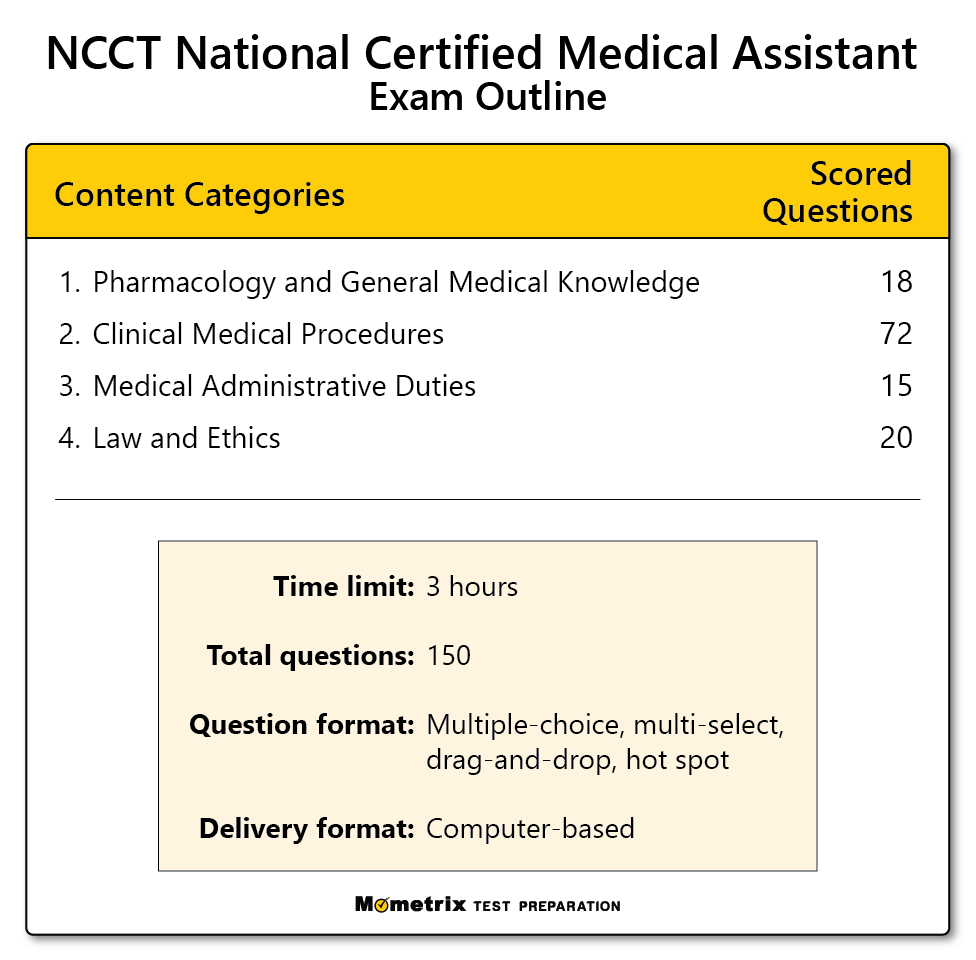
1. Pharmacology and General Medical Knowledge (18 scored questions)
The questions in this category are designed to test your knowledge and skills in the following areas:
- Applying basic knowledge of anatomy and physiology
- Recognizing and interpreting commonly used medical terminology
- Recognizing common drug classifications
- Identifying commonly used medications by generic and brand names
- Understanding the “Rights” of medication use
- Consulting pharmaceutical desk references to check medications
- Performing basic medication-related calculations
- Preparing and administering medication using various routes
2. Clinical Medical Procedures (72 scored questions)
The questions in this category are designed to test your knowledge and skills in the following areas:
- Following CDC Standard Precautions and transmission precautions
- Implementing disinfection, cleansing, and sterilization of exam rooms
- Following patient isolation procedures
- Practicing safe patient handling and transfer procedures
- Handling and disposing of chemicals
- Practicing safe body mechanics and ergonomics to prevent injuries
- Responding to emergency situations
- Using PPE
- Following post-exposure guidelines
- Identifying the patient
- Adapting care to patients with special considerations
- Taking a patient history
- Obtaining patient vital signs
- Assisting with minor surgical procedures
- Recognizing and reporting abnormal screening results
- Performing ear lavages and eye irrigations
- Collecting specimen cultures
- Performing vision screening tests
- Assisting with respiratory tests
- Performing suture and staple removal
- Instructing patients in specimen collection
- Adhering to standards for patient introduction, identification, and order verification
- Identifying additives used for blood collection
- Performing capillary punctures
- Performing venipunctures
- Recognizing and responding to complications during blood collection
- Labeling specimens appropriately
- Handling laboratory specimens per protocol
- Following the correct order of draw for blood collection
- Explaining the ECG procedure to the patient
- Correcting artifacts and recording errors
- Placing electrodes on the patient for the ECG test
- Adapting technique to patients with special considerations
- Capturing and recording ECG tracings
3. Medical Administrative Duties (15 scored questions)
The questions in this category are designed to test your knowledge and skills in the following areas:
- Directing patients and visitors to the appropriate team member or location
- Setting up and managing appointments using scheduling techniques
- Using peripheral devices
- Managing prior authorizations and pre-certifications
- Maintaining electronic medical office data
- Managing medical office electronic data using devices other than computers
- Using ICD codes to bill for services
- Answering, evaluating, and directing incoming calls to team members
4. Law and Ethics (20 scored questions)
The questions in this category are designed to test your knowledge and skills in the following areas:
- Recognizing legal responsibilities and the scope of practice for the medical assistant
- Adhering to advance directives
- Following the protocol on terminating patient care
- Making corrections and additions to medical records per state and federal guidelines
- Obtaining patient consent for exams and treatment
- Maintaining confidentiality and complying with disclosure laws
- Recognizing and responding to violations of medical law
- Complying with CLIA, OSHA, and DEA guidelines
Check Out Mometrix's National Certified Medical Assistant Study Guide
Get practice questions, video tutorials, and detailed study lessons.
Top 3 Most Challenging NCMA Questions
Now that you know more about the test, try your hand at some targeted practice!
Over the last year, we've compiled the data from about 3,000 test-takers who tried their hand at the practice test at the top of this page. According to the data, around 70% of people answered these three questions incorrectly.
Answer each question and read through the answer explanation, whether you got the answer right or wrong. This will help you ensure you've got the topic mastered.
Whether you struggled with these questions or aced them on your first try, be sure to take the full practice test to get a better idea of how prepared you really are!
1. Which of the following describes the correct sizing of crutches for a patient?

2. A patient is anxious and begins hyperventilating. His hands and lips start to feel numb and tingly, and he feels lightheaded. What is the physiological cause of his symptoms?
3. Which of the following statements about ECG chest lead placement is TRUE?
Registration
To register for the exam, you must create an online NCCT account and submit an application, along with the necessary documentation to prove your eligibility. You will also need to pay the $119 exam fee.
Once your application is approved, NCCT will confirm your approved test date, location or delivery method, and testing instructions.
Test Day
On the day of the exam, you should arrive at the testing center at least 15 minutes prior to the scheduled time. Bring a valid, government-issued, nonmilitary photo ID with a name that matches your application. Current high school students who do not have a government-issued ID may use their current school ID. Have your NCCT username and password available so you can log in for testing.
Before you enter the testing room, you will be asked to store any personal items. Once checked in, follow the proctor’s directions to begin your exam.
Scoring
NCCT uses a criterion-referenced standard-setting process to establish the passing point for its certification exams. This means candidates are measured against a predetermined standard rather than graded on a curve or compared with other candidates. The passing score is based on difficulty ratings established by a panel of qualified subject-matter experts and approved by the NCCT Board of Testing.
Your NCMA exam score is based on a scaled scoring method, which places your raw score (the number of questions you answered correctly) on a numerical scale of 200 to 720. To pass the exam, you must achieve a scaled score of at least 575.
Your examination results are provided immediately after testing. You can also access your results by logging into your NCCT account.
Check Out Mometrix's National Certified Medical Assistant Flashcards
Get complex subjects broken down into easily understandable concepts.
How to Prepare
Start with a NCMA Practice Test
Before creating your study schedule, take a NCMA practice test to establish a starting point. You don't need to wait until you have reviewed every medication, clinical procedure, administrative task, and legal requirement. At this stage, the goal is to identify where your preparation time will have the greatest effect.
Review your results by section:
- Pharmacology and General Medical Knowledge: Can you recognize common drug classes and medications, understand medication-administration rights, complete basic medication calculations, prepare medications for different routes, and recognize signs and symptoms of common medical conditions?
- Clinical Medical Procedures: Can you apply infection-control and safety procedures, complete patient intake and care, perform phlebotomy procedures, and prepare for and obtain ECGs?
- Medical Administrative Duties: Can you appropriately direct patients and telephone calls, schedule appointments, manage electronic medical information, use common office technology, and handle prior authorizations?
- Law and Ethics: Do you understand scope of practice, advance directives, confidentiality, medical records, consent, ethical responsibilities, reportable conditions, OSHA, CLIA, and relevant medication regulations?
Identifying those specific weaknesses will show you where to devote more attention during your study time.
Review Difficult Questions
After each practice session, review every question you answered incorrectly AND every question you guessed on or answered with low confidence. A correct guess doesn't demonstrate that you could perform the task safely and accurately in a medical office.
For each difficult question, determine which of the following caused the problem:
- You confused two medications or drug classes.
- You selected the wrong medication-administration route or procedure.
- You made a dosage or measurement-conversion error.
- You knew a clinical procedure but completed its steps in the wrong order.
- You overlooked a patient-identification or safety requirement.
- You failed to identify the cause of an ECG artifact.
- You overlooked a significant patient-history or vital-sign finding.
- You selected an action outside the medical assistant's role.
- You applied the wrong legal or ethical requirement.
- You knew the material but did not recognize how it applied to the scenario.
- You spent too long on one question and rushed later questions.
Then, outline a specific plan for improvement based on what you discovered. In other words, don't just say, “I need to study clinical procedures.” Specify that you need to practice the venipuncture sequence from patient identification through specimen labeling.
Similarly, replace “study law” with a specific task such as distinguishing implied from informed consent, reviewing proper corrections to medical records, or identifying situations involving mandatory reporting.
Utilize Answer Explanations
Answer explanations are an underutilized studying resource. To take full advantage of them, read the explanation for every question you found difficult, including questions you answered correctly.
For each one, make sure you can confidently explain:
- Why the correct answer is correct
- Why each incorrect option is wrong
- Which medical-assisting skill or principle is being tested
- Which information in the scenario controls the answer
- What the medical assistant should do and why
- How the same concept could appear in a different patient situation
For clinical-procedure questions, reconstruct the entire process rather than memorizing one isolated step.
For administrative questions, don't just memorize coding systems as unrelated acronyms. Understand that:
- ICD codes identify diagnoses and conditions.
- CPT codes describe professional procedures and services.
- HCPCS codes are used for additional healthcare procedures, supplies, equipment, and services.
Study Clinical Workflows, Not Individual Questions
Memorizing the answer to one NCMA question will not prepare you for a new patient with different symptoms, vital signs, medications, laboratory orders, or clinical needs. Instead, learn how medical-assisting responsibilities fit together.
For a typical patient encounter, practice thinking through the workflow:
- Confirm the patient's identity.
- Determine the reason for the visit.
- Review and update relevant medical information.
- Obtain required vital signs and measurements.
- Recognize findings that require attention.
- Prepare the patient and examination area.
- Assist with the ordered examination or procedure.
- Complete laboratory, medication, ECG, or other clinical tasks as appropriate.
- Provide permitted patient instructions.
- Document the encounter accurately.
- Direct significant findings or questions to the appropriate healthcare professional.
- Complete necessary follow-up or administrative tasks.
A procedure is not mastered until you can explain what happens before, during, and after it and recognize what should change when the patient or circumstances change.
FAQs
Q
How many questions are on the NCCT NCMA exam?
A
There are 150 questions on the exam.
Q
How long is the NCCT NCMA exam?
A
The time limit for the exam is 3 hours.
Q
What is the passing score for the NCCT NCMA exam?
A
To pass the exam, you must achieve a scaled score of at least 575.
Q
How much does the NCCT NCMA exam cost?
A
The examination fee is $119.


NCMA and NCCT are registered trademarks of Training and Educational Services, Inc., which is not affiliated with Mometrix Test Preparation and does not endorse this page.