The National Association for Healthcare Quality (NAHQ) administers the Certified Professional in Healthcare Quality® (CPHQ®) exam to assess test-takers’ knowledge of healthcare quality practices and competencies.
Our free CPHQ practice test contains a comprehensive view of what you can expect to see on test day. Click “Start Test” above to get started!
Eligibility
There are no set-in-stone eligibility requirements for the CPHQ exam, but you should keep in mind that the exam is not designed to test candidates at the entry level. Generally, you will need about 2 years of experience with the knowledge and skills that a healthcare quality professional needs to have. If you do not have 2 years of experience under your belt, review the exam outline to see if you’re prepared to take the exam.
CPHQ Exam Outline
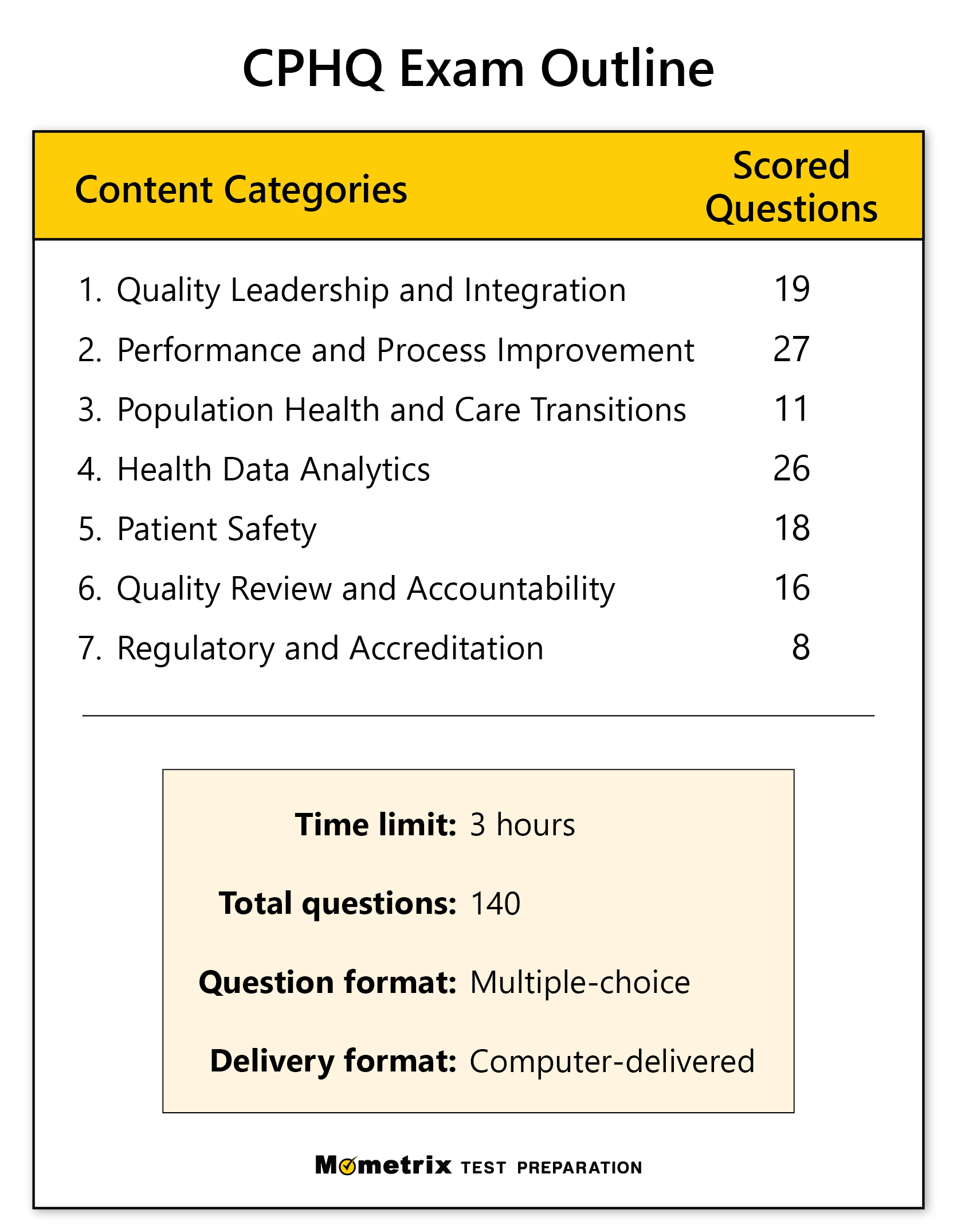
The CPHQ exam consists of 125 scored multiple-choice questions and 15 non-scored multiple-choice questions. The non-scored questions are trial questions that help determine the questions that appear in a future exam. You will have 3 hours to complete the computer-based test.
There are three types of questions you will encounter on the exam:
- Recall (23%)
- Application (57%)
- Analysis (20%)
The recall questions cover specific facts and concepts that you need to know, the application questions test your ability to interpret and apply information to certain situations, and the analysis questions ask you to evaluate, integrate, and solve various pieces of information.
The exam itself is split into seven sections:
- Quality Leadership and Integration (19 scored questions)
- Performance and Process Improvement (27 scored questions)
- Population Health and Care Transitions (11 scored questions)
- Health Data Analytics (26 scored questions)
- Patient Safety (18 scored questions)
- Quality Review and Accountability (16 scored questions)
- Regulatory and Accreditation (8 scored questions)
Check out Mometrix's CPHQ Study Guide!
Get practice questions, video tutorials, and detailed study lessons.
Registration
Application and Payment
There are two methods available for registration. If you are using a credit card, you must complete the application process on the NAHQ website, where you will be asked to create an account and continue with the enrollment process.
The US examination fee varies depending on membership status:
- Non-members: $714
- Standard members: $500
- Premium members: $357
- CPHQ members: $500
- Student members: $500
If you are using a check, you will need to fill out an application form and mail it to NAHQ, along with your check and the $25 processing fee.
Scheduling
Once NAHQ has received your application and payment, you can schedule your exam. You can make an appointment online, or you can schedule over the phone with PSI at 877-714-5686.
US candidates generally have 90 days to schedule and take the exam after paying online or after NAHQ processes a mailed application. International candidates must test during the window they applied for.
Test Day
There are two options available regarding how you take the exam: in-person or online.
In-person Testing
You will need to arrive at the testing center no later than your scheduled exam time. If you arrive more than 15 minutes late, you’ll be denied admission, forfeit your exam fee, and need to submit a new application and pay again.
When you arrive, you will be asked to provide two means of identification with your name and signature (one must be a photo ID). After the check-in process is complete, follow the testing center’s instructions for storing permitted personal items. You will not be allowed to bring any documents with you into the testing room.
Before you begin the exam, you will be given a practice test on the equipment that will be used for the actual exam. This will help you become familiar with the computer and overall format of the exam. Once you are ready, you may close the practice exam and begin the actual exam, at which point the 3-hour time limit will begin to take effect.
Online Testing
To be eligible to take the exam remotely, you must have a computer that has both webcam and microphone capabilities, which you should test before your exam date.
On the day of the exam, it is recommended that you launch through the NAHQ test portal 30 minutes early. Upon launching the exam, you will be asked to provide two means of identification, one of which must be a photo ID.
Before your exam begins, ensure that the space around you is free of all personal items, including your cell phone, food, headphones, sticky notes, plants, books, and drink coasters. You are allowed to have one clear glass of water, which you will need to show to the exam proctor before you begin.
Before you begin the exam, you will be given a practice test that emulates the real exam. This will help you become familiar with the format of the exam. Once you are ready, you may close the practice exam and begin the actual exam, at which point the 3-hour time limit will begin to take effect.
Check out Mometrix's CPHQ Flashcards!
Get complex subjects broken down into easily understandable concepts.
Passing Score
To pass the exam, you need a minimum scaled score of 600.
US candidates receive an unofficial score report after testing. International candidates can access their results in their PSI account approximately 8–12 weeks after the testing window closes.

CPHQ Online Prep Course
If you want to be fully prepared, Mometrix offers an online CPHQ prep course designed to give you everything you need to succeed!
Here's what you'll find in the CPHQ course:
- 50+ Review Lessons Covering Every Topic
- Over 950 CPHQ Practice Questions
- 500+ Digital Flashcards
- Money-back Guarantee
- Mobile Access
Everyone learns differently, so we've tailored the CPHQ online prep course to ensure every learner has what they need to prepare for the CPHQ exam.
Click below to check it out!
Study Tips
Start with a CPHQ Practice Test
Before creating your study schedule, take a CPHQ practice test to establish a starting point. You don't need to wait until you have reviewed every quality tool, statistical method, patient safety principle, or accreditation requirement. At this stage, the goal is to identify where your preparation time will have the greatest effect.
Review your results across the seven content areas:
- Quality Leadership and Integration: Can you connect quality and safety activities to strategic goals, engage stakeholders, establish priorities, and support an organization's quality infrastructure?
- Performance and Process Improvement: Can you identify improvement opportunities, select appropriate methods and tools, facilitate change, work with teams, and evaluate whether an intervention succeeded?
- Population Health and Care Transitions: Can you use population data, address disparities and social determinants of health, and identify opportunities to improve care processes and transitions?
- Health Data Analytics: Can you design measures, collect and validate data, select appropriate displays and statistical methods, interpret variation, and use results to support decisions?
- Patient Safety: Can you apply systems thinking, human factors, high-reliability principles, event reporting, root cause analysis, and proactive risk assessment?
- Quality Review and Accountability: Can you apply standards and best practices, evaluate performance and documentation, assess patient experience, and connect quality initiatives to accountability and reimbursement?
- Regulatory and Accreditation: Can you evaluate accreditation options, apply regulatory requirements, monitor compliance, and maintain survey readiness?
Identifying those specific weaknesses will show you where to devote more attention during your study time.
Review Difficult Questions
After each practice session, review every question you answered incorrectly AND every question you guessed on or answered with low confidence.
For each difficult question, determine which of the following caused the problem:
- You recognized a quality tool but didn't know when it should be used.
- You selected an improvement method before clearly defining the problem.
- You confused structure, process, outcome, and experience measures.
- You interpreted variation or a data display incorrectly.
- You focused on an individual's mistake instead of the system factors that contributed to it.
- You confused retrospective event analysis with proactive risk assessment.
- You chose an action that made sense in your workplace but wasn't the best general quality-management approach.
- You identified an improvement opportunity but didn't consider how success should be measured.
Then, outline a specific plan for improvement based on what you discovered. In other words, don't just say, “I need to study quality improvement.” Note that you need to practice distinguishing when a process map, fishbone diagram, PDSA cycle, or FMEA would be appropriate.
Similarly, replace “study statistics” with something specific, such as distinguishing common-cause from special-cause variation on a control chart.
Utilize Answer Explanations
Answer explanations are an underutilized studying resource. To take full advantage of them, read the explanation for every question you found difficult, including questions you answered correctly.
For each one, make sure you can confidently explain:
- Why the correct answer is correct
- Why each incorrect answer is less appropriate
- What quality, safety, data, or regulatory principle is being tested
- Which information in the scenario controls the answer
- What the quality professional should do next
- How the same principle could appear in another healthcare setting
For improvement questions, identify the problem first and then determine where the team is in the improvement process. A question about identifying causes requires a different tool than one about testing a change or evaluating whether the change worked.
For data questions, don't stop after recognizing a chart or statistical term. Determine what the data actually show and what conclusion or action the evidence supports.
Match the Quality Tool to the Problem
Don't memorize Lean, Six Sigma, PDSA, FMEA, process maps, fishbone diagrams, and other quality tools as isolated definitions. Know what problem each tool helps solve and where it belongs in an improvement effort.
Use this process:
Problem → Measure Current Performance → Analyze Causes → Select Intervention → Implement → Evaluate → Sustain
For example, a process map can help reveal how work currently flows, while a fishbone diagram can organize possible causes of a problem. FMEA is useful for identifying potential failures before harm occurs, while root cause analysis examines factors contributing to an event that has already occurred.
FAQs
Is the exam all multiple-choice?
Yes, all 140 questions on the CPHQ exam are multiple-choice.
How long do you have to take the exam?
You are allotted three hours to take the CPHQ exam.
What is the pass rate for the CPHQ exam?
NAHQ reported a 2024 CPHQ pass rate of 65% among US-based candidates and 53% worldwide.
What is a passing score?
The scaled score you need to pass the exam is 600.


CPHQ and Certified Professional in Healthcare Quality are registered trademarks of National Association for Healthcare Quality, which is not affiliated with Mometrix Test Preparation and does not endorse this page.


