The Certified Medical Assistant® (CMA) exam, provided by the American Association of Medical Assistants (AAMA), allows candidates to become certified as a medical assistant in the United States. This is an occupation that is expected to have an employment rate increase of 12% by 2034.
Click “Start Test” above to take a free CMA practice test!
Exam Eligibility
To be eligible to sit for the CMA exam, you must be in one of the following three categories:
Category 2: You must be a non-recent (greater than 12 months since graduation) graduate of an accredited medical assisting program. To be eligible under this category, you must submit an official transcript from an accredited medical assisting program.
Category 3: This category is for those wishing to recertify their CMA credential. As you would expect, you must have taken and passed the CMA previously to be eligible under this category, so you must provide your CMA (AAMA) certificate number and the most recent certification or recertification date on the application.

Medical Assistant Test Outline
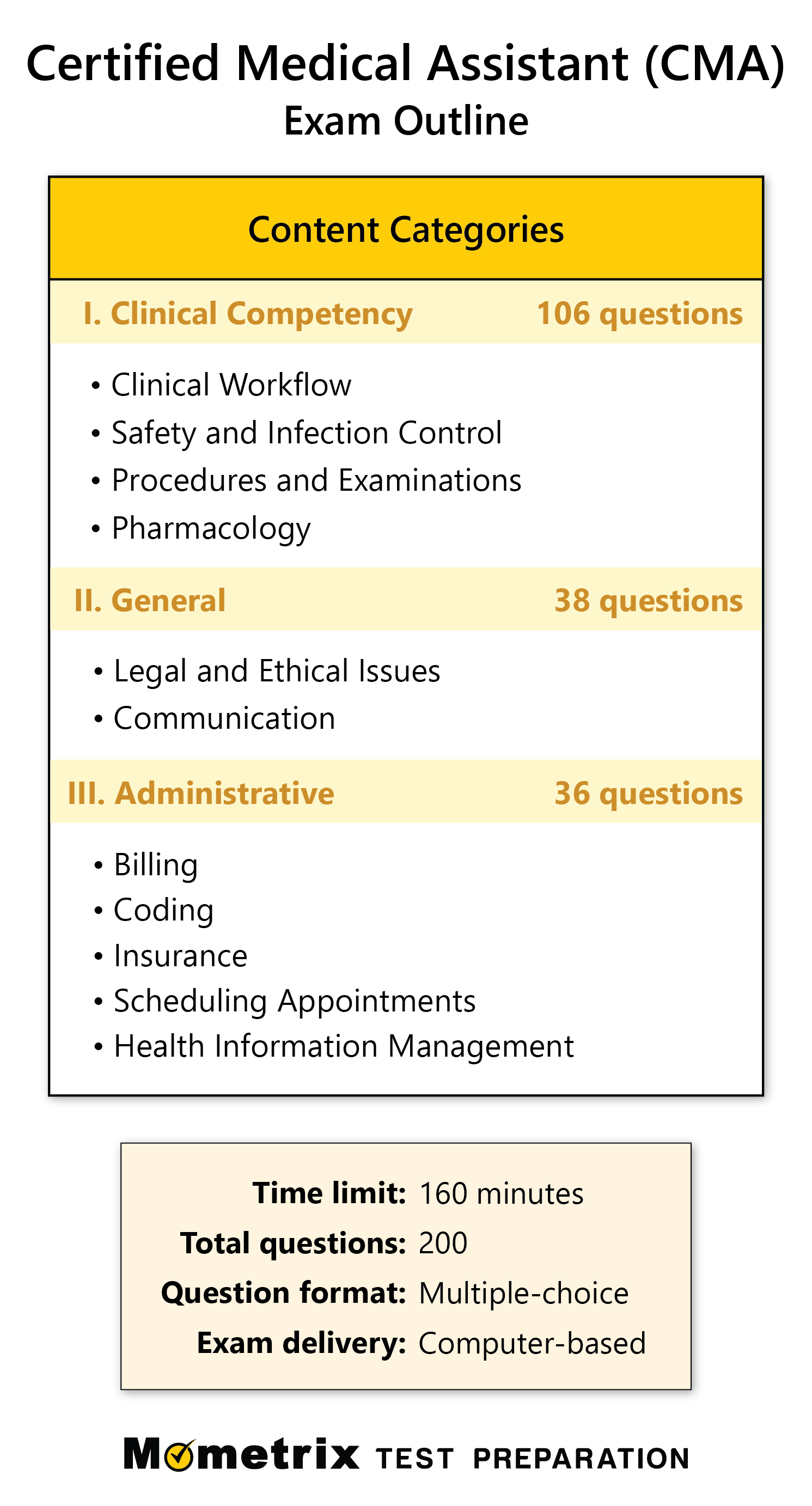
The CMA exam consists of 200 multiple-choice questions, 20 of which will not count toward your score. The exam is administered in four 40-minute segments, with optional breaks between each segment.
The questions are split into three content categories:
I. Clinical Competency (106 questions)
The Clinical Competency category is the largest on the exam, taking up 59% of the questions. These are the topics that will be covered in this category:
A. Clinical Workflow
- Vital Signs
- Medical Terminology
- Interviewing Techniques
- Documentation of Care
- Patient Screenings and Wellness Assessments
- Processing Provider Orders
B. Safety and Infection Control
- Infectious Agents
- Infection Cycle
- Modes of Infectious Transmission
- Standard Precautions and Exposure Control
- Medical Asepsis
- Biohazard Disposal and Regulated Waste
- Safety Resources
- Safety and Emergency Procedures
- Emergency Management, Identification, and Response
- Basic First Aid
- Body Mechanics/Ergonomics
- Risk Management and Quality Assurance
C. Procedures and Examinations
- Preparing Patients for Examinations, Procedures, and Treatments
- Supplies, Equipment, Techniques, and Patient Instruction
- Surgical Assisting
- Wound Care
- Instruments
- Anatomy and Physiology
- Specimen Collection Techniques
- Prepare, Process, and Examine Specimens
- Laboratory Quality Control and Quality Assurance
- Clinical Laboratory Improvement Act (CLIA) Requirements
- Laboratory Panels and Selected Tests
D. Pharmacology
- Medications
- Preparing and Administering Oral and Parenteral Medications
- Immunization Resources
II. General (38 questions)
The General category contains 38 questions, taking up 21% of the questions. These are the topics that will be covered in this category:
E. Legal and Ethical Issues
- HIPAA
- Protected Health Information (PHI)
- Consent
- Federal and State Regulations
- Pharmaceutical Laws
- Mandatory Reporting and Public Health Statutes
- Ethical Standards
- Medical Directives
F. Communication
- Interpersonal Relationship Skills
- Customer Service
- Therapeutic and Adaptive Responses
- Learning Styles
- Health Care Team Roles
- Professional Telephone Etiquette and Techniques
III. Administrative (36 questions)
The Administrative category contains 36 questions, taking up 20% of the questions. These are the topics that will be covered in this category:
G. Billing, Coding, and Insurance
- Coding Applications
- Insurance Fraud and/or Abuse
- Coverage for Patient Services and Waivers
- Insurance Types
- Authorizations and Resources
- Financial Terminology
- Patient Account Financial Procedures
- Financial Calculations
- Billing and Collections
H. Scheduling Appointments and Health Information Management
- Scheduling Appointments
- Medical Reception
- Patient Registration
- Electronic Health Records
Check Out Mometrix's CMA Study Guide
Get practice questions, video tutorials, and detailed study lessons.
Top 5 Most Challenging CMA Questions
Now that you know more about the test, try your hand at some targeted practice!
Over the last year, we’ve compiled the data from about 5,000 test-takers who tried their hand at the practice test at the top of this page. According to the data, around 70% of people answered these five questions incorrectly.
Answer each question and read through the answer explanation, whether you got the answer right or wrong. This will help you ensure you’ve got the topic mastered.
Whether you struggled with these questions or aced them on your first try, be sure to take the full practice test to get a better idea of how prepared you really are!
1. A woman’s serum beta hCG is 52 mIU/mL three days after her expected menses. Two days later it is rechecked, and the result is 85 mIU/mL. What can be said about the status of this pregnancy?
2. Which of the following reflects a PR interval seen with first degree heart block?
3. Which of the following laboratory values evaluates blood viscosity?

4. Which of the following should receive the MMR vaccination?
5. Which of the following is NOT a function of the Centers for Disease Control and Prevention (CDC)?
Registration
Before you can register for the exam, you must obtain an exam scheduling permit. To obtain your permit, you must submit the required documentation and candidate fee. The fee is payable by money order, credit or debit card, cashier’s/certified check or institution check only.
Five to 10 days after you submit your application, you will receive an email. If you were successful in submitting all required documentation and the candidate fee, your 90-day testing period will be assigned and the availability of your exam Scheduling Permit will be included. Failure to respond to an “incomplete” status could void your application which would require you to reapply and pay the candidate fee again.
You must schedule your exam directly through their online registration site or by calling the number listed on your scheduling permit. Test dates, times, and locations are on a first-come-first-served basis, so make an effort to schedule your exam as soon as possible so you can obtain your preferred test time and location.
Fees
The exam fees are as follows:
- Category 1: $125
- Category 2: $125 for AAMA members and $250 for nonmembers
- Category 3: $125 for AAMA members and $250 for nonmembers
Test Day
You should arrive at the test center at least 30 minutes before your scheduled test time. If you arrive late, you may not be admitted. You will be asked to present the required identification, sign the test center log, have your photograph taken, and store all personal items in an assigned locker (it is recommended that you leave all personal items in your car or at home as the lockers are small).
Test center staff will take your scheduling permit and escort you to your assigned station. You will be instructed on the use of the computer equipment and provided dry-erase markers and an eraser. You are allowed no other supplies. A dry-erase marker and eraser are the only supplies you will be given.
Once you enter the testing center and take your seat, you will not be allowed to talk to any other test-taker, and you will be allowed breaks only at the designated break time. Failure to follow the test center rules could result in the cancellation of your test and your candidate fee forfeited.
How the CMA Exam is Scored
Your score is a result of the number of correct responses on the examination, and will fall in a range of 200-800. The minimum score you need to pass the CMA exam is 405.
At the conclusion of your exam, you will receive an official pass/fail notification. Your official score report is emailed and posted to your AAMA account about 24 hours after the exam.
The exam report will include your percentile rank in the three content areas to help you identify your areas of strength and weakness. If you pass and all requirements are verified, you are awarded the CMA (AAMA) credential and receive a digital badge.
Check Out Mometrix's CMA Flashcards
Get complex subjects broken down into easily understandable concepts.
How to Pass
Start with a CMA Practice Test
Before creating your study schedule, take a CMA practice test to establish a starting point. You don’t need to wait until you have reviewed every medical term, procedure, medication, and administrative rule. At this stage, the goal is to identify where your preparation time will have the greatest effect.
Review your results by section:
- Clinical Competency: Can you complete patient intake and discharge tasks, measure and recognize vital signs, maintain infection control, prepare patients for examinations, assist with procedures, collect and process specimens, understand anatomy and physiology, and apply medication-safety principles?
- General Knowledge: Can you apply legal and ethical requirements, protect patient information, obtain appropriate consent, recognize mandatory-reporting situations, communicate therapeutically, and respond appropriately to different patient needs?
- Administrative Knowledge: Can you schedule appointments, manage health information, apply basic coding and billing principles, verify insurance coverage, process claims, and maintain accurate medical records?
You should also examine narrower weaknesses within each category. For example:
- Do you know how to measure blood pressure but struggle to identify an abnormal result?
- Can you identify laboratory equipment but not the correct order of specimen-processing steps?
- Do you recognize a medication but confuse its route, contraindications, or adverse effects?
- Can you identify an insurance form but not the action required after a claim rejection?
Identifying those specific weaknesses will show you what to study instead of repeatedly reviewing material you already understand.
Review Difficult Questions
After each practice session, review every question you answered incorrectly AND every question you guessed on or answered with low confidence. Guessing correctly does not necessarily mean that you have mastered the skill.
For each difficult question, determine which of the following caused the problem:
- You did not understand the medical terminology, anatomy, or physiology.
- You knew the procedure but completed the steps in the wrong order.
- You overlooked an infection-control or patient-safety requirement.
- You selected an action outside the medical assistant’s role.
- You failed to identify information that should be documented or reported.
- You confused two medications, routes, dosages, or adverse effects.
- You made a dosage-calculation or metric-conversion error.
- You misunderstood a legal or ethical requirement.
- You confused coding, insurance, scheduling, or record-management procedures.
- You understood the topic but spent too long reaching an answer.
- You changed a sound answer without identifying evidence that it was wrong.
Then, outline a specific plan for improvement based on what you discovered. In other words, don’t just say, “I need to study clinical procedures.” Specify that you need to practice maintaining a sterile field, selecting the correct patient position, or identifying the proper order of venipuncture tubes.
Similarly, replace “review administrative duties” with a precise goal such as distinguishing an explanation of benefits from a remittance advice, understanding the purpose of an Advance Beneficiary Notice, or reviewing how rejected claims are handled.
Utilize Answer Explanations
Answer explanations are an underutilized studying resource. To take full advantage of them, read the explanation for every question you found difficult, including questions you answered correctly.
For each one, make sure you can confidently explain:
- Why the correct answer is correct
- Why each incorrect option is wrong
- What medical-assisting responsibility or principle is being tested
- Which information in the question supports the answer
- How the action protects the patient, maintains compliance, or supports accurate care
- How the same concept could appear in a different scenario
For clinical questions, do not stop after identifying the correct procedure. Reconstruct the complete process. For vital-sign and laboratory questions, determine whether the result is normal, abnormal, or potentially urgent. Then identify what the medical assistant should record, repeat, or report.
For legal and ethical questions, identify the exact principle involved. Determine whether the scenario concerns privacy, release of information, informed consent, negligence, abandonment, assault, battery, mandatory reporting, controlled substances, advance directives, or another requirement.
Study Concepts, Not Individual Questions
Memorizing the answer to one CMA practice question will not prepare you for a different patient, procedure, medication, or office situation. Your goal should be to understand the process behind the answer and apply it when the details change.
For example, learn how a requested test, tube additive, collection order, labeling requirements, handling instructions, and possible contamination affect specimen collection.
Similarly, learn how to listen to an upset patient, clarify the concern, maintain professional boundaries, attempt appropriate service recovery, and determine when another healthcare team member should become involved.
The exact questions on your test will be different from the ones you encounter during practice. If you can explain a skill without looking at your notes and then apply it correctly to a new question, that is a good indication that you have mastered it.
Certified Medical Assistant Online Prep Course
If you want to be fully prepared, Mometrix offers an online CMA prep course designed to give you everything you need to succeed!
Here’s what you’ll find in the CMA course:
- 70+ Review Lessons Covering Every Topic
- Over 1,450 CMA Practice Questions
- 350+ Digital Flashcards
- 30+ Instructional Videos
- Money-back Guarantee
- Mobile Access
Everyone learns differently, so we’ve tailored the CMA online prep course to ensure every learner has what they need to prepare for the Certified Medical Assistant exam.
Click below to check it out!
FAQs
Q
How hard is the CMA exam?
A
The CMA exam has a pass rate of 69%, so it is considered a moderate-to-easy exam if an adequate amount of studying and preparation has been done.
Q
How many questions are on the CMA exam?
A
There are 200 questions on the exam.
Q
How long is the CMA exam?
A
The time limit for the exam is 160 minutes, which is just over 2.5 hours.
Q
How much is the CMA exam?
A
The CMA exam costs $125 for AAMA members and $250 for non-members.
Q
What is a passing score for the CMA exam?
A
To pass the exam, you will need a minimum score of 405.


Certified Medical Assistant is a registered trademark of American Association of Medical Assistants, which is not affiliated with Mometrix Test Preparation and does not endorse this page.