The Certified Arborist® exam is administered by the International Society of Arboriculture (ISA) to assess your knowledge and skills in the field of arboriculture.
Click “Start Test” above to take a free Certified Arborist practice test!
Exam Eligibility
In order to apply to become a Certified Arborist, you must fulfill at least one of the following requirements:
You must have at least three years of full-time experience in arboriculture. Some of the many eligible duties include cabling and bracing, fertilization, pruning, and the diagnosis and treatment of tree problems. Example employers include municipalities, landscape companies, tree care companies, and nurseries.
You can submit supervised volunteer work, as long as you can provide documentation showing the hours worked and responsibilities. To validate work experience, you must submit a letter of reference from previous or current employers. If you are self-employed, you must submit three letters of reference.
Education
You may fulfill the eligibility requirements by completing a university-accredited degree program with additional practical experience in arboriculture or by completing an assessment-based certificate program.
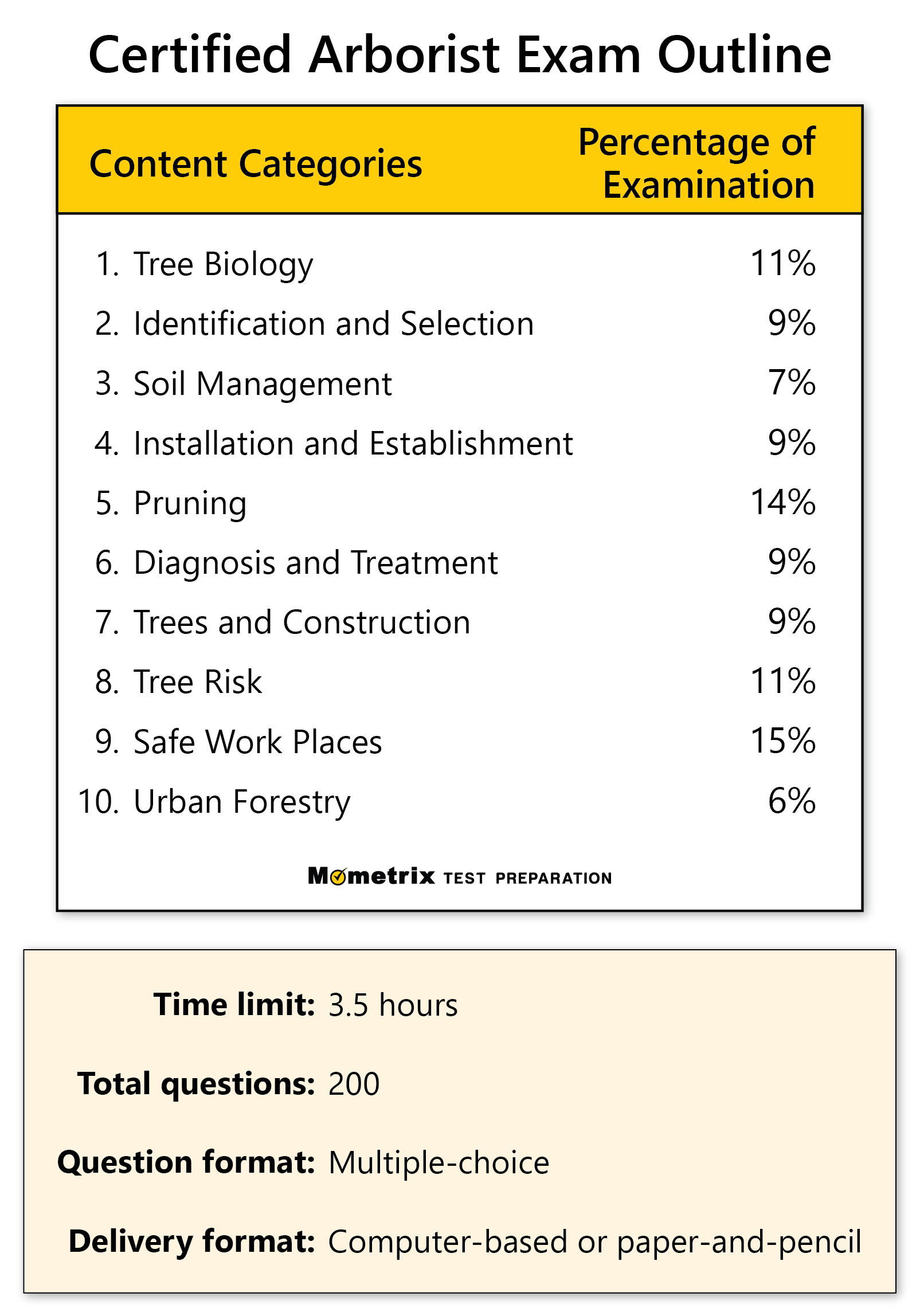
Certified Arborist Exam Outline
The Certified Arborist exam contains 200 multiple-choice questions, and you will have 3.5 hours to complete the exam.
The questions are split into ten domains. Each domain contains multiple tasks, and each task contains a set of knowledge-based and skills-based areas.
1. Tree Biology (11%)
TASK A:
Recommend and specify tree work based on knowledge of tree anatomy, biomechanics, and physiology.
Knowledge
- Anatomy and functions of roots, trunks, leaves, twigs, and branches
- Photosynthesis
- Respiration
- Energy allocation and storage within a tree
- Tree profiles
- Tree identification
- Mechanical stress and response growth
- Growth habits and stages
- Water movement within the tree
- Morphophysiology
Skills
- Identifying trees
- Making management and maintenance recommendations based on structural and physiological needs
- Making management and maintenance recommendations based on the developmental stage of the tree
TASK B:
Explain the life cycle of a tree and develop tree work recommendations based on developmental needs and tree growth.
Knowledge
- Vegetative growth
- Tree death
- Phenology
- Environmental effects and responses
- Propagation
- Reproduction
Skills
- Developing maintenance recommendations based on condition and life cycle
2. Tree Identification and Selection (9%)
TASK A:
Describe the importance of proper tree identification when it comes to tree management.
Knowledge
- The relationship among tree species characteristics, accurate tree identification, and problem diagnosis
Skills
- Using tree identification reference materials
- Using tree identification systems
TASK B:
Explain tree classification systems and utilize appropriate nomenclature during tree identification and communication.
Knowledge
- General tree classification
Skills
- Using and notating plant-specific names in communication and report writing
TASK C:
Describe important physical and morphological structures used in the identification of tree species.
Knowledge
- Leaf anatomy, types, arrangements, and characteristics
- Root, branch, twig, and trunk anatomy
- Tropical and desert tree characteristics
- Fruits
- Seeds and seedpods
- Flower and inflorescence types
- Tree profiles
Skills
- Collecting tree samples that aid in identification of the tree
- Recognizing notable features in key anatomical structures
- Utilizing available tree identification resources and tools
TASK D:
Select trees appropriate for a given planting site and project needs, taking into consideration short-term and long-term requirements and maintenance goals.
Knowledge
- Tree species characteristics
- Considerations and potential vulnerabilities of specific species
Skills
- Collecting and analyzing soil samples
- Assessing site characteristics
- Selecting a tree species that will thrive at a given site
- Recommending tree species for the planting site
- Communicating tree requirements and site considerations
- Making recommendations based on tree requirements and site considerations
3. Soil Management (7%)
TASK A:
Assess the chemical, biological, and physical components of soil and its relationship in supporting tree development and growth.
Knowledge
- Industry standards for soil management
- Biological components of soil
- Chemical characteristics of soil
- Physical characteristics of soil
- Soil formation and horizons
- Relationship between root distribution and soil
- Soil sampling methods
- Urban soils
Skills
- Collecting and testing soil samples
- Interpreting test results
- Analyzing soil characteristics
TASK B:
Explain the interaction between soil and water and how it affects tree growth and development, list management options when needed, and assess site conditions.
Knowledge
- Water movement and drainage
- Supplemental water systems
- Water budgets
- Soil structure
- Water behavior in soil
- Local climatic conditions affecting availability and uptake of water from soil
- Relationship among soil characteristics, water, and drainage
Skills
- Assessing water-holding capacity and drainage
- Recommending methods for effective water management
TASK C:
Identify soil volume, structure, and nutrition requirements and recommend mitigation strategies when needed.
Knowledge
- Soil management and amendments
- Types of fertilizer
- Tree nutritional and uptake requirements
- Fertilization application timing and techniques
- Soil volume and structure requirements for trees
Skills
- Recommending soil management and development strategies to support tree growth and development in urban areas
- Recommending and applying fertilizer on a needs basis, according to applicable industry standards
- Identifying soil improvement and remediation strategies
4. Installation and Establishment (9%)
TASK A:
Plant and transplant trees according to industry standards.
Knowledge
- How the nursery industry propagates and grows trees
- Advantages and disadvantages of different nursery stock types
- Industry-standard planting and transplanting practices
- Planting timing
- Backfilling
- Root ball interaction with soil and planting hole
- Proper tree placement
- Impact of soil amendments
Skills
- Assessing the quality and health of planting stock
- Pruning roots and shaving root balls to prevent girdling
- Transplanting trees
- Handling planting stock
- Removing root ball package materials
- Preparing the planting site
- Backfilling and adding soil to support tree establishment
TASK B:
Provide care for newly planted trees to ensure growth, good structure, and survival.
Knowledge
- Tree species characteristics
- Trunk wrap and support systems
- Environmental and cultural requirements for different tree species
Skills
- Determining watering requirements
- Selecting and applying mulch
- Recognizing inappropriate planting techniques
- Pruning young trees for good structure
- Installing support for newly planted trees
- Recommending plant health care plans
- Including and engaging local stakeholders to ensure long-term maintenance
5. Pruning (14%)
TASK A:
Explain why pruning is undertaken and list the main industry-standard pruning systems, types of cuts, general practices, and objectives.
Knowledge
- Pruning practices and considerations in relation to optimal timing and quantity
- Pruning objectives
- Accepted industry standards for tree pruning
- Wound response
- Outcomes of tree pruning
Skills
- Communicating how tree pruning promotes good structure
- Assessing site and tree conditions that influence pruning decisions
- Explaining the difference between unacceptable and acceptable pruning techniques to a lay audience
TASK B:
List commonly used industry-standard pruning tools and their uses.
Knowledge
- Chainsaws
- Scissor-type tools
- Pruning saws
Skills
- Selecting the appropriate pruning tool for a given scenario
- Cleaning and maintaining pruning tools
- Handling pruning tools according to best practices
TASK C:
Recommend and execute tree pruning in a way that minimizes impact and promotes longevity.
Knowledge
- Compartmentalization of decay in trees (CODIT)
- Root and utility pruning
- Improper pruning techniques
- Safety standards and requirements for working near electrical systems
- Anatomy and physiology of tree parts, branches, and branch unions
- Types of pruning cuts
- Disinfection of tools
- ISO 11681-2:2011/AMD 1:2017
Skills
- Determining where the pruning cut should be according to the branch union anatomy and best practices
- Writing pruning specifications and objectives
- Sequencing cuts to facilitate the ease of handling removed materials
- Minimizing the potential for bark tearing beyond the point of branch attachment
- Predicting tree response to pruning cuts depending on the tree species, timing, age, wound size, and overall health of the tree
TASK D:
Explain pruning practices that are detrimental to tree health and longevity.
Knowledge
- Consequences of improper cuts on tree health and structure
- Harmful pruning practices
Skills
- Anticipating potential impacts of detrimental pruning practices to tree health and structure
- Explaining why certain pruning strategies, cuts, and wound dressings may be detrimental to tree health and longevity
6. Diagnosis and Treatment (9%)
TASK A:
Explain and implement diagnostic principles and practices.
Knowledge
- Tree identification
- Common biotic and abiotic stresses and disorders
- Diseases
- Difference between signs and symptoms
- Difference between biotic and abiotic disorders
Skills
- Identifying the causes of common tree health problems
- Identifying emerging regional problems and trends in plant pests and disease recognition and monitoring
TASK B:
Explain plant health care and integrated pest management principles.
Knowledge
- PHC and IPM principles
- Compounding factors
- Stress factors
TASK C:
Develop and implement a plant health care management plan that takes integrated pest management into consideration and a holistic view of the landscape and environmental needs.
Knowledge
- PHC and IPM principles
- Tree identification
- Standards and laws associated with chemical control use, proper waste management, storage, and application
- Tree diagnostics and treatment
Skills
- Developing and implementing a PHC management plan
- Communicating findings and associated management plans and recommendations
- Monitoring pest resurgence, treatment success, and follow-up care
7. Trees and Construction (9%)
TASK A:
Develop and implement tree protection plans for individual trees or tree populations that are on or near construction, development, or demolition sites.
Knowledge
- TPZ and CRZ
- Accepted industry standards related to trees and construction
- Species-specific resilience/vulnerability to construction
- Tree protection measures
- Site plans
- Construction phases
- Roles of developers and contractors within a tree protection plan
- Methods for root and soil protection
Skills
- Interpreting a site plan
- Coordinating tree protection activities with contractors and developers
- Assessing the effectiveness of tree protection plans
- Recommending measures to protect trees from damage before and during construction
- Utilizing the site plan to aid in implementing the tree protection plan
TASK B:
Predict the impact of construction activities on tree health and stability.
Knowledge
- Construction practices and techniques
- The impact of construction activity on tree health and stability, trunk, branches, and root systems
TASK C:
Recommend treatments for trees that have been impacted during construction.
Knowledge
- Short-term and long-term impact of construction on a tree’s longevity
- Conditions when tree removal and replacement is necessary
Skills
- Assessing risk related to construction injury to the tree
- Developing a treatment and mitigation plan
- Providing care to the tree to promote recovery
- Recommending short-term and long-term treatments to promote recovery
8. Tree Risk (11%)
TASK A:
Identify and communicate the roles and responsibilities of different parties involved in tree risk management.
Knowledge
- Roles and responsibilities of the risk assessor
- Roles and responsibilities of the tree owner/manager
- Roles and responsibilities of the arborist
Skills
- Communicating risk and risk management with a diverse audience
TASK B:
List the types of risk associated with trees.
Knowledge
- Tripping
- Slipping
- Whole tree vs. tree part failure
- Other potential risk sources
TASK C:
Perform a limited visual tree risk assessment of an individual tree or a population of trees near specified targets.
Knowledge
- Site analysis
- Assessment levels
- Tree stability
- Tree analysis
- Mitigation of tree risk
Skills
- Identifying obvious tree defects and conditions that may increase the likelihood of failure
- Determining the interval of inspections
- Determining which level of assessment is necessary under various circumstances
- Recommending measures to mitigate tree risk
9. Safe Work Practices (15%)
TASK A:
Explain and comply with industry safety standards, regulations, local laws, and directives for performing tree work and ensuring the safety of climbers, workers, and other persons near the work zone.
Knowledge
- Industry safety standards and requirements
- Industry safety standards and requirements regarding working near electrical systems
- ISO 11681-2:2011/AMD 1:2017
- Work-zone security, communication, and work planning best practices
- Fire safety
Skills
- Referring to relevant laws and regulations from all levels of government
- Accessing and maintaining reference materials
TASK B:
Develop safety protocols to mitigate risk present within the tree of interest, work site, or equipment being used.
Knowledge
- Command and response communication system
- Local plants and animals that are potential hazards to workers
- Signs and symptoms of trunk and root decay
- Species-related patterns of whole tree or tree part failure
- Fire safety
- Mechanical or physical damage done to a tree and/or root system
- Ergonomics
- Visual tree inspection
- Common defects in trees
Skills
- Reviewing documentation
- Determining if the tree can withstand the necessary work forces
- Securing hazardous materials when not in use
- Managing traffic hazards
- Assessing tree structure
- Preparing the work zone
- Visually identifying obvious tree defects and conditions
- Visually inspecting the immediate surroundings of the tree
- Developing and communicating a job briefing
TASK C:
Comply with safety standards when working near electrical hazards.
Knowledge
- Basic properties of electricity
- Common electrical systems and other services
- Minimum approach distances
- Sources of electrical shock
Skills
- Identifying what stage of electrical distribution the line is carrying
- Maintaining minimum approach distances
- Identifying electrical hardware and line features
- Wearing personal protection equipment
TASK D:
Utilize tools and equipment to safely conduct tree work.
Knowledge
- Pruning saws
- Large equipment and vehicle applications
- Scissor-type tools
- Chippers and stump grinders
- Aerial lifts
Skills
- Recognizing operational flaws
- Coordinating arboriculture work with large equipment vehicle operators
- Inspecting tools and equipment for sustainability
- Selecting the appropriate mechanical or hand tools to perform arboricultural work
- Using mechanical and hand tools in accordance with manufacturing specifications
TASK E:
Utilize appropriate personal protective equipment to protect the health and safety of the arborist.
Knowledge
- Head protection systems
- Eye protection systems
- Hearing protection
- Leg, foot, and hand protection
- Industry-standard tree-climbing saddle/harness, connecting links, and spurs/gaffs
- Other PPE according to local regulations
Skills
- Selecting and inspecting appropriate PPE
- Wearing, adjusting, and maintaining PPE
- Selecting tree-climbing equipment that is appropriate for project specifications and meets regulations and industry standards
TASK F:
Explain critical climbing tasks necessary to perform tree work safely.
Knowledge
- Climbing ropes and rope systems used in arboriculture
- Climbing techniques used for tie in and ascent
- Procedures for a safe and controlled ascent, descent, and tree work while aloft
- Knots or rope tools which provide safe entry and activity in the tree
TASK G:
Explain methods and techniques for tree-rigging used in arboriculture.
Knowledge
- Tree-rigging hardware, techniques, and systems
- Tree characteristics and strength in relation to anchor point and anticipated forces in use during rigging
TASK H:
Remove trees using appropriate techniques to ensure accuracy and safety as well as processing the tree parts.
Knowledge
- Techniques for felling
- Work positioning techniques to reduce repetitive strain injuries and minimize exposure to chainsaw kickback
- Chainsaw safety features
- Cutting techniques
- Techniques for aerial dismantlement
- Tree-removal safety hazards
Skills
- Developing a felling strategy
- Developing a felling escape route strategy
- Work positioning to maximize comfort and control and minimize exposure to kickback while handling a chainsaw
- Selecting and recommending appropriate tools to achieve directional control
TASK I:
Aid in providing care or oversight during emergency situations involving physical harm or hazardous conditions that pose a safety risk to the arborist, other workers, and other persons near the work zone.
Knowledge
- CPR
- Aerial rescue
- Emergency action plan
- First aid
Skills
- Communicating with emergency responders
- Assessing environmental hazards
- Documenting and communicating with stakeholders after an emergency
TASK J:
Promote the importance of safety and training of safety procedures and behaviors.
Knowledge
- Safety procedures
- Importance of safety training
- Relevant guidelines and standards for arboriculture work
Skills
- Communicating the benefits of safety training and procedures
10. Urban Forestry (6%)
TASK A:
Discuss the aesthetic, ecological, economic, environmental, social, and health benefits of urban forests and trees.
Knowledge
- Aesthetic benefits of trees
- Environmental benefits of trees
- Economic benefits of trees
- Sociological benefits of trees
- Health benefits of trees
- Benefit-cost ratio (BCR) and return on investment (ROI) associated with trees
Skills
- Discussing benefits, tradeoffs, and investment associated with trees with different stakeholders
- Recording appropriate tree attributes for calculating tree value
- Using established tree value calculators to determine the value of tree
TASK B:
Explain accepted plant appraisal principles and approaches.
Knowledge
- Appraisal approaches
- Community tree benefits
- Real estate value improvement
TASK C:
List possible regulatory ordinances and laws concerning trees.
Knowledge
- Regional laws concerning wildlife management and habitat protection
- Ordinances and tree preservation orders
- Potential local laws and regulations
- Regional permitting and licensing procedures
Skills
- Accessing and maintaining reference materials
- Referring to relevant laws and regulations from all levels of government
TASK D:
Utilize tools and equipment to safely conduct tree work.
Knowledge
- Sustainable initiatives
- Tree inventories
- Pests and diseases management
- Pruning/maintenance cycle
- Diversity of species management and planning
- Invasive species management
- Planting plans, initiatives, and canopy cover goals
Skills
- Collecting tree data onsite
TASK E:
Inform the public and various stakeholders regarding proper tree care and management practices.
Knowledge
- Industry-standard maintenance practices and tree care for trees in an urban environment
Skills
- Communicating with a diverse audience
Check Out Mometrix's Certified Arborist Study Guide
Get practice questions, video tutorials, and detailed study lessons
Get Your Study Guide
Top 3 Most Challenging Arborist Questions
Now that you know more about the test, try your hand at some targeted practice!
Over the last year, we’ve compiled the data from about 3,000 test-takers who tried their hand at the practice test at the top of this page. According to the data, around 65% of people answered these three questions incorrectly.
Answer each question and read through the answer explanation, whether you got the answer right or wrong. This will help you ensure you’ve got the topic mastered.
Whether you struggled with these questions or aced them on your first try, be sure to take the full practice test to get a better idea of how prepared you really are!

1. According to ANSI standards, which is NOT a standard to be set in the post-construction phase?
2. What is the goal of air layering a tree?
The basic process involves cutting into a healthy branch, applying a rooting hormone, wrapping the cut in a moist substrate, and waiting for the cutting to root out. Once it has been rooted out, the clone can be removed from the parent tree and transplanted. This is a complex process that should only be performed by arborists with proper training.
3. What term could apply to autumn leaf drop, fruit ripening, and a tree dying?
Registration
You may apply for the Certified Arborist Exam on the ISA website, through the “My ISA Dashboard.” After submission, you will receive an approval or denial email from ISA. In the approval email, there will be a link to sign up for the exam.
After enrollment, candidates who requested a pen and paper exam will receive a confirmation packet with the location, date, and time of the exam, as well as a contact person. Applicants who requested a computer-based exam will receive an email with a link to schedule the test.
Exam Fees
The application fee is $40 USD for ISA members or current ISA credential holders and $50 USD for all other applicants.
The full examination fee is $369, with a discount available for ISA members and/or credential holders.

Certified Arborist Online Prep Course
If you want to be fully prepared, Mometrix offers an online Certified Arborist prep course designed to give you everything you need to succeed!
Here’s what you’ll find in the Certified Arborist course:
- 80+ Review Lessons Covering Every Topic
- 600 Certified Arborist Practice Questions
- 550 Digital Flashcards
- Money-back Guarantee
- Mobile Access
Everyone learns differently, so we’ve tailored the Certified Arborist online prep course to ensure every learner has what they need to prepare for the Certified Arborist exam.
Click below to check it out!
Test Day
Testing location depends on whether candidates are taking the exam through an ISA chapter, affiliate organization, or separately. Some of the common procedures and tips are listed below.
- Please arrive at the testing center 30 minutes before the start of the exam.
- Bring two forms of identification. One ID must have a photograph, while the other ID must have your signature.
- You are allowed to take bathroom breaks, but that time is considered your exam time.
- Food, beverages, reference materials, books, papers, cell phones, and other mobile devices are prohibited.
Exam Scores
The current passing score is 76%.
For computer-based exams, you will receive your result notification immediately after completing the exam. Your formal results will be posted to your ISA web account within four weeks of your exam date, and ISA will notify you by email when they are available.
ISA doesn’t release the exam questions and answers for review, and it doesn’t provide a list of the questions you answered correctly or incorrectly. The only performance information available is the information provided in your score report and ISA account.
Retaking the Exam
If you don’t pass the exam, ISA will notify you by email that your results are available in your ISA web account.
You may retake the exam 30 days after your most recent exam attempt. A retake fee of $120 applies each time you schedule a retake, regardless of whether you take the exam in a paper-based or computer-based format.
Check Out Mometrix's Certified Arborist Flashcards
Get complex subjects broken down into easily understandable concepts
Get Your Flashcards
Study Tips
Start with a Practice Test
Before creating your study schedule, take a practice test to establish a starting point. You don’t need to wait until you have memorized every tree species, pest, soil property, pruning technique, and safety standard. At this stage, the goal is to identify where your preparation time will have the greatest effect.
Review your results by section:
- Tree Biology: Can you apply tree anatomy, physiology, biomechanics, growth, water movement, energy storage, CODIT, and developmental stages to tree-care recommendations?
- Tree Identification and Selection: Can you identify important tree characteristics and select species that fit the site’s environmental conditions, available space, and management objectives?
- Soil Management: Do you understand soil physical, chemical, and biological properties, water movement, rooting conditions, nutrition, amendments, and soil-management strategies?
- Installation and Establishment: Can you evaluate nursery stock, prepare a planting site, plant or transplant correctly, recognize planting defects, and manage newly planted trees?
- Pruning: Can you select appropriate pruning objectives, cuts, tools, timing, and techniques while recognizing practices that damage tree health and structure?
- Diagnosis and Treatment: Can you distinguish signs from symptoms and biotic from abiotic problems, diagnose common tree-health issues, and apply plant health care and integrated pest management principles?
- Trees and Construction: Can you anticipate construction impacts, establish tree-protection measures, interpret site conditions, and recommend treatment for construction-damaged trees?
- Tree Risk: Can you recognize potential tree and target hazards, perform a limited visual risk assessment, distinguish levels of assessment, and recommend appropriate risk mitigation?
- Safe Work Practices: Can you identify work-site hazards, use appropriate PPE and equipment, work safely around electrical conductors, understand climbing and rigging principles, and respond appropriately to emergencies?
- Urban Forestry: Do you understand tree benefits, appraisal principles, relevant regulations, inventories, management planning, and communication with stakeholders?
Identifying those specific weaknesses will show you where to devote more attention during your study time.
Review Difficult Questions
After each practice session, review every question you answered incorrectly AND every question you guessed on or answered with low confidence. A correct guess doesn’t demonstrate that you could perform the task safely and accurately in a medical office.
For each difficult question, determine which of the following caused the problem:
- You confused a symptom with a sign.
- You assumed a pest or disease was responsible without considering abiotic causes.
- You recognized a tree defect but misunderstood its significance.
- You selected a treatment before determining the likely cause of the problem.
- You chose a tree based on appearance instead of site compatibility.
- You knew a pruning technique but selected it for the wrong objective.
- You overlooked root-system damage because the visible problem was in the canopy.
- You focused on the likelihood of tree failure without considering the target.
- You selected a technically possible work method without adequately addressing worker safety.
- You failed to recognize an electrical hazard.
- You answered according to a habit used by your employer rather than accepted arboricultural practice.
Then, outline a specific plan for improvement based on what you discovered. In other words, don’t just say, “I need to study pruning.” Specify that you need to practice determining how species, tree age, wound size, timing, and condition affect pruning response.
Similarly, replace “study soils” with a specific task such as reviewing how compaction affects root growth, oxygen, and water movement.
Utilize Answer Explanations
Answer explanations are an underutilized studying resource. To take full advantage of them, read the explanation for every question you found difficult, including questions you answered correctly.
For each one, make sure you can confidently explain:
- Why the correct answer is correct
- Why each incorrect option is wrong
- What arboricultural principle is being tested
- Which information in the scenario controls the answer
- What effect the condition has on tree health, structure, risk, or work safety
- What the arborist should recommend or do next
- How the same principle could appear in a different tree or site
For tree biology questions, connect the biological process to management. For example, instead of memorizing that roots require oxygen, ask yourself
- What happens to root function when soil becomes compacted or waterlogged?
- How does that affect water and nutrient uptake?
- What canopy symptoms could eventually result?
- Which management practices could improve the rooting environment?
Study Tree Responses and Management Decisions, Not Individual Questions
Memorizing the answer to one arborist practice question will not prepare you for another tree growing in a different soil, climate, developmental stage, or landscape.
Connect the conditions you observe with the biological response of the tree. For example:
Soil compaction → reduced pore space → poorer aeration and water movement → restricted root development → reduced uptake → tree stress
Or:
Large improper pruning cut → unnecessary tissue injury → increased exposure of wood → greater potential for decay and structural consequences
This cause-and-effect thinking is useful across nearly every domain.
FAQs
Q
How hard is the Certified Arborist exam?
A
The exam is not considered to be a difficult exam, especially if you study adequately before you take it.
Q
How many questions are on the Certified Arborist exam?
A
The exam contains 200 multiple-choice questions.
Q
How long is the Certified Arborist exam?
A
The time limit for the exam is 3.5 hours.
Q
What is a passing score for the Certified Arborist exam?
A
You need to score 76% to pass the exam.
Q
How much does the Certified Arborist exam cost?
A
The general admission cost is $369.


Certified Arborist is a registered trademark of International Society of Arboriculture, which is not affiliated with Mometrix Test Preparation and does not endorse this page.