The Certified Case Manager (CCM®) exam is the gold standard for assessing your knowledge and competency to become certified as a case manager. This page covers the topics on the exam, the number and type of questions, how CCM exam scoring and pass/no-pass results work, and everything you need to register for the assessment.
Click “Start Test” above to take a free CCM practice test!
CCM Exam Eligibility
To be eligible to take the CCM exam, you must meet the education requirements and at least ONE of the work experience requirements:
Education
You must have one of the following:
- A current, active, unrestricted license or certification in a health or human services discipline
- A baccalaureate or graduate degree in a health or human services field from a fully accredited institution
Work Experience
You must have at least 12 months of full-time case management experience directly supervised by a board-certified case manager.
Category 2
You must have at least 24 months of full-time case management experience (no proof of supervision is necessary).
Category 3
You must have 12 months of full-time case management experience as a supervisor of case management services.
Code of Conduct
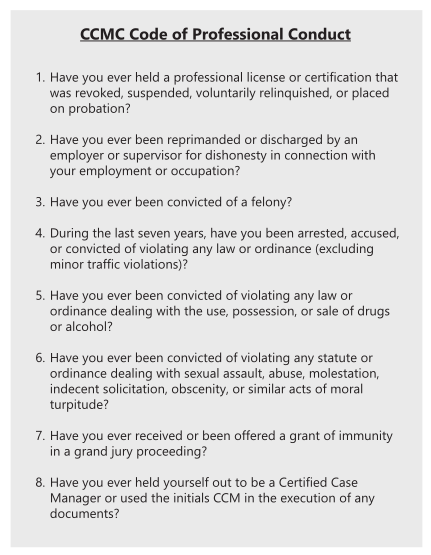
You also need to comply with the CCMC Code of Professional Conduct:
CCM Exam Outline
The CCM exam contains 180 multiple-choice questions, and you will be given a total of 3 hours to finish it. Out of the 180 questions, 30 questions are “pretest” questions that do not count toward your final score. These unscored questions are used by the test administrators to gauge the quality and validity of the questions for future versions of the exam.
The exam is split into six knowledge domains:
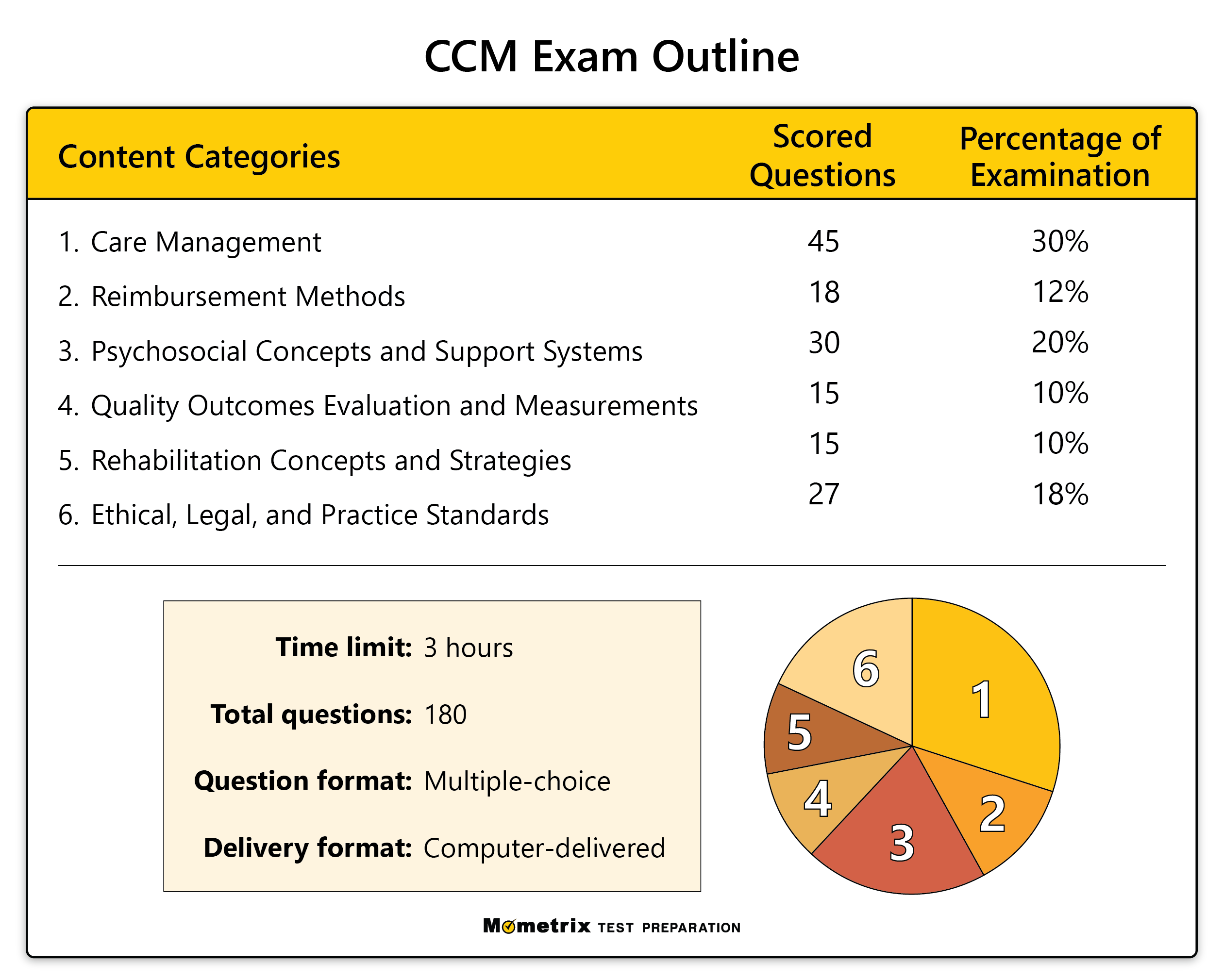
1. Care Management (45 scored questions)
The questions in this domain take up 30% of the exam. Here are some of the topics they cover:
- Criteria pertaining to caseload assignment and selection
- Client-centered care plan development
- Age-specific care
- Evidence-based case management and care management models and processes
- Cost containment principles
- Management based on length and type of care
- Medication management
- Assessing client’s acuity or severity levels
- Features of care settings
- Key aspects of care coordination
- Collaboration with community-based support services agencies and providers
2. Reimbursement Methods (18 scored questions)
The questions in this domain take up 12% of the exam. Here are some of the topics they cover:
- Reimbursement and payment methodologies
- Key features of accountable care organizations
- Military and veteran benefit programs
- Available financial resources
- Coding methodologies
- Utilization review/management principles
- Negotiation techniques
- Key features of insurance principles
3. Psychosocial Concepts and Support Systems (30 scored questions)
The questions in this domain take up 20% of the exam. Here are some of the topics they cover:
- Signs of abuse and neglect
- Behavioral health concepts
- Client empowerment, engagement, and self-care management
- Crisis intervention strategies
- Health-related social needs
- Client support system dynamics
- Assessments that measure psychological and cognitive capacity
- Supportive care programs
- Wellness concepts and illness prevention concepts
- Key factors of social drivers of health
- The influence of gender health on care needs
- Trauma-informed care principles
4. Quality and Outcomes Evaluation and Measurements (15 scored questions)
The questions in this domain take up 10% of the exam. Here are some of the topics they cover:
- Accreditation standards and requirements
- Basic elements of cost-benefit analysis
- Data gathering, interpretation, evaluation, and reporting
- Healthcare analytics
- Sources of quality indicators
- Quality and performance improvement methods, tools, and processes
- The impact of case management practices on value-based care
5. Rehabilitation Concepts and Strategies (15 scored questions)
The questions in this domain take up 10% of the exam. Here are some of the topics they cover:
- Current adaptive technologies
- Basic functional capacity to identify care needs
- Care coordination needs related to rehabilitation settings
- Unique rehabilitation aspects of care for people with disabilities
- Vocational rehabilitation programs and resources
6. Ethical, Legal, and Practice Standards (27 scored questions)
The questions in this domain take up 18% of the exam. Here are some of the topics they cover:
- Ethical standards related to care management
- Professional conduct
- Healthcare- and disability-related legislation
- Legal and regulatory requirements pertaining to case management practice
- Industry best practices pertaining to privacy, confidentiality, and risk management
- Responsibilities pertaining to documentation and case summary
- Advocating for the client and their support systems
Check Out Mometrix's CCM Study Guide
Get practice questions, video tutorials, and detailed study lessons.
Top 3 Most Challenging CCM Questions
Now that you know more about the test, try your hand at some targeted practice!
Over the last year, we’ve compiled the data from about 2,000 test-takers who tried their hand at the practice test at the top of this page. According to the data, around 75% of people answered these three questions incorrectly.
Answer each question and read through the answer explanation, whether you got the answer right or wrong. This will help you ensure you’ve got the topic mastered.
Whether you struggled with these questions or aced them on your first try, be sure to take the full practice test to get a better idea of how prepared you really are!

1. If a facility intends to monitor and improve customer satisfaction, the FIRST step for case management is to identify:
2. A patient’s routine dialysis tests, drugs, and supplies are paid by Medicare as a bundle of services. This type of payment is known as:
3. In order for an unmarried former spouse of a person who served in the military for 25 years to receive TRICARE benefits, the ex-spouse must have been married to the service person for at least:
Registration
Once you have confirmed that you meet all of the necessary requirements, you may apply online through your account with The Commission.
After confirming eligibility, log in or create an account, select My Account, choose CCM Exam Application, complete the application, and select Checkout and Make Payment.
Once you have been approved to take the exam, you will receive an email with your Candidate ID number and instructions for scheduling your exam with Pearson.
Fees
The nonrefundable application fee is $235, and the examination fee is $195. This means that you must pay a total of $430 when you send in your application.
Canceling/Rescheduling
You may reschedule or cancel within the same testing period if appointment times are available and it is at least 48 hours before your appointment. Exams cannot be rescheduled or canceled less than 48 hours before the appointment.
Failure to reschedule/cancel in time or failure to appear results in forfeiture of the application and exam fee. A $10 fee applies only if you call the Pearson Contact Center for scheduling assistance. A separate $85 deferral fee applies if you defer your exam appointment to the next available exam window.
Test Day
There are two available testing methods for the CCM exam: in-person testing and remote testing.
In-person Testing
You should arrive at the testing center 30 minutes prior to your scheduled exam time. A late arrival means you will not be able to take the exam. Once you arrive, you will be asked to show a valid government-issued photo ID.
Before you enter the testing room, you will be asked to leave all personal items in a secure locker outside the room. Personal items include things like your cell phone, bags, pencils, car keys, and jackets. Pearson provides an erasable white board that must be surrendered when you leave the exam room.
The exam is administered in two sessions with one designated 10-minute break midway through the exam. You may leave the room for reasonable needs, but you must notify Pearson staff and sign back in.
Remote Testing
You should log in to your account 15-30 minutes before the scheduled exam time. This will allow you to perform a system readiness check and complete the check-in process. The system readiness check will ensure that you have everything you need to remotely take the exam, such as a webcam, microphone, adequate internet connection, adequate screen resolution, and up-to-date operating system.
Check in through Pearson OnVUE by selecting Check-in to start exam from your confirmation, reschedule, or reminder email, or by logging in to Pearson, viewing your upcoming appointment, and following the on-screen check-in prompts.
You will not be allowed to use a dual- or multi-monitor setup, and no pets or people are allowed to be in the room with you.
Once the proctor is satisfied that you are ready to go, the exam will begin.
Scoring
Because of the exam’s digitized format, there’s a bit of convenience when it comes to the scoring process. Once you complete the exam at your designated testing site, you’ll be given prompt indication of whether you have failed or passed and thus earned your full certification.
We recommend taking this notification with the slightest grain of salt. While this indicator has a very high accuracy rate, there is still a margin of error. The grading process for CCM certification is extremely intricate. You could potentially be thought to have scored one way and actually performed oppositely.
If you’ve done well on the exam, congratulations! You’ve officially earned the CCM credential.
Retaking the Test
If you do not pass the CCM exam, you may schedule a retake for the next exam cycle. You are permitted one retake per application, and the application is valid for two consecutive exam windows.
If you do not schedule the retake in the next consecutive cycle, or if you do not pass the retake, you must submit a new application and pay the applicable application and exam fees. The retake fee is $195.
CCM Online Prep Course
If you want to be fully prepared, Mometrix offers an online CCM prep course designed to give you everything you need to succeed!
Here’s what you’ll find in the CCM course:
- 60+ Review Lessons Covering Every Topic
- Over 1,450 CCM Practice Questions
- 300+ Digital Flashcards
- Money-back Guarantee
- Mobile Access
Everyone learns differently, so we’ve tailored the CCM online prep course to ensure every learner has what they need to prepare for the CCM exam.
Click below to check it out!
Check Out Mometrix's CCM Flashcards
Get complex subjects broken down into easily understandable concepts.
Study Tips
Start with a CCM Practice Test
Before creating your study schedule, take a CCM practice test to establish a starting point. You don’t need to wait until you have reviewed every insurance program, psychosocial theory, rehabilitation concept, and healthcare law. At this stage, the goal is to identify where your preparation time will have the greatest effect.
Review your results by section:
- Care Management: Can you assess client needs, develop client-centered plans of care, coordinate across settings, manage transitions, collaborate with interdisciplinary teams, address medication issues, understand levels of care, and connect clients with appropriate resources?
- Reimbursement Methods: Do you understand insurance principles, Medicare and Medicaid, private and military benefits, managed care, utilization management, reimbursement methodologies, coding systems, financial resources, and negotiation techniques?
- Psychosocial Concepts and Support Systems: Can you address behavioral health, readiness for change, health literacy, social needs, family and support systems, crisis intervention, cultural considerations, trauma-informed care, and client engagement?
- Quality and Outcomes Evaluation and Measurements: Do you understand quality indicators, healthcare analytics, performance improvement, accreditation, data interpretation, cost-benefit concepts, and the effect of case management on value-based care?
- Rehabilitation Concepts and Strategies: Can you evaluate functional needs, distinguish rehabilitation settings and resources, understand adaptive technology, and address vocational and disability-related rehabilitation?
- Ethical, Legal, and Practice Standards: Can you apply ethical standards, privacy and confidentiality requirements, healthcare legislation, professional standards, documentation requirements, risk management, advocacy, and scope-of-practice principles?
Identifying those specific weaknesses will show you where to devote more attention during your study time.
Review Difficult Questions
After each practice session, review every question you answered incorrectly AND every question you guessed on or answered with low confidence. A correct guess doesn’t demonstrate that you could perform the task safely and accurately in a medical office.
For each difficult question, determine which of the following caused the problem:
- You knew the underlying case management concept but could not apply it to the client scenario.
- You answered from the perspective of your own clinical discipline rather than the case manager’s role.
- You focused on the diagnosis instead of the client’s complete needs.
- You selected a service before completing an adequate assessment.
- You overlooked a psychosocial or social barrier.
- You failed to involve the client in decision-making.
- You selected an ideal service without considering coverage or available resources.
- You chose a solution that addressed the immediate problem but not continuity of care.
- You failed to recognize an ethical or legal issue.
- You selected an action outside the case manager’s role or professional scope.
- You selected a reasonable action, but not the best next action.
Then, outline a specific plan for improvement based on what you discovered. In other words, don’t just say, “I need to study Medicare.” Specify that you need to review the major differences between Medicare Parts A, B, C, and D or that you need to review how benefit limitations can affect discharge planning.
Similarly, replace “study ethics” with a specific task such as identifying conflicts between client autonomy and safety.
Utilize Answer Explanations
Answer explanations are an underutilized studying resource. To take full advantage of them, read the explanation for every question you found difficult, including questions you answered correctly.
For each one, make sure you can confidently explain:
- Why the correct answer is correct
- Why each incorrect answer is less appropriate
- Which CCM domain or case management principle is being tested
- Which facts in the scenario matter
- What the case manager should do next
- Why that action fits the case manager’s role
- How the same principle could appear with a different client or care setting
For example, for care management questions, reconstruct the case management process. Ask yourself what’s already been assessed, what info is missing, what risks are present, which team members need to be involved, and how progress will be monitored, among other things.
Study the Case Management Process, Not Individual Questions
Memorizing the answer to one CCM practice question will not prepare you for a different client with different medical, behavioral, financial, functional, and social circumstances.
Use a repeatable case management process:
- Assess: Determine things like medical needs, living situation, insurance coverage, and client goals.
- Identify Problems and Barriers: Separate the client’s needs into specific problems.
- Develop a Client-Centered Plan: Ask what the client wants, what outcome is realistic, which resources are available, and what barriers must be addressed.
- Implement and Coordinate: Determine who needs to be contacted, which services need authorization, and what needs to happen before a transition.
- Monitor: Determine if the client received the service, if the intervention is working, if new barriers have appeared, and if the level of care remains appropriate.
- Evaluate and Revise: If the plan is not producing the desired result, determine why before simply adding another service.
This sequence can help prevent jumping from a problem directly to an intervention before performing an adequate assessment.
FAQs
Q
How many questions are on the CCM exam?
A
There are 180 multiple-choice questions on the exam.
Q
How long do you have to take the CCM?
A
The time limit for this exam is 3 hours.
Q
How much does it cost to take the CCM exam?
A
The application fee for the exam is $235, and the examination fee is $195, which is a total of $430.
Q
What is the pass rate for the CCM exam?
A
The average pass rate for the CCM exam is 74%.


CCM is a registered trademark of the Commission for Case Manager Certification, which is not affiliated with Mometrix Test Preparation and does not endorse this page.