The National Healthcareer Association (NHA) offers the Certified Clinical Medical Assistant (CCMA) credential to eligible medical assistants.
Click “Start Test” above to take a free NHA CCMA practice test, and check out our premium-quality CCMA test prep resources by clicking the links below!
Exam Eligibility
To sit for the CCMA exam, you must have a high school diploma or equivalent. Eligible candidates expecting to graduate within 18 months may take the exam and receive provisional certification.
You also need to meet one qualifying training or experience pathway:
Pathway 1: Medical Assistance Training
This pathway is for those who have completed a medical assistant training/education program within the last five years. NHA allows several qualifying training routes, including military medical services training and certain employer-based training programs.
Pathway 2: Medical Assistance Work Experience
This pathway is for those who have supervised work experience in the medical assisting field. NHA specifies that you need to have one of the following:
- At least one year of supervised medical assisting work experience within the last three years
- At least two years of supervised medical assisting work experience within the last five years
California Applicants
If you are a California resident applying through the work-experience pathway, NHA requires at least two years of work experience as a medical assistant within the last five years immediately before your exam date.
CCMA Exam Outline
The CCMA exam contains 180 multiple-choice questions, 30 of which do not count toward your score, and you are given a time limit of 3 hours. The unscored questions are called “pretest” questions, and they are randomly distributed throughout the exam. These questions are used by the exam administrators to evaluate questions that will appear on future exams as scored questions.
The NHA CCMA exam is split into 7 domains, each of which has some combination of knowledge statements and task statements. Knowledge statements test you on pertinent knowledge that you should know as a medical assistant, while task statements test you on necessary duties that you need to be able to perform properly.
1. Foundational Knowledge and Basic Science
This domain contains only knowledge statements, which cover the following topics:
- Healthcare systems and settings
- Medical terminology
- Basic pharmacology
- Nutrition
- Psychology
2. Anatomy and Physiology
This domain contains only knowledge statements, which cover the following topics:
- Body structures and organ systems
- Pathophysiology and disease processes
- Microbiology
3. Clinical Patient Care
This domain contains both knowledge statements and task statements, which cover the following topics:
- General patient care
- Patient intake and vitals
- Infection control
- Testing and laboratory procedures
- Phlebotomy
- EKG and cardiovascular testing
4. Patient Care Coordination and Education
This domain contains both knowledge statements and task statements, which cover the following topics:
- Preventive medicine and wellness
- Transition of patient care
- Collaboration with healthcare providers
- Referral forms and processes
- Tracking and reporting technologies
- Optimization of health outcomes via patient compliance
- Team-member roles and responsibilities
- Barriers to care
5. Administrative Assisting
This domain contains both knowledge statements and task statements, which cover the following topics:
- Diagnostic and procedural codes
- Electronic and paper-based scheduling and monitoring systems
- Clinical and administrative supply inventory
- Authorizations and pre-certifications
- Filing systems
- Urgency of appointment needs
- Telephone etiquette
- Chart review
- CMS billing requirements
- Data entry and data fields
- Advance Beneficiary Notice of Noncoverage (ABN)
6. Communication and Customer Service
This domain contains both knowledge statements and task statements, which cover the following topics:
- Communication between patients and providers
- Teamwork and team management
- Challenging customer service occurrences
- Active listening
- Communication styles
- Therapeutic communication
- Email etiquette
- Escalation of problem situations
- Coaching and feedback
- Scope of permitted questions
7. Medical Law and Ethics
This domain contains both knowledge statements and task statements, which cover the following topics:
- Adherence to the professional code of ethics
- Providing and collecting MOLST forms
- Power of attorney
- Informed consent
- Reporting laws
- Medical record storage
- Hippocratic Oath
- Medical malpractice
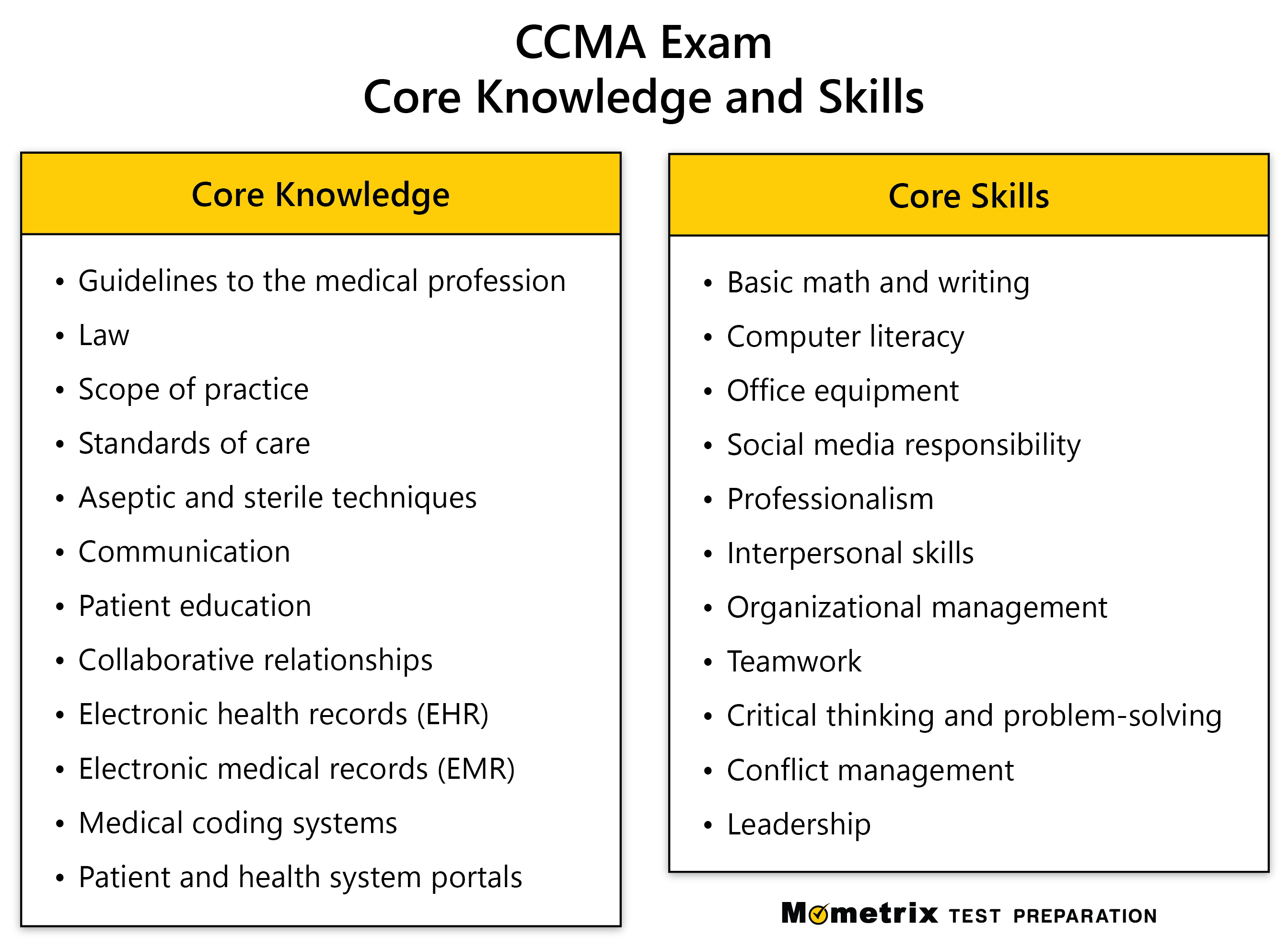
To help you prepare for the knowledge and task statements, take a look at the core knowledge and core skill items you should be familiar with:
Check Out Mometrix's CCMA Study Guide
Get practice questions, video tutorials, and detailed study lessons.
Top 5 Most Challenging CCMA Questions
Now that you know more about the test, try your hand at some targeted practice!
Over the last year, we've compiled the data from about 6,000 test-takers who tried their hand at the practice test at the top of this page. According to the data, around 65% of people answered these five questions incorrectly.
Answer each question and read through the answer explanation, whether you got the answer right or wrong. This will help you ensure you've got the topic mastered.
Whether you struggled with these questions or aced them on your first try, be sure to take the full practice test to get a better idea of how prepared you really are!

1. Which of the following is NOT a function of the Centers for Disease Control and Prevention (CDC)?
2. What is the most common first sign of puberty in males?
3. A medical assistant comes into the office in the morning. He notices that an urgent message left by a patient last night needs to be returned, paperwork needs to be filed, a patient is at the desk with a question, and a lab tray needs to be set up for an appointment in an hour.
Which of the following tasks should be completed first?
4. According to Maslow’s theory of human behavior, self-actualization is considered the highest category of need. What is considered the second-highest category?
5. According to Maslow’s hierarchy, which two categories are below belonging and social needs?
The next level includes security of oneself and the safety of loved ones. The next level includes fulfillment of relationships with family members and friends and intimacy with loved ones. Self-esteem is the second-highest level, followed by the highest level of self-actualization.
Registration
Registering for the CCMA exam is a two-part process.
First, create or sign in to your NHA account, select the CCMA exam, complete the eligibility attestations, and finalize your application and payment. Then follow your account’s scheduling instructions. If you apply through a school or employer, its roster approval may be required before you can schedule.
Next, follow your NHA account’s instructions to select your exam date and testing location or remote-proctoring option. The examination fee of $169 is payable at the time of registration and is accepted via credit card, debit card, or prepaid voucher.
LRP
Before registering for the remote proctor option, make sure your equipment meets the requirements. LRP requirements include the following:
- A supported desktop or laptop computer and operating system
- At least 8 GB of RAM (16 GB is recommended)
- A screen resolution of at least 1024×768 (1920×1080 or higher is recommended)
- A working webcam that can be moved to complete a 360° scan of your testing area
- A working microphone and computer speakers
- A stable broadband internet connection (3 Mbps or faster for both upload and download is recommended)
- The ability to install the PSI Secure Browser if required for your exam
NHA and PSI strongly recommend running a system check before registering for the LRP delivery method. VPNs and corporate firewalls should not be used because they may interfere with the secure testing connection.
NHA CCMA Online Prep Course
If you want to be fully prepared, Mometrix offers an online NHA CCMA prep course designed to give you everything you need to succeed!
Here's what you'll find in the NHA CCMA course:
- 60+ Review Lessons Covering Every Topic
- Over 700 NHA CCMA Practice Questions
- 350+ Digital Flashcards
- 30+ Instructional Videos
- Money-back Guarantee
- Mobile Access
Everyone learns differently, so we've tailored the NHA CCMA online prep course to ensure every learner has what they need to prepare for the NHA CCMA exam.
Click below to check it out!
Test Day
On the day of your exam, you must present one form of valid government-issued photo identification with your signature. The name on your registration must match the name on your identification.
In-person Testing
If you take the exam at a PSI testing center, plan to arrive at least 30 minutes before your scheduled appointment. During check-in, PSI staff will verify your identification and may take your photograph or complete other security procedures.
You will be asked to store personal items in a locker before entering the testing room. These may include your phone, wallet, purse, coat, food, drinks, notes, and other personal belongings.
Once your personal items are secured, you will enter the testing room and work through the identification screen and a tutorial at your testing station. Once this step is complete, your exam will begin.
Scratch paper is not provided for exams taken at PSI testing centers. Instead, PSI provides a physical whiteboard, marker, and eraser for note-taking during the exam.
Live Remote Proctoring (LRP)
Before taking the exam through live remote proctoring, complete PSI's required system compatibility check and make sure your computer, internet connection, webcam, microphone, and testing environment meet the current technical requirements. Best practice is to ensure any system update is postponed from the time you schedule to the time you complete your exam.
On test day, take the exam in a private, quiet room where you can remain alone and uninterrupted. Your desk and surrounding testing area must be clear of unauthorized materials, electronic devices, food, drinks, and other prohibited items.
Physical scratch paper is not permitted during PSI live remote proctoring. A digital whiteboard is provided within the testing system for taking notes.
During the exam, you must remain within view of the webcam and follow the proctor's instructions. You may not use unauthorized devices or materials, communicate with other people, or leave the testing area unless specifically permitted. Failure to follow testing rules may result in your exam session being terminated.
How the CCMA Exam is Scored
If you took the exam at your school or organization, a preliminary score report is available at the end of your exam. Computer-based exams taken at a PSI testing center or via LRP receive notification within 48 hours of completing the exam. The preliminary result is not your official report. When your official score report is available, you will receive an email notification to view your information in your NHA online account.
From your account, you can see your score report that indicates your score, passing status, and diagnostic information on your performance in each of the domains. The diagnostic information breaks down your performance in the domains by identifying one of three measures: above the passing standard, near the passing standard, or below the passing standard. The passing standard is 390 on a scale of 200 to 500.
Retaking the CCMA
If you need to retake the CCMA exam, you can register as a returning candidate after a 30-day waiting period. You'll need to sign in to your existing NHA account, re-register for the exam, and pay the $169 examination fee.
You can take the exam three times, with a 30-day waiting period between each attempt. Failure of the exam on the third attempt requires a one-year waiting period before retaking the exam. Each retake attempt requires registration and payment of the full examination price.
CCMA Study Tips
Start with a Practice Test
Before creating your study schedule, take a CCMA practice test to establish a starting point. You don't need to wait until you have reviewed every medical term, clinical procedure, medication, and administrative process. At this stage, the goal is to identify where your preparation time will have the greatest effect.
Review your results by section and content area:
- Foundational Knowledge and Basic Science: Do you understand healthcare systems, medical terminology, basic pharmacology, nutrition, psychology, measurements, and medication calculations?
- Anatomy and Physiology: Can you identify body structures, explain how major organ systems function together, and recognize common diseases and diagnostic procedures?
- Clinical Patient Care: Can you complete patient intake, obtain vital signs, assist with examinations and procedures, maintain infection control, perform point-of-care testing, collect blood specimens, and assist with EKG and cardiovascular testing?
- Patient Care Coordination and Education: Can you help patients understand instructions, coordinate referrals and follow-up care, identify barriers to care, and reinforce provider education appropriately?
- Administrative Assisting: Can you manage appointments, medical records, insurance verification, prior authorizations, coding information, referrals, and patient check-in and checkout?
- Communication and Customer Service: Can you communicate professionally with patients, caregivers, providers, and third-party payers while handling conflicts and difficult situations appropriately?
- Medical Law and Ethics: Do you understand confidentiality, consent, medical records, mandatory reporting, scope of practice, malpractice, and other legal and ethical responsibilities?
Identifying those specific weaknesses will show you where to devote more attention during your study time.
Review Difficult Questions and Procedural Mistakes
After each practice session, review every question you answered incorrectly AND every question you guessed on or answered with low confidence. Guessing correctly does not necessarily mean that you could perform the task safely in a medical office.
For each difficult question, determine which of the following caused the problem:
- You didn't know the underlying medical terminology or physiological process.
- You confused a normal finding with an abnormal one.
- You knew a procedure but completed the steps in the wrong order.
- You overlooked a patient-identity or safety requirement.
- You failed to recognize an infection-control concern.
- You failed to identify a finding that should be documented or reported.
- You selected the wrong specimen tube or processing procedure.
- You made a medication, dosage, or measurement-conversion error.
- You misunderstood an administrative or insurance process.
- You selected a response that violated patient confidentiality or another legal requirement.
Then, outline a specific plan for improvement based on what you discovered. In other words, don't just say, “I need to practice vital signs.” Specify that you need to practice selecting the correct blood-pressure cuff size or distinguishing normal from abnormal pulse and respiratory patterns.
For phlebotomy questions, review the correct order of draw and learn which additives are contained in common collection tubes.
Utilize Answer Explanations
Answer explanations are an underutilized studying resource. To take full advantage of them, read the explanation for every question you found difficult, including questions you answered correctly.
For each one, make sure you can confidently explain:
- Why the correct answer is correct
- Why each incorrect option is wrong
- What medical-assisting responsibility or principle is being tested
- Which information in the question controls the answer
- Why the action is safe and appropriate for a medical assistant
- How the same concept could appear in a different patient scenario
For procedural questions, don't stop after learning which individual step was correct. Reconstruct the entire procedure, determining how the patient should be identified, which equipment is needed, in what order the procedure should be completed, etc.
For EKG questions, don't memorize electrode locations without understanding the procedure.
Study Workflows, Not Individual Questions
Memorizing the answer to one CCMA practice question will not prepare you for a new patient with different vital signs, medications, symptoms, orders, insurance information, or clinical needs. Instead, learn how common medical-assisting responsibilities fit into complete workflows.
For a patient visit, practice thinking through the encounter from beginning to end. For every clinical procedure you study, ask things like what needs to happen before the procedure, how the patient needs to be positioned, and what you should do if something goes wrong.
A procedure isn't mastered because you recognize the correct answer when you see it. You should be able to explain the entire process and recognize what should change when the patient or circumstances change.
Know When the Medical Assistant Should Act
Many CCMA questions are easier once you correctly identify the boundaries of the medical assistant’s role.
Don't pick an answer because it seems medically helpful. Ask whether the medical assistant is actually authorized and qualified to perform that action.
For example, a medical assistant may obtain vital signs and recognize that a result falls outside an expected range, but identifying the result doesn't automatically authorize the medical assistant to diagnose the underlying condition or independently alter the treatment plan.
When reviewing scenario questions, don't create fake universal rules like “always notify the provider first.” A routine task, abnormal vital sign, medication question, emergency, confidentiality concern, and dissatisfied patient require different responses.
FAQs
Q
How many questions are on the CCMA exam?
A
There are 180 multiple-choice questions, 30 of which are unscored pretest questions.
Q
How long is the CCMA exam?
A
The time limit for the exam is 3 hours.
Q
What is the passing score for the CCMA exam?
A
To pass the exam, you will need to achieve a scaled score of 390.
Q
How much does the CCMA exam cost?
A
The examination fee is $169.


Mometrix Test Preparation is not affiliated with or endorsed by any official testing organization. All organizational and test names are trademarks of their respective owners.