
If you have a teacher interview coming up, do not try to memorize perfect answers. Instead, prepare clear examples that show how you teach, manage a classroom, support different learners, communicate with families, and work with other educators.
Most teacher interviews include a mix of general questions, classroom-management questions, lesson-planning questions, behavioral questions, and scenario-based questions. The strongest answers are specific. They explain what you believe, what you actually do in the classroom, and how your actions help students learn.
Below are 40 common teacher interview questions, sample answers, and tips to help you prepare.
How to Answer Teacher Interview Questions
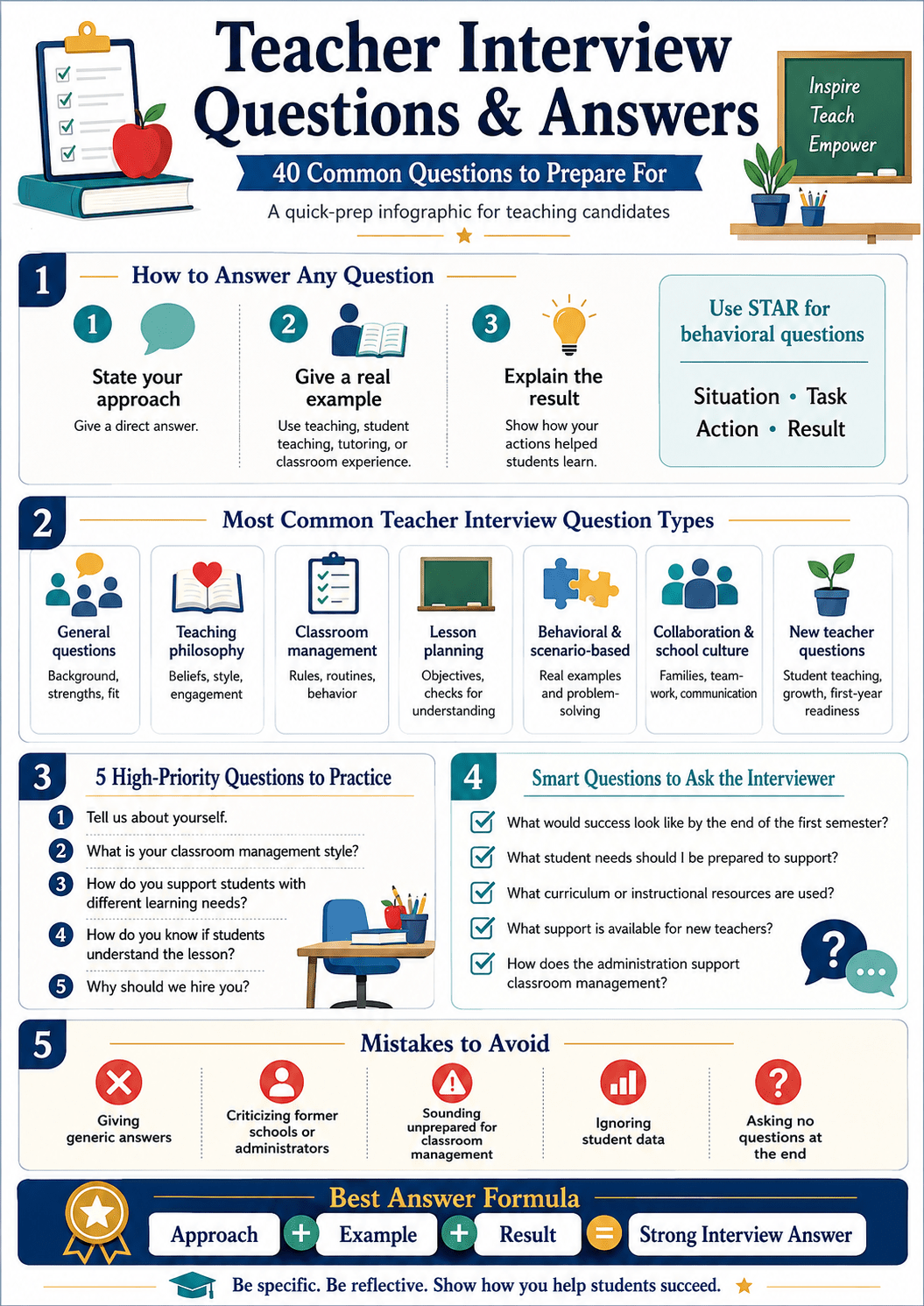
Before reviewing specific questions, build your answers around this simple structure:
- State your approach.
Give a direct answer to the question. - Give a classroom example.
Use a real example from teaching, student teaching, tutoring, substitute teaching, coaching, volunteering, or field experience. - Explain the result.
Show how your approach helped students, improved behavior, supported learning, or strengthened relationships.
For behavioral interview questions, use the STAR method:
- Situation: What was happening?
- Task: What needed to be done?
- Action: What did you do?
- Result: What changed?
Avoid vague answers like “I care about students” or “I make learning fun.” Those are not differentiators. Most candidates say something similar. Your answer needs proof.
General Teacher Interview Questions
1. Tell us about yourself.
What interviewers want to know:
Interviewers want a concise summary of your background, teaching strengths, and fit for the role. This is not the time to give your entire life story. Focus on your preparation, experience, and what makes you a strong candidate for this specific teaching position.
Sample answer:
“I recently completed my student teaching in a fourth-grade classroom, where I planned lessons, led small groups, communicated with families, and supported students at different reading levels. I’m especially interested in helping students build confidence through structured routines, clear expectations, and lessons that connect to real-world examples. I’m excited about this role because your school emphasizes both academic growth and a positive classroom culture, which matches the kind of teacher I’m working to become.”
Answer tip:
Keep your answer focused on education, teaching experience, and the school’s needs. End by connecting your background to the position.
2. Why did you decide to become a teacher?
What interviewers want to know:
They want to understand your motivation. A strong answer should show genuine commitment without sounding generic or overly sentimental.
Sample answer:
“I became a teacher because I enjoy helping students move from confusion to confidence. I had teachers who made difficult subjects feel possible, and I want to create that same experience for students. What keeps me motivated is seeing students realize they can learn something they thought was out of reach.”
Answer tip:
Avoid answers that only focus on loving children or wanting summers off. Tie your motivation to student learning, growth, and service.
3. Why do you want to teach at this school?
What interviewers want to know:
Interviewers want to see whether you researched the school and understand why this role is a good fit.
Sample answer:
“I’m interested in this school because of your focus on student growth, family involvement, and collaborative teaching. I looked at your school website and noticed your emphasis on [specific program, value, or initiative]. That stood out to me because I want to be part of a school where teachers work together and students are supported academically and socially.”
Answer tip:
Replace the bracketed section with something specific from the school’s website, mission statement, improvement plan, or recent announcements.
4. What are your strengths as a teacher?
What interviewers want to know:
They want to know what you can reliably bring to the classroom. Choose strengths that matter in teaching, such as organization, relationship-building, communication, classroom management, flexibility, or lesson planning.
Sample answer:
“One of my strengths is building structure without making the classroom feel rigid. I use clear routines, model expectations, and give students opportunities to practice procedures. That helps reduce behavior issues and gives students more time to focus on learning.”
Answer tip:
Name one or two strengths and prove them with examples. Do not list every positive trait you can think of.
5. What is one area where you are still growing?
What interviewers want to know:
They want self-awareness. A good answer should be honest, but it should not raise doubts about whether you can handle the job.
Sample answer:
“I’m continuing to improve how I use assessment data to adjust instruction. I’m comfortable checking for understanding during lessons, but I’m working on becoming more systematic about using exit tickets, small-group data, and student work samples to plan reteaching and enrichment.”
Answer tip:
Pick a real growth area, then explain what you are doing to improve. Avoid serious red flags such as poor classroom management, chronic disorganization, or difficulty accepting feedback.
Teaching Philosophy Interview Questions
6. What is your teaching philosophy?
What interviewers want to know:
They want to understand what guides your decisions as a teacher. Your philosophy should connect beliefs to classroom practice.
Sample answer:
“My teaching philosophy is that students learn best when expectations are clear, lessons are engaging, and students feel safe enough to participate. I believe strong relationships and strong instruction go together. Students need to know that I care about them, but they also need structure, feedback, and high expectations.”
Answer tip:
Avoid abstract statements that sound nice but do not say much. Explain what your philosophy looks like in the classroom.
7. How would you describe your teaching style?
What interviewers want to know:
They want to know how you actually teach. Your answer should explain how you structure lessons and involve students.
Sample answer:
“My teaching style is structured, interactive, and student-centered. I like to begin with a clear learning goal, model the skill, give students guided practice, and then check for understanding before moving on. I also try to include discussion, collaboration, or hands-on practice so students are actively using what they are learning.”
Answer tip:
Use concrete instructional language. “Fun,” “creative,” or “flexible” are fine, but they need to be backed up with teaching practices.
8. How do you keep students engaged?
What interviewers want to know:
They want to know whether you can keep students participating and learning, not just entertained.
Sample answer:
“I keep students engaged by varying the pace of instruction and giving them meaningful ways to participate. That might include partner discussion, quick checks for understanding, real-world examples, student choice, or short written responses. I also pay attention to when students are losing focus and adjust before the lesson falls apart.”
Answer tip:
Engagement should not mean constant games or gimmicks. Focus on participation, relevance, pacing, and active learning.
9. How do you support students with different learning needs?
What interviewers want to know:
They want to see whether you can differentiate instruction and follow required supports for students.
Sample answer:
“I start by identifying what students need: more modeling, more practice, a different format, enrichment, or accommodations. I use strategies such as small groups, visual supports, sentence frames, chunked assignments, and frequent checks for understanding. I also make sure I’m following IEPs, 504 plans, and school support procedures.”
Answer tip:
Mention both instructional differentiation and formal accommodations when appropriate. Schools need to know you take student supports seriously.
10. How do you challenge advanced students?
What interviewers want to know:
They want to know whether you can support all learners, including students who already understand the main lesson.
Sample answer:
“I try not to give advanced students just ‘more work.’ I want to give them deeper work. That might mean asking them to explain their reasoning, compare strategies, complete an extension task, research a related question, or apply the skill in a more complex context.”
Answer tip:
The best answer shows that enrichment is about depth, complexity, and independence, not simply extra worksheets.
Classroom Management Interview Questions
11. What is your classroom management style?
What interviewers want to know:
Classroom management is one of the biggest concerns in teacher hiring. Interviewers want to know that you can create a calm, respectful learning environment.
Sample answer:
“My classroom management style is proactive and consistent. I teach expectations directly, practice routines, reinforce positive behavior, and address problems early before they grow. I want students to understand that rules are not about control; they are about creating a classroom where everyone can learn.”
Answer tip:
Show that you have a plan before problems happen. Do not frame classroom management as punishment.
12. How would you handle a disruptive student?
What interviewers want to know:
They want to know whether you can respond calmly, fairly, and effectively without escalating the situation.
Sample answer:
“I would first try to understand whether the behavior is caused by confusion, attention-seeking, frustration, or something outside the classroom. In the moment, I would use the least disruptive response possible, such as proximity, a nonverbal cue, or a private redirection. If the behavior continued, I would follow the school’s discipline process and look for a longer-term solution, such as a behavior goal, family communication, or support from another staff member.”
Answer tip:
A strong answer balances empathy with accountability. Do not suggest ignoring repeated behavior or immediately sending every student out of the room.
13. What classroom rules would you use?
What interviewers want to know:
They want to know whether your expectations are clear, teachable, and age-appropriate.
Sample answer:
“I prefer a small number of clear, positively stated expectations, such as: be respectful, be prepared, participate, and keep the classroom safe. I would teach what those expectations look like during different parts of the day instead of assuming students already know.”
Answer tip:
Rules are only useful if students understand what they look like in real situations. Mention modeling and practice.
14. How do you build relationships with students?
What interviewers want to know:
They want to know how you create trust while maintaining professional boundaries and high expectations.
Sample answer:
“I build relationships by learning students’ names quickly, greeting them, noticing their interests, listening when they speak, and following through consistently. I also try to create moments where students feel seen for more than their academic performance.”
Answer tip:
Strong relationships do not mean trying to be students’ friend. Emphasize trust, respect, consistency, and care.
15. How would you handle a student who refuses to do work?
What interviewers want to know:
They want to see whether you can keep expectations high without turning the situation into a power struggle.
Sample answer:
“I would avoid turning it into a power struggle. I would quietly check in to find out why the student is refusing. If the task feels too hard, I might break it into a smaller first step. If the student is upset, I might give them a brief reset and return to the task. The goal is to keep the student accountable while helping them re-engage.”
Answer tip:
Do not say you would simply let the student opt out. The answer should show calm persistence and problem-solving.
Lesson Planning and Instruction Interview Questions
16. Walk us through a typical lesson.
What interviewers want to know:
They want to know whether you can plan instruction with a clear objective, logical sequence, and evidence of student learning.
Sample answer:
“I start with the objective and a quick hook or review. Then I model the skill, think aloud, and give students guided practice. After that, students practice more independently while I circulate and check for understanding. I end with a quick assessment, such as an exit ticket or short response, so I know who is ready to move on and who needs more support.”
Answer tip:
Mention the objective, modeling, practice, checks for understanding, and closure.
17. How do you know if students understand the lesson?
What interviewers want to know:
They want to know whether you monitor learning during instruction instead of waiting until a test.
Sample answer:
“I use checks for understanding throughout the lesson instead of waiting until the test. That can include questioning, whiteboard responses, turn-and-talks, exit tickets, short quizzes, or reviewing student work while they practice. If several students are confused, I reteach. If only a few are struggling, I pull a small group or provide targeted support.”
Answer tip:
Strong answers mention both informal checks and what you do with the information.
18. What would you do if a lesson was not working?
What interviewers want to know:
They want flexibility and reflection. A teacher who cannot adjust instruction in real time will struggle.
Sample answer:
“If a lesson was not working, I would pause and check where students were getting lost. I might reteach with a different example, use a visual, model the process again, or shift to guided practice. After the lesson, I would reflect on whether the issue was pacing, directions, background knowledge, or the task itself.”
Answer tip:
Do not blame the students. Show that you can diagnose and adjust.
19. How do you use assessment data?
What interviewers want to know:
They want to know whether you can use data to make instructional decisions.
Sample answer:
“I use assessment data to make instructional decisions. If many students miss the same skill, that tells me I need to reteach or adjust the lesson. If only a few students are struggling, I can create a small group. I also look for students who are ready for enrichment so they continue growing.”
Answer tip:
Do not make data sound like paperwork. Explain how it changes your teaching.
20. How do you incorporate technology in the classroom?
What interviewers want to know:
They want to know whether you can use technology purposefully and responsibly.
Sample answer:
“I use technology when it improves learning, not just because it is available. For example, I might use digital quizzes for quick feedback, collaborative documents for group writing, or online tools to support practice. I also think it is important to set expectations so technology does not become a distraction.”
Answer tip:
Avoid listing tools just to sound current. Focus on instructional purpose.
Behavioral and Scenario-Based Teacher Interview Questions
21. Tell me about a time you worked with a team to solve a problem.
What interviewers want to know:
Teaching is collaborative. Interviewers want to know whether you can share ideas, listen, and work toward a solution.
Sample answer:
“During student teaching, our grade-level team noticed students were struggling with multi-step word problems. We compared student work and realized many students understood the math but were missing key information in the problem. We created a common strategy for annotating problems and used it across classrooms. Over the next few weeks, students became more confident explaining their steps.”
Answer tip:
Use a real example if possible. Show what you personally contributed.
22. Tell me about a time you received constructive criticism.
What interviewers want to know:
They want to know whether you are coachable. New teachers especially need to show that they can accept feedback.
Sample answer:
“My cooperating teacher once pointed out that I was giving directions too quickly. I realized some students were confused before they even started the task. I began writing directions on the board, modeling the first step, and asking a student to restate the task. That feedback helped me become clearer and more intentional.”
Answer tip:
Do not pretend you have never needed feedback. That sounds immature, not impressive.
23. How would you handle conflict with a parent or guardian?
What interviewers want to know:
They want professionalism, calm communication, and a student-centered approach.
Sample answer:
“I would listen first and try to understand the concern. I would stay calm, focus on the student’s needs, and use specific examples rather than general opinions. If needed, I would involve an administrator or support staff member. My goal would be to keep the conversation professional and solution-focused.”
Answer tip:
Avoid defensive language. Schools want teachers who can communicate with families without escalating tension.
24. What would you do if most of the class failed an assignment or test?
What interviewers want to know:
They want to know whether you take responsibility for instruction and respond to evidence.
Sample answer:
“If most of the class failed, I would treat that as instructional data. I would look for patterns, identify which skills were missed, and decide whether the problem was the lesson, the assessment, pacing, or background knowledge. Then I would reteach the key skills and reassess in a way that shows whether students improved.”
Answer tip:
Do not say you would simply curve the grades or move on. The answer should show instructional adjustment.
25. How would you support a student who is falling behind?
What interviewers want to know:
They want to know whether you can identify needs early and use supports before the student falls further behind.
Sample answer:
“I would first identify the specific skill gap. Then I would provide targeted support through small-group instruction, extra practice, modified assignments, or check-ins. I would also communicate with the family and collaborate with support staff if the student needed additional intervention.”
Answer tip:
A strong answer includes diagnosis, intervention, monitoring, and communication.
26. Tell me about a time you helped a student who was struggling.
What interviewers want to know:
They want evidence that you can support students academically or behaviorally.
Sample answer:
“In one placement, I worked with a student who had difficulty organizing written responses. I noticed the student understood the material during discussion but struggled to put ideas on paper. I started using sentence frames and graphic organizers during small-group work. Over time, the student’s responses became more complete and organized.”
Answer tip:
Choose an example where your actions made a measurable or visible difference.
27. Describe a time when you had to be flexible.
What interviewers want to know:
Schools are unpredictable. They want to know whether you can adjust without losing control of the lesson or the classroom.
Sample answer:
“During a lesson, the technology I planned to use stopped working. Instead of spending the whole class trying to fix it, I switched to a whiteboard version of the activity and had students work in pairs. The lesson was not exactly what I planned, but students still practiced the skill and completed the objective.”
Answer tip:
Your example should show problem-solving, not panic.
28. How would you respond if a student said your class was boring?
What interviewers want to know:
They want to know whether you can accept student feedback without becoming defensive.
Sample answer:
“I would not take it personally, but I would pay attention to it. I might ask the student what part felt boring or difficult to connect with. Then I would look for ways to make the lesson more active, relevant, or appropriately challenging while still keeping the academic goal clear.”
Answer tip:
Do not promise that every lesson will be exciting. Promise that every lesson will have a purpose and that you will reflect on student engagement.
Collaboration and School Culture Interview Questions
29. How do you work with other teachers?
What interviewers want to know:
They want to know whether you can be part of a team and contribute professionally.
Sample answer:
“I value collaboration because teaching is stronger when teachers share ideas, data, and resources. I’m comfortable planning with a team, discussing student progress, and adjusting instruction based on what is working in other classrooms.”
Answer tip:
Avoid sounding like you want to work in isolation. Schools need team players.
30. What can you contribute to our school community?
What interviewers want to know:
They want to know how you will add value beyond your classroom.
Sample answer:
“I can contribute reliability, strong communication, and a willingness to be involved beyond my classroom. Depending on the school’s needs, I would be interested in supporting clubs, tutoring, family events, or academic teams.”
Answer tip:
Be honest. Do not overpromise to sponsor five clubs if you cannot sustain that workload.
31. How do you communicate with families?
What interviewers want to know:
They want proactive, professional communication that supports student success.
Sample answer:
“I believe family communication should be consistent, respectful, and proactive. I do not want the first contact with a family to be negative. I would use the school’s preferred communication tools to share updates, concerns, and student progress.”
Answer tip:
Mention positive communication as well as problem-solving communication.
32. How do you handle classroom observations?
What interviewers want to know:
They want to know whether you are open to feedback and professional growth.
Sample answer:
“I see observations as an opportunity to grow. It is normal to feel a little nervous, but feedback helps me improve. I would want observers to see clear routines, student engagement, and evidence that students are working toward a specific learning goal.”
Answer tip:
Do not say observations do not bother you at all. A little honesty is fine. The key is showing that you welcome feedback.
33. How do you respond to pressure or stress?
What interviewers want to know:
Teaching is demanding. Interviewers want to know whether you can stay organized and professional under pressure.
Sample answer:
“I try to stay organized and focus on what I can control. Teaching comes with unexpected challenges, so I prioritize, ask for help when appropriate, and reflect on what needs to change. I also try not to let one difficult moment define the whole day.”
Answer tip:
Avoid making yourself sound overwhelmed. Show healthy coping, prioritization, and professionalism.
34. How would you support a positive school culture?
What interviewers want to know:
They want someone who will strengthen the school, not just manage their own classroom.
Sample answer:
“I would support a positive school culture by being consistent with students, respectful with colleagues, and willing to participate in schoolwide expectations. I think students notice when adults work together. I would try to model the same respect, responsibility, and growth mindset that we want students to develop.”
Answer tip:
Connect culture to everyday behavior, not just big events.
New Teacher Interview Questions
35. What did you learn from student teaching?
What interviewers want to know:
They want to know whether you reflected on your experience and understand the realities of teaching.
Sample answer:
“I learned that planning matters, but flexibility matters just as much. A lesson can look strong on paper and still need adjustment once students respond to it. I also learned how important routines are. When students know what to expect, the classroom runs more smoothly.”
Answer tip:
Choose lessons that show maturity: planning, routines, feedback, differentiation, and classroom management.
36. How would you establish authority as a new teacher?
What interviewers want to know:
They want to know that you can lead a classroom even if you are new to the profession.
Sample answer:
“I would establish authority by being prepared, consistent, and respectful. I do not think authority comes from being harsh. It comes from setting expectations, following through, knowing the content, and showing students that I am there to help them succeed.”
Answer tip:
Do not confuse authority with intimidation. Schools want calm leadership.
37. What would be your biggest challenge as a first-year teacher?
What interviewers want to know:
They want self-awareness and a realistic view of the first year.
Sample answer:
“My biggest challenge would likely be balancing planning, grading, communication, and classroom management efficiently. I know the first year has a steep learning curve, so I would use feedback, stay organized, and learn from experienced teachers.”
Answer tip:
Do not choose a challenge that makes you sound unprepared for the basic responsibilities of teaching.
38. How will you continue growing as a teacher?
What interviewers want to know:
They want to know whether you are committed to professional growth.
Sample answer:
“I plan to keep growing by using feedback, reflecting on student data, observing experienced teachers, and participating in professional development. I also want to keep improving my lesson planning and classroom management by paying attention to what actually helps students learn.”
Answer tip:
Show humility and initiative. Growth should sound active, not passive.
39. What would you do during the first week of school?
What interviewers want to know:
They want to know whether you understand the importance of routines, relationships, and expectations.
Sample answer:
“During the first week, I would focus on building relationships, teaching routines, setting expectations, and learning about students as learners. I would also begin collecting informal data so I understand students’ strengths and needs. I would not rush into content without first creating a classroom structure that supports learning.”
Answer tip:
The first week is not just icebreakers. Emphasize routines, procedures, community, and early assessment.
40. Why should we hire you?
What interviewers want to know:
This is your closing pitch. They want to know why you are the right person for the position.
Sample answer:
“You should hire me because I am prepared to work hard, keep learning, and put students first. I bring strong planning habits, a calm and consistent approach to classroom management, and a genuine commitment to helping students grow. I also understand that teaching is collaborative, and I want to contribute to the larger school community.”
Answer tip:
Do not just say you are passionate. Summarize the specific strengths that make you a good fit for the job.
Questions to Ask at the End of a Teacher Interview
At the end of most teacher interviews, you will be asked if you have any questions. Always prepare a few. Good questions show that you are thinking seriously about the role, the students, and the school community.
Questions about the role
- What would success look like for the person in this role by the end of the first semester?
- What are the biggest challenges facing this grade level or department right now?
- How much common planning time do teachers typically have?
- What curriculum or instructional resources are currently used?
- What support is available for new teachers?
Questions about students and instruction
- What student needs should I be especially prepared to support?
- How does the school use assessment data to guide instruction?
- What intervention systems are in place for struggling students?
- How are advanced students challenged?
- What technology tools are commonly used in classrooms?
Questions about school culture
- How would you describe the school culture?
- How does the administration support teachers with classroom management?
- What does family communication typically look like here?
- What opportunities are there to be involved outside the classroom?
- What do teachers enjoy most about working at this school?
Do not ask questions that are easy to answer from the school website. Also avoid leading with salary, vacation time, or benefits unless the employer brings them up. At this stage, your questions should show that you are thinking seriously about students, instruction, and fit.
How to Prepare for a Teacher Interview
Preparing well matters more than memorizing dozens of answers. Before the interview, take these steps:
Research the school
Review the school website, mission statement, grade levels, programs, calendar, extracurricular activities, and any public information about curriculum or school priorities. If the district has a strategic plan or school improvement plan available, review that too.
Prepare specific examples
Think of examples from student teaching, substitute teaching, tutoring, coaching, volunteering, or previous classroom experience. Prepare examples about classroom management, lesson planning, differentiation, teamwork, conflict, feedback, and student growth.
Review your teaching materials
Bring or prepare examples such as:
- Resume copies
- Teaching certificate or license information, if applicable
- Sample lesson plans
- Student teaching evaluations, if appropriate
- Classroom management plan
- Teaching portfolio
- References
- Examples of student work, with identifying information removed
Practice out loud
Reading answers silently is not enough. Practice saying your answers out loud so you sound prepared but not robotic.
Prepare your own questions
Choose three to five thoughtful questions to ask the interviewer. Your questions should show that you care about students, instruction, collaboration, and school culture.
Teacher Interview Mistakes to Avoid
Even strong candidates can weaken their chances with vague or careless answers. Avoid these common mistakes:
Giving generic answers
Do not say, “I want to make a difference,” and stop there. Explain how you plan to make a difference.
Criticizing former teachers, schools, or administrators
Even if your previous experience was difficult, keep your answer professional. Focus on what you learned and how you grew.
Sounding unprepared for classroom management
Classroom management questions matter. Have a clear answer about routines, expectations, redirection, and consistency.
Ignoring student data
Modern teaching requires using assessments and student work to guide instruction. Be ready to explain how you know whether students are learning.
Asking no questions at the end
Having no questions can make you seem uninterested or unprepared. Always bring a few thoughtful questions.
Frequently Asked Questions
What are the most common teacher interview questions?
The most common teacher interview questions usually ask about your teaching philosophy, classroom management style, lesson planning process, communication with families, experience with diverse learners, and ability to work with other teachers.
How should I answer teacher interview questions?
Use specific examples. A strong answer explains your approach, gives a real classroom example, and describes the result. For behavioral questions, use the STAR method: situation, task, action, and result.
What should I bring to a teacher interview?
Bring extra copies of your resume, your teaching certificate or license information if applicable, sample lesson plans, student teaching examples, references, and a portfolio if you have one.
How do I prepare for a first-year teacher interview?
Prepare examples from student teaching, tutoring, substitute teaching, practicum experience, coaching, or volunteering. Be ready to explain how you would manage a classroom, plan lessons, support struggling students, and ask for feedback.
What questions should I ask at the end of a teacher interview?
Ask about the school’s instructional priorities, student needs, curriculum, support for new teachers, classroom management expectations, team planning, and what success looks like in the role.
How long should my teacher interview answers be?
Most answers should be about one to two minutes long. If your answer is too short, it may sound vague. If it is too long, the interviewer may lose the main point. Aim for a clear answer, one example, and a brief result.
How do I answer teacher interview questions with no teaching experience?
Use examples from student teaching, tutoring, substitute teaching, coaching, mentoring, volunteering, camp counseling, or working with children in another setting. Focus on transferable skills such as planning, communication, leadership, patience, and problem-solving.
What is the best answer to “Why should we hire you as a teacher?”
The best answer connects your strengths to the school’s needs. Mention your preparation, classroom management approach, ability to support students, willingness to collaborate, and commitment to continued growth.
Final Thoughts
Teacher interviews are not about giving perfect answers. They are about showing that you can think like a teacher.
Before your interview, review the questions above and prepare examples that show your approach to instruction, classroom management, student support, family communication, and collaboration. The more specific your answers are, the more confident and prepared you will sound.
Test Prep Resource: Praxis Practice Tests